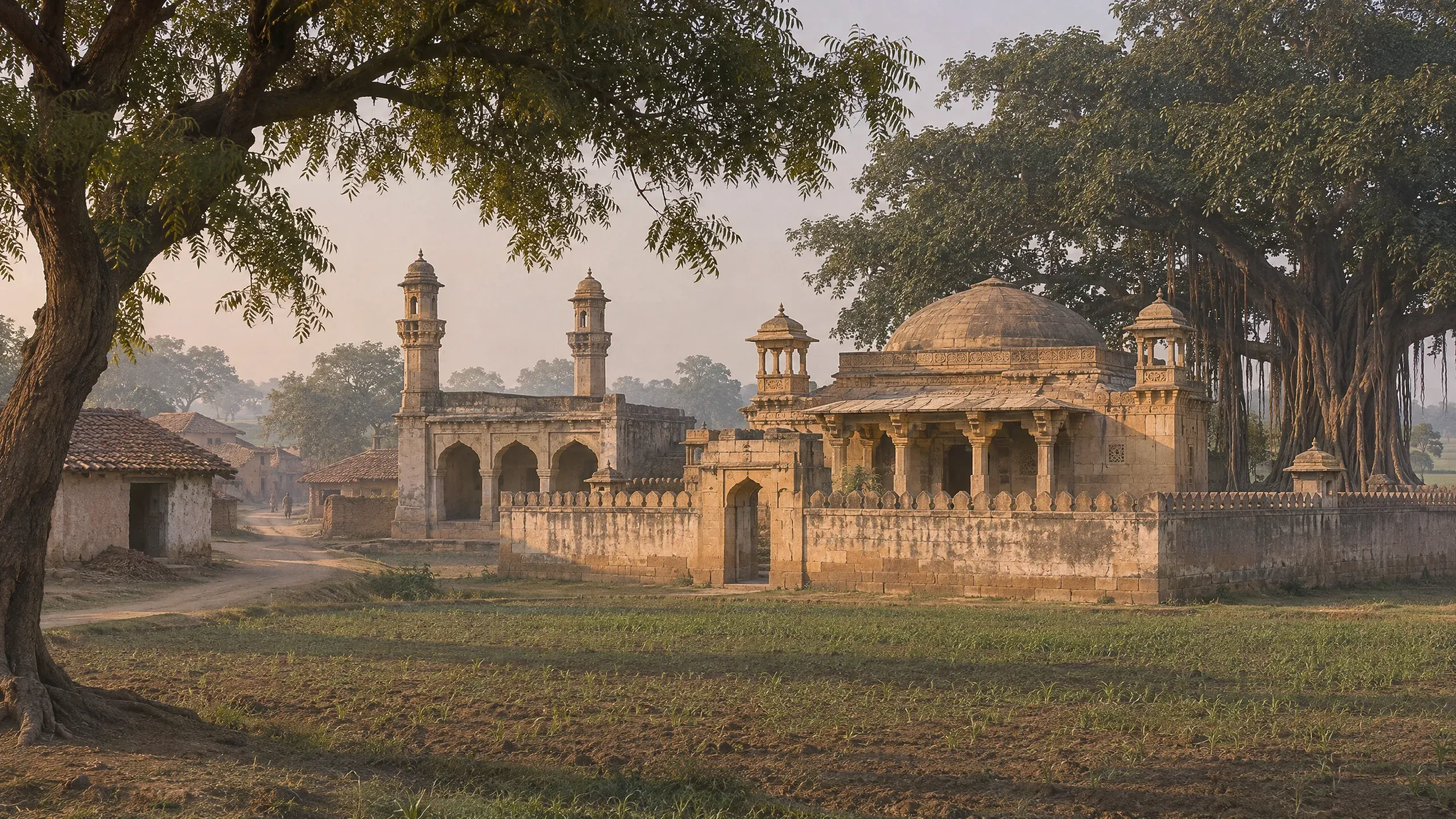
Pirana is a village near Ahmadabad in Gujarat. It is the site of the mausoleum of Imam Shah (d. 919/1513), son of Pir Hasan Kabir al-Din. Imam Shah founded the settlement, and it became the centre of the Imamshahi branch of the Satpanth. Moir and Khan estimate the sect’s following at about a million, mostly in Gujarat, with smaller numbers in Maharashtra and Madhya Pradesh. Pirana’s history follows that following through several identities: a Nizari mission station, a Sufi dargah under Mughal patronage, a shrine fought over by sayyids and Patidars, and since the 1990s a Hindu sect whose shrine looks like a temple.12
Foundation
In the tradition Moir and Khan summarise, Imam Shah came to Gujarat after being passed over for the pirship. Sultan Mahmud Begra (r. 1459–1511) became his patron and granted him land at Pirana. There he gained followers among the Kanbi farming caste, who were impressed by his miracles and by his preaching of the living Imam, who would come to India as Nikalank. He organised his followers into gaddis, each with a kaka responsible for teaching and collecting dues. Daftary notes legendary accounts that he converted the sultan, who gave a daughter in marriage to his son Nur Muhammad Shah. Daftary treats these as legendary.34
Imam Shah died at Pirana in 919/1513. Daftary concludes he had stayed loyal to the Imams in Persia. His son Nur Muhammad Shah demanded that the dasond tithes be delivered to him at Pirana instead of passing through Sindh to the Imam. He claimed the imamate for himself and, looking back, for his father. Kheta, the mukhi of some 18,000 converts, refused, and most Gujarati Nizaris stayed loyal to the Imams. Moir and Khan doubt the later Nizari story that Nur Muhammad was excommunicated. They find no clear break in the manuscript ginans of father and son. Nur Muhammad died in 940/1533–1534 and was buried in his father’s mausoleum.56
Three lines of sayyids
Moir and Khan trace authority at Pirana through three sons of Nur Muhammad Shah. The youngest, Sayyid Khan, was accepted as spiritual successor, and his descendants, the Sayyidkhanis, kept that position until the second half of the seventeenth century. One source says that Sayyid Khan divided the land around the shrine. The Nurshahis, descendants of Mustafa Shah, received the left side. The Sayyidkhanis received the right. The Jalalshahis, descendants of the eldest son Shihab al-Din, received the main shrine. After Sayyid Khan’s death in 1572, Gujarat came under Mughal rule. There are reports of a pitched battle over the tomb in the early seventeenth century, and in 1664 the Mughal authorities gave the Jalalshahi Ashraf Shah charge of the shrine and its revenues.78
Aurangzeb and the Broach revolt
Moir and Khan argue that the Mughals at first treated the dargah as another Sufi shrine. They see this as a measure of how well the Satpanthis practised taqiyya. That changed under Aurangzeb. Daftary records that Shahji Miran Shah, leader of the Aththiya branch from 1067/1657, was summoned to have his beliefs examined by Sunni jurists. He died on the way, possibly by poisoning himself. Around 1100/1688–1689 his followers, especially Matiya Kanbis, seized the fort of Broach and proclaimed his son king. Aurangzeb crushed the revolt. By the end of the century, Moir and Khan write, many Satpanthis had become Sunnis under the Jalalshahi and Nurshahi sayyids. The Sayyidkhanis drifted towards Twelver Shi’ism.910
Shrine and pilgrimage
Around 1750 the Jalalshahi leader Sayyid Abbasali obtained Mughal confirmation of his family’s hold on the shrine. A Mughal allowance for its upkeep was continued by later rulers, including the British. The Sayyidkhanis were shut out of management, dues and burial in the precinct. They lost a court case in the 1830s and built their own shrine outside the enclosure. In the late eighteenth century the Jalalshahi Bara Mian made Pirana more like a Sufi dargah. He turned Imam Shah’s urs into a major festival, introduced langar, the free distribution of food, and made the kakas more accountable. James Forbes described the mausoleum’s white marble, false pearls, flowers and “stained glass from Europe, in the manner of our cathedrals”. Guest houses (musafar khanas) were built for growing numbers of pilgrims.1112
From Satpanth to Hindu sect
By the mid-nineteenth century the Patidars had become a third force alongside the sayyids and kakas. A court case in 1932 over control of the shrine left the judges unsure whether the sect was Hindu or Muslim. In 1939 the shrine was registered as a trust, the “Bawa Imamshah Rauza”. Its management committee is still in operation: three sayyids claiming descent from Imam Shah and seven murids drawn from the Kacchi Patidars, chaired by the kaka, a title from the Persian for “servant”.1314
Karsan Das, born in 1932 at Kotra in Kutch, became head caretaker in 1986. This was the period when the Patidars moved to the BJP and Hindutva organisations targeted the Satpanthi “Guptis”. At the Sant Sammelan of 1996 the title kaka and his Muslim name, Pir Karim, were dropped. Om was painted on the shrine, and Imam Shah’s room became a puja khand with images of Mahesh, Vishnu and Brahma. Burial was renamed samadhi. After Karsan Das died in 2004, the Patidars chose Nanak Das, and the sayyids went to court. A Ganesh statue now stands at the renovated gate, and Moir and Khan write that the shrine’s exterior “looks exactly like that of a Hindu temple built in eighteenth-century style”. The sayyid Shamsuddin Bawa continued to practise taqiyya and to initiate a few Satpanthis at his home in Ahmadabad.1516
Footnotes
-
Farhad Daftary, The Isma’ilis: Their History and Doctrines, 2nd ed. (Cambridge: Cambridge University Press, 2007), pp. 445–446. ↩
-
Zawahir Moir and Dominique-Sila Khan, “New Light on the Satpanthi Imamshahis of Pirana,” South Asia: Journal of South Asian Studies n.s. 33, no. 2 (2010), pp. 210–211, https://doi.org/10.1080/00856401.2010.494824. ↩
-
Moir and Khan, “New Light on the Satpanthi Imamshahis,” p. 215. ↩
-
Daftary, The Isma’ilis, p. 445. ↩
-
Daftary, The Isma’ilis, p. 446. ↩
-
Moir and Khan, “New Light on the Satpanthi Imamshahis,” p. 217. ↩
-
Moir and Khan, “New Light on the Satpanthi Imamshahis,” p. 219. ↩
-
Moir and Khan, “New Light on the Satpanthi Imamshahis,” pp. 220–221. ↩
-
Moir and Khan, “New Light on the Satpanthi Imamshahis,” pp. 221–222. ↩
-
Daftary, The Isma’ilis, pp. 446–447. ↩
-
Moir and Khan, “New Light on the Satpanthi Imamshahis,” pp. 223–224. ↩
-
Moir and Khan, “New Light on the Satpanthi Imamshahis,” p. 225, citing James Forbes, Oriental Memoirs, vol. III (London, 1813), pp. 150–161. ↩
-
Moir and Khan, “New Light on the Satpanthi Imamshahis,” pp. 226, 230–231. ↩
-
Moir and Khan, “New Light on the Satpanthi Imamshahis,” pp. 211, 231. ↩
-
Moir and Khan, “New Light on the Satpanthi Imamshahis,” section “Kaka Karsan Das and His Reforms,” pp. 231–232. ↩
-
Moir and Khan, “New Light on the Satpanthi Imamshahis,” p. 233. ↩