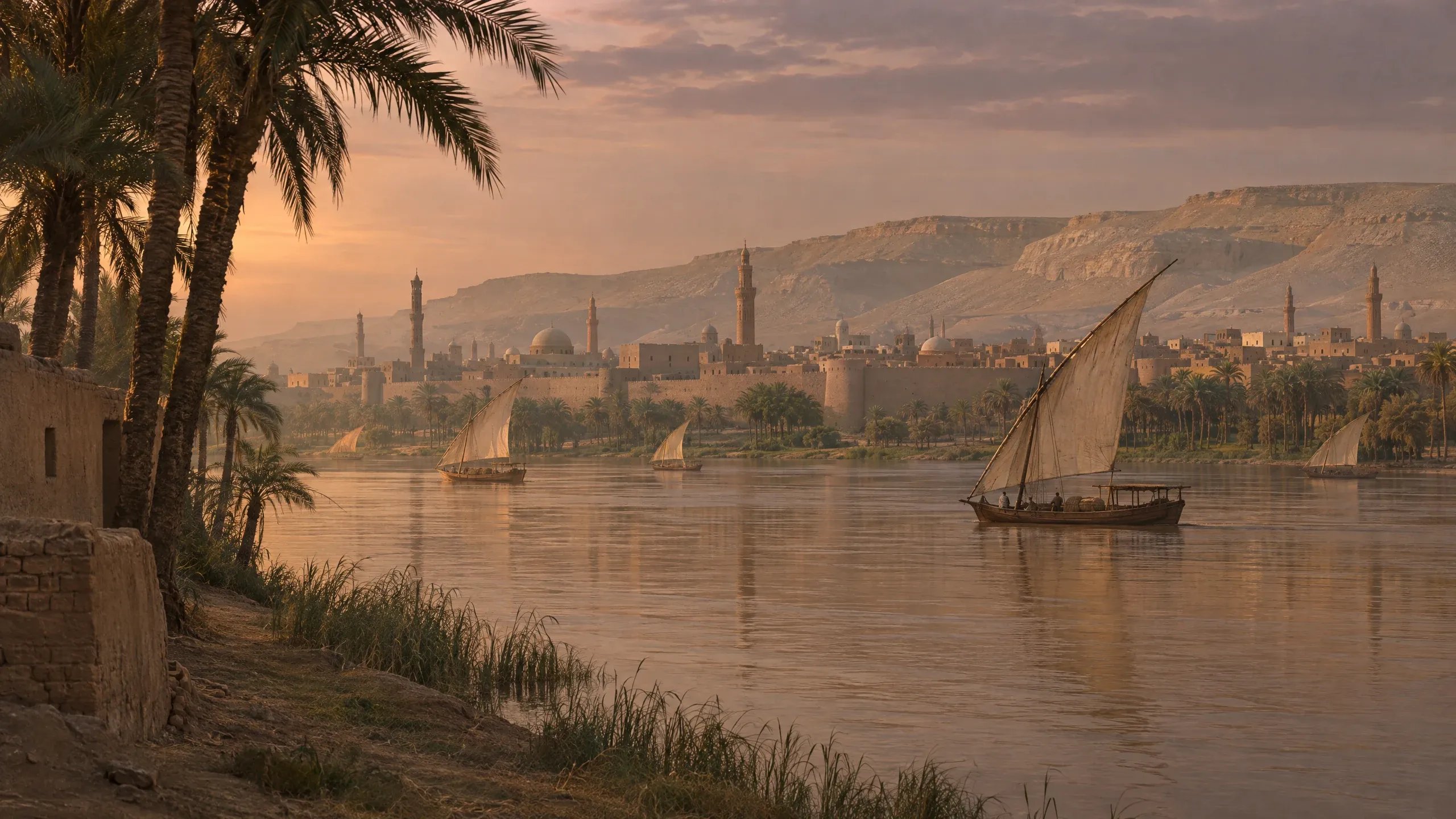
The Fatimid caliphate was the first major Muslim state since the time of Ali ibn Abi Talib to be headed by an Imam from the ahl al-bayt, the family of the Prophet. Founded in Ifriqiya in 909 CE (297 AH) and moved to Egypt in 973, it was ruled for its first 185 years by eight Ismaili Imams who were at once caliphs of a state and heads of a religious mission, the da’wa. Farhad Daftary calls this period, from 909 to the death of al-Mustansir in 1094, the “golden age” of Ismailism: the Ismailis possessed a state of their own, and their literature and intellectual life reached an apogee.1
Ismailism was the creed of the dynasty and of its da’wa, not of most of its subjects. The Fatimids never imposed it on the whole population; inside their territories Ismailis could practise their faith openly, while outside them they continued to observe taqiyya, precautionary dissimulation.1 The state’s subjects in Ifriqiya were mostly Maliki Sunnis and Kharijis, and in Egypt mostly Sunnis and Coptic Christians.2
At its height the dynasty claimed suzerainty over North Africa, Egypt, Sicily, the Hijaz, Palestine and Syria, and was recognised as custodian of Mecca and Medina; for about a year the khutba was even read in its name in Baghdad, the Abbasid capital. Louis Massignon called the tenth century the “Ismaili century of Islam”. The da’is of the period were also the movement’s theologians and philosophers, and the Fatimid palace in Cairo housed major libraries.34
The history of the period rests on sources of unusual variety: chancery documents (sijillat) preserved by later Egyptian authors such as al-Maqrizi, Ibn Taghribirdi and al-Qalqashandi, documents from the Cairo Geniza, and a large Ismaili literature. Daftary divides the period into a North African phase, from 909 until the court left Ifriqiya, and an Egyptian phase, from 973 to 1094.5
From Salamiyya to Sijilmasa
The founder of the dynasty, Abd Allah, known by his regnal title al-Mahdi, left Syria in the face of Abbasid pursuit and reached Egypt, then under the quasi-autonomous Tulunids, early in 291/904. His chamberlain Ja’far later wrote a detailed account of the journey. In Fustat he was received by the chief local da’i, Abu Ali, and lived for a year disguised as a Hashimid merchant.6
In 292/905 an Abbasid army arrived to restore direct Abbasid rule in Egypt. Instead of going on to Yemen, where the da’i Ibn Hawshab led a loyal community, al-Mahdi joined a merchant caravan heading west. Daftary suggests two reasons for the change: the intensity of the Abbasid search for the Imam, and the beginnings of dissident activity in Yemen, where the chief da’i Firuz had deserted to Ali ibn al-Fadl. From Tripoli al-Mahdi sent ahead the da’i Abu’l-Abbas Muhammad, but he was recognised in Qayrawan and imprisoned by the Aghlabids, who ruled Ifriqiya for the Abbasids. Al-Mahdi, his son Abu’l-Qasim (the future al-Qa’im) and Ja’far crossed southern Ifriqiya in Shawwal 292/August 905 and reached Sijilmasa, a caravan town on the edge of the Sahara ruled by the Midrarid amir al-Yasa’ ibn Midrar.6 There al-Mahdi lived quietly for four years among the town’s merchants, staying in contact with his da’i in the Kutama country.7
The Kutama da’wa
That da’i was Abu Abd Allah al-Husayn ibn Ahmad, called al-Shi’i, a native of San’a’ who had converted in southern Iraq and served under Ibn Hawshab. On the pilgrimage of 279/892 he met Kutama Berber pilgrims in Mecca and, on Ibn Hawshab’s instructions, returned with them to the Lesser Kabylia in present-day eastern Algeria, where he was active from 280/893. He first settled at Ikjan, north of Setif, and later moved to Tazrut, a few kilometres south-west of Mila, where he built a dar al-hijra, a place of refuge for converts. From there he turned the Kutama confederation into a disciplined army.7
Abu Abd Allah enforced the shari’a on tribesmen who had followed customary law, lived simply, and personally instructed initiates in regular lectures, the origin of the later majalis al-hikma, “sessions of wisdom”. His subordinate da’is held similar sessions, including separate sessions for women.7 By 290/903 he had begun the conquest of Ifriqiya. Mila, Tubna and Billizma fell, and in 296/909 the Kutama took Qafsa, Qastiliya and al-Urbus. The last Aghlabid, Ziyadat Allah III, abandoned his palace city of Raqqada outside Qayrawan and fled to Egypt. On 1 Rajab 296/25 March 909 Abu Abd Allah entered Raqqada.8
For almost a year he governed Ifriqiya as al-Mahdi’s deputy. He appointed governors, introduced the Shi’i call to prayer and added blessings on the ahl al-bayt to the Friday sermon. His coins proclaimed the arrival of the hujjat Allah, the “proof of God”. His brother Abu’l-Abbas, freed from prison, held public disputations with the Maliki jurists of Qayrawan in the city’s Great Mosque.8
The caliphate proclaimed
In Ramadan 296/June 909 Abu Abd Allah led the Kutama west. On the way he ended the Ibadi Rustamid principality of Tahart, which had ruled since 160/777. At Sijilmasa he freed al-Mahdi, whom the Midrarid amir had placed under house arrest, and in Dhu’l-Hijja 296/August 909 al-Mahdi was acclaimed caliph there in ceremonies lasting several days.89
Al-Mahdi entered Raqqada on 20 Rabi’ II 297/4 January 910. The next day, Friday 5 January 910, the khutba was read in every mosque of Qayrawan in the name of Abu Muhammad Abd Allah, al-imam al-mahdi bi’llah and amir al-mu’minin, “commander of the faithful”. A manifesto read from the pulpits announced that the caliphate now belonged to the ahl al-bayt, and jurists were instructed to give opinions according to Shi’i principles, with particular attention to the teachings of Imam Ja’far al-Sadiq. The dynasty took its name from Fatima, the Prophet’s daughter, from whom al-Mahdi traced his descent. For Ismailis the event closed the dawr al-satr, the period of concealment, and opened the dawr al-kashf, the period of manifestation, in which the Imam led the community openly.9
Da’wa and state
The new state soon faced a conflict between the revolutionary da’wa and the requirements of government. Abu Abd Allah resented the limits placed on his authority and, with his brother, became involved in a conspiracy that drew on his popularity among the Kutama. Both were executed in 298/911 on al-Mahdi’s orders. After an initial revolt, the Kutama remained loyal to the dynasty.10
The first decades were spent in war. The Fatimids fought Ibadi Zanata Berbers, many of them clients of the Umayyads of Cordoba, as well as the Idrisids of Fez. A Zanata revolt was subdued in 299/911 and Tahart retaken; the Idrisids were subjugated in 305/917.11 Al-Mahdi also sent two expeditions against Egypt under his son Abu’l-Qasim, in 301–302/913–915 and 307–309/919–921. Both failed, leaving only Barqa in Fatimid hands, and the second cost the young Fatimid fleet heavily.11 A third, sent by al-Qa’im in 323/935, was repelled by Muhammad ibn Tughj al-Ikhshid, and the Ikhshidid regent Kafur later delayed a Fatimid conquest for more than three decades.12
Mahdiya and the sea
Al-Mahdi founded the town of Mahdiya on the east coast of Ifriqiya and moved his capital there from Raqqada in 308/921. The town had a shipyard and became the base of the Fatimid fleet.1112 In 322/934 al-Qa’im sent twenty ships from Mahdiya to Italy; the expedition sacked Genoa the following year, and Sardinia and Corsica were occupied for a time.13 Al-Mahdi died in Rabi’ I 322/March 934, after a caliphate of twenty-five years and an imamate of thirty-five, and was succeeded by his son Abu’l-Qasim Muhammad, al-Qa’im bi-Amr Allah.14
Sicily
Sicily had come under the Fatimids with the Aghlabid lands. Its Muslims were mainly Maliki Sunnis, and the da’wa did not take root there. A revolt under Ibn Qurhub ended when he was delivered to al-Mahdi and executed in 304/916. In 336/948 al-Mansur appointed al-Hasan ibn Ali al-Kalbi as governor, founding the Kalbid dynasty, which governed the island under Fatimid suzerainty for about a century, a prosperous period for Sicilian commerce and culture.13 The Kalbids fought Byzantium on the island and in southern Italy: in 351/962 they took Taormina and renamed it Mu’izziyya, and in 354/964 they defeated a Byzantine expedition of Nicephorus II Phocas by land and sea.14
Abu Yazid and the founding of Mansuriyya
The gravest threat to the North African state came from within. Abu Yazid Makhlad ibn Kaydad, a Nukkari Ibadi of the Zanata Banu Ifran,14 began preaching around Qastiliya in 316/928 and rose in revolt in 332/943–944. In Safar 333/October 944 he took Qayrawan, whose Maliki population at first cooperated with him, and he besieged al-Qa’im in Mahdiya, which held out.15 Al-Qa’im died in Mahdiya in Shawwal 334/May 946, after a reign of twelve years, by which time the tide had begun to turn against Abu Yazid.15
His son Isma’il, al-Mansur bi’llah, concealed his father’s death16 and took the offensive. He relieved Susa, forced Abu Yazid to withdraw from Qayrawan in Muharram 335/August 946, pursued him west past Tubna and Masila, and finally defeated him in Muharram 336/August 947 at the mountain stronghold of Kiyana; Abu Yazid was captured and died of his wounds.17 Al-Mansur then built a new capital, Mansuriyya, near the village of Sabra south of Qayrawan, and settled there in 337/948. It remained the capital until the court left for Egypt. Al-Mansur died in Shawwal 341/March 953, after an imamate of about seven years.17
Mansuriyya was laid out on a circular plan, as excavations have shown, with palaces, gates and a mosque called al-Azhar, names that reappeared in Cairo a generation later.17
The Qarmatis are not the Fatimids
Contemporary and later sources often merged the Fatimids with the Qarmatis, the Ismaili groups that had broken with the leadership in 286/899 and refused to recognise al-Mahdi. The Qarmatis of Bahrayn under Abu Tahir al-Jannabi sacked Basra in 311/923 and, in Dhu’l-Hijja 317/January 930, attacked Mecca during the pilgrimage and carried off the Black Stone.18 The Stone was returned in 339/950–951 in exchange for a payment from the Abbasids. Daftary rejects the old view of M. J. de Goeje that the Qarmatis acted on al-Mahdi’s orders: they never recognised the Fatimid imamate, and the two shared only a hostility to the Abbasids.1920
Al-Mu’izz and the road to Egypt
The fourth caliph, al-Mu’izz li-Din Allah (r. 341–365/953–975), inherited a pacified state. Daftary describes him as an excellent planner and organiser and a statesman skilled in diplomacy.21 His general Jawhar, a freedman of possibly Slavic origin who had served as secretary to al-Mansur and al-Mu’izz, swept the western Maghrib in 347/958. He defeated the Banu Ifran near Tahart, took Sijilmasa and killed its Midrarid amir, and in 349/960 took Fez from its Umayyad governor. Fatimid authority now reached the Atlantic, with the exception of Ceuta. The Sanhaja chief Ziri ibn Manad, a firm supporter of the dynasty, fought alongside him.21
Preparations for Egypt took about ten years. The army was enlarged beyond the Kutama, and da’is worked in Egypt itself, even approaching Kafur.22 Kafur’s death in 357/968, a famine and the weakness of his successor Ahmad ibn Ali opened the way. Ya’qub ibn Killis, a Jewish convert to Islam who had run Kafur’s finances, fled to the Fatimids and urged an immediate invasion; he later became the dynasty’s first vizier.22
The conquest of Egypt
Jawhar left Qayrawan in Rabi’ I 358/February 969 after a ceremonial send-off in which al-Mu’izz gave him his own garments and ordered provincial governors to dismount before him. He entered Fustat in Sha’ban 358/July 969 and issued an aman, a guarantee of safety, to the population. The name of the Abbasid caliph al-Muti’ was dropped from the khutba; Shi’i forms of prayer were introduced gradually.2 In the four years that followed, Jawhar dealt with the famine, reformed the administration and finances, and relied on the Kutama and other Maghribis for key posts.23 He replaced the debased Ikhshidid currency with a new gold coinage, the Mu’izzi dinar, of very high fineness, and required taxes to be paid in it (see Fatimid coinage).24
Cairo and al-Azhar
North of Fustat Jawhar laid out a walled palace city on a plan prepared by al-Mu’izz, with two palaces at its centre. It was first called al-Mansuriyya, after the capital in Ifriqiya, and later renamed al-Qahira al-Mu’izziyya, “the victorious city of al-Mu’izz”, from which the name Cairo derives. Like its North African predecessor it had gates named Bab al-Futuh and Bab Zuwayla.2 In Jumada I 359/April 970 Jawhar laid the foundations of the congregational mosque of al-Azhar, completed two years later. In 378/988–989, under al-Aziz, the vizier Ibn Killis organised regular teaching there, the beginning of the mosque’s role as a centre of learning (see al-Azhar and Fatimid Cairo).225
Syria, the Qarmatis and the move to Cairo
Mecca and Medina, whose amirs al-Mu’izz had subsidised, accepted his suzerainty in 359/969–970. Fatimid recognition in the Hijaz lasted, with interruptions, until the reign of al-Mustansir, when it was lost for good after a last restoration in 467–473/1074–1081.2326 Syria proved far harder. A Fatimid army under Ja’far ibn Falah defeated an Ikhshidid and Qarmati force near Ramla early in 359/970, but in 360/971 the Qarmati commander al-Hasan al-A’sam, allied with the Buyids and Hamdanids, retook Damascus, killed Ja’far ibn Falah and advanced to the gates of Cairo. Jawhar held the city, and al-A’sam withdrew in Rabi’ I 361/December 971.2327
Al-Mu’izz left Ifriqiya in Shawwal 361/August 972, appointing Buluggin ibn Ziri governor; Buluggin’s descendants, the Zirids, ruled Ifriqiya until 543/1148, from Mahdiya after 449/1057.28 The caliph entered Cairo in Ramadan 362/June 973 with his sons, the leading da’is, among them al-Qadi al-Nu’man, many Kutama, his treasury and the coffins of his three predecessors.27 Al-A’sam invaded Egypt a second time in 363/974 and besieged Cairo, but was defeated when his Jarrahid ally deserted him.29 Al-Mu’izz dismissed Jawhar soon after arriving and entrusted the finances to Ibn Killis. He died in Rabi’ II 365/December 975, aged forty-four, and was buried in the mausoleum attached to the palace, where his predecessors had been reinterred.29
The reform of al-Mu’izz and the eastern da’wa
Al-Mu’izz was the first Fatimid caliph to pursue specific da’wa objectives beyond his frontiers, partly to win back the dissident Qarmatis. He corresponded with emissaries from Sind and reworked the doctrine of the imamate. In his formulation, expressed in the works of al-Qadi al-Nu’man and Ja’far ibn Mansur al-Yaman and in prayers attributed to the caliph himself, Muhammad ibn Isma’il was the Qa’im and seventh natiq, but his functions were carried out by his descendants, the Fatimid Imams, as his khulafa’ or deputies. He also permitted the incorporation of a Neoplatonised cosmology into Fatimid thought.303132
The policy had results. The Khurasani da’i Abu Ya’qub al-Sijistani endorsed the Fatimid imamate in the works he wrote after al-Mu’izz’s accession, and much of the Ismaili following in Khurasan, Sistan and Makran followed him.32 Around 347/958 a Fatimid vassal state was established in Sind with its seat at Multan, where from about 354/965 the khutba was read for al-Mu’izz. It lasted until Mahmud of Ghazna made its ruler a tributary in 396/1005–1006 and annexed the city in 401/1010–1011, massacring its Ismailis.3233
Al-Qadi al-Nu’man and Ismaili law
Before the Fatimids there was no Ismaili school of law; Ismailis had followed the law of the land. Codification began under al-Mahdi and was completed by al-Qadi al-Nu’man (d. 363/974), who served the first four caliphs and was chief judge from 337/948. Commissioned by al-Mu’izz, he compiled the Da’a’im al-Islam, “The Pillars of Islam”, which the Imam endorsed as the official code of the state. It remains the principal legal text of the Tayyibi Ismailis, including the Bohras.3334 Ismaili law recognised three sources: the Qur’an, the sunna of the Prophet as transmitted by the Imams, and the teachings of the Imams themselves; it rejected ijma’ and qiyas as sources of law.3536
Al-Nu’man founded a dynasty of judges. His son Ali (d. 374/984) was the first to bear the official title qadi al-qudat, chief judge, which he held under al-Aziz for nine years; another son, Muhammad, and two grandsons held the office after him. The family’s tenure ended in 441/1049, when al-Nu’man’s great-grandson was dismissed and replaced by al-Yazuri.37
Al-Nu’man also inaugurated public Friday sessions on law after the midday prayer, using the Da’a’im, and private majalis al-hikma on esoteric doctrine for initiates, whose content the Imam approved in advance. In Cairo the public sessions continued at al-Azhar and the city’s other great mosques, and the private sessions in a hall of the palace.3839
Al-Aziz: Syria and an open court
Al-Aziz bi’llah (r. 365–386/975–996), the third son of al-Mu’izz, was the first Fatimid caliph to begin his reign in Egypt. He had been designated heir only a year earlier, after the death of his elder brother Abd Allah; the eldest brother, Tamim, had been passed over.3740 His main external goal was Syria. Jawhar, sent against the Turkish commander Alftakin in Damascus, was besieged for about seventeen months at Ascalon and allowed to return only on humiliating terms. Al-Aziz then took the field himself and defeated Alftakin and the Qarmatis near Ramla in 368/978, after which the Qarmatis of Bahrayn declined to a local power.40
Aleppo, a Hamdanid principality under Byzantine protection, remained out of reach. In 385/995 the emperor Basil II came in person to relieve it from a Fatimid siege.4142 Al-Aziz was the first Fatimid to recruit Turkish troops, against the wishes of his Berber officers, a decision with long consequences.41 By the end of his reign Fatimid sovereignty was recognised, at least nominally, from the Atlantic to the Red Sea, in the Hijaz, Yemen, Syria and Palestine, and the khutba was read for him in Multan and briefly in Mosul.42
Ibn Killis, vizier from 367/977 and given the title al-wazir al-ajall in 368/978, organised the administration and finances and wrote a legal treatise based on the rulings of al-Mu’izz and al-Aziz.4225 Al-Aziz appointed Christians and Jews to high office: Isa ibn Nasturus, a Copt, became the first Christian vizier in 385/995. His brothers-in-law became the Melkite patriarch of Jerusalem and metropolitan of Cairo, and the Coptic patriarch was permitted to rebuild the church of St Mercurius near Fustat.25 He also encouraged the Shi’i observances of Ashura and Ghadir Khumm, introduced under al-Mu’izz. He died at Bilbays in Ramadan 386/October 996, setting out on campaign against Aleppo.2543
Relations with Byzantium alternated between war in northern Syria and negotiation. Al-Aziz concluded a treaty with Basil II that lifted commercial restrictions, and Barjawan, regent for al-Hakim, agreed a ten-year truce with the emperor from 391/1001. The truce ended when al-Hakim ordered the destruction of the Holy Sepulchre; in 406/1015–1016 Basil II forbade trade with the Fatimids. Under al-Zahir an agreement of 423/1032 allowed the emperor to rebuild the church, and in 429/1038 a thirty-year peace was concluded.4244454647
Al-Hakim
Al-Hakim bi-Amr Allah (r. 386–411/996–1021) succeeded at about eleven, the first Fatimid born in Egypt. His early reign was dominated by the struggle between the Berber faction of the army, the Maghariba, and the eastern faction of Turks and Daylamis, the Mashariqa. The Kutama chief al-Hasan ibn Ammar was made wasita, the intermediary between caliph and government, and was overthrown by the eunuch Barjawan, the caliph’s tutor, who ruled from 387/997 until al-Hakim had him killed in 390/1000.434448
From then on al-Hakim governed himself. He issued a long series of decrees, many later reversed, and executed numerous viziers and commanders. Daftary notes that his image was shaped largely by the Melkite historian Yahya al-Antaki and later hostile Sunni writers, and that modern scholarship presents him as generally popular and closely engaged with the da’wa.4845 His measures against Christians and Jews took shape by 395/1004 and culminated in the destruction of the Church of the Holy Sepulchre in Jerusalem, ordered in 400/1009; in 404/1013 he allowed forced converts to return to their faiths, and later restored churches.4845 In 395/1005 he founded the Dar al-’Ilm, the “House of Knowledge”, in part of the palace, with a large library and teaching in the Qur’an, hadith, law, grammar, logic, astronomy and mathematics.45
Outside Egypt he faced the revolt of Abu Rakwa in Barqa (395–397/1004–1007) and of the Jarrahids in Palestine, who in 403/1012 set up the sharif of Mecca as an anti-caliph.49 In Ifriqiya, after 407/1016–1017, Ismailis were massacred under the Zirid al-Mu’izz ibn Badis.50 In the east, however, the da’wa expanded. Hamid al-Din al-Kirmani, active in Iraq, was the period’s most learned theologian. In 401/1010–1011 the Uqaylid ruler of Mosul and Kufa had the khutba read for al-Hakim, prompting the Abbasid caliph al-Qadir to issue in 402/1011 the Baghdad manifesto denying the Fatimids’ Alid descent.5152 In 404/1013 al-Hakim named a great-grandson of al-Mahdi, Abd al-Rahim ibn Ilyas, as heir, passing over his own son.53
The Druze
In al-Hakim’s last years some da’is who had come from Persia and Central Asia began to proclaim his divinity. Al-Hasan al-Akhram organised the movement early in 408/1017, the first year of the Druze era, and was killed in 408/1018. Hamza ibn Ali resumed preaching in 410/1019, and his rival Muhammad ibn Isma’il al-Darazi, after whom the movement was named, was the first to declare al-Hakim’s divinity publicly.5354 The official da’wa opposed them. There is no evidence that al-Hakim endorsed these ideas, and none of his edicts claims divinity. Al-Kirmani wrote several refutations in Cairo, including al-Risala al-Wa’iza (408/1017).5455 The movement survived mainly in Syria, became a closed community after 435/1043 and developed into a distinct religion (see The Druze).5556
Druze doctrine, preserved in the canon known as the Rasa’il al-hikma, holds that al-Hakim was the last manifestation of the One, assigns cosmic ranks to Hamza and four other hudud, and abrogates the laws of earlier religions. Daftary treats it as a new religion outside Ismailism; its adherents call themselves muwahhidun, unitarians, and in his 2007 estimate numbered about 300,000, mainly in Syria, Lebanon and Israel.5657
On 27 Shawwal 411/13 February 1021 al-Hakim rode out to the Muqattam hills and did not return. His donkey and clothes, cut by daggers, were found; his body never was.58
Al-Zahir and Sitt al-Mulk
Al-Hakim’s half-sister Sitt al-Mulk secured the succession of his son Ali, al-Zahir li-I’zaz Din Allah (r. 411–427/1021–1036). She removed the designated heir Abd al-Rahim ibn Ilyas, had the Kutama chief Ibn Dawwas executed, and governed as regent until her death in 413/1023.5846 Power then passed to the vizier al-Jarjara’i. Famine struck in 415/1024, Maliki jurists were expelled in 416/1025, and in 420/1029 the general Anushtigin al-Duzbari defeated a Bedouin coalition at Uqhuwana in Palestine. He took Aleppo in 429/1038. Al-Zahir died of plague, in his early thirties, in Sha’ban 427/June 1036.46
Sitt al-Mulk, born at Mansuriyya in 359/970, was a daughter of al-Aziz who never married and held large estates and her own retinue. Some medieval accounts accused her of arranging her brother’s death; Daftary records this as one of several versions. She restored order, addressed grievances and reopened negotiations with Byzantium, and later sources called her al-sayyida al-’amma. From al-Zahir onward the throne regularly passed to minors.5846
Al-Mustansir: the longest reign
Al-Mustansir bi’llah came to the throne at seven and reigned almost sixty lunar years (427–487/1036–1094), the longest reign of the dynasty. His mother Rasad dominated the court after al-Jarjara’i’s death in 436/1044. The capable vizier al-Yazuri (442–450/1050–1058) restored some order, but after his execution factional conflict among Turkish, Berber and black Sudanese regiments intensified.59
The reign also saw the da’wa’s greatest reach. Al-Mu’ayyad fi’l-Din al-Shirazi, who arrived from Shiraz in 439/1047, directed the Fatimid support for the Turkish commander al-Basasiri against the Saljuqs. In Dhu’l-Qa’da 450/December 1058 al-Basasiri entered Baghdad and had the khutba read for al-Mustansir for about a year; the Abbasid regalia were sent to Cairo.604761 Al-Mu’ayyad became chief da’i in 450/1058, headed the Dar al-’Ilm from 454/1062, and delivered the 800 lectures of the Majalis al-Mu’ayyadiyya.61
Al-Mu’ayyad was born around 390/1000 in Shiraz, the son of a Daylami da’i. At the court of the Buyid Abu Kalijar he won the ruler and many Daylami troops to the da’wa, until Abbasid pressure forced him to leave in 438/1046; his autobiography, the Sira, covers these years. He died in Cairo in 470/1078 and was buried in the Dar al-’Ilm; al-Mustansir led the funeral prayer.6261
In Yemen the Sulayhid Ali ibn Muhammad founded a dynasty in 439/1047 that ruled as Fatimid vassals until 532/1138; Queen Arwa was appointed hujja of Yemen after 477/1084, the first woman to hold high rank in the da’wa. Da’is sent from Yemen founded a community in Gujarat from 460/1067–1068, the origin of the Tayyibi Bohras.636465 The Persian poet and philosopher Nasir Khusraw spent three years in Cairo (439–441/1047–1050), returned as hujja of Khurasan and spent his last years in exile in Yumgan in Badakhshan, where Ismailis regard him as the founder of their community.666768
Born in 394/1004 at Qubadiyan near Balkh, Nasir Khusraw had served as a financial official under the Ghaznavids and Saljuqs before a spiritual crisis led him to resign at about forty-one. He left Khurasan in 437/1046 and entered Cairo in Safar 439/August 1047; his Safar-nama describes the city in detail. Back in Balkh by 444/1052 he preached the da’wa, was denounced as a heretic, and took refuge in Yumgan under Ali ibn al-Asad, an Ismaili amir of Badakhshan, where he completed Jami’ al-hikmatayn in 462/1070. He died after 465/1072–1073; his tomb stands near Fayzabad in Afghan Badakhshan.666768
Ali al-Sulayhi, son of the judge of Haraz, fortified Masar in 439/1047, took Zabid in 452/1060 and controlled all of Yemen by 455/1063, ruling from San’a’. He was killed on the way to Mecca in 459/1067. Arwa, wife of his son al-Mukarram, moved the capital to Dhu Jibla and governed until her death in 532/1138. The Yemeni chief judge Lamak ibn Malik spent five years in Cairo studying with al-Mu’ayyad at the Dar al-’Ilm, and it was probably on al-Mu’ayyad’s instructions that Lamak sent the da’i Abd Allah to Cambay in Gujarat in 460/1067–1068. Daftary considers it likely that the extension of the da’wa to western India followed the Fatimid Red Sea trade routes through Aydhab and Aden.636465
How the da’wa was organised
Unlike the Abbasids, who disbanded their revolutionary mission after taking power, the Fatimids kept theirs. It operated inside their dominions, where Ismailism remained a minority faith, and abroad, where its da’is worked under the protection of taqiyya.69 Under the early caliphs the chief judge often also headed the da’wa; from al-Hakim’s reign the two offices were usually held by different men, with the chief judge taking precedence. Provincial da’is served in Damascus, Tyre, Acre, Ramla and Ascalon.3870
The ranks of the da’wa, called hudud al-din, were fixed by the time of al-Mu’ayyad. At their head below the Imam stood the bab, the term Ismaili sources use for the office Sunni historians call da’i al-du’at, chief da’i. The world was divided into twelve jaza’ir, “islands”, each under a hujja. Below the hujja came several grades of da’i, the ma’dhun, who administered the oath of allegiance, the mukasir, and finally the mustajib, the initiate. Hamid al-Din al-Kirmani’s seven-rank scheme in Rahat al-’aql is the most elaborate description and later became the basis of the Tayyibi hierarchy. Daftary stresses that this was a paradigm not always filled in practice, and that the da’wa never sought mass conversion.717273
Teaching was graded. Public sessions on law were open to all; the majalis al-hikma were for initiates who paid a due called najwa. Under al-Hakim there were separate sessions for the leading members of the community, for palace officials and for women, held at al-Azhar and, for women of the court, in the palace. The tradition culminated in al-Mu’ayyad’s 800 lectures.39
Government, money and learning
The title of vizier was not used in Ifriqiya; Ibn Killis was the first to hold it. Until Badr al-Jamali, viziers were “men of the pen” who executed the caliph’s orders; Badr and his successors were “viziers of the sword” with delegated authority. Several viziers were Christians.74 Government ran through three main bureaux: the chancery (diwan al-insha’), the army and salaries (diwan al-jaysh wa’l-rawatib) and finance (diwan al-amwal).69
The Mu’izzi dinar introduced by Jawhar kept its high gold content throughout the Fatimid period, even during the crisis under al-Mustansir. Revenues rose, especially from the textile towns of Tinnis and Damietta, and Fatimid gold coins circulated as an international currency, supplied from the mines of Upper Egypt and Nubia.2475 Egyptian workshops produced linen and silk textiles, rock crystal, glass, lustre ceramics, metalwork, ivory, leather, paper and sugar (see Fatimid art and architecture).76 Learning was patronised at court: the astronomer Ibn Yunus compiled al-Zij al-Hakimi for al-Hakim, and the historians al-Musabbihi and al-Quda’i and the physician Ibn Ridwan worked in Fatimid Cairo.77
Ismaili thought flourished in the same period. Al-Sijistani, al-Kirmani, al-Mu’ayyad and Nasir Khusraw developed a Neoplatonic Ismaili philosophy; the chief judge al-Maliji compiled the Majalis al-Mustansiriyya, and Nasir Khusraw’s Wajh-i din became a key text of ta’wil for the Ismailis of Central Asia.78 The Qarmati state of Bahrayn, which Nasir Khusraw visited in 443/1051, collapsed in 469–470/1076–1077, and the new ’Uyunid ruler acknowledged al-Mustansir.79
Crisis and Badr al-Jamali
The Fatimid lands shrank. The Zirids renounced Fatimid allegiance around 440/1048, Ifriqiya was lost, and the Normans’ conquest of Sicily by 463/1070–1071 left Barqa as the western limit.6528 The Saljuqs entered Baghdad in 447/1055; Syria was largely lost by 471/1078–1079, and the sharif of Mecca transferred the khutba to the Abbasids in 462/1069–1070.804726
According to a tradition reported in the sources, the vizier al-Yazuri persuaded al-Mustansir to send the Bedouin Banu Hilal and Banu Sulaym into Ifriqiya in response. The Zirids were defeated in 443/1051–1052, and by 449/1057 the Zirid ruler had abandoned Qayrawan for Mahdiya. In 436/1044–1045 the Qarakhanids massacred Ismailis in Bukhara and Transoxania.652862
Egypt itself collapsed. The Nile was low for seven consecutive years (457–464/1065–1072); there was famine, the Turkish commander Nasir al-Dawla seized power and plundered the palace, and the Fatimid libraries were destroyed in 461/1068–1069.81 Al-Mustansir called in Badr al-Jamali, the Armenian governor of Acre, who arrived in Jumada I 466/January 1074, killed the Turkish leaders and became amir al-juyush, commander of the armies, with authority over the civil, judicial and religious administration. Egypt recovered under him, but from this point real power lay with the vizier.818082
The succession of 1094
Badr died in Rabi’ I 487/1094, having arranged for his son al-Afdal to succeed him. Al-Mustansir died on 18 Dhu’l-Hijja 487/28 December 1094.82 His eldest son Nizar had received the nass, the designation of succession. Al-Afdal instead enthroned a younger son, Ahmad, as al-Musta’li. Nizar rose in Alexandria in 488/1095, was defeated and died in prison in Cairo. The Ismailis of Persia, led by Hasan-i Sabbah, upheld Nizar’s imamate, and the community divided permanently into Nizaris and Musta’lians, the subject of the next chapter.83
Footnotes
-
Farhad Daftary, The Isma’ilis: Their History and Doctrines, 2nd ed. (Cambridge University Press, 2007), p. 137. ↩ ↩2
-
Farhad Daftary, The Isma’ilis: Their History and Doctrines, 2nd ed. (Cambridge University Press, 2007), p. 159. ↩ ↩2 ↩3 ↩4
-
Farhad Daftary, The Isma’ilis: Their History and Doctrines, 2nd ed. (Cambridge University Press, 2007), p. 138. ↩
-
Farhad Daftary, The Isma’ilis: Their History and Doctrines, 2nd ed. (Cambridge University Press, 2007), p. 139. ↩
-
Farhad Daftary, The Isma’ilis: Their History and Doctrines, 2nd ed. (Cambridge University Press, 2007), p. 140. ↩
-
Farhad Daftary, The Isma’ilis: Their History and Doctrines, 2nd ed. (Cambridge University Press, 2007), p. 125. ↩ ↩2
-
Farhad Daftary, The Isma’ilis: Their History and Doctrines, 2nd ed. (Cambridge University Press, 2007), p. 126. ↩ ↩2 ↩3
-
Farhad Daftary, The Isma’ilis: Their History and Doctrines, 2nd ed. (Cambridge University Press, 2007), p. 127. ↩ ↩2 ↩3
-
Farhad Daftary, The Isma’ilis: Their History and Doctrines, 2nd ed. (Cambridge University Press, 2007), p. 128. ↩ ↩2
-
Farhad Daftary, The Isma’ilis: Their History and Doctrines, 2nd ed. (Cambridge University Press, 2007), p. 141. ↩
-
Farhad Daftary, The Isma’ilis: Their History and Doctrines, 2nd ed. (Cambridge University Press, 2007), p. 142. ↩ ↩2 ↩3
-
Farhad Daftary, The Isma’ilis: Their History and Doctrines, 2nd ed. (Cambridge University Press, 2007), p. 143. ↩ ↩2
-
Farhad Daftary, The Isma’ilis: Their History and Doctrines, 2nd ed. (Cambridge University Press, 2007), p. 144. ↩ ↩2
-
Farhad Daftary, The Isma’ilis: Their History and Doctrines, 2nd ed. (Cambridge University Press, 2007), p. 145. ↩ ↩2 ↩3
-
Farhad Daftary, The Isma’ilis: Their History and Doctrines, 2nd ed. (Cambridge University Press, 2007), p. 146. ↩ ↩2
-
Farhad Daftary, Historical Dictionary of the Ismailis (Scarecrow Press, 2012), s.v. “al-Mansur”. ↩
-
Farhad Daftary, The Isma’ilis: Their History and Doctrines, 2nd ed. (Cambridge University Press, 2007), p. 147. ↩ ↩2 ↩3
-
Farhad Daftary, The Isma’ilis: Their History and Doctrines, 2nd ed. (Cambridge University Press, 2007), p. 148. ↩
-
Farhad Daftary, The Isma’ilis: Their History and Doctrines, 2nd ed. (Cambridge University Press, 2007), p. 151. ↩
-
Farhad Daftary, The Isma’ilis: Their History and Doctrines, 2nd ed. (Cambridge University Press, 2007), p. 152. ↩
-
Farhad Daftary, The Isma’ilis: Their History and Doctrines, 2nd ed. (Cambridge University Press, 2007), p. 156. ↩ ↩2
-
Farhad Daftary, The Isma’ilis: Their History and Doctrines, 2nd ed. (Cambridge University Press, 2007), p. 158. ↩ ↩2
-
Farhad Daftary, The Isma’ilis: Their History and Doctrines, 2nd ed. (Cambridge University Press, 2007), p. 161. ↩ ↩2 ↩3
-
Paula A. Sanders, “The Fatimid state, 969–1171”, in Carl F. Petry (ed.), The Cambridge History of Egypt, vol. 1 (Cambridge University Press, 1998), p. 158. ↩ ↩2
-
Farhad Daftary, The Isma’ilis: Their History and Doctrines, 2nd ed. (Cambridge University Press, 2007), p. 177. ↩ ↩2 ↩3 ↩4
-
Farhad Daftary, The Isma’ilis: Their History and Doctrines, 2nd ed. (Cambridge University Press, 2007), p. 198. ↩ ↩2
-
Farhad Daftary, The Isma’ilis: Their History and Doctrines, 2nd ed. (Cambridge University Press, 2007), p. 162. ↩ ↩2
-
Farhad Daftary, The Isma’ilis: Their History and Doctrines, 2nd ed. (Cambridge University Press, 2007), p. 202. ↩ ↩2 ↩3
-
Farhad Daftary, The Isma’ilis: Their History and Doctrines, 2nd ed. (Cambridge University Press, 2007), p. 163. ↩ ↩2
-
Farhad Daftary, The Isma’ilis: Their History and Doctrines, 2nd ed. (Cambridge University Press, 2007), p. 164. ↩
-
Farhad Daftary, The Isma’ilis: Their History and Doctrines, 2nd ed. (Cambridge University Press, 2007), p. 165. ↩
-
Farhad Daftary, The Isma’ilis: Their History and Doctrines, 2nd ed. (Cambridge University Press, 2007), p. 166. ↩ ↩2 ↩3
-
Farhad Daftary, The Isma’ilis: Their History and Doctrines, 2nd ed. (Cambridge University Press, 2007), p. 167. ↩ ↩2
-
Farhad Daftary, The Isma’ilis: Their History and Doctrines, 2nd ed. (Cambridge University Press, 2007), p. 169. ↩
-
Farhad Daftary, The Isma’ilis: Their History and Doctrines, 2nd ed. (Cambridge University Press, 2007), p. 170. ↩
-
Farhad Daftary, The Isma’ilis: Their History and Doctrines, 2nd ed. (Cambridge University Press, 2007), p. 171. ↩
-
Farhad Daftary, The Isma’ilis: Their History and Doctrines, 2nd ed. (Cambridge University Press, 2007), p. 172. ↩ ↩2
-
Farhad Daftary, The Isma’ilis: Their History and Doctrines, 2nd ed. (Cambridge University Press, 2007), p. 214. ↩ ↩2
-
Farhad Daftary, The Isma’ilis: Their History and Doctrines, 2nd ed. (Cambridge University Press, 2007), p. 215. ↩ ↩2
-
Farhad Daftary, The Isma’ilis: Their History and Doctrines, 2nd ed. (Cambridge University Press, 2007), p. 173. ↩ ↩2
-
Farhad Daftary, The Isma’ilis: Their History and Doctrines, 2nd ed. (Cambridge University Press, 2007), p. 175. ↩ ↩2
-
Farhad Daftary, The Isma’ilis: Their History and Doctrines, 2nd ed. (Cambridge University Press, 2007), p. 176. ↩ ↩2 ↩3 ↩4
-
Farhad Daftary, The Isma’ilis: Their History and Doctrines, 2nd ed. (Cambridge University Press, 2007), p. 178. ↩ ↩2
-
Farhad Daftary, The Isma’ilis: Their History and Doctrines, 2nd ed. (Cambridge University Press, 2007), p. 179. ↩ ↩2
-
Farhad Daftary, The Isma’ilis: Their History and Doctrines, 2nd ed. (Cambridge University Press, 2007), p. 181. ↩ ↩2 ↩3 ↩4
-
Farhad Daftary, The Isma’ilis: Their History and Doctrines, 2nd ed. (Cambridge University Press, 2007), p. 192. ↩ ↩2 ↩3 ↩4
-
Farhad Daftary, The Isma’ilis: Their History and Doctrines, 2nd ed. (Cambridge University Press, 2007), p. 197. ↩ ↩2 ↩3
-
Farhad Daftary, The Isma’ilis: Their History and Doctrines, 2nd ed. (Cambridge University Press, 2007), p. 180. ↩ ↩2 ↩3
-
Farhad Daftary, The Isma’ilis: Their History and Doctrines, 2nd ed. (Cambridge University Press, 2007), p. 182. ↩
-
Farhad Daftary, The Isma’ilis: Their History and Doctrines, 2nd ed. (Cambridge University Press, 2007), p. 183. ↩
-
Farhad Daftary, The Isma’ilis: Their History and Doctrines, 2nd ed. (Cambridge University Press, 2007), p. 184. ↩
-
Farhad Daftary, The Isma’ilis: Their History and Doctrines, 2nd ed. (Cambridge University Press, 2007), p. 185. ↩
-
Farhad Daftary, The Isma’ilis: Their History and Doctrines, 2nd ed. (Cambridge University Press, 2007), p. 186. ↩ ↩2
-
Farhad Daftary, The Isma’ilis: Their History and Doctrines, 2nd ed. (Cambridge University Press, 2007), p. 187. ↩ ↩2
-
Farhad Daftary, The Isma’ilis: Their History and Doctrines, 2nd ed. (Cambridge University Press, 2007), p. 188. ↩ ↩2
-
Farhad Daftary, The Isma’ilis: Their History and Doctrines, 2nd ed. (Cambridge University Press, 2007), p. 189. ↩ ↩2
-
Farhad Daftary, The Isma’ilis: Their History and Doctrines, 2nd ed. (Cambridge University Press, 2007), p. 190. ↩
-
Farhad Daftary, The Isma’ilis: Their History and Doctrines, 2nd ed. (Cambridge University Press, 2007), p. 191. ↩ ↩2 ↩3
-
Farhad Daftary, The Isma’ilis: Their History and Doctrines, 2nd ed. (Cambridge University Press, 2007), p. 193. ↩
-
Farhad Daftary, The Isma’ilis: Their History and Doctrines, 2nd ed. (Cambridge University Press, 2007), p. 196. ↩
-
Farhad Daftary, The Isma’ilis: Their History and Doctrines, 2nd ed. (Cambridge University Press, 2007), p. 204. ↩ ↩2 ↩3
-
Farhad Daftary, The Isma’ilis: Their History and Doctrines, 2nd ed. (Cambridge University Press, 2007), p. 203. ↩ ↩2
-
Farhad Daftary, The Isma’ilis: Their History and Doctrines, 2nd ed. (Cambridge University Press, 2007), p. 199. ↩ ↩2
-
Farhad Daftary, The Isma’ilis: Their History and Doctrines, 2nd ed. (Cambridge University Press, 2007), p. 200. ↩ ↩2
-
Farhad Daftary, The Isma’ilis: Their History and Doctrines, 2nd ed. (Cambridge University Press, 2007), p. 201. ↩ ↩2 ↩3 ↩4
-
Farhad Daftary, The Isma’ilis: Their History and Doctrines, 2nd ed. (Cambridge University Press, 2007), p. 205. ↩ ↩2
-
Farhad Daftary, The Isma’ilis: Their History and Doctrines, 2nd ed. (Cambridge University Press, 2007), p. 206. ↩ ↩2
-
Farhad Daftary, The Isma’ilis: Their History and Doctrines, 2nd ed. (Cambridge University Press, 2007), p. 207. ↩ ↩2
-
Farhad Daftary, The Isma’ilis: Their History and Doctrines, 2nd ed. (Cambridge University Press, 2007), p. 213. ↩ ↩2
-
Farhad Daftary, The Isma’ilis: Their History and Doctrines, 2nd ed. (Cambridge University Press, 2007), p. 216. ↩
-
Farhad Daftary, The Isma’ilis: Their History and Doctrines, 2nd ed. (Cambridge University Press, 2007), p. 217. ↩
-
Farhad Daftary, The Isma’ilis: Their History and Doctrines, 2nd ed. (Cambridge University Press, 2007), p. 218. ↩
-
Farhad Daftary, The Isma’ilis: Their History and Doctrines, 2nd ed. (Cambridge University Press, 2007), p. 219. ↩
-
Farhad Daftary, The Isma’ilis: Their History and Doctrines, 2nd ed. (Cambridge University Press, 2007), p. 212. ↩
-
Paula A. Sanders, “The Fatimid state, 969–1171”, in Carl F. Petry (ed.), The Cambridge History of Egypt, vol. 1 (Cambridge University Press, 1998), p. 162. ↩
-
Marius Canard, “Fatimids”, Encyclopaedia of Islam, 2nd ed., vol. II (Brill, 1965), pp. 860–861. ↩
-
Marius Canard, “Fatimids”, Encyclopaedia of Islam, 2nd ed., vol. II (Brill, 1965), p. 862. ↩
-
Farhad Daftary, The Isma’ilis: Their History and Doctrines, 2nd ed. (Cambridge University Press, 2007), p. 208. ↩
-
Farhad Daftary, The Isma’ilis: Their History and Doctrines, 2nd ed. (Cambridge University Press, 2007), p. 210. ↩
-
Farhad Daftary, The Isma’ilis: Their History and Doctrines, 2nd ed. (Cambridge University Press, 2007), p. 195. ↩ ↩2
-
Farhad Daftary, The Isma’ilis: Their History and Doctrines, 2nd ed. (Cambridge University Press, 2007), p. 194. ↩ ↩2
-
Farhad Daftary, The Isma’ilis: Their History and Doctrines, 2nd ed. (Cambridge University Press, 2007), p. 211. ↩ ↩2
-
Farhad Daftary, “Nezar b. al-Mostanser”, Encyclopaedia Iranica (2014). https://www.iranicaonline.org/articles/nezar-al-mostanser ↩