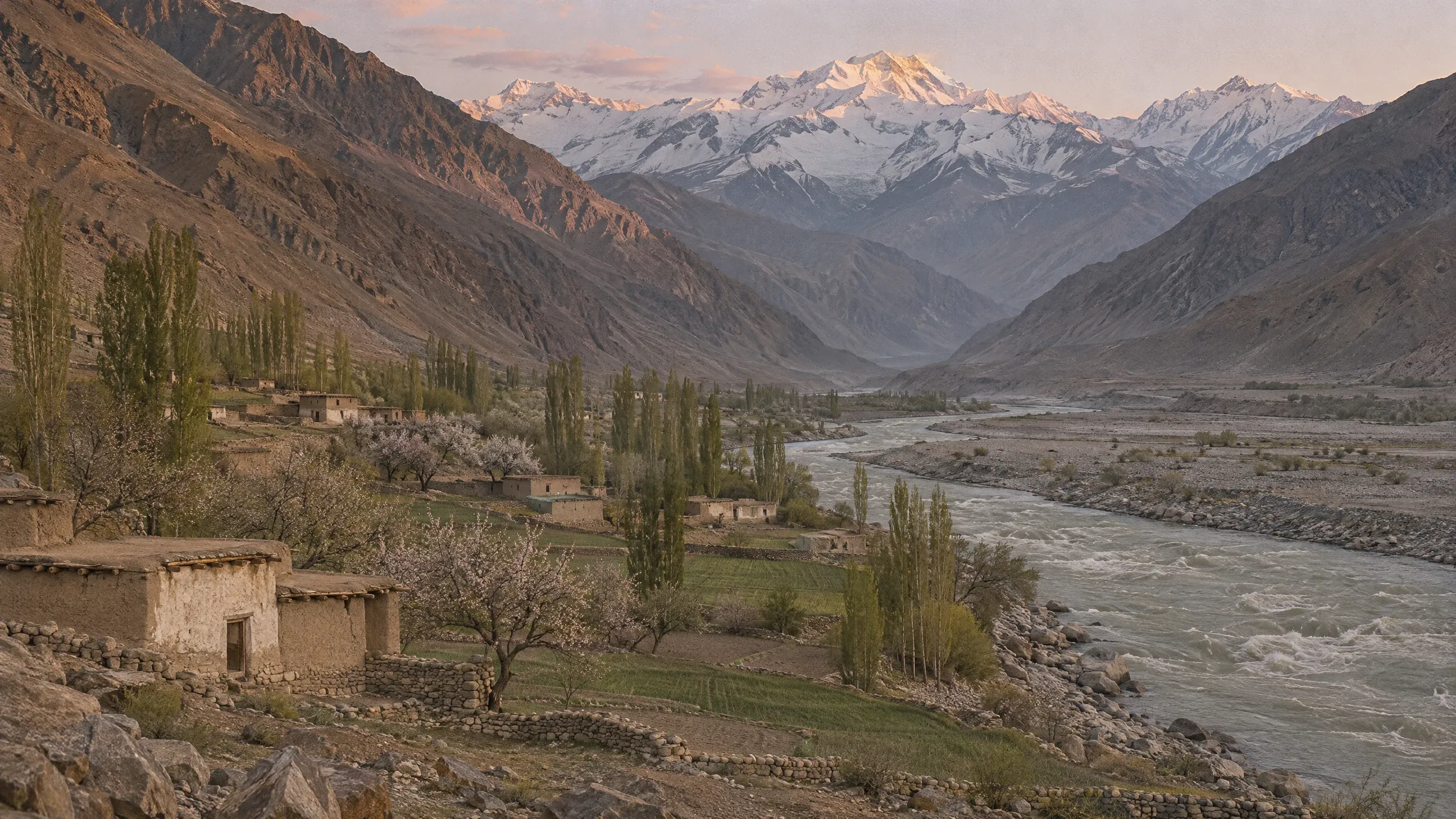
The fourth period of the modern Imamat began on 11 July 1957, when the will of Aga Khan III named his grandson Karim, then a student at Harvard University, as the 49th Imam. Aga Khan IV held the office for 67 years, until his death in Lisbon on 4 February 2025; he was succeeded by his eldest son, Aga Khan V. This chapter follows that period: the migrations of the community from East Africa and South Asia to the West, the Ismaili Constitution, the building of the Aga Khan Development Network, its universities and cultural institutions, the Ismaili Centres, the opening of Central Asia after 1991, and the establishment of the Seat of the Imamat in Lisbon.12
The succession of 1957
Karim was born in Geneva on 13 December 1936, the elder son of Prince Aly Khan and his first wife, Joan Yarde-Buller, daughter of the 3rd Baron Churston. His younger brother is Prince Amyn; his half-sister Princess Yasmin is the daughter of Aly Khan’s later marriage to the actor Rita Hayworth. He spent part of his early childhood in Nairobi, was schooled at the Institut Le Rosey in Switzerland and entered Harvard University, where he was an undergraduate when he became Imam. He completed his degree in 1959, a Bachelor of Arts in Islamic history; Britannica notes that he had intended to continue to a doctorate in history before the Imamat changed his plans.13
He was married twice. In 1969 he married Sarah Frances Croker Poole, who took the name Begum Salimah; they divorced in 1995. Their children are Princess Zahra, Prince Rahim, born in 1971 and later Aga Khan V, and Prince Hussain. His second marriage, to Gabriele Renate Thyssen, who took the name Begum Inaara, produced Prince Aly Muhammad. He was survived by four grandchildren. The AKDN obituary dates the marriage to 1998 and the divorce to 2011; Britannica gives 1995 and 2014. This page follows the AKDN dates and records the discrepancy.14
Aga Khan III died on 11 July 1957 at Versoix, near Geneva.5 His will named his grandson Karim as successor rather than either of his sons, Aly Khan and Sadruddin. Britannica quotes the passage in which the old Imam explained the choice: “In view of the fundamentally altered conditions in the world in very recent years due to the great changes which have taken place including the discovery of atomic science, I am convinced that it is in the best interests of the Shia Muslim Ismaili Community that I should be succeeded by a young man who has been brought up and developed during recent years and in the midst of the new age and who brings a new outlook on life to his office as Imam.” In Ismaili doctrine the designation (nass) of a successor is the prerogative of the reigning Imam from among his male descendants, and the will was the instrument of that designation.26
The Guardian’s obituary of Prince Sadruddin later wrote that “Sadruddin rarely showed his disappointment. He respected Karim; but the two never became very close and, just occasionally, he betrayed his feeling that life had been unjust.”7
Within about a fortnight of the succession, Queen Elizabeth II granted the new Imam the style “His Highness”, as earlier British sovereigns had done for the first three Aga Khans. Britannica quotes his recollection, given to Sports Illustrated in 1964: “Overnight my whole life changed completely. I woke up with serious responsibilities toward millions of other human beings.”89
Sadruddin was passed over in the succession of 1957, when Aga Khan III designated his grandson Karim, rather than either of his sons, as the 49th Imam; see Aga Khan IV and Prince Aly Khan. The Guardian’s obituarist wrote that “the formidable old Aga Khan had apparently felt that Sadruddin would remain a playboy”, and that Sadruddin “rarely showed his disappointment. He respected Karim; but the two never became very close”. This is the assessment of a single obituary and is reported here as such.10
Following practice established under his grandfather, the new Imam was formally installed (in community usage, takht nashini, “ascending the throne”) in a series of ceremonies in the principal centres of the community. Photographs published by the Tanzanian newspaper The Citizen record the formal installation in Dar es Salaam in 1957 and his enthronement in Nairobi on 25 October 1957. Britannica notes that he began visiting his scattered followers in the first year of his Imamat.119
The community he inherited was concentrated in East Africa (Kenya, Uganda, Tanganyika and Zanzibar), the Indian subcontinent (Karachi, Bombay, Hunza), Iran, Afghanistan and Syria, with the Ismailis of Soviet Badakhshan cut off from the Imam by the Soviet border. The background to this distribution is treated in The Twentieth Century, Ismailis of East Africa and Ismailis of Central Asia.1
Decolonisation and the East African migrations
The first two decades of the Imamat coincided with independence across East Africa and with the nationalisation policies that followed. The decisive episode was the order of President Idi Amin, announced in 1972, that people of Asian ancestry leave Uganda within 90 days. Many of those expelled were Ismailis. Canada sent a team of officials to Kampala, and the Vancouver Sun’s retrospective records that the Canadian mission evacuated 4,420 Ugandan refugees on charter flights between late September and November 1972. Prince Sadruddin was then UN High Commissioner for Refugees. The expulsion is treated in Uganda expulsion, 1972.127
The settlement of Ismailis from East Africa and South Asia in Canada, the United Kingdom, the United States and Portugal gave the community its present western diaspora; its institutions are described under The Ismaili Diaspora. Britannica records that the Aga Khan urged his followers to become citizens of the countries in which they lived, a position consistent with the Imamat’s description of itself as having no territorial or political role.913
Ismailis of South Asian origin, overwhelmingly from the Khoja community of Gujarat, Kutch and Kathiawar, had settled in Zanzibar, Mombasa, Dar es Salaam, Nairobi and Kampala from the nineteenth century; their history is treated in Ismailis of East Africa and The Khojas. CBC’s retrospective of 2018 records the testimony of a refugee who described himself as “a fourth generation African”, and the Vancouver Sun describes another as “a third-generation Ugandan citizen”. At independence many Ismailis and Goans in Uganda “had largely opted to become Ugandan rather than hold onto British citizenship”, a choice which in 1972 left them without the British passports that gave other Ugandan Asians a right of entry to Britain.1415
In August 1972 President Idi Amin announced that people of Asian ancestry had ninety days to leave Uganda. CBC states that the order “affected at least 80,000 people, many who had lived in Uganda for generations”, and that “many of them were Ismailis”. The event is treated in detail in The Ugandan Expulsion of 1972.1415
According to CBC, “when Amin’s decree came, the Aga Khan called then prime minister Pierre Trudeau asking him to help”. The Vancouver Sun reports that Trudeau’s government “initially agreed to admit 3,000 asylum seekers” and had to send a team to Kampala, “where Canada had no diplomatic representation”; it soon became clear that “there would be far more than 3,000 people who qualified under the Canadian points system”. The Canadian team evacuated 4,420 refugees on charter flights between late September and November 1972. One of the officials involved later told the newspaper: “We certainly didn’t go looking for Ismailis.” Nevertheless, “most of the Ugandans who settled in Canada were Ismaili”.1415
CBC gives the total number of Ugandan Asians who came to Canada as “more than 7 000” and calls it “the first time in Canadian history that Canada accepted a large group of non-European refugees”. Britain, which received the largest share of those with British passports, resettled many more; the first chartered flights reached Stansted Airport on 18 September 1972.14
Communities in the West
The Ismaili community of Canada grew from these refugees and from later migration. From the 1970s, Ismailis across Canada “established religious, cultural and social centres, mainly in rented accommodation in major cities and towns”. In 1978 Aga Khan IV announced that Burnaby would have the first Ismaili Centre in Canada; it was opened in 1985 by Prime Minister Brian Mulroney. See Vancouver.1617
Addressing both Houses of Parliament on 27 February 2014, Aga Khan IV said that the partnership between the Imamat and Canada “has been immensely strengthened, of course, by the presence for more than four decades of a significant Ismaili community”, and that “our experience in Canada has been a particularly positive chapter”. He described “a quarter century of close collaboration between AKDN and Canada”, including Canadian support for the Aga Khan Rural Support Programme in northern Pakistan and for the Institute for Educational Development of Aga Khan University.18
Imamat institutions in Canada include the Delegation of the Ismaili Imamat in Ottawa (2008), the Global Centre for Pluralism (2006, headquarters 2017), and in Toronto the Aga Khan Museum, the Ismaili Centre and the Aga Khan Park (2014–2015). Aga Khan IV received honorary Canadian citizenship, which he acknowledged in his address of 2014. See Toronto.19202118
The Ismaili community “has lived in the UK for more than 60 years”, according to AKDN’s release of February 2026. The Ismaili Centre at Cromwell Gardens, South Kensington, opened by Margaret Thatcher on 24 April 1985, was “the first high profile religious and cultural centre to be specially designed and built for the Ismaili community in the West”.2223
Britain is also a centre of Imamat institutions. The Aga Khan Foundation (UK) was established in 1973, the Institute of Ismaili Studies in 1977, and the Aga Khan University’s Institute for the Study of Muslim Civilisations in 2002; all are based at the Aga Khan Centre at King’s Cross. AKDN states that since 1973 it “has partnered with UK agencies such as the FCDO and British International Investment” on projects in Africa, South and Central Asia and the Middle East.22
On 4 February 2026, a year after his accession, Aga Khan V was received at 10 Downing Street by Prime Minister Keir Starmer, and signed with the Foreign Secretary, Yvette Cooper, a Memorandum of Understanding between the United Kingdom and the Ismaili Imamat. According to AKDN, it covers “climate change, empowering women and girls, and driving economic growth” and “establishes official representation between the two parties with a joint coordinating committee”. The visit, which included a meeting with the Mayor of London, Sadiq Khan, on 3 February, was made to meet “the Ismaili community from the UK and Ireland”. See London.22
The community in Portugal derives principally from Mozambique. An article by Rita Tavares in the Portuguese newspaper Observador, reproduced in translation by Ismailimail, states that “at the end of the 1970s, the Ismailis who were in Mozambique went to Portugal, on the recommendation of Aga Khan”. The Aga Khan Foundation began working in Portugal in 1983, and the relationship between the Imamat and the Portuguese state was formalised in a series of agreements: a Protocol of Cooperation with the government (2005), a Protocol of International Cooperation with the Ministry of Foreign Affairs (2008), an International Agreement with the Portuguese Republic (2009) and the Agreement of 2015 establishing the Seat of the Ismaili Imamat in Portugal.2425
The Ismaili Centre in Lisbon dates from 1998. In 2025, according to AKDN, the Foundation supported 261 civil-society organisations in Portugal and its early childhood programmes reached around 1,100 children. On 28 March 2023 an attacker killed two women at the Lisbon centre; the then prime minister, Antonio Costa, described it as an isolated act. See Lisbon.2526
The United States community is more recent than those of Canada and Britain. When Aga Khan IV arrived at Fulton County Airport on 13 March 2018 at the start of a ten-day Diamond Jubilee visit, the Atlanta Journal-Constitution noted that his previous visit to Atlanta had been in 2008, for the Golden Jubilee; on 14 March Governor Nathan Deal presented him with a state proclamation. In Atlanta five metropolitan jamatkhanas have organised interfaith blood drives. See Atlanta.2728
The Ismaili Center in Houston was announced in March 2018 and opened in November 2025 (6 November according to The Ismaili; REjournals gives 5 November) during the first visit of Aga Khan V to the country, when he was presented with keys to the cities of Sugar Land and Houston. The Mayor of Houston, John Whitmire, was chief guest. He then visited Dallas, where Mayor Eric L. Johnson presented him with the Key to the City. See Houston.293031
The Constitution and the institutions of the community
Aga Khan III had issued separate constitutions for the Ismailis of different territories. In 1986 Aga Khan IV ordained a single Constitution, which the Ismaili Imamat describes as bringing “for the first time” the social governance of the global community “under a common aegis”. Under it, National, Regional and Local Councils are responsible for social governance; Religious Education Boards (Tariqah boards) provide religious education, research and publication; and Conciliation and Arbitration Boards resolve disputes among members. The Constitution is discussed in The Ismaili Constitution.32
The Imamat’s own statement of the office, quoting the Aga Khan’s 2014 address to the Parliament of Canada, is that “the role of the Ismaili Imam is a spiritual one; his authority is that of religious interpretation. It is not a political role … the Imams do not govern any land.” The same text adds that faith “does not remove Muslims or their Imams from daily, practical matters”.1333
AKDN describes the Ismaili Imamat as “a supranational legal entity” that “refers to the institution or office of the spiritual leader of the global Ismaili community, established in accordance with applicable customary law”. In the same text it states that the office, “founded in 632”, spans “almost 1,400 years of history and 49 uninterrupted successions by direct hereditary lineage”. The Nizari count of fifty Imams and forty-nine successions is treated in The Imamat.34
The succession of February 2025 followed the established procedure of designation (nass) by the reigning Imam. Aga Khan IV died in Lisbon on 4 February 2025; the next day, after the reading of his will in the presence of family members and community leaders, his eldest son was announced as his successor. The Guardian quoted the community’s statement that he had been designated “in accordance with historical Shia Imami Ismaili Muslim tradition and practice”. Since 2018 the Imamat has had a formal seat in Lisbon; see The Seat of the Imamat.3536
Britannica states that in 1986 Aga Khan IV “spearheaded the adoption of a constitution that established an administrative structure for the global diaspora”, and that he “ordered his followers to become citizens of the countries in which they resided and to leave countries where they faced trouble and persecution”. Under the constitution national councils, such as the Ismaili Council for the USA, administer the community’s social affairs in each country. The constitution is treated in The Ismaili Constitution.3738
Religious life centres on the jamatkhana. In the major cities of the West the community also has purpose-built Ismaili Centres: London and Burnaby (1985), Lisbon (1998), Dubai (2008), Dushanbe (2009), Toronto (2014) and Houston (2025). In Canada, FOCUS Humanitarian Assistance was “established in 1994 by the Ismaili community under the guidance of His Highness the Aga Khan” to respond to emergencies and help refugees settle.3938
Alongside the community’s own institutions are the agencies of the Aga Khan Development Network, which AKDN defines as “a contemporary initiative to fulfil the mandate of the Ismaili Imamat through institutional action to improve the quality of human life, irrespective of origin, faith, or gender”. AKDN figures cited in its obituary of Aga Khan IV give some 96,000 employees and about US$1 billion a year in non-profit development activity in more than 30 countries; these are the network’s own figures.3440
No census counts Ismailis worldwide, and published figures are estimates. The Guardian reported in February 2025 that the community’s website “says it numbers 12 to 15 million people”. The BBC gave “about 15 million”, including some 500,000 in Pakistan. Britannica refers to “approximately 15 million Isma’ilis worldwide”. The Atlanta Journal-Constitution, reporting the Diamond Jubilee visit of 2018, used a higher figure of “approximately 20 million”. These figures are not independently verified and are given here as reported.35363741
Building the Aga Khan Development Network
The network’s institutions descend from the schools, clinics, hospitals and cooperative and insurance societies founded by the Ismaili community under Aga Khan III, particularly in East Africa and South Asia (see Ismailis of East Africa). The AKDN obituary of Aga Khan IV states that he “inherited and enhanced schools that his grandfather … established in Asia and Africa”, and that he “founded what is today known as the Aga Khan Development Network more than 50 years ago”. The Guardian gives 1967 as the founding date of the group.4243
The name “Aga Khan Development Network” came into general use later than the agencies themselves, as a collective description of separately constituted bodies. Britannica describes the AKDN as “an umbrella organization for nine subsidiary organizations”.4445
AKDN states that it “works primarily through agencies that are registered in Switzerland as non-profit institutions”. Two are constituted differently. Aga Khan University “is chartered by the Government of Pakistan as an international university with the authority to operate programmes, branches and campuses anywhere in the world”. The University of Central Asia “is a self-governing regional university whose Charter was established pursuant to an international treaty between Tajikistan, Kazakhstan, the Kyrgyz Republic and the Ismaili Imamat”.46
The Aga Khan Fund for Economic Development (AKFED) “is incorporated as a for-profit development agency under Swiss law”, while “its project companies operate as commercial entities under the laws of the countries in which they are resident”. It is described as “the only development agency in the AKDN that works on a commercial basis”; its surpluses “are reinvested in further development initiatives, including contributions to social and cultural projects”.46
AKDN lists nine agencies:45
The network’s own published figures, as given in the AKDN obituary of February 2025, are: two universities, more than 200 schools and more than 700 health facilities; electricity generated annually for 10 million people; health care for 5 million; education for 2 million students; and 5 million visitors a year at its parks and gardens. The same text gives “an annual budget of approximately US$1 billion for its non-profit activities” and some 96,000 employees, “the vast majority of whom are Asians and Africans living and working in their home countries or regions”. These are institutional figures and are not independently audited in the sources consulted; the Guardian, writing on the same day, gave a staff figure of 80,000 and the same budget.4743
The obituary also counts, within the schools, a portfolio of 200 schools serving “more than 85,000 students”, and lists the commercial sectors of AKFED as “commercial banking, insurance, telecommunications, energy, tourism and media”.4247
The network describes its approach as long-term and integrated: “we embed physical and social infrastructure, health and education services, business and finance facilities, environmental planning and more within the communities where we work, in partnership with governments, businesses, civil society organisations and the communities themselves”. It states that its work “is underpinned by the ethical principles of Islam, emphasising self-reliance and human dignity”, and that all programmes “promote peaceful pluralism, aim for gender equality and respect the environment”.45
The AKDN obituary describes the founder’s instruction that the agencies “work closely with national and local governments on a politically neutral basis”. Before his accession, Prince Rahim chaired the network’s Environment and Climate Committee, reflecting the weight given to climate in the network’s later programmes.4748
Universities
The university grew out of a hospital project. AKDN’s account of Aga Khan IV’s educational work places AKU within a wider programme that began with the schools “his grandfather … established in Asia and Africa”, and records that he “established the Aga Khan University in 1983 as Pakistan’s first private, internationally chartered university, which is home to leading medical, nursing and education faculties and programmes”.49
The charter granted by the Government of Pakistan is the legal basis for the university’s international reach. AKDN describes AKU as “chartered by the Government of Pakistan as an international university with the authority to operate programmes, branches and campuses anywhere in the world”. When the Kampala campus opened in 2025 the university called it “a fulfilment of the charter granted by the Pakistan government, which designated the AKU as an international university”.5051
The university’s presence in East Africa built on institutions that predated it. In his address on receiving the university’s Kenyan charter, Aga Khan IV recalled “the founding of enduring institutions such as Jubilee Insurance, the Aga Khan Hospital in Nairobi – now the Aga Khan University Hospital – and the Nation Media Group”. He stated that AKU had been operating in Kenya “since 2002, under a letter of interim authority from the Government”, and that “while its Charter is new, AKU is a firmly established institution in Kenya”. See Nairobi and Ismailis of East Africa.52
The Kenyan charter was presented on 11 June 2021. In accepting it, Aga Khan IV said that “the Charter details AKU’s functions, powers, obligations, and governance”, and announced that the university, “newly housed in a dynamic urban campus”, would “launch new programmes in nursing and medicine”, together with a Nairobi-based Brain and Mind Institute for research on mental health “especially among women, adolescents, and disadvantaged populations”.52
In Uganda, AKU has had a presence “since 2000”, and The Ismaili reported that its nursing programmes had “graduated more than 1,500 Ugandan nurses through its earlier degree and diploma programmes” before the new campus opened.5153
In September 2025 Aga Khan V, as chancellor, and President Yoweri Museveni of Uganda inaugurated the first phase of AKU’s Kampala campus at Nakawa, on a 60-acre site. Princess Zahra and Janet Museveni, the First Lady, attended. Dawn, quoting the university, described it as the first “full-scale campus expansion outside of Pakistan” since 1983. The Ismaili reported that “at full capacity, the campus will host 100 faculty and 700 students”, beginning with a four-year Bachelor of Nursing Science programme, and that “the Nakawa campus is among the most significant investments that AKU has made anywhere in its history.” The same ceremony included the conferral on Aga Khan V of the Order of the Pearl of Africa. See Kampala.5153
Aga Khan V linked the campus to his father’s intentions: “This investment in AKU’s new academic and student housing facilities, together with its hospital, embody the belief of our late father, which I share, that Ugandans deserve the very best access to international quality higher education and health care.” A 101-bed teaching hospital was under construction on the site.53
Education was described by AKDN as among Aga Khan IV’s “most important priorities”. Aga Khan University was founded in 1983 as “Pakistan’s first private, internationally chartered university” and by 2025 operated in six countries. In September 2025 it opened the first phase of its Kampala campus, described by the university as its first “full-scale campus expansion outside of Pakistan”. See Aga Khan University.4254
The University of Central Asia was created in 2000 to serve “high mountain societies”. Its first campus opened at Naryn in the Kyrgyz Republic on 19 October 2016, on a 252-hectare site given by the Kyrgyz government; the first intake of 71 undergraduates was nearly 40 per cent women. A campus at Khorog in Tajikistan followed, and a third was planned at Tekeli in Kazakhstan. See Khorog and Ismailis of Central Asia.55
Architecture and the arts
Tajddin’s Encyclopaedia of Ismailism attributes the Award’s foundation to the Imam’s experience of building: “It was the Imam’s own involvement in construction in developing countries during the 1960s and 1970s that evoked his concern with the deteriorating architectural heritage and inappropriate building practices in many Muslim societies.” The Award was founded in 1977 “to sensitize those who build in the developing world to the unique heritage of Muslim history and architecture.” The AKDN obituary of Aga Khan IV lists it among his principal cultural initiatives, alongside the Historic Cities Programme and the Aga Khan Museum.5657
The Award’s published criteria emphasise “architecture that not only provides for people’s physical, social and economic needs, but that also stimulates and responds to their cultural expectations.” Particular attention is given to “building schemes that use local resources and appropriate technology in innovative ways”.58
The sixteenth cycle (2023–2025) produced seven winners, sharing US$1 million. In AKDN’s descriptions they were:59
These were the first winners announced after the death of Aga Khan IV in February 2025.5957
The museum’s core holdings derive from collections formed by the family of the Imams. In an interview published at the opening, Aga Khan IV, speaking with his brother Prince Amyn, “said the genesis of the family’s collection starts with their grandfather and uncle, both of whom were voracious collectors”: Aga Khan III and Prince Sadruddin Aga Khan. The same report records that the Harvard art historian Stuart Cary Welch encouraged the family “to focus on Islamic art during the 1950s and 1960s”, and that Prince Sadruddin filled his Geneva house, Bellerive, with Islamic ceramics; the museum imported some of his red display cabinets.60
Aga Khan IV began buying “a few artworks after his grandfather died in 1957”; by the 1990s he had narrowed his collecting “to Islamic art, particularly Indian miniature paintings that highlighted the architecture and gardens of the Mughal era”. The report gives the death of Prince Sadruddin in 2003 as a turning point, after which the family had to decide the future of his estate. He attributed his interest partly to finding, as a Harvard student in the mid-1950s, that his classmates knew little of Islamic art or culture.60
The 2014 report states that the museum’s parameters “ruled out Paris and London, which have encyclopedic museums containing prized Islamic collections”. Aga Khan IV linked the choice of Toronto to the history of the Ismaili community in Canada, which “played a key role in accepting thousands of Nizari Ismailis who were living in Uganda” in 1972, and said that Canada was home to some 100,000 Ismailis. See The Ismaili Diaspora and The Expulsion from Uganda, 1972.60
The Wynford Drive project had a longer history. At the inauguration of the park in 2015 Aga Khan IV said that “the building process here on Wynford Drive began five years ago”, but that the project “actually began much earlier – back in 1996 – when we first started planning for a new Ismaili Centre in Toronto”.61
The museum announced on 18 August 2014 that it would “open its doors to the public on Thursday, 18 September”, with “a collection of over 1 000 objects, representing more than ten centuries of human history and a geographic area stretching from the Iberian coast to China”, complemented by “a vibrant performing arts programme”. Its first temporary exhibitions were In Search of the Artist and The Garden of Ideas, which, according to the director Henry Kim, explored “past and present artists – how they were trained, what ideas motivated them, how they expressed individuality within highly structured art forms”. Anyone who bought a membership by 31 December 2014 was recognised as a Founding Member.62
The Ismaili Centres
At the foundation-stone ceremony of the London centre in 1979 Aga Khan IV said: “It is my conviction that the building of this Centre is symbolic of a growing understanding of Islam.” At the opening of the Dubai centre in 2008 he described it as “a place for peaceful contemplation”, which “is not a place to hide from the world, but rather a place which inspires us to engage our worldly work as a direct extension of our faith”. He traced the symbolism of these buildings to “the Fatimid tradition – going back to over 1,000 years – and widely shared with sister traditions throughout the Islamic world, from Baghdad to Bokhara”.6364
The centres were conceived as representative buildings. An Ismaili retrospective of 2010 records that “by 1997, more than 12 years after the formal opening, the full implication of Mawlana Hazar Imam’s vision for such high profile [Ismaili Centres] was becoming clearer to the international leadership”. Before them, Ismailis in Canada, for example, had from the 1970s “established religious, cultural and social centres, mainly in rented accommodation in major cities and towns”.6365
The Ismaili Centre at Cromwell Gardens in South Kensington was “the first high profile religious and cultural centre to be specially designed and built for the Ismaili community in the West”. Its foundation stone was laid in 1979, and it was opened on 24 April 1985 by Prime Minister Margaret Thatcher in the presence of Aga Khan IV. The architect was Neville Conder of the Casson Conder Partnership, “with traditional elements of the Islamic interior designed by Karl Schlamminger, a German-born Muslim”. The building “was widely acclaimed by architectural critics for its design and craftsmanship”.6366
The London centre hosted the gathering of the community’s international leadership with Aga Khan IV in 1997 on the fortieth anniversary of his accession, and since 2000 it has taken part annually in London’s Open House. See London.63
The Ismaili Centre in Burnaby, British Columbia, was the first in Canada. During his visit to Vancouver in 1978 Aga Khan IV “announced to the Jamati leadership that Burnaby would be home to the first Ismaili Centre in Canada”. The building was designed by the Vancouver architect Bruno Freschi to a brief requiring “a synthesis of Islamic architecture and contemporary building design”. It was opened on 23 August 1985 by Prime Minister Brian Mulroney, in the presence of Aga Khan IV and the Premier of British Columbia, Bill Bennett. Freschi later said: “I was inspired by the opportunity to work on a significant spiritual architectural space, and one from such a long and profound tradition in spiritual architecture.” See Vancouver.6765
The Ismaili Centre in Lisbon, the third, was designed by the Indian architect Raj Rewal with the Portuguese architect Frederico Valsassina. The Ismaili’s account of the design states that Rewal, “himself from a non-Muslim tradition”, drew on “Persian garden designs, from the Alhambra, the Mughal splendour of Fatehpur Sikri and the Monastery of Jeronimos in Lisbon itself”, and that the complex is “a geometric fusion of gardens and courtyards as well as buildings embodying in hewn stone surfaces, polished tile and delicately balanced cupolas”. It is the centre at which the attack of 28 March 2023 took place. See Lisbon and The Seat of the Imamat.6869
The Ismaili dates its opening ceremony to 11 July 1998, when Aga Khan IV and President Jorge Sampaio opened it;70 the AKDN release of December 2003 already lists Lisbon among the “existing major centres” with London and Vancouver.71
On 13 December 2003 Aga Khan IV announced “the first Ismaili Centre to be built in the Middle East”, at a foundation ceremony in Dubai attended by Sheikh Ahmed bin Saeed Al Maktoum, representing Sheikh Mohammed bin Rashid Al Maktoum. The release stated that it would be “comparable in scope and standing to existing major centres in London, Vancouver and Lisbon, the one underway in Dushanbe and the one in advanced planning stages in Toronto”.71
The centre was opened in March 2008, during the Golden Jubilee of Aga Khan IV. Gulf News reported that it was “built on land donated by” Sheikh Mohammed bin Rashid Al Maktoum, Vice President and Prime Minister of the UAE and Ruler of Dubai, and that the Aga Khan Trust for Culture had laid out an adjoining 3,000-square-metre park, “conceived as a neighbourhood garden based upon the concept of Islamic gardens”, as a gift to Dubai residents. It was then “the fourth Ismaili Centre in the world”.64
The Ismaili Centre, Toronto, “was opened by Prime Minister Stephen Harper on 12 September 2014 in the presence of Mawlana Hazar Imam”. It was designed by the Indian architect Charles Correa and stands in a 6.8-hectare park by Vladimir Djurovic, shared with the Aga Khan Museum by Fumihiko Maki; the two buildings “were opened on the same day in separate ceremonies”. Aga Khan IV said in 2015 that planning for “a new Ismaili Centre in Toronto” had begun in 1996. In March 2026 the centre was the venue at which the Mayor of Toronto presented the Key to the City to Aga Khan V. See Toronto.727374
“In March 2018, an announcement was made to confirm the intention to establish an Ismaili Center in Houston. A year later, Farshid Moussavi and Thomas Woltz were selected as the building and landscape architects respectively.” Its design “combines modern architectural technology with traditional Persian forms and ornament, including ceramic mosaics and mashrabiya screens”. Work continued after the death of Aga Khan IV in February 2025, and the centre was opened in November 2025 (The Ismaili describes the opening on 6 November; REjournals dates the formal inauguration to 5 November) during the first visit of Aga Khan V to the United States, with the Mayor of Houston, John Whitmire, as chief guest. See Houston.757631
Pluralism and the Global Centre
The Ottawa Citizen reported in 2017 that “the idea for this centre dates back to the 1990s when the Aga Khan began asking Canadian leaders to explain the success of Canada’s approach to diversity”. The 2006 funding agreement described itself as “the culmination of a long-standing dialogue initiated in 2002”. Aga Khan IV’s personal connection with Canada dated from 1972, when Prime Minister Pierre Trudeau admitted Ismailis expelled from Uganda; Justin Trudeau later described the Aga Khan as a family friend from that period.777879
On 18 April 2005 the Government of Canada announced its “intellectual, institutional and financial contribution to become a partner in the new Global Centre for Pluralism in cooperation with the Aga Khan Development Network”, and Aga Khan IV welcomed the announcement in Ottawa. The government stated that it would contribute CAD 30 million; the initial investment by the AKDN was given as CAD 40 million. The release defined the mission as promoting “pluralist values and practices in culturally diverse societies worldwide to ensure that every individual has the opportunity to realize his or her full potential as a citizen, irrespective of cultural, ethnic or religious differences”.80
The release also tied the project to Canadian foreign policy, describing its mission as “consistent with several key Canadian international policy objectives, among them the promotion of democracy and good governance, a more equitable sharing of the world’s resources between developed and developing countries, and the projection of Canadian values”. Aga Khan IV’s statement included the sentence: “Pluralism is no longer simply an asset or a prerequisite for progress and development, it is vital to our existence.”80
The headquarters was opened on Tuesday 16 May 2017. The Governor General, David Johnston, presided at the ribbon-cutting, joined by his predecessor Adrienne Clarkson and the former United Nations secretary-general Kofi Annan, both members of the centre’s board. The CBC described the centre as “part think tank, part advocacy group” and reported that the opening took place amid controversy over Prime Minister Justin Trudeau’s holiday on the Aga Khan’s island in the Bahamas; the centre’s secretary general, John McNee, said: “That’s not a matter for the Global Centre for Pluralism.” McNee added that “Liberal and Conservative prime ministers have all readily responded to the Aga Khan’s interest in promoting pluralism in the world, drawing on Canada’s experience.”79
The centre gives institutional form to a theme that recurs in Aga Khan IV’s speeches. In his address to both Houses of the Parliament of Canada on 27 February 2014 he called it “a joint project of the Imamat and the Canadian government” and said that “sharing Canada’s robust pluralistic history is a core mission of our Global Centre”. He recalled that at the establishment of the Delegation in 2008 the Prime Minister had described their collaboration as making Canada “the headquarters of the global effort to foster peace, prosperity” and pluralism. For the period after February 2025 see Aga Khan V.81
Central Asia after 1991
The Ismailis of the Pamirs, in the Gorno-Badakhshan Autonomous Region of Tajikistan and in Afghan Badakhshan, are an indigenous community, treated with the poet and missionary Nasir Khusraw in the earlier chapters. After the dissolution of the Soviet Union in 1991 and during the Tajik civil war, AKDN began large-scale work in the region; it states that it “committed over $1 billion between 1995 and 2018” in Tajikistan and works “with over half a million beneficiaries a year”. It has redeveloped Khorog Park, which “receives over 55,000 visitors annually”, and sponsors a town-planning initiative in Khorog. The Ismaili Centre in Dushanbe was opened on 12 October 2009.8283
The University of Central Asia was established in 2000 by an international treaty between the governments of Tajikistan, the Kyrgyz Republic and Kazakhstan and Aga Khan IV, as a “secular, internationally chartered, not-for-profit University”, with campuses in Naryn, Khorog and Tekeli. See Ismailis of Central Asia.4084
In Afghanistan, AKDN “began working in Afghanistan in 1996, distributing food aid during the civil war”, and states that “since 2002, we and our partners have committed over $1 billion in development assistance to the country”. In 2025, according to AKDN, its projects “served over four million people across 20 provinces”, and its cultural programmes in Kabul, Herat, Balkh and Badakhshan “have restored over 90 historic buildings”.85
AKDN began large-scale work in Tajikistan after the dissolution of the Soviet Union in 1991. It states that it has “committed over $1 billion between 1995 and 2018” in the country, that it covers “all regions of the country” and that it employs “over 3,500 people in health care, education, business” and other fields. A reception at the Ismaili Centre on Imamat Day, 11 July, marked “the 15th anniversary of the signing of an Agreement of Cooperation between the Government of Tajikistan and the AKDN”. See AKDN.868788
The network’s agencies in the country include the First Microfinance Bank Tajikistan, established by AKDN for clients “many of whom live in remote areas and are dependent on remittances”, and Pamir Energy, which “provides energy for about 99 percent of the population of Gorno-Badakhshan”. AKDN states that the Aga Khan Foundation “has supported 326,000 farmers”, that community organisations it established “connect over 1.4 million constituents”, and that the Aga Khan Agency for Habitat “has helped over 465,000 people mitigate the impact of natural disasters” and “responded to over 200 emergencies”.87
The University of Central Asia, founded in 2000 by a treaty between Kazakhstan, the Kyrgyz Republic, Tajikistan and Aga Khan IV, is described by AKDN as a “secular, internationally chartered, not-for-profit University”. Its first campus opened at Naryn, Kyrgyz Republic, on 19 October 2016, on a 252-hectare site given by the Kyrgyz government; its Tajik campus is at Khorog. See Aga Khan University for the Imamat’s other university.8986
The Ismaili reported that President Rahmon and Aga Khan IV “toured the facility prior to the Opening Ceremony”. Aga Khan IV called the Centre “a place … for peaceful contemplation of the spirit”, which “will have a space for congregational gathering, just like the array of Ismaili Centres in major cities across the world … from London to Vancouver and Lisbon to Dubai”, and hoped that “people of all faiths and background will gather here for educational and cultural events”. Princess Zahra, Prince Hussain and Princess Khaliya attended. See also London, Vancouver and Lisbon.9091
Lisbon and the Seat of the Imamat
In June 2015 the Ismaili Imamat and the Republic of Portugal signed the Agreement for the establishment of the Seat. The Ismaili characterises it as “a pioneering gesture that underlines the values of tolerance, cooperation, and mutual respect”, which “provides an enabling framework that will facilitate the global work of the Ismaili Imamat and marks the first such accord in the Imamat’s modern history”. The Agreement followed an invitation from the Portuguese government; at the designation ceremony Aga Khan IV said, “I am grateful for the government of Portugal for inviting me to establish the Seat within its territory.”92
The text of the Agreement is a matter of Portuguese law; the Ismaili’s summary describes its effect in general terms, as a framework for the Imamat’s international work, and does not set out its articles. This page therefore records the Agreement’s existence, date and purpose as stated by the parties and does not characterise its legal provisions further.92
The Diamond Jubilee of Aga Khan IV, which marked sixty years since his accession on 11 July 1957, closed in Lisbon in July 2018. Tens of thousands of Ismailis travelled to the city; Aga Khan IV arrived on 6 July. On 10 July he addressed the Assembly of the Republic, calling the Seat a “committed global institution” and stating that “Lisbon, already a leading international crossroads city, will also now serve as a central connecting point for the global Ismaili community.” He described the decision as “taken after much reflection and consultation” and as “a true milestone moment in the long history of the Imamat”.939294
On the following day, 11 July 2018, the anniversary of his accession, he formally designated the premises at Rua Marquês de Fronteira as the Seat. The President of the Assembly of the Republic, Eduardo Ferro Rodrigues, had called the occasion “the high point, even a historic point of projection of the Ismaili community and Portugal”. The occasion was also marked by the launch of the Imamat’s official website, ismaili.imamat, and by the presentation of a gift from the community: a coloured aquatint of the Qajar ruler Fath Ali Shah enthroned, one of a series of reduced copies of wall paintings of 1812–13. The gift recalled that it was Fath Ali Shah who first conferred the title Aga Khan; see The Aga Khan Title.9295
On 28 March 2023 a man armed with a large knife attacked people at the Ismaili Centre, Lisbon, on Avenida Lusíada, killing two Portuguese women who worked in the centre’s refugee support programme. Police shot and detained the suspect, an Afghan refugee who had been receiving help at the centre. Prime Minister António Costa said that it appeared to be “an isolated act”. The Ismaili Centre is a separate building from the Seat.96
The death of Aga Khan IV and the accession of Aga Khan V
Aga Khan IV died in Lisbon on 4 February 2025, aged 88. On 5 February his will was opened in Lisbon in the presence of family members and community leaders, and his eldest son, Prince Rahim, was announced as the 50th Imam, Aga Khan V. On 10 February 2025 King Charles III granted the new Aga Khan the style “His Highness”.978
After a funeral in Lisbon his body was taken to Aswan in Egypt. On 9 February 2025 Aga Khan V led the funeral procession through the city with the Governor of Aswan; the casket was carried across the Nile to the mausoleum of Aga Khan III, where he was buried. The full account of the succession appears in The Present.9711
Aga Khan IV died in Lisbon on 4 February 2025, aged 88. On 5 February his will was unsealed and read in Lisbon “in the presence of the Imam’s family and senior Jamati leaders”, and Prince Rahim was declared the 50th Imam. The Ismaili announcement states the doctrinal position of the community: “The Nur of Imamat, in unbroken hereditary succession from Hazrat Mawlana Ali (peace be upon him), is vested in our 50th Imam”. The concept is explained in The Imamat.9899
The succession passed from father to eldest son, unlike the designation of 1957, in which Aga Khan III had passed over his own sons in favour of a grandson. Press reports at the time noted that he was 53 years old and that he had long held senior roles in the family’s institutions.10099
On 10 February 2025 the Royal Household announced that King Charles III had granted him the style “His Highness”. The announcement noted that the same title had been granted to his father by Queen Elizabeth II in 1957, about a fortnight after his succession, and that the previous Aga Khans had received comparable recognition from British sovereigns.101
After a funeral in Lisbon, Aga Khan V accompanied his father’s body to Egypt. On 9 February 2025 he led the funeral procession through Aswan with the Governor of Aswan; the casket was taken across the Nile and carried by hand to the mausoleum of Aga Khan III, where Aga Khan IV was buried.102
In March 2025 President William Ruto of Kenya conferred on him the Chief of the Order of the Golden Heart of Kenya, the country’s highest order; Princess Zahra received the second class, Elder of the Order of the Golden Heart, at the same time. The gazette notice conferred the awards “in recognition of distinguished and outstanding services rendered to the nation in various capacities and responsibilities”; press reports described them as recognising “distinguished contributions to the nation through the Aga Khan Development Network”.103
In September 2025 he presided, with President Yoweri Museveni, over the inauguration of the first phase of the Aga Khan University campus at Nakawa in Kampala, which AKU described as its first “full-scale campus expansion outside of Pakistan” since 1983. He spoke as Chancellor of the university; Princess Zahra attended as Pro-Chancellor. The 60-acre campus has a seven-storey University Centre, student housing for 164 students and the Nakawa Specialty Medical Centre; construction of the 101-bed Aga Khan University Hospital, Kampala, began on the same day. Museveni conferred on him the Most Excellent Order of the Pearl of Africa, Uganda’s highest civil award.104105
At the ceremony he linked the project to his father’s intentions: the investment, he said, embodied “the belief of our late father, which I share, that Ugandans deserve the very best access to international quality higher education and health care”.105
In November 2025 Aga Khan V made his first visit as Imam to the United States. He arrived in Sugar Land, Texas, and received the keys to Sugar Land and Houston. On 6 November 2025, by The Ismaili’s account (REjournals gives 5 November), he presided over the opening of the Ismaili Center Houston, the first Ismaili Centre in the United States, with Mayor John Whitmire of Houston as chief guest. The building, begun under his father, is described under Houston and Ismaili Centres.10631
On 9 November he left Houston for Dallas, where Mayor Eric L. Johnson presented him with the Key to the City of Dallas; The Ismaili’s report also records honours from neighbouring cities, including Carrollton and Euless.107
On 30 March 2026 Mayor Olivia Chow presented him with the Key to the City of Toronto at the Ismaili Centre, Toronto, during the inauguration of Generations Toronto, an affordable housing and long-term care development built by the Ismaili community with support from all levels of government; the city’s own contribution was C$17.5 million in incentives. The city described the Key as “Toronto’s highest honour granted by the Mayor to an individual or a group”.108
In March 2026 Prime Minister Mark Carney and the Aga Khan issued a Joint Declaration on the importance of partnerships in housing. On 25 July 2026 in Vancouver the Minister of Foreign Affairs, Anita Anand, joined the Aga Khan to announce a memorandum of understanding between the federal agency Build Canada Homes and the Ismaili Council for Canada, aimed at delivering over 1,250 rental homes, including affordable units, in British Columbia, Alberta, Ontario and Quebec through the “Generations” model of multi-generational housing; the release states that the initial tranche “is intended to dedicate at least 30 per cent of units to low- and moderate-income affordability levels, subject to project-specific approvals and funding availability”. The Ismaili’s report of the event, held under the title “Building Together”, records a second memorandum, between FinDev Canada and the Aga Khan Fund for Economic Development, on investment across South Asia and sub-Saharan Africa; the signing of architectural renderings for Generations Burnaby, Generations Tri-Cities and a multi-purpose centre at Burnaby Lake; and the presence of the Premier of British Columbia, David Eby. In his address Aga Khan V said: “As Ismaili Muslims, our understanding of Islam is that faith should find expression in efforts to improve the quality of human life, and that self-reliance and service should reinforce one another.” See Vancouver.109110
Footnotes
-
Aga Khan Development Network, “His Highness Prince Karim Aga Khan IV, 1936–2025” (AKDN, February 2025), sections “Early life & family”, “The Aga Khan Development Network”, “Engagement in education”, “Patron of the arts”, “Sporting pursuits”, “Titles and honours”, https://the.akdn/en/resources-media/whats-new/spotlights/his-highness-prince-karim-aga-khan-iv-19362025. ↩ ↩2 ↩3 ↩4
-
Encyclopaedia Britannica, “Aga Khan IV” (2025), section “Background and early life” (quoting the will of Aga Khan III), https://www.britannica.com/biography/Aga-Khan-IV. ↩ ↩2
-
Encyclopaedia Britannica, “Aga Khan IV” (2025), opening summary and section “Background and early life”, https://www.britannica.com/biography/Aga-Khan-IV. ↩
-
Encyclopaedia Britannica, “Aga Khan IV” (2025), final paragraphs of section “Career as imam”, https://www.britannica.com/biography/Aga-Khan-IV. ↩
-
Encyclopaedia Britannica, “Aga Khan III”, opening summary, https://www.britannica.com/biography/Aga-Khan-III. ↩
-
Ismaili Imamat, “The Ismaili Imamat” (official website), opening section on succession, https://ismaili.imamat/. ↩
-
Hella Pick, “Prince Sadruddin Aga Khan” (obituary), The Guardian, 15 May 2003, https://www.theguardian.com/news/2003/may/15/guardianobituaries1. ↩ ↩2
-
The Royal Household, “The King is pleased to grant the new Aga Khan the title His Highness”, 10 February 2025, https://www.royal.uk/news-and-activity/2025-02-10/the-king-is-pleased-to-grant-the-new-aga-khan-the-title-his-highness. ↩ ↩2
-
Encyclopaedia Britannica, “Aga Khan IV” (2025), section “Career as imam”, https://www.britannica.com/biography/Aga-Khan-IV. ↩ ↩2 ↩3
-
Hella Pick, “Prince Sadruddin Aga Khan” (obituary), The Guardian, 15 May 2003, https://www.theguardian.com/news/2003/may/15/guardianobituaries1. ↩
-
“In Memoriam: His Highness the Aga Khan IV” (photo essay, captions on the 1957 installation), The Citizen (Dar es Salaam), February 2025, https://www.thecitizen.co.tz/tanzania/photos/in-memoriam-his-highness-the-aga-khan-iv-4930174. ↩ ↩2
-
“We did it the Canadian way”, Vancouver Sun (series on the Ismaili community in British Columbia), https://vancouversun.com/news/ismaili%20anniversary/we-did-it-the-canadian-way. ↩
-
Ismaili Imamat, “The Ismaili Imamat” (official website), introductory statement, https://ismaili.imamat/. ↩ ↩2
-
CBC Radio, “1972 Ugandan Refugees: An Honourable Place in Canada”, Rewind, 5 January 2018, https://www.cbc.ca/radio/rewind/1972-ugandan-refugees-an-honourable-place-in-canada-1.4475567. ↩ ↩2 ↩3 ↩4
-
“We did it the Canadian way”, Vancouver Sun, 2012 (anniversary feature on the Ugandan Asian refugees), https://vancouversun.com/news/ismaili%20anniversary/we-did-it-the-canadian-way. ↩ ↩2 ↩3
-
The Ismaili, “Ismaili Centre, Vancouver” (Ismaili Centres section), https://the.ismaili/ismailicentres/vancouver; and The Ismaili, “Reflecting on 25 years of the Ismaili Centre, Burnaby”, 2010, https://the.ismaili/us/en/news/reflecting-25-years-burnaby. ↩
-
The Ismaili, “Reflecting on 25 years of the Ismaili Centre, Burnaby”, 2010, https://the.ismaili/us/en/news/reflecting-25-years-burnaby. ↩
-
Aga Khan IV, address to both Houses of the Parliament of Canada, Ottawa, 27 February 2014, https://the.akdn/en/resources-media/resources/speeches/address-both-houses-parliament-canada-house-commons-chamber-his-highness-the-aga-khan. ↩ ↩2
-
Global Centre for Pluralism, “Who we are”, https://www.pluralism.ca/who-we-are/. ↩
-
The Ismaili (theismaili.org), “Opening of the Ismaili Centre, Toronto”, September 2014, archived 5 February 2016, https://web.archive.org/web/20160205115414/http://theismaili.org/ismailicentres/toronto/opening-toronto. ↩
-
Aga Khan Development Network, “His Highness Prince Karim Aga Khan IV (1936–2025)”, https://the.akdn/en/resources-media/whats-new/spotlights/his-highness-prince-karim-aga-khan-iv-19362025. ↩
-
Aga Khan Development Network, “His Highness the Aga Khan meets UK Prime Minister, signs partnership agreement with UK”, news release, London, 5 February 2026, https://the.akdn/en/resources-media/whats-new/news-release/his-highness-the-aga-khan-meets-uk-prime-minister-signs-partnership-agreement-with-uk-2026. ↩ ↩2 ↩3
-
The Ismaili, “Looking back on 25 years of the Ismaili Centre, London”, 2010, archived, https://web.archive.org/web/2015/http://www.theismaili.org/cms/989/Looking-back-on-25-years-of-the-Ismaili-Centre-London. ↩
-
Rita Tavares, “Ismailis: a fe que chegou a Portugal via Mocambique”, Observador, in English translation as “Ismailism: The faith which came to Portugal via Mozambique”, Ismailimail, 31 July 2018, https://ismailimail.blog/2018/07/31/ismailism-the-faith-which-came-to-portugal-via-mozambique-story-of-malik-and-shehnaz/. ↩
-
Aga Khan Development Network, “Portugal” (Where we work), https://the.akdn/en/where-we-work/europe/portugal. ↩ ↩2
-
“Lisbon stabbing: Two women killed at Ismaili Muslim centre”, BBC News, 28 March 2023, https://www.bbc.com/news/world-europe-65097098. ↩
-
“Aga Khan arrives in Atlanta for historic Diamond Jubilee visit”, Atlanta Journal-Constitution, 13–14 March 2018, https://www.ajc.com/news/local/aga-khan-spiritual-leader-shia-ismaili-muslims-arrives-atlanta-for-historic-visit/uDQPG0oLjhyYOaXUADNjcL/. ↩
-
The Ismaili, “Interfaith blood drives at five metro Atlanta jamatkhanas may save 780 lives”, https://the.ismaili/us/en/news/interfaith-blood-drives-five-metro-atlanta-jamatkhanas-may-save-780-lives. ↩
-
The Ismaili, “Mawlana Hazar Imam arrives in the United States”, November 2025, https://the.ismaili/us/en/news/mawlana-hazar-imam-arrives-in-the-united-states. ↩
-
The Ismaili, “Mawlana Hazar Imam honoured upon arrival in Dallas”, 10 November 2025, https://the.ismaili/us/en/news/mawlana-hazar-imam-honoured-upon-arrival-in-dallas. ↩
-
“The Ismaili Center, a first of its kind in the United States, opens in Houston”, REjournals, November 2025, https://rejournals.com/the-ismaili-center-a-first-of-its-kind-in-the-united-states-opens-in-houston/. ↩ ↩2 ↩3
-
Ismaili Imamat, “The Ismaili Imamat” (official website), section on the Ismaili Constitution and social governance, https://ismaili.imamat/. ↩
-
Aga Khan IV, “Address to both Houses of the Parliament of Canada in the House of Commons Chamber”, Ottawa, 27 February 2014 (AKDN speeches), https://the.akdn/en/resources-media/resources/speeches/address-both-houses-parliament-canada-house-commons-chamber-his-highness-the-aga-khan. ↩
-
Aga Khan Development Network, “His Highness the Aga Khan meets UK Prime Minister, signs partnership agreement with UK”, news release, 5 February 2026, notes to editors, https://the.akdn/en/resources-media/whats-new/news-release/his-highness-the-aga-khan-meets-uk-prime-minister-signs-partnership-agreement-with-uk-2026. ↩ ↩2
-
“Rahim al-Hussaini named as fifth Aga Khan after death of father”, The Guardian, 5 February 2025, https://www.theguardian.com/world/2025/feb/05/rahim-al-hussaini-named-as-50th-aga-khan-after-death-of-father. ↩ ↩2
-
“Aga Khan IV: spiritual leader of Ismaili Muslims dies aged 88”, BBC News, 5 February 2025, https://www.bbc.co.uk/news/articles/ce3ndgd6076o. ↩ ↩2
-
“Aga Khan IV”, Encyclopaedia Britannica, https://www.britannica.com/biography/Aga-Khan-IV. ↩ ↩2
-
The Ismaili, “Mawlana Hazar Imam arrives in the United States”, November 2025, https://the.ismaili/us/en/news/mawlana-hazar-imam-arrives-in-the-united-states. ↩ ↩2
-
Aga Khan Development Network, “Canada” (Where we work), https://the.akdn/en/where-we-work/north-america/canada. ↩
-
Aga Khan Development Network, “His Highness Prince Karim Aga Khan IV (1936–2025)”, https://the.akdn/en/resources-media/whats-new/spotlights/his-highness-prince-karim-aga-khan-iv-19362025. ↩ ↩2
-
“Aga Khan arrives in Atlanta for historic Diamond Jubilee visit”, Atlanta Journal-Constitution, 13 March 2018, https://www.ajc.com/news/local/aga-khan-spiritual-leader-shia-ismaili-muslims-arrives-atlanta-for-historic-visit/uDQPG0oLjhyYOaXUADNjcL/. ↩
-
Aga Khan Development Network, “His Highness Prince Karim Aga Khan IV, 1936–2025” (2025), section “Engagement in education”, https://the.akdn/en/resources-media/whats-new/spotlights/his-highness-prince-karim-aga-khan-iv-19362025. ↩ ↩2 ↩3
-
“Rahim al-Hussaini named as 50th Aga Khan after death of father”, The Guardian, 5 February 2025, https://www.theguardian.com/world/2025/feb/05/rahim-al-hussaini-named-as-50th-aga-khan-after-death-of-father. ↩ ↩2
-
Encyclopaedia Britannica, “Aga Khan IV” (2025), section “Career as imam”, https://www.britannica.com/biography/Aga-Khan-IV. ↩
-
Aga Khan Development Network, “Our agencies” (How We Work), agency summaries, https://the.akdn/en/how-we-work/our-agencies. ↩ ↩2 ↩3
-
Aga Khan Development Network, “Frequently asked questions” (Our Approach), questions on legal status and funding, https://the.akdn/en/how-we-work/our-approach/frequently-asked-questions. ↩ ↩2
-
Aga Khan Development Network, “His Highness Prince Karim Aga Khan IV, 1936–2025” (2025), section “The Aga Khan Development Network”, https://the.akdn/en/resources-media/whats-new/spotlights/his-highness-prince-karim-aga-khan-iv-19362025. ↩ ↩2 ↩3
-
The Institute of Ismaili Studies, “Prince Rahim Aga Khan V Named 50th Hereditary Imam of the Shia Ismaili Muslims”, 5 February 2025, https://www.iis.ac.uk/news/2025/february/prince-rahim-aga-khan-v-named-50th-hereditary-imam-of-the-shia-ismaili-muslims/. ↩
-
Aga Khan Development Network, “His Highness Prince Karim Aga Khan IV, 1936–2025” (2025), section “Engagement in education”, https://the.akdn/en/resources-media/whats-new/spotlights/his-highness-prince-karim-aga-khan-iv-19362025. ↩
-
Aga Khan Development Network, “Frequently asked questions”, question on legal status, https://the.akdn/en/how-we-work/our-approach/frequently-asked-questions. ↩
-
“AKU launches its first full campus outside Pakistan”, Dawn, 12 September 2025, https://www.dawn.com/news/1941399/aku-launches-its-first-full-campus-outside-pakistan. ↩ ↩2 ↩3
-
Aga Khan IV, “Address by Mawlana Hazar Imam at the Kenya Charter Granting Ceremony of the Aga Khan University”, Nairobi, 11 June 2021, The Ismaili, https://the.ismaili/ae/en/speech/address-mawlana-hazar-imam-the-kenya-charter-granting-ceremony-the-aga-khan-university-0. ↩ ↩2
-
The Ismaili, report on the opening of the first phase of the AKU Kampala campus at Nakawa and the conferral of the Order of the Pearl of Africa, September 2025 “Mawlana Hazar Imam awarded Uganda’s highest civilian honour and opens new AKU campus in Kampala”, https://the.ismaili/us/en/news/mawlana-hazar-imam-awarded-uganda-s-highest-civilian-honour-and-opens-new-aku-campus-in-kampala. ↩ ↩2 ↩3
-
“AKU launches its first full campus outside Pakistan”, Dawn, 12 September 2025, https://www.dawn.com/news/1941399/aku-launches-its-first-full-campus-outside-pakistan. ↩
-
Aga Khan Development Network, “University of Central Asia opens its first campus”, press release, Naryn, 19 October 2016, https://www.akdn.org/press-release/university-central-asia-opens-its-first-campus-part-broad-commitment-fostering-social. ↩
-
Mumtaz Ali Tajddin, Encyclopaedia of Ismailism, entry “Aga Khan Award for Architecture (AKAA)”, reproduced by the Heritage Society, https://heritage.ismaili.net/node/98210. ↩
-
Aga Khan Development Network, “His Highness Prince Karim Aga Khan IV, 1936–2025” (2025), section “Patron of the arts”, https://the.akdn/en/resources-media/whats-new/spotlights/his-highness-prince-karim-aga-khan-iv-19362025. ↩ ↩2
-
Aga Khan Development Network, “Aga Khan Award for Architecture” (Aga Khan Trust for Culture), introduction and governance sections, https://the.akdn/en/how-we-work/our-agencies/aga-khan-trust-culture/aga-khan-award-for-architecture. ↩
-
Aga Khan Development Network, “Aga Khan Award for Architecture 2025 winners”, press release, Bishkek, 2 September 2025, https://the.akdn/en/how-we-work/our-agencies/aga-khan-trust-culture/aga-khan-award-for-architecture/aga-khan-award-for-architecture-2023-2025-cycle/aga-khan-award-for-architecture-2025-winners. ↩ ↩2
-
“The Aga Khan’s New Islamic Treasure Trove”, press report of 4 September 2014 reproduced by the Heritage Society (original publication not named on the reproduction), https://heritage.ismaili.net/node/80260. ↩ ↩2 ↩3
-
Aga Khan IV, “Inauguration of the Aga Khan Park”, Toronto, 25 May 2015, https://www.akdn.org/speech/his-highness-aga-khan/inauguration-aga-khan-park-toronto. ↩
-
The Ismaili, “Aga Khan Museum announces September opening date”, Toronto, 18 August 2014, https://the.ismaili/us/en/news/aga-khan-museum-announces-september-opening-date. ↩
-
The Ismaili, “Looking back on 25 years of the Ismaili Centre, London”, 2010, archived, https://web.archive.org/web/2015/http://www.theismaili.org/cms/989/Looking-back-on-25-years-of-the-Ismaili-Centre-London. ↩ ↩2 ↩3 ↩4
-
“Aga Khan opens Ismaili Centre in Dubai”, Gulf News, March 2008, https://gulfnews.com/uae/aga-khan-opens-ismaili-centre-in-dubai-1.93243. ↩ ↩2
-
The Ismaili, “Ismaili Centre, Vancouver” (Ismaili Centres section), https://the.ismaili/ismailicentres/vancouver; and The Ismaili, “Reflecting on 25 years of the Ismaili Centre, Burnaby”, 2010, https://the.ismaili/us/en/news/reflecting-25-years-burnaby. ↩ ↩2
-
The Ismaili (theismaili.org), “Opening of the Ismaili Centre, London”, archived 12 September 2015, https://web.archive.org/web/20150912074652/http://www.theismaili.org/ismailicentres/london/opening-london. ↩
-
The Ismaili, “Reflecting on 25 years of the Ismaili Centre, Burnaby”, 2010, https://the.ismaili/us/en/news/reflecting-25-years-burnaby. ↩
-
The Ismaili, “Architecture of the Ismaili Centre, Lisbon”, https://the.ismaili/architecture-lisbon. ↩
-
“Lisbon stabbing: Two women killed at Ismaili Muslim centre”, BBC News, 28 March 2023, https://www.bbc.com/news/world-europe-65097098. ↩
-
The Ismaili, “President of Portugal visits Ismaili Centre Lisbon to celebrate its 20th anniversary”, 2018, https://the.ismaili/us/en/news/president-portugal-visits-ismaili-centre-lisbon-celebrate-its-20th-anniversary. ↩
-
Aga Khan Development Network, “Aga Khan announces first Ismaili Centre in Middle East”, news release, Dubai, 13 December 2003, https://the.akdn/en/resources-media/whats-new/news-release/aga-khan-announces-first-ismaili-centre-middle-east. ↩ ↩2
-
The Ismaili (theismaili.org), “Opening of the Ismaili Centre, Toronto”, September 2014, archived 5 February 2016, https://web.archive.org/web/20160205115414/http://theismaili.org/ismailicentres/toronto/opening-toronto. ↩
-
Aga Khan IV, “Inauguration of the Aga Khan Park”, Toronto, 25 May 2015, https://www.akdn.org/speech/his-highness-aga-khan/inauguration-aga-khan-park-toronto. ↩
-
City of Toronto, “Mayor Olivia Chow presents Key to the City to His Highness Prince Rahim Aga Khan V”, news release, 30 March 2026, https://www.toronto.ca/news/mayor-olivia-chow-presents-key-to-the-city-to-his-highness-prince-rahim-aga-khan-v/. ↩
-
The Ismaili, “Ismaili Center, Houston” (Ismaili Centres section), https://the.ismaili/ismailicentres/houston. ↩
-
The Ismaili, “Mawlana Hazar Imam arrives in the United States”, November 2025, https://the.ismaili/us/en/news/mawlana-hazar-imam-arrives-in-the-united-states. ↩
-
“Former Sussex Drive war museum ready to reopen as the Global Centre for Pluralism”, Ottawa Citizen, May 2017, https://ottawacitizen.com/news/local-news/former-sussex-drive-war-museum-ready-to-reopen-as-the-global-centre-for-pluralism. ↩
-
“Canadian government, Aga Khan sign funding agreement”, Business Recorder, report of the Ottawa signing, https://www.brecorder.com/news/3331332. ↩
-
“Aga Khan opens Ottawa pluralism centre, as Trudeau chopper controversy swirls”, CBC News, 16 May 2017, https://www.cbc.ca/news/politics/aga-khan-pluralism-centre-1.4118277. ↩ ↩2
-
Aga Khan Development Network, “Aga Khan welcomes Government of Canada’s partnership in new Global Centre for Pluralism”, news release, Ottawa, 18 April 2005, https://the.akdn/en/resources-media/whats-new/news-release/aga-khan-welcomes-government-canadas-partnership-new-global-centre-pluralism. ↩ ↩2
-
Aga Khan IV, “Address to both Houses of the Parliament of Canada”, Ottawa, 27 February 2014, https://the.akdn/en/resources-media/resources/speeches/address-both-houses-parliament-canada-house-commons-chamber-his-highness-the-aga-khan. ↩
-
Aga Khan Development Network, “Tajikistan” (Where we work), https://the.akdn/en/where-we-work/central-asia/tajikistan. ↩
-
The Ismaili, “Gallery: opening of the Ismaili Centre, Dushanbe”, https://the.ismaili/us/en/news/gallery-opening-dushanbe. ↩
-
Aga Khan Development Network, “University of Central Asia opens its first campus as part of broad commitment to fostering social and economic development”, press release, https://www.akdn.org/press-release/university-central-asia-opens-its-first-campus-part-broad-commitment-fostering-social. ↩
-
Aga Khan Development Network, “Afghanistan” (Where we work), https://the.akdn/en/where-we-work/south-asia/afghanistan. ↩
-
See Ismailis Today, section “Central Asia and Afghanistan”, citing AKDN, “Tajikistan” and “University of Central Asia”. ↩ ↩2
-
Aga Khan Development Network, “Tajikistan” (Where we work), https://the.akdn/en/where-we-work/central-asia/tajikistan. ↩ ↩2
-
The Ismaili, “The Ismaili Centre, Dushanbe”, archived 24 March 2012, https://web.archive.org/web/20120324152001/http://www.theismaili.org/ismailicentre/dushanbe. ↩
-
Aga Khan Development Network, “University of Central Asia opens its first campus as part of broad commitment to fostering social and economic development”, press release, Naryn, 19 October 2016, https://www.akdn.org/press-release/university-central-asia-opens-its-first-campus-part-broad-commitment-fostering. ↩
-
The Ismaili, “Gallery: opening of the Ismaili Centre, Dushanbe”, https://the.ismaili/us/en/news/gallery-opening-dushanbe. ↩
-
“Ba Shokouh: the Ismaili Centre in Dushanbe, Tajikistan”, photo essay with text and photographs by FNDA Architecture, Simerg Photos, 27 March 2014, quoting Aga Khan IV’s speech at the opening, https://simergphotos.com/2014/03/27/ba-shokouh-the-ismaili-centre-in-dushanbe-tajikistan/. ↩
-
The Ismaili, “Mawlana Hazar Imam designates the Seat of the Ismaili Imamat”, July 2018, https://the.ismaili/news/mawlana-hazar-imam-designates-seat-imamat. ↩ ↩2 ↩3 ↩4
-
“Thousands of Ismailis gather at Lisbon park to welcome Mawlana Hazar Imam … for highest point of his Diamond Jubilee”, Barakah, 7 July 2018, https://barakah.com/2018/07/07/thousands-of-ismailis-gather-at-lisbon-park-to-welcome-mawlana-hazar-imam-his-highness-the-aga-khan-for-highest-point-of-his-diamond-jubilee/. ↩
-
The Ismaili, “Mawlana Hazar Imam delivers historic address to Portuguese Parliament”, July 2018, https://the.ismaili/us/en/news/mawlana-hazar-imam-delivers-historic-address-portuguese-parliament. ↩
-
Encyclopaedia Britannica, “Aga Khan IV” (2025), section “Background and early life”, https://www.britannica.com/biography/Aga-Khan-IV. ↩
-
“Lisbon stabbing: Two women killed at Ismaili Muslim centre”, BBC News, 28 March 2023, https://www.bbc.com/news/world-europe-65097098. ↩
-
“Aga Khan IV, spiritual leader of Ismaili Muslims, dies aged 88”, BBC News, 5 February 2025, https://www.bbc.co.uk/news/articles/ce3ndgd6076o. ↩ ↩2
-
The Ismaili, “50th Imam declared: Mawlana Hazar Imam Shah Rahim al-Hussaini Aga Khan”, 5 February 2025, https://the.ismaili/pk/en/news/50th-imam-declared-mawlana-hazar-imam-shah-rahim-al-hussaini-aga-khan. ↩
-
“Aga Khan IV, spiritual leader of Ismaili Muslims, dies aged 88”, BBC News, 5 February 2025, https://www.bbc.co.uk/news/articles/ce3ndgd6076o. ↩ ↩2
-
“Rahim al-Hussaini named as 50th Aga Khan after death of father”, The Guardian, 5 February 2025, https://www.theguardian.com/world/2025/feb/05/rahim-al-hussaini-named-as-50th-aga-khan-after-death-of-father. ↩
-
The Royal Household, “The King is pleased to grant the new Aga Khan the title His Highness”, 10 February 2025, https://www.royal.uk/news-and-activity/2025-02-10/the-king-is-pleased-to-grant-the-new-aga-khan-the-title-his-highness. ↩
-
“In Memoriam: His Highness the Aga Khan IV” (photo essay, captions dated 9 February 2025), The Citizen (Dar es Salaam), https://www.thecitizen.co.tz/tanzania/photos/in-memoriam-his-highness-the-aga-khan-iv-4930174. ↩
-
“President of Kenya awards Prince Rahim and Princess Zahra Aga Khan highest honour” (reproducing a Capital FM Kenya report of 8 March 2025 and the presidential gazette text), Ismailimail, 8 March 2025, https://ismailimail.blog/2025/03/08/president-of-kenya-awards-prince-rahim-princess-zahra-aga-khan-highest-honour/. ↩
-
“AKU inaugurates new campus in Kampala”, Dawn (Karachi), September 2025, https://www.dawn.com/news/1941399. ↩
-
The Ismaili, report on the inauguration of the first phase of the AKU Kampala campus at Nakawa and the conferral of the Order of the Pearl of Africa, September 2025 “Mawlana Hazar Imam awarded Uganda’s highest civilian honour and opens new AKU campus in Kampala”, https://the.ismaili/us/en/news/mawlana-hazar-imam-awarded-uganda-s-highest-civilian-honour-and-opens-new-aku-campus-in-kampala. ↩ ↩2
-
The Ismaili, “Mawlana Hazar Imam arrives in the United States”, November 2025, https://the.ismaili/us/en/news/mawlana-hazar-imam-arrives-in-the-united-states. ↩
-
The Ismaili, “Mawlana Hazar Imam honoured upon arrival in Dallas”, 10 November 2025, https://the.ismaili/us/en/news/mawlana-hazar-imam-honoured-upon-arrival-in-dallas. ↩
-
City of Toronto, “Mayor Olivia Chow presents Key to the City to His Highness Prince Rahim Aga Khan V”, news release, 30 March 2026, https://www.toronto.ca/news/mayor-olivia-chow-presents-key-to-the-city-to-his-highness-prince-rahim-aga-khan-v/. ↩
-
Government of Canada (Housing, Infrastructure and Communities Canada) and Ismaili Council for Canada, “Government of Canada and Ismaili Council for Canada sign memorandum to advance affordable housing development across Canada”, news release (CNW), Vancouver, 25 July 2026, as syndicated by AOL, https://www.aol.com/articles/government-canada-ismaili-council-canada-180000000.html. ↩
-
The Ismaili, “Ismaili Imamat and Canadian leaders mark new community investments in British Columbia”, 25 July 2026, https://the.ismaili/ca/en/news/ismaili-imamat-and-canadian-leaders-mark-new-community-investments-in-british-columbia. ↩