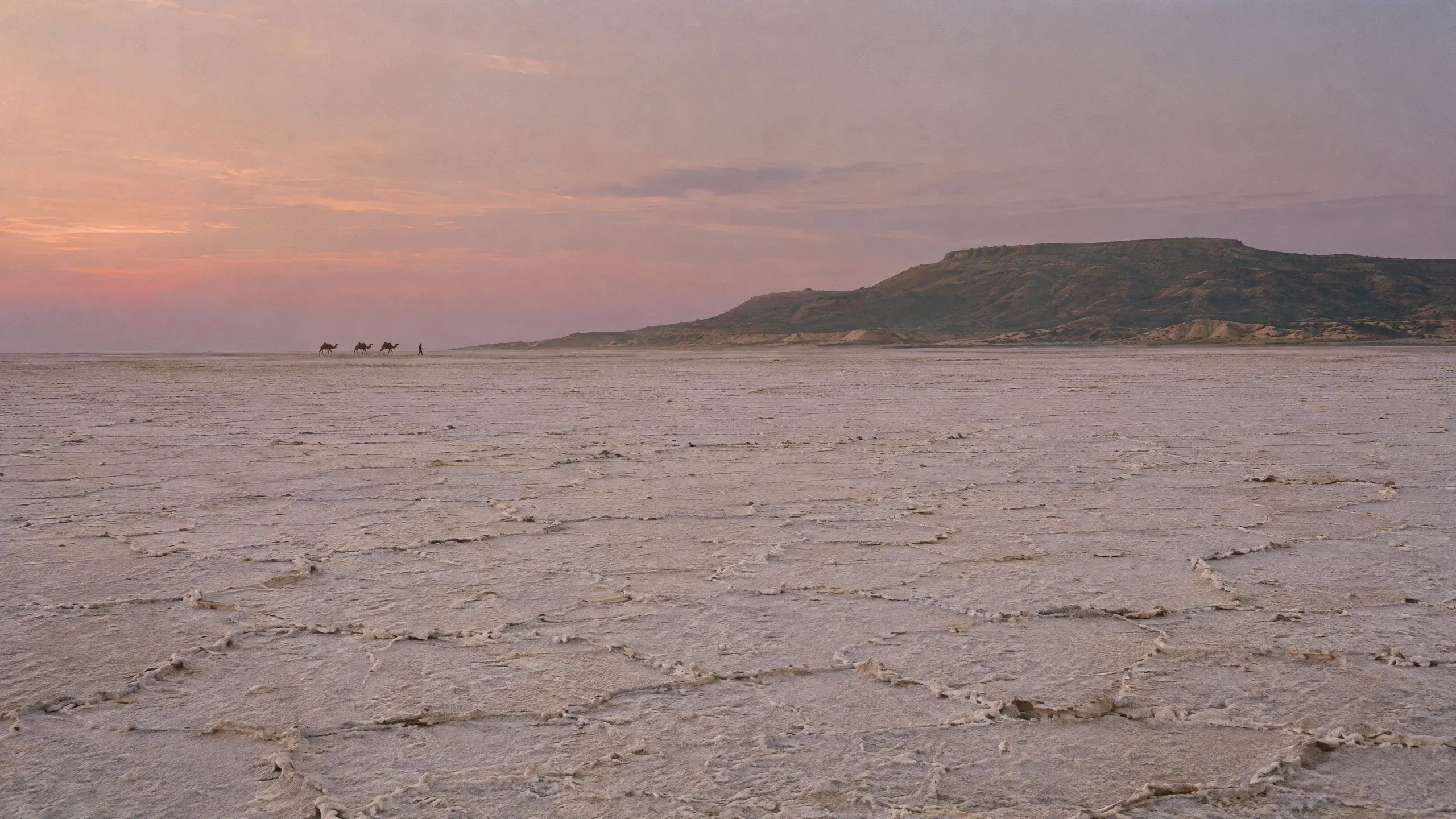
Kutch (Kachchh, Cutch) is the north-western district of Gujarat, bordering Pakistan. It is almost an island. The Great and Little Ranns, vast salt marshes, surround it to the north and east, and the Gulf of Kachchh lies to the south. For Ismaili history, Kutch matters in three ways. It was a stage in the movement of the Nizari da’wa from Sindh into Gujarat. It was a homeland of the Khojas who moved to Bombay and East Africa. And it became the main stronghold of the Imamshahi Satpanth among the Kacchi Patidars, where Moir and Khan documented the abandonment of the old khanas in the late twentieth century.123
The land
Britannica describes the Rann as saline mudflats split by the Kutch highland into the Great Rann, about 18,000 km², and the Little Rann, about 5,100 km². In the rainy season the Rann floods, and Kutch becomes in effect an island. A local fable, Britannica notes, derives the name from the Sanskrit for “tortoise”, which the region’s map resembles when turned upside down. The district administration describes Kutch as the largest district of Gujarat, at 45,674 km², or 23.27 per cent of the state. About 51 per cent of it is saline desert, and its coastline runs for about 406 km. Settlement in the Rann goes back to the Indus civilisation, whose largest site in the region is Dholavira.45
Dadu and the Kadiwala sayyids
Kutch enters Nizari history at the end of the age of the pirs. Daftary records that Pir Dadu, sent to Sindh in the second half of the sixteenth century, was forced around 992/1584 to leave for Navanagar (Jamnagar) with Sindhi Nizaris who had fled with him. He then moved to Bhuj, the chief town of Kutch, and died there in 1001/1593. Daftary credits Dadu with reorganising the Indian Nizari community and strengthening its ties with the Imams at Anjudan. His name was later left out of the lists of pirs.6
In the next century the town of Kadi, which Daftary places in Cutch, was home to Sayyid Fadil Shah, a descendant of Pir Hasan Kabir al-Din through his son Rahmat Allah. He was active there around the middle of the eleventh/seventeenth century. He collected the tithes of the Nizari Momnas of Gujarat and sent them to Persia. His descendants, the Kadiwala sayyids, later moved to Sindh and settled around 1194/1780 at Tando Muhammad Khan. His sons, Pir Mashayikh and Hasan Pir, led the Momnas of northern Gujarat and of Kathiawar.7
Kutch and the Imams in Bombay
The nineteenth-century Imams knew Kutch at first hand. Daftary writes that Aga Khan I left Sindh by way of Karachi in October 1844 and passed through Kutch and Kathiawar, arriving in Gujarat in January 1845. He visited the Khoja communities along his route. His mother, who had moved to India, died in Kutch in 1267/1851.89
Kutch was also a main source of Khoja emigrants. Daftary records that the early Nizari Khoja settlers in East Africa came mainly from Kutch, Kathiawar, Surat and Bombay and first settled on Zanzibar. By 1820 a small community was established there. Later in the century, droughts and famines in Gujarat pushed many Khoja farmers to join the traders’ caravans. Kassam lists Kutchi among the six languages in which ginans exist, alongside Punjabi, Sindhi, Multani, Hindi and Gujarati.1011
The Satpanth of the Kacchi Patidars
Kutch was even more central to the Imamshahi branch of Satpanth. Moir and Khan note that the Satpanth spread during the sixteenth and seventeenth centuries from Pirana across Gujarat and beyond, “from Khandesh and Burhanpur to Kathiawar and Kacch”, often through the missionary work of the sayyids themselves. By the twentieth century about three-quarters of Imamshahi followers were Patidars, an agricultural caste formerly known as Kanbis. Under early British rule many of them called themselves Guptis, “the hidden ones”. The rules of the Pirana shrine required its head, the kaka, to be a Kacchi Karwa Patidar. Since 1939 its trust has included seven Kacchi Patidar members alongside three sayyids.1213
Kutch was also where the twentieth-century redefinition of the Satpanth was fought out. Narayan Ramji Limbani, known as “Contractor”, was a Kacchi Patidar who had moved to Bombay. Mocked by upper-caste Hindus for his Satpanthi beliefs, he joined the Arya Samaj, and in 1926 published an attack on the sect. In his home village of Virani, the old Satpanthi khana was turned into an Arya Samaj shrine. Swami Audharam, head of an ashram near Bhuj, spread the Sanatan Dharma movement in Kutch with the aim of bringing Satpanthis back into Brahminical Hinduism. Later the Lakshminarayan movement also spread there.14
The last stage came under Kaka Karsan Das, born in 1932 in the village of Kotra in Kutch, who became head of Pirana in 1986. In Kutch’s Satpanthi villages new temples were built next to the Lakshminarayan shrines. These “Nishkalanki Mandirs” had a canopy for the ghat-pat rite, images of three Hindu deities and the syllable Om painted on the wall. The old khanas, usually set up in ordinary houses, were abandoned. Moir and Khan’s fieldwork in Kutch in 2000 also found sayyids who had left the Satpanth for the Swaminarayan sect, or had formed groups influenced by the Sanatan Dharma movement or the Lakshminarayan cult.1516
Footnotes
-
“Rann of Kachchh,” Encyclopaedia Britannica, https://www.britannica.com/place/Rann-of-Kachchh; “Gujarat,” Encyclopaedia Britannica, https://www.britannica.com/place/Gujarat. ↩
-
Farhad Daftary, The Isma’ilis: Their History and Doctrines, 2nd ed. (Cambridge: Cambridge University Press, 2007), pp. 447–448, 485. ↩
-
Zawahir Moir and Dominique-Sila Khan, “New Light on the Satpanthi Imamshahis of Pirana,” South Asia: Journal of South Asian Studies n.s. 33, no. 2 (2010), pp. 213, 232, https://doi.org/10.1080/00856401.2010.494824. ↩
-
“Rann of Kachchh,” Encyclopaedia Britannica; “Gujarat,” Encyclopaedia Britannica, land section. ↩
-
District Administration, Kachchh, “About District,” https://kachchh.nic.in/about-district/. ↩
-
Daftary, The Isma’ilis, p. 447. ↩
-
Daftary, The Isma’ilis, pp. 447–448. ↩
-
Daftary, The Isma’ilis, p. 472. ↩
-
Daftary, The Isma’ilis, p. 464. ↩
-
Daftary, The Isma’ilis, p. 485. ↩
-
Tazim R. Kassam, Songs of Wisdom and Circles of Dance: An Anthology of Hymns by the Satpanth Isma’ili Saint, Pir Shams (PhD dissertation, McGill University, 1992), ch. 6, discussion of the languages of the ginans, https://archive.org/details/bk038. ↩
-
Moir and Khan, “New Light on the Satpanthi Imamshahis,” p. 219. ↩
-
Moir and Khan, “New Light on the Satpanthi Imamshahis,” pp. 211, 227. ↩
-
Moir and Khan, “New Light on the Satpanthi Imamshahis,” section “The Role of the Arya Samaj,” pp. 228–230. ↩
-
Moir and Khan, “New Light on the Satpanthi Imamshahis,” section “Kaka Karsan Das and His Reforms,” pp. 231–232. ↩
-
Moir and Khan, “New Light on the Satpanthi Imamshahis,” p. 213. ↩