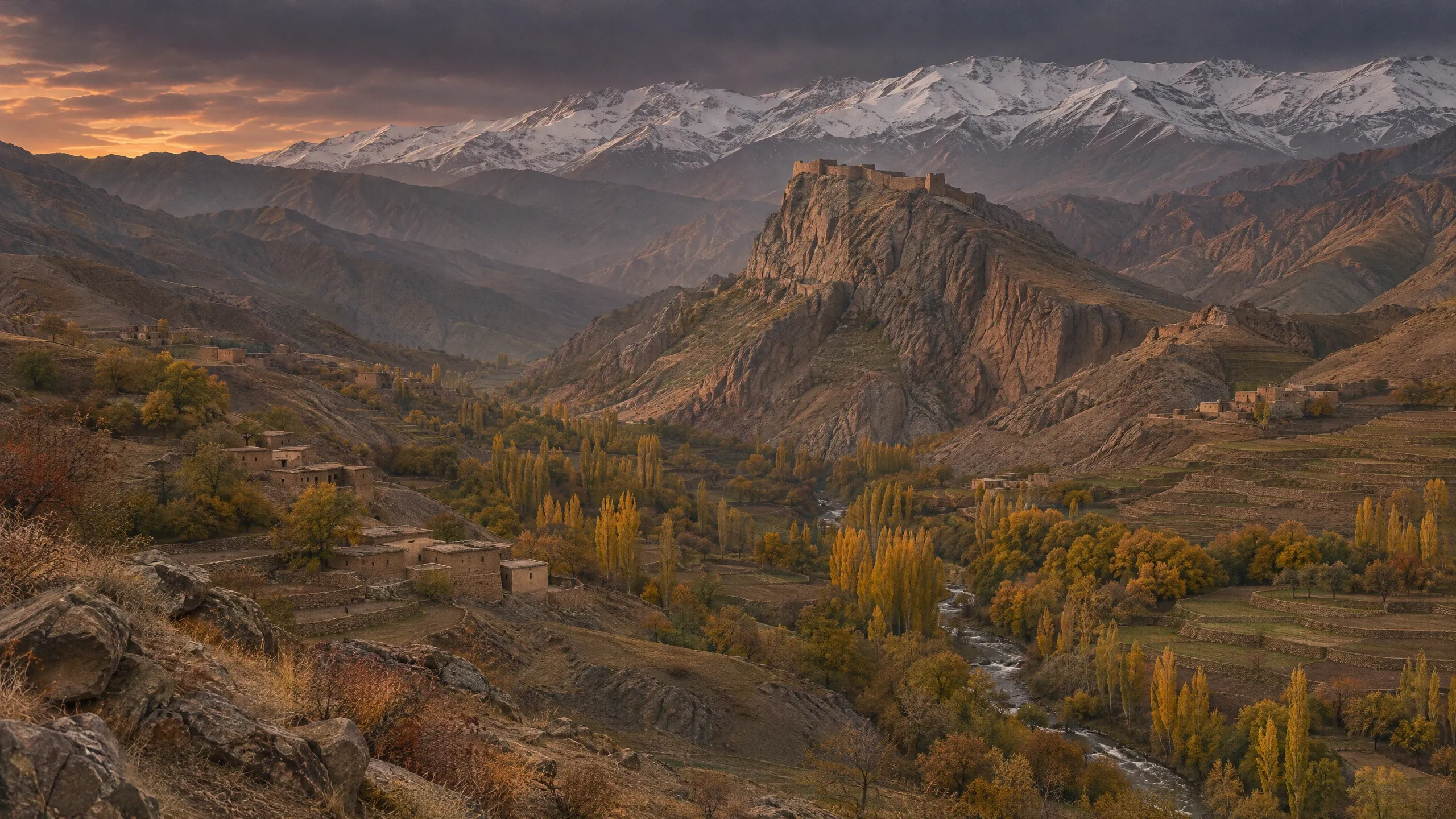
On the night of 6 Rajab 483 / 4 September 1090 Hasan-i Sabbah entered the castle of Alamut, on a rock in the Rudbar valley of the central Alborz, and took it from its Zaydi owner without a fight. For the next 166 years Alamut was the seat of a Nizari Ismaili state. It never formed a single block of territory. It was a network of mountain castles and fortified towns in Rudbar, Qumis, Quhistan in eastern Persia and the Jabal Bahra’ in Syria, held together by a shared allegiance and a single command.1
The state was led by eight lords of Alamut. The first three, Hasan-i Sabbah, Buzurg-Ummid and his son Muhammad, governed as representatives of a hidden Imam. From 1164 the lords of Alamut were recognised as Imams themselves, descended from Nizar.2 The state outlasted the Great Saljuqs whom it had defied and fell only to the Mongols in 1256. In Europe its members became known as the “Assassins”, and the legends attached to that name still shape popular ideas of the Nizaris.3
Hasan-i Sabbah and the Persian da’wa
Before the split of 1094 the Ismailis of Persia were led by a single chief da’i based at Isfahan, ’Abd al-Malik b. ’Attash, whose authority by the 1070s extended from Kirman to Azerbaijan.4 Hasan-i Sabbah was born in the mid-1050s at Qumm into a Twelver Shi’i family that claimed Yemeni Arab descent, and grew up at Rayy. His life is known mainly from his lost autobiography, the Sargudhasht-i Sayyidna, as quoted by later Persian historians. At seventeen he was introduced to Ismaili ideas by a da’i named Amira Darrab. He had thought Ismailism a heretical philosophy, but he was won over and took the oath of allegiance to the Fatimid Imam al-Mustansir.5
In Ramadan 464 / 1072 Hasan met Ibn ’Attash at Rayy, who gave him a post in the da’wa and urged him to go to Cairo. His route took him through Azerbaijan, Mayyafariqin, from which the qadi expelled him, Mosul and Damascus; finding the road south blocked, he went by the coast through Beirut, Sidon, Tyre, Acre and Caesarea. He arrived in Cairo in Safar 471 / August 1078 and stayed about three years in Egypt without seeing al-Mustansir. A conflict with the vizier Badr al-Jamali led to his expulsion; Nizari sources say the quarrel concerned Nizar’s rights. He returned to Isfahan in Dhu’l-Hijja 473 / June 1081.6 The popular story that Hasan, the vizier Nizam al-Mulk and the poet ’Umar Khayyam were schoolfellows who swore to help one another first appears in Rashid al-Din. Scholars dismiss it, since the three men’s ages are irreconcilable.6
For nine years Hasan travelled as a da’i through Kirman, Yazd and Khuzistan and spent three years at Damghan. He concentrated on the Caspian highlands of Daylam, whose mountaineers had a long tradition of independence and of Shi’i loyalties. By about 480/1087 he had chosen Alamut as his base and sent da’is to win over its garrison.7
The seizure of Alamut
Alamut stood about 35 kilometres north-east of Qazwin on a rock in the valley of the Alamut river, a tributary of the Shahrud. Juvayni compared the rock to “a kneeling camel with its neck resting on the ground”. A Justanid ruler of Daylam was said to have begun building the castle in 246/860–61. It had later passed to the Musafirids and then to the Zaydi Alids, and in 1090 it was held for the Saljuq sultan Malikshah by a Zaydi named Mahdi.8
Hasan’s da’is had converted much of the garrison. Hasan entered the castle secretly and lived there for a time disguised as a schoolmaster. When he revealed himself, he allowed Mahdi to leave and gave him a draft for 3,000 gold dinars on the ra’is Muzaffar, a secret convert who later governed Girdkuh. Daftary treats the seizure as the foundation of the Nizari state and the start of an open revolt against the Saljuqs.9
Hasan repaired the fortifications and built storerooms and water channels, planted trees and organised irrigation in the valley below. The castle was reached only by a narrow path on its northern face, and it was never taken by force. When Saljuq raids frightened the garrison, Hasan told them he had received a message from the Imam calling Alamut baldat al-iqbal, “the city of good fortune”.10 Its name was explained by a folk etymology as aluh amukht, “the eagle’s teaching”, from a story that an eagle had shown a Daylami king the site.10
The revolt against the Saljuqs
Daftary sees several motives behind the revolt. It was Shi’i, directed against the Sunni Saljuqs and the Abbasid caliphate they protected. It drew on Persian resentment of Turkish rule: Hasan called the sultan an ignorant Turk. The Nizaris adopted Persian as their religious language, the first major Muslim community to do so. It also reflected local grievances against the Saljuq system of military land grants (iqta’). Nizari members called one another rafiq, “comrade”, and Hasan was known for his austerity.11
In 484/1091–92 Hasan sent the da’i Husayn Qa’ini to Quhistan, the barren highlands of south-eastern Khurasan. There a popular rising took Tun, Tabas, Qa’in and Zuzan, and the region was governed from then on by a muhtasham appointed from Alamut.12 Early in 485/1092 Malikshah, advised by his vizier Nizam al-Mulk, sent armies against Rudbar and Quhistan. The amir Arslan Tash besieged Alamut, where Hasan had about seventy men. A da’i from Qazwin brought 300 more through the siege lines, and at the end of Sha’ban 485 / October 1092 a sortie routed the besiegers.13
On 10 Ramadan 485 / 14 October 1092 Nizam al-Mulk was killed near Sihna in western Persia by Abu Tahir Arrani. The murder is generally attributed to Hasan, but contemporaries also suspected Malikshah and his wife Terken Khatun, and Daftary notes that modern scholarship increasingly takes that view seriously.14 A month later Malikshah died, and the Saljuq empire fell into more than a decade of civil war between his sons. The Nizaris used the chaos to take further castles: Mansurakuh, Mihrin and Ustunawand near Damavand, Girdkuh near Damghan in 489/1096, and Lamasar, the largest Nizari fortress in Rudbar, captured by Buzurg-Ummid in 489/1096 (or 495/1102 according to Juvayni).15
Castles, towns and the dar al-hijra
The Nizari state took shape as a chain of strongholds. Each served as a refuge, a dar al-hijra in the old Ismaili term, and a local headquarters, and at first they acted with considerable independence.16 In Rudbar the castles formed a defensive system around Alamut and Lamasar. Girdkuh, a high rock about 15 kilometres north-west of Damghan, controlled the main road from western Persia to Khurasan; its garrison dug a deep well into the rock. In Quhistan the Nizaris held not castles alone but towns, and the muhtasham resided at Tun, Qa’in or the castle of Mu’minabad near Birjand.17
Near Isfahan, the Saljuq capital, Ahmad, son of ’Abd al-Malik b. ’Attash, seized the castle of Shahdiz by 494/1100, again disguised as a schoolmaster to its Daylami garrison. He was said to have made 30,000 converts and collected taxes in the district. The Nizaris also held castles in the Zagros and in Fars around Arrajan.18 The state had its own mint, which struck coins at Alamut under the name Kursi al-Daylam.19
Fida’is, reprisals and sieges
The Nizaris faced armies far larger than their own. Their answer was the targeted killing of enemy leaders by devotees called fida’is. Daftary notes that assassination had been used by earlier groups and by the Nizaris’ contemporaries, the Saljuqs and Crusaders among them, but that the Nizaris gave it an unusually large role. The killings were usually carried out in public to maximise their effect, and the fida’is generally died in the attempt. Rolls of honour of their missions were kept at Alamut.20
As a result, almost every prominent murder of the period was attributed to the Nizaris. The killings also brought heavy reprisals. Around 486/1093 suspected Ismailis in Isfahan were thrown on a bonfire, and in 494/1101 the sultans Barkiyaruq and Sanjar agreed on joint action against the Nizaris; massacres followed at Isfahan and Baghdad, and a Saljuq army ravaged Quhistan.21 Daftary finds no evidence that the fida’is used hashish, and doubts that a special corps existed in the early years.20 In the later Alamut period fida’is were sometimes placed in the households of their targets as servants, which helps explain how they reached guarded rulers.20
The Nizaris were also drawn into the Saljuq civil war. In 493/1100 the sultan Barkiyaruq took 5,000 Ismailis into his army, and Muzaffar, the governor of Girdkuh, fought with 5,000 Nizaris for Barkiyaruq’s commander against Sanjar. Barkiyaruq later purged the Ismailis from his forces. Ibn al-Athir reports that officers asked to be allowed to wear armour in the sultan’s presence for fear of fida’is.22
After Barkiyaruq’s death in 498/1105 his brother Muhammad Tapar reunited the Saljuq sultanate and turned against the Nizaris. In 500/1107 he besieged Shahdiz. Ahmad b. ‘Attash argued that the Nizaris were true Muslims who differed only on the Imamate, and offered terms. Part of the garrison was allowed to leave for Arrajan and Quhistan, but Ahmad and about eighty men fought to the last tower. Ahmad’s wife, wearing her jewels, threw herself from the ramparts; Ahmad was paraded through Isfahan and flayed alive, and the heads of the defenders were sent to the Abbasid caliph. The nearby castle of Khanlanjan was destroyed, and the atabeg of Fars, Fakhr al-Din Chawli, destroyed the Nizari forts around Arrajan.23 An earlier expedition into Rudbar under Nizam al-Mulk’s son, the vizier Diya’ al-Mulk Ahmad, had failed.24
The Saljuqs then turned on Rudbar. From 503/1109 the governor of Sawa, Anushtagin Shirgir, waged an eight-year campaign of attrition, destroying the crops of the valley each year and besieging Lamasar and Alamut. Hasan sent his wife and daughters to Girdkuh, where they earned their living by spinning. In Dhu’l-Hijja 511 / April 1118 news of Muhammad Tapar’s death reached the besiegers, who withdrew, leaving their supplies to the Nizaris. Shirgir himself was later executed, and the Saljuq historian al-Bundari accused the vizier al-Dargazini of being a secret Nizari convert.24
Ta’lim: the doctrine of authoritative teaching
Hasan-i Sabbah was also the movement’s theologian. His Persian treatise known as the Four Chapters (Fusul-i arba’a) is lost, but al-Shahrastani preserved an Arabic summary of it around 521/1127. Hasan argued that reason alone cannot bring knowledge of God. Mankind needs an authoritative teacher (mu’allim), and there can be only one such teacher in each age, not the many competing scholars of the Sunni world. The teacher’s authority is not proved by miracles or ancestry: reason shows the need for him, and his existence proves itself.25
This doctrine of ta’lim, “authoritative teaching”, gave the Nizaris their name among their opponents, the Ta’limiyya. It also allowed them to remain loyal to an Imam they could not see. The Abbasid caliph al-Mustazhir commissioned al-Ghazali to refute it.25 Hasan’s own conduct matched his teaching. He lived in modest quarters at Alamut, reading and writing, and was called Sayyidna, “our master”. He had both his sons executed, one on suspicion of murder and the other for drinking wine.26
Stalemate: Buzurg-Ummid and Muhammad
After 1118 the conflict settled into what Hodgson called a stalemate. The Nizaris had failed to overthrow the Saljuqs and had lost their urban bases, but they held a territorial state in Rudbar, Qumis and Quhistan that the Saljuqs could not take.27 Sultan Sanjar, who ruled the eastern Saljuq lands until 1157, preferred peace. According to Juvayni, he was persuaded after waking to find a dagger thrust into the ground beside his bed. Juvayni later saw in the Alamut library several decrees in which Sanjar “conciliated and flattered” the Nizaris. Sanjar granted them a pension of 3,000 to 4,000 dinars from the taxes of Qumis and allowed them to levy a toll on travellers beneath Girdkuh.28
In 515/1121 al-Afdal, the Fatimid vizier who had set Nizar aside, was assassinated in Cairo; Nizari sources credited three fida’is from Aleppo, and Hasan ordered seven days of celebration. The Fatimid court responded in 516/1122 with al-Hidaya al-Amiriyya, a refutation of the Nizari case, and with a letter urging Hasan to renounce Nizar.29 Hasan-i Sabbah died in 518/1124. He had named Buzurg-Ummid, the commander of Lamasar, as his successor; the da’i Abu ’Ali Ardistani secured for him the allegiance of the castles. He was buried at Alamut, where his mausoleum remained a place of visitation until the Mongols destroyed it.30
Buzurg-Ummid, a native of Rudbar, led the Nizaris from 518/1124 to 532/1138. In his time the Nizaris built the castles of Sa’adatkuh and Maymundiz, defeated a Saljuq expedition into Rudbar in 520/1126, and sent fida’is against high targets. The Fatimid caliph al-Amir was killed in 524/1130, and the Abbasid caliph al-Mustarshid at Maragha in 529/1135, probably with Saljuq connivance.31 In 530/1136 Buzurg-Ummid gave refuge at Alamut to the Saljuq amir Yaranqush and refused to hand him over.32 He died in Jumada I 532 / February 1138, having designated his son Muhammad three days before. From then on the leadership passed from father to son.33
Muhammad b. Buzurg-Ummid (r. 532–557/1138–1162) extended the state with the castles of Mubarakkuh and Firuzkuh and sent a mission to Ghur in Afghanistan. Fida’is killed the caliph al-Rashid at Isfahan in 532/1138 and the Saljuq sultan Da’ud at Tabriz in 538/1143. The Bawandid ruler of Mazandaran, Shah Ghazi Rustam, became a bitter enemy after the Nizaris killed his son in 537/1142, and built towers of Nizari heads. The governor of Rayy, ’Abbas, massacred Nizaris until he was himself killed in Baghdad in 541/1146 and his head sent to Alamut. In 538/1143 an attack on Lamasar by Sultan Mas’ud was repelled.34 Elsewhere, around 700 Nizaris were massacred at Amid in Diyar Bakr in 518/1124, and Nizari raiders reached Georgia.35 In this period the Nizaris kept libraries at Alamut, in Quhistan and in Syria with religious and scientific works and instruments, which outside scholars also used (see the library of Alamut).36
Syria
In Syria the Nizari mission was led by Persians sent from Alamut. Daftary divides its early history into three periods: at Aleppo until 507/1113, at Damascus until 524/1130, and from then on in the castles of the Jabal Bahra’, the coastal mountains between Hama and the sea.37 At Aleppo the da’i known as al-Hakim al-Munajjim worked under the Saljuq prince Ridwan. Nizari fida’is killed the ruler of Hims in his great mosque in 496/1103, and the Nizaris briefly held Afamiya until Tancred took it in 500/1106, the first clash between Nizaris and Crusaders.38
At Damascus the da’i Bahram allied with the vizier al-Mazdaqani, who gave him the frontier fortress of Baniyas in 520/1126. Bahram was killed in 522/1128. When al-Mazdaqani was murdered in 523/1129, more than 6,000 Ismailis were massacred in Damascus.39 The mission then moved to the Jabal Bahra’. In 527/1132–33 the Nizaris bought Qadmus. They acquired Kahf, Khariba and in 535/1140–41 Masyaf, which became the usual seat of the Syrian chief da’i, and also held Khawabi, Rusafa, Maniqa and Qulay’a, the “castles of the da’wa”.40 William of Tyre, whose chronicle contains the earliest general Crusader account of the Syrian Nizaris, credited them with ten castles and 60,000 followers. In 547/1152 they killed Count Raymond II of Tripoli, their first Frankish victim, and the Templars imposed an annual tribute on them.41
The Syrian Nizaris were caught between the Crusader states and the rising Zangid power. Zangi took Aleppo in 522/1128, and his son Nur al-Din (r. 541–569/1146–1174) abolished the Shi’i forms of prayer there in 543/1148. A Nizari force under ‘Ali b. Wafa’ fought alongside Raymond of Antioch against Nur al-Din, and both were killed at the battle of Inab in Safar 544 / June 1149.42 In Persia the Syrian territories were counted with Rudbar and Quhistan as the three main parts of the Nizari state, and their chief da’i was normally appointed from Alamut.32
The Qiyama
Hasan, the heir of Muhammad b. Buzurg-Ummid, had studied Hasan-i Sabbah’s writings, philosophy and Sufism and gathered followers who expected the coming of the Imam. His father had 250 of them killed. When Muhammad died in Rabi’ I 557 / March 1162, Hasan, then about thirty-five, succeeded him as Hasan II.43
On 17 Ramadan 559 / 8 August 1164, at a pulpit set up facing west at the foot of Alamut, Hasan II proclaimed the Qiyama, the “resurrection”. Dressed in white and holding a sword, he read a message attributed to the hidden Imam that relieved the Nizaris of the burden of the shari’a and named Hasan the Imam’s khalifa. He then led a festival prayer and invited the assembly to break the fast in the middle of Ramadan. He called the day the “festival of the resurrection” (’id-i qiyamat), and the Nizaris celebrated 17 Ramadan as a feast every year afterwards.44 The proclamation was repeated at Mu’minabad in Quhistan on 28 Dhu’l-Qa’da 559 / 18 October 1164, and later in Syria.45
The doctrine interpreted the Last Day spiritually. The resurrection was the manifestation of the truth (haqiqa) in the Imam; those who recognised him lived in Paradise, and the outward law gave way to its inner meaning.46 Daftary reads the Qiyama as a declaration of independence from the wider Muslim world and an admission that the Nizaris had failed to win it over. Outsiders barely noticed it: Ibn al-Athir does not mention it, and Daftary notes that even the hostile Juvayni reports no libertinism in Rudbar. Many modern Nizaris regard parts of the standard account, especially the abolition of the shari’a, with scepticism.47
Hasan II was stabbed to death at Lamasar on 6 Rabi’ I 561 / 9 January 1166 by his brother-in-law, Hasan b. Namawar. His son Nur al-Din Muhammad, who reigned for forty-four years, the longest of any lord of Alamut, declared that his father had been the Imam by descent from Nizar. Nur al-Din Muhammad was a prolific writer, and his doctrine made the present Imam the centre of Nizari belief: the Imam was the manifestation (mazhar) of God’s command, and to see him truly was to be in Paradise. Believers were divided into the people of opposition, the people of gradation and the people of union, according to how much of the truth they grasped.48 Outside Syria the first three decades of his reign were quiet. The Badusapanid ruler Hazarasf took refuge at Alamut and gave the Nizaris castles; later years brought petty wars with the Ghurids in Quhistan and with local rulers of the Caspian region.49
Nizari tradition explained the new genealogy through three hidden Imams, Ali al-Hadi, Muhammad al-Muhtadi and Hasan al-Qahir, and a grandson of Nizar said to have been brought secretly to Alamut in 488/1095.50
Rashid al-Din Sinan
The most famous Nizari leader in Syria was Rashid al-Din Sinan, the original “Old Man of the Mountain” of the Crusader chronicles. Brought up near Basra and trained at Alamut, where he was a companion of Hasan II, he was sent to Syria soon after Hasan’s accession in 1162. After the deaths of the chief da’i Abu Muhammad and his unauthorised successor, Sinan took over the mission on Alamut’s orders.51 He rebuilt Rusafa and Khawabi, took Ullayqa near the Hospitaller castle of Marqab, and moved between Masyaf, Kahf and Qadmus with a corps of fida’is.51
Sinan’s diplomacy balanced the Zangids, the Crusaders and Saladin. Around 569/1173 he sent an envoy to King Amalric I of Jerusalem, but the envoy was murdered by a Templar on the orders of the Grand Master. In 570–571/1174–1176, at the request of Gumushtigin, regent of Aleppo, Nizari fida’is twice tried to kill Saladin. Saladin besieged Masyaf briefly and then made a truce, and relations between the two men remained quiet thereafter.52 In Rabi’ II 588 / April 1192 Conrad of Montferrat, newly elected king of Jerusalem, was killed at Tyre by two men disguised as monks. Who ordered the killing remained disputed: many sources blamed Richard I of England, while Ibn al-Athir said Saladin had paid Sinan.52
Sinan proclaimed the Qiyama in Syria some time after 1164, with limited effect, and Nur al-Din Muhammad tried more than once to replace him. He also suppressed a faction in the Jabal al-Summaq, the Sufat, whom Ibn al-’Adim accused of libertinism after the Qiyama. When Richard I and Saladin made peace in 1192, the Nizari territories were included in the treaty at Saladin’s request.53 Sinan died at Kahf in 589/1193 (less probably a year earlier), the only Syrian chief da’i to act with real independence from Alamut. Under his successors, appointed again from Alamut, the Syrian Nizaris dealt with the emperor Frederick II, whose envoys brought gifts worth about 80,000 dinars to the chief da’i Majd al-Din in 624/1227; with Pope Gregory IX, who condemned their dealings with the military orders in 633/1236; and with Louis IX of France, whom their envoys approached at Acre in 648/1250.54
Jalal al-Din Hasan and the return to the shari’a
Nur al-Din Muhammad died in Rabi’ I 607 / September 1210, possibly poisoned. His son Jalal al-Din Hasan III, born in 562/1166 and designated in childhood, had been unhappy with the Qiyama and had already made secret contacts with Sunni rulers.55 On his accession he repudiated the Qiyama, ordered his followers to observe the shari’a in its Sunni form and built mosques. He invited scholars from Qazwin to inspect the Alamut library and burn the books they thought heretical. In 608/1211 the Abbasid caliph al-Nasir recognised him as a Muslim ruler.56
The Nizaris accepted the change, and later explained it as a return to taqiyya, precautionary concealment. Politically it brought real gains. For the first time the Nizari state was recognised by its neighbours, Ghurid attacks ended, and the Syrian Nizaris received Ayyubid help.57 Hasan III allied with the caliph and with Muzaffar al-Din Ozbeg of Azerbaijan, and in 610/1213 led an army out of Rudbar, the first lord of Alamut to do so. He was also, in Daftary’s assessment, evidently the first Muslim ruler to come to terms with the Mongols, sending envoys to Chingiz Khan in 616/1219. In 611/1214–15 his allies defeated the rebel Mengli near Hamadan, and Hasan received Abhar and Zanjan; he was away from Rudbar for a year and a half. In 614/1217 fida’is killed the rebel Ighlamish at the caliph’s request.58 He died of dysentery in Ramadan 618 / November 1221. His vizier accused his Sunni wives and his sister of poisoning him, and they were put to death.59
Ala al-Din Muhammad and the scholars
Hasan III’s son Ala al-Din Muhammad III succeeded at the age of nine. His father’s Sunni policies were never formally renounced but were gradually relaxed. In his reign the Nizaris worked out the doctrine of satr, “concealment”: the Qiyama had been a temporary state, and periods of concealment under the shari’a and of manifestation of the truth would alternate until the final resurrection.60
The Mongol invasions of 1219–1221 sent many refugees, among them Sunni scholars, to the Nizari castles of Quhistan.61 The muhtasham Shihab al-Din was so generous to them that complaints reached Alamut, and the Sunni historian Minhaj-i Siraj Juzjani visited Quhistan three times in 621–623/1224–1226.61 Muhammad III’s reign was not a time of retreat. Around 619/1222 the Nizaris seized Damghan and recovered castles in Qumis, and in 618/1221 four fida’is from Quhistan killed the ruler of Sistan at Zarang.62
Relations with the last Khwarazmshah, Jalal al-Din, were tense. When Jalal al-Din’s vizier Sharaf al-Mulk, on his orders, had five fida’is burned alive, Alamut demanded 10,000 dinars for each of them, and the Khwarazmians agreed to reduce the tribute owed by the Nizaris by 10,000 dinars a year for five years. The Khwarazmian secretary al-Nasawi, who visited Alamut as an envoy, described Muhammad III and his vizier and the lavish gifts he received.63 After Jalal al-Din’s death in 628/1231 the Nizaris made peace with Qazwin, while the execution of Hasan III’s Gilani wives left lasting tension with the Caspian rulers.63
Lewis describes Muhammad III’s reign as “a period of both intellectual and political activity”. The library of Alamut, he writes, “was famous”, and even the hostile Juvayni admits his interest in it; at this time it attracted a number of scholars from outside.64 The most famous of the scholars was Nasir al-Din Tusi (see the library of Alamut), who served the muhtasham of Quhistan from about 1227 and wrote the Akhlaq-i Nasiri there before moving to Alamut. Daftary finds no evidence that Tusi was held against his will, as he later claimed, and considers it safe to say that he willingly embraced Ismailism.65 The Rawdat al-taslim, completed in 640/1243 under Tusi’s influence, is the main surviving statement of Nizari doctrine from the whole Alamut period.66
The Mongol conquest
Nizari diplomacy could not stop the Mongols. In 1238 Nizari envoys travelled with those of the Abbasid caliph to the kings of France and England to seek an alliance, and in 1246 a Nizari embassy to the Great Khan Güyük was dismissed with contempt.67 In 650/1252 the Great Khan Möngke entrusted his brother Hülegü with the conquest of the Nizari state and the caliphate. An advance army of 12,000 men under Ket-Buqa crossed the Oxus in March 1253, took castles in Quhistan and besieged Girdkuh. In December 1253 the Girdkuh garrison killed a hundred Mongols in a night sortie, and in 1254, weakened by cholera, it was reinforced from Alamut.68
At Alamut, Muhammad III was murdered at Shirkuh on 1 December 1255. His son Rukn al-Din Khurshah, born about 627/1230 and designated in childhood, had quarrelled with his father in the last years of the reign. He at once offered submission to the Mongol commander Yasa’ur Noyan at Hamadan. His vizier Shams al-Din Gilaki reached Hülegü on 9 September 1256 to ask for a year’s grace and for Alamut and Lamasar to be spared, and in October Khurshah sent his brother Shiranshah to the Mongol camp with 300 men. Daftary notes that Hülegü meanwhile had Nizaris near Qazwin secretly killed. Khurshah’s negotiations bought no time, and Hülegü advanced into Rudbar in several columns in the autumn of 1256, entering it himself through Taliqan on 31 October. On 8 November he stood before Maymundiz, and after a short bombardment Khurshah surrendered on 29 Shawwal 654 / 19 November 1256, accompanied by Tusi.69 Around forty castles in Rudbar were demolished. Alamut surrendered in December, and Juvayni examined its library before the castle was destroyed. Lamasar held out until late 1257.70
The siege of Maymundiz is described in detail by Juvayni, who was in Hülegü’s camp. Trees the Nizaris had planted were cut down to make mangonels, and a Chinese ballista with a range of 2,500 paces was brought up; the fida’is opposed surrender, and an unusually mild autumn allowed the siege to continue. Some fida’is fought on for three days after Khurshah came down. Alamut’s commander, Muqaddim al-Din, at first refused to yield, but the castle surrendered at the end of Dhu’l-Qa’da 654 / December 1256 after the garrison was given three days to remove its belongings.71 Juvayni describes its rock-cut galleries and tanks, a conduit that brought river water half way round the castle into cisterns, and stores of wine, vinegar and honey said to have been laid down in Hasan-i Sabbah’s time.72
Khurshah was sent to Mongolia. Möngke refused to see him, and in spring 655/1257 he and his companions were put to death near the Khangai mountains. A general massacre of the Nizaris followed, including some 12,000 in Quhistan according to Juvayni.73 In Syria the castles survived the Mongol invasion of 1260 but passed to the Mamluk sultan Baybars; The Syrian Nizaris chose their own leaders after 1256. Masyaf and three other castles surrendered to the Mongols in 658/1260 and were recovered after the Mamluk victory at ’Ayn Jalut. Baybars then appointed and deposed the chief da’is, taxed the gifts the Nizaris received from Frankish rulers and from 665/1267 took tribute from them. Ullayqa and Rusafa surrendered in 669/1271, and Kahf, the last of them, fell in 671/1273. Baybars afterwards used Nizari fida’is against his own enemies, and Ibn Battuta found the castles still inhabited by Ismailis in 726/1326. The full story is told under the Mongol conquest.74
The last Persian outpost, Girdkuh, held out for seventeen years after the Mongols first besieged it. It finally surrendered for want of clothing on 29 Rabi’ II 669 / 15 December 1270, in the reign of Hülegü’s son Abaqa, and its survivors were killed. Juvayni, who had watched the fall of Alamut, recalled that the castle had resisted the Saljuqs for more than a decade.75
Myths and evidence
The Nizari state left fewer sources of its own than almost any medieval Muslim state of its importance. Its chronicles were lost with the Alamut library, and the main narratives were written after 1256 by Juvayni, Rashid al-Din and Kashani, who drew on those chronicles but wrote for the Mongol court. Juvayni in particular wrote with open hostility.76 Sunni writers called the Nizaris malahida, “heretics”, and the Fatimid polemic of 1122 called the Syrian Nizaris hashishiyya, a term of abuse meaning “rabble”.77
In Europe these materials combined with Crusader rumour to produce the “Assassin legends”: tales of young men drugged with hashish, shown a false paradise and ordered to leap to their deaths. Marco Polo, passing through Persia in 1273, gave them their best-known form.78 Daftary finds no evidence that the Nizaris used hashish and treats the legends as the product of “uninformed Crusader circles” (see the Assassins legend).20
The evidence that survives shows a different state: a network of communities that held out for more than a century and a half against far stronger powers; a movement that made Persian a language of religious thought; libraries used by scholars of many faiths; and a doctrine that could be reshaped from ta’lim to Qiyama to satr as circumstances changed.79 The community survived the destruction of the state. Its Imams, beginning with Khurshah’s son Shams al-Din Muhammad, lived in concealment, and the history of the Nizaris continues in After Alamut.80
Footnotes
-
Farhad Daftary, The Isma’ilis: Their History and Doctrines, 2nd ed. (Cambridge University Press, 2007), pp. 314, 316, 395. ↩
-
Daftary, The Isma’ilis, pp. 326, 363–364. ↩
-
Daftary, The Isma’ilis, pp. 12–13; Bernard Lewis, The Assassins: A Radical Sect in Islam (Weidenfeld and Nicolson, 1967), ch. 1. ↩
-
Daftary, The Isma’ilis, p. 311. ↩
-
Daftary, The Isma’ilis, pp. 311–312. ↩
-
Daftary, The Isma’ilis, pp. 313–314. ↩
-
Daftary, The Isma’ilis, pp. 314, 317; ’Ata-Malik Juvayni, The History of the World-Conqueror, tr. J. A. Boyle (Manchester University Press, 1958), vol. 2, p. 719. ↩
-
Daftary, The Isma’ilis, pp. 314, 316. ↩
-
Daftary, The Isma’ilis, p. 316. ↩
-
Daftary, The Isma’ilis, p. 318. ↩
-
Daftary, The Isma’ilis, p. 319. ↩
-
Daftary, The Isma’ilis, p. 319. ↩
-
Daftary, The Isma’ilis, pp. 320–321, 324. ↩
-
Daftary, The Isma’ilis, pp. 326–327. ↩
-
Daftary, The Isma’ilis, pp. 321, 353. ↩
-
Daftary, The Isma’ilis, pp. 330, 336. ↩
-
Daftary, The Isma’ilis, pp. 326, 353. ↩
-
Daftary, The Isma’ilis, pp. 329–330. ↩
-
Daftary, The Isma’ilis, pp. 320–321, 330. ↩
-
Daftary, The Isma’ilis, pp. 320, 336. ↩
-
Daftary, The Isma’ilis, p. 344. ↩
-
Daftary, The Isma’ilis, pp. 338–339. ↩
-
Daftary, The Isma’ilis, p. 342; Lewis, The Assassins, pp. 58–59, quoting Juvayni. ↩
-
Daftary, The Isma’ilis, pp. 245, 342. ↩
-
Daftary, The Isma’ilis, p. 344. ↩
-
Daftary, The Isma’ilis, pp. 344, 346. ↩
-
Daftary, The Isma’ilis, p. 355. ↩
-
Daftary, The Isma’ilis, pp. 356–357. ↩
-
Daftary, The Isma’ilis, pp. 344, 346. ↩
-
Daftary, The Isma’ilis, p. 355. ↩
-
Daftary, The Isma’ilis, p. 332. ↩
-
Daftary, The Isma’ilis, pp. 332, 334. ↩
-
Daftary, The Isma’ilis, p. 348. ↩
-
Daftary, The Isma’ilis, pp. 349–350. ↩
-
Daftary, The Isma’ilis, pp. 310, 350, 352. ↩
-
Daftary, The Isma’ilis, p. 352. ↩
-
Daftary, The Isma’ilis, pp. 357–358. ↩
-
Daftary, The Isma’ilis, pp. 358–359. ↩
-
Daftary, The Isma’ilis, pp. 359, 370; Juvayni, World-Conqueror, vol. 2, p. 691. ↩
-
Daftary, The Isma’ilis, pp. 359–360. ↩
-
Daftary, The Isma’ilis, pp. 360–362, 366. ↩
-
Daftary, The Isma’ilis, pp. 363–365. ↩
-
Daftary, The Isma’ilis, pp. 366, 374. ↩
-
Daftary, The Isma’ilis, pp. 363–364. ↩
-
Daftary, The Isma’ilis, p. 372. ↩
-
Daftary, The Isma’ilis, pp. 370, 373, 389–390. ↩
-
Daftary, The Isma’ilis, p. 375. ↩
-
Daftary, The Isma’ilis, pp. 375–376, 389. ↩
-
Daftary, The Isma’ilis, p. 376. ↩
-
Daftary, The Isma’ilis, pp. 376, 383. ↩
-
Daftary, The Isma’ilis, p. 376. ↩
-
Daftary, The Isma’ilis, pp. 378, 380–382. ↩
-
Daftary, The Isma’ilis, p. 384. ↩
-
Lewis, The Assassins, p. 84. ↩
-
Daftary, The Isma’ilis, pp. 378–379. ↩
-
Daftary, The Isma’ilis, p. 380. ↩
-
Daftary, The Isma’ilis, p. 388. ↩
-
Daftary, The Isma’ilis, pp. 388, 391. ↩
-
Daftary, The Isma’ilis, pp. 391–392, 394–395. ↩
-
Daftary, The Isma’ilis, pp. 396, 398; Juvayni, World-Conqueror, vol. 2, pp. 717–720. ↩
-
Daftary, The Isma’ilis, pp. 395–396. ↩
-
Juvayni, World-Conqueror, vol. 2, pp. 719–720. ↩
-
Daftary, The Isma’ilis, pp. 396–397. ↩
-
Daftary, The Isma’ilis, pp. 398, 400, 402. ↩
-
Daftary, The Isma’ilis, p. 398. ↩
-
Daftary, The Isma’ilis, pp. 302–306. ↩
-
Daftary, The Isma’ilis, pp. 10–11. ↩
-
Daftary, The Isma’ilis, pp. 12–13; Lewis, The Assassins, pp. 6–7. ↩
-
Daftary, The Isma’ilis, pp. 302–303, 316, 380. ↩
-
Daftary, The Isma’ilis, pp. 402, 410–411. ↩