When Aga Khan III was installed as Imam in Bombay in 1885, the Nizari Ismailis were a set of largely separate communities: Khoja traders in Bombay, Sind, Kutch and Kathiawar and along the coast of East Africa; farming villages in Khurasan and around Mahallat in Persia; the Syrian Nizaris around Salamiyya, Masyaf and Qadmus; and mountain communities in Badakhshan, Hunza and Chinese Turkestan who rarely saw a representative of the Imam. When he died in 1957, the communities of South Asia and East Africa were governed by written constitutions and councils, possessed schools, hospitals, an insurance company, an investment trust and cooperative societies, and had produced a professional and commercial class educated in English. The Central Asian communities, by contrast, had been cut off by the Soviet border since the 1920s. This chapter follows those developments in roughly chronological order, with the regional histories set out in their own sections. It draws chiefly on Daftary’s survey, the Imam’s own memoirs and Wahab’s archival study of the Indians of Zanzibar.1
The community in 1885
The previous generation had settled the Imamat in British India. Aga Khan I had left Persia permanently in 1257/1841 and established his seat in Bombay, where the Aga Khan Case of 1866 confirmed his position as head of the Khoja Ismailis and his rights over communal property. His son Aga Khan II held the Imamat for only four years, from 1881 to 1885, and died in August 1885 after contracting pneumonia on a hunting trip near Poona.2
The departure of Aga Khan I from Persia had left the Persian Nizaris without direct access to their Imam for the first time in almost seven centuries. Daftary describes the Khurasani, Kirmani and other Persian communities as becoming disorganised, each developing on its own resources, and as increasingly practising taqiyya under the outward form of Twelver Shi’ism.3
In the memoirs, Aga Khan III listed the extent of his following in his youth: India and Burma; the East African coast from Mombasa to East London and inland in South Africa; Syria, Persia and Afghanistan; Chinese Turkestan; Russian Central Asia; and the Ottoman provinces later known as Iraq. He described his position as a “dual responsibility”: spiritual head of a dispersed community and a public figure within the Muslim population of India.4
Minority and education, 1885-1898
The new Imam was born at Karachi on 2 November 1877 and was seven years old at his accession (eight in lunar years, the age Daftary and Algar give). His uncle Aga Jangi Shah was his nominal guardian, but his mother Shams al-Muluk, known as Lady Ali Shah, supervised both his education and the community’s affairs, working through a council. He was taught Arabic, Persian literature, Ismaili doctrine and calligraphy in Bombay and Poona, and later English and European subjects.5
His first public acts belonged to Bombay. In 1893 he intervened in a Hindu-Muslim dispute over cow slaughter. During the bubonic plague epidemic in the city, which the memoirs date to the late summer of 1897, he supported the inoculation campaign of the bacteriologist Waldemar Haffkine and had himself publicly inoculated so that his followers would follow his example. In the same year he travelled to Simla to present addresses of loyalty to the Viceroy on Queen Victoria’s Diamond Jubilee.6
Family violence and the courts
The family disputes that had marked the nineteenth century continued. Aga Jangi Shah and his son Abbas were murdered at Jidda, according to Daftary in 1314/1896; Algar dates the murder to 1326/1908. In 1897 the Imam married Jangi Shah’s daughter Shahzada Begum, who had witnessed the murders. The marriage was brief.7
A daughter of Jangi Shah, Hajji Bibi, then sued in the Bombay High Court, with other relatives, for a share of the property held by the Imam. In 1908 Justice Russell found for Aga Khan III. Like the 1866 judgment, the decision distinguished the Ismaili Khojas from Khojas who had become Sunnis or Ithna’asharis, and confirmed the Imam’s rights over the offerings made by his followers.8
The Hajji Bibi case also had consequences in Persia. Murad Mirza, whose family at Sidih in southern Khurasan had collected dues for the Imams for forty years, stopped sending the tithes to Bombay, claimed the rank of hujja and sided with Hajji Bibi. He then claimed that her son Samad Shah was the rightful Imam, and a faction in southern Khurasan, later called the Murad Mirza’is, followed him.9
Secession also took place among the Khojas. Algar records that several thousand Khojas went over to Twelver Shi’ism around 1901 and that a Khojah Reformers’ Society operated in Karachi. In Zanzibar the Ithna’ashari Khojas formed a separate community which by 1934 numbered about 2,173, the second-largest Indian Muslim group on the island.10
Europe, empire and the first honours, 1898-1904
From 1898 onwards Aga Khan III spent long periods in Europe, which became his main residence after 1907. On his first journey he dined with Queen Victoria at Windsor. On his second, in 1900, he met Muzaffar al-Din Shah of Persia in Paris, Kaiser Wilhelm II at Potsdam and Sultan Abd al-Hamid II at Istanbul. At the coronation of Edward VII in 1902 he was promoted from KCIE to GCIE, and in November of that year Lord Curzon appointed him to the Viceroy’s Legislative Council, where he served for two years in Calcutta.11
These connections had a practical use. In the memoirs he describes intervening with the British in Zanzibar and the German authorities in Dar es Salaam during his first East African visit of 1899, in disputes that concerned his followers’ trading rights and land.12
The Khojas and the Indian Ocean
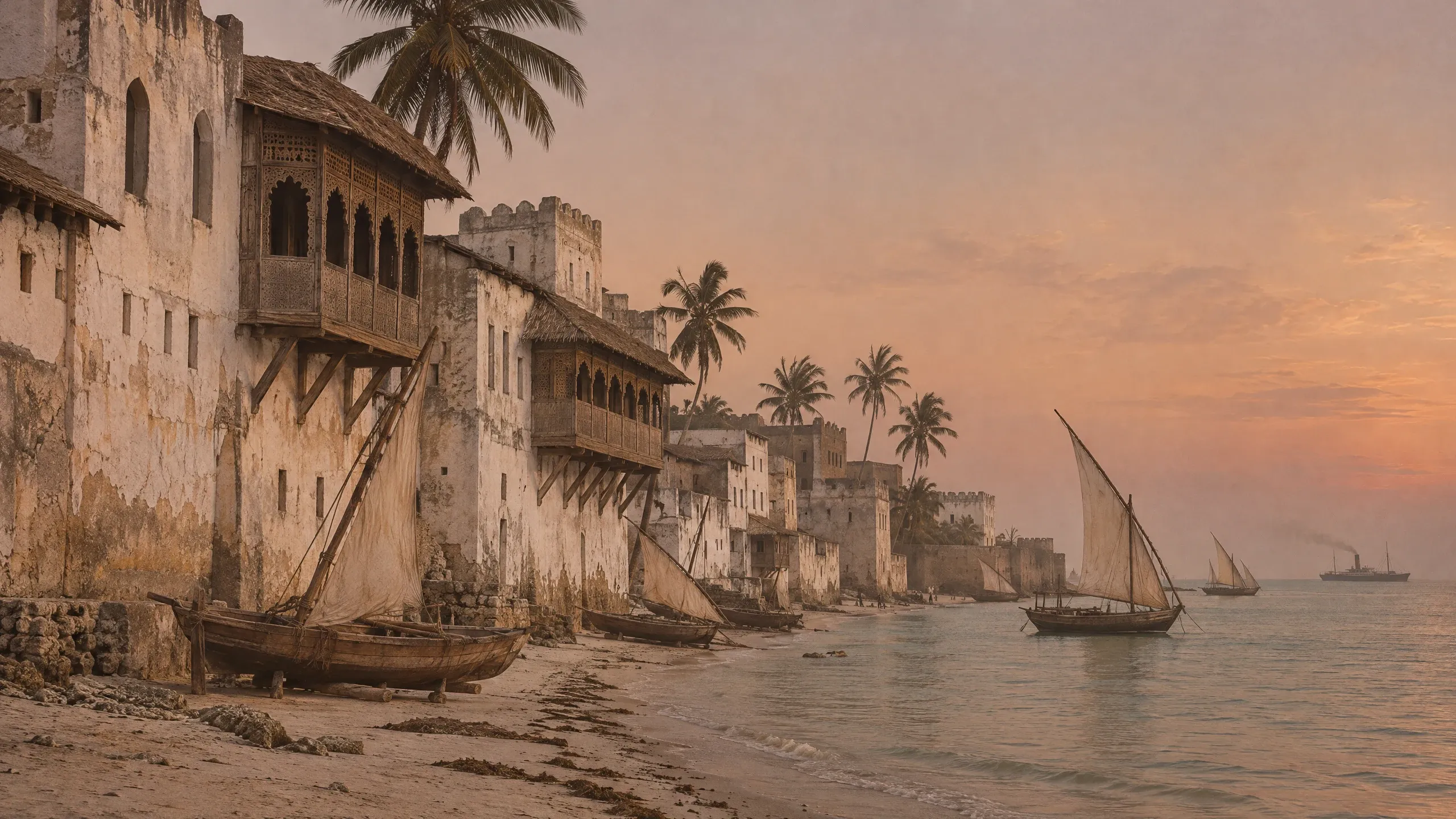
Khoja merchants had traded with the Arabian and African coasts since at least the seventeenth century. Wahab dates the main Ismaili Khoja settlement at Zanzibar to the 1820s and 1830s, with migrants from Beraja in the Jamnagar region of Kathiawar. A jamatkhana had been founded by 1838. When Sayyid Sa’id moved his capital from Muscat to Zanzibar in 1840 there were 165 Ismaili families on the island, and two decades later the number had grown to about 2,100 individuals.13
Daftary identifies several reasons for the growth: the commercial opportunities of the Omani Sultanate, recurrent droughts and famines in Kutch and Kathiawar, and from the late nineteenth century the roads and railways built inland by the colonial powers. By the First World War there were jamats at Zanzibar, Mombasa, Dar es Salaam, Nairobi, Kampala and Tanga, and in many smaller trading towns.14
Community memory credits the Imams with advising this migration. Wahab cites oral evidence that Aga Khan I advised the jamats of Kutch and Kathiawar to leave after famine, and that Aga Khan III gave specific advice to settle on the East African coast. Wealthy Ismaili merchants helped newcomers settle. Allidina Visram, at the Imam’s request, worked with Mukhi Valji Hirji and Mukhi Varas Hashim Jamal to settle poor Ismailis from Kathiawar in Kenya and Uganda by offering housing, work and goods on credit.15
The 1905 constitution
The second East African visit, in 1905, produced the first written Ismaili constitution. Its rules set up a hierarchy of councils, beginning with a council at Zanzibar presided over by the mukhi with authority over the mainland settlements, and they codified personal law on marriage, divorce and inheritance. Asani describes it as the first document in which the Ismailis were “formally and legally defined in modern terms as a ‘religious community’” with the Imam at its head. The constitution was revised several times over the following half-century; see The Ismaili Constitution.16
By the early 1920s the main centres of the community had moved to the mainland, and Zanzibar had ceased to be its seat. A revised constitution of 1926 created separate councils for Tanganyika, Kenya and Uganda, with the Zanzibar council coordinating them; this coordinating body later became a Supreme Council. Further revisions followed in 1937, 1946 and 1954. Daftary estimates the Ismailis of East Africa at about 50,000 by the mid-1950s, nearly half of them in Tanganyika.17
Schools in Zanzibar
Education was the field in which the councils were most active. During his 1905 visit the Imam founded the Shi’a Imami Ismaili Kanyashala in Zanzibar. It later became the Aga Khan Girls’ School, and Wahab identifies it as the first girls’ school for Indians on the island; the Bohras opened a community school four years later. An Ismaili boys’ school followed in 1907, and in 1954 the girls’ school added a secondary section that opened with twelve pupils in Class IX.18
The Ismaili schools charged no fees and accepted children from other communities, but the community declined to merge them with the government-supported Sir Euan Smith Madrasa. Wahab gives two reasons: religious instruction, and the fact that the madrasa charged fees while the community schools did not. The boys’ and girls’ schools were merged in the late 1950s, and after the revolution of 1964 the school was nationalised as the Kidutani school.19
Muslim politics in India, 1903-1914
In India his public career began in Muslim educational politics. He took an active part in the first All-India Muslim Educational Conference at Bombay in 1903 and presided over the next session at Delhi in 1904. Encouraged by Aligarh figures such as Mohsin al-Mulk, he campaigned for the Muhammadan Anglo-Oriental College at Aligarh to become a Muslim university.20
On 1 October 1906 he led the Muslim deputation that met the Viceroy, Lord Minto, at Simla to request separate electorates for Muslims. The All-India Muslim League was founded at Dacca at the end of the year to give political organisation to that demand. He was not present, but was elected its first president. Daftary and Algar both date his part in the League’s founding to 1907; Daftary says he resigned the presidency in 1912, Algar that he held it until 1913.21
At the coronation durbar of George V in 1911-12 he became a Knight Grand Commander of the Star of India. In 1914 he made a second visit to Burma, where, according to Algar, he advised his followers to adopt Burmese dress and Buddhist names; Daftary describes the advice as giving up their Indo-Muslim names and habits.22
Persia: Fida’i Khurasani and the Khurasan schools
In Persia the Imam’s authority was restored through Muhammad b. Zayn al-Abidin, known as Fida’i Khurasani (born c. 1850 at Dizbad, between Mashhad and Nishapur), who had studied at the Baqiriyya madrasa in Mashhad and travelled to Bombay three times between 1896 and 1906. A firman of 1321/1903 appointed him mu’allim, the teacher in charge of religious affairs in Persia. A separate agent, Muhammad Husayn Mahmudi, was made responsible for dealings with the government, and the Persian jamats were told to stop paying tithes to Murad Mirza. At the Imam’s suggestion Fida’i also wrote a history of Ismailism, the Hidayat al-mu’minin.23
Around 1910 the Persian Nizaris were told to set themselves apart from the Twelvers. They were to recite the full list of Qasim-Shahi Imams after their daily prayers and to stop taking part in Muharram mourning, on the grounds that they had a living Imam. During the disorder of the Constitutional Revolution, Twelver clerics attacked Dizbad, and in 1327/1909 two Ismailis held at Darrud who would not curse the Imam were executed. The British Consul at Mashhad intervened to stop further persecution. Fida’i died in 1342/1923 and was succeeded as mu’allim by Sayyid Sulayman Badakhshani.24
From the 1930s the Khurasani jamats set out to build a school in every Ismaili village. The first, opened in 1932 at Dizbad, was named after Nasir Khusraw. To fund the programme the Imam let them keep 80 per cent of their tithes and send only 20 per cent to him. Daftary records high literacy in the Ismaili villages that followed, and a movement of educated Ismailis into Mashhad and Tehran as teachers and civil servants.25
The First World War
During the First World War Aga Khan III urged Muslims in British territories to support the Allies and to ignore the Ottoman Sultan’s call to jihad. In 1916 he was given the status of a first-class ruling prince of the Bombay Presidency, although he ruled no territory. That year his cousin Aqa Farrukh Shah, son of Aga Akbar Shah, was murdered near Kirman while on a pro-Allied political mission in Persia, and Daftary records an attempt on the Imam’s life in Switzerland in 1917 attributed to German agents.26
Illness kept him in Switzerland from 1916 to the summer of 1919. There he wrote India in Transition (1918), setting out his views on the future of India and of South-east Asia, and after the war he presented these proposals to the Secretary of State for India, Edwin Montagu.27
In 1923 he and the jurist Syed Ameer Ali wrote to the Turkish prime minister Ismet Pasha asking that the caliphate be preserved. According to Algar, the letter was published in the press before it reached its addressee, and the Ankara government used it as evidence of foreign interference; the caliphate was abolished in 1924.28
Indians in East Africa, 1920-1924
After the war, the political status of Indians in Kenya, Uganda and Tanganyika became an imperial question. In the memoirs the Aga Khan recounts serving in the early 1920s on committees that negotiated the rights of Indian settlers in the colonies, and claims that the modus vivendi which lasted for many years in Kenya, Uganda and Tanganyika came out of their recommendations. Writing in the early 1950s, he put his followers of Indian origin in East Africa at about 17,000 in Kenya, 27,000 in Tanganyika and 6,000 in Uganda.29
Greenwall, writing in 1952, notes that the Imam also took up restrictions on Indians in Uganda, with only partial success. Greenwall also reports the complaints of Khoja reformers about the scale of offerings collected during the Imam’s visits to Karachi in 1920. These were the arguments of a dissident party, and Greenwall reports them as such.30
Council life in East Africa between the wars
By the 1930s the councils had become a large part of everyday life in East Africa. Wahab quotes a speech given on 12 June 1937 at the Aga Khan Club in Zanzibar by Hassanali Jaffer Hameer, secretary of the Ismailia Provincial Council. He presented education as the Imam’s central demand of his followers: they were to reject illiteracy and found schools for their children. Wahab describes the Ismaili schools as funded entirely from community resources and annual grants from the Imam, with wealthy members paying so that poorer families’ children could attend free of charge.31
Greenwall, who travelled widely to research his 1952 book, recorded differences in procedure from place to place. In Zanzibar the Khojas held annual elections for communal office, while in most other parts of Africa officers were chosen each year without election. He called the network of institutions in South Africa, Portuguese East Africa, Kenya, Madagascar and Zanzibar a “loosely knotted Welfare State” maintained by its members’ contributions. He also described Mozambique as a clearing point through which collected funds were transferred. These observations come from an outsider and are not documented from community records, but they are among the few contemporary descriptions of the system.32
The councils also acted as courts in family matters. The constitutions contained long sections on marriage, divorce and the guardianship of children, and Asani notes that they set out personal and family law in detail alongside the rules for the councils themselves. They were revised several times during the twentieth century as circumstances changed. In colonial East Africa, communal tribunals of this kind sat alongside the colonial courts, and the community’s personal law was administered internally.33
The settlement inland followed the railway. Ismaili traders opened shops at stations and market towns in Kenya and Uganda, and Tanga, Dar es Salaam, Mombasa, Nairobi and Kampala became the main centres. The post-war history of these communities, including the transition to independence and the expulsion of Asians from Uganda in 1972, is told in The Ismailis of East Africa.34
A United States intelligence assessment written in 1972 summarised the wider pattern for Asian settlement in East Africa. Asians had arrived in large numbers in the early twentieth century to build the railways and open small retail businesses along the lines. Colonial law barred them from owning arable land, so they went into commerce, services and the professions. By the eve of independence they made up the bulk of the region’s middle class. The Ismailis were one of the most organised of these communities.35
Round Table Conferences, 1928-1934
In 1928 Aga Khan III presided over the All-India Muslim Conference at Delhi, which set out a common Muslim position on constitutional reform. He then led the Muslim delegation to the first Round Table Conference in London in 1930. Muhammad Ali Jinnah, from a Khoja family, was a member of the delegation; see Jinnah and the Aga Khan. During the second conference, in 1931, he held long private talks with Gandhi, who was the sole representative of the Congress. Daftary calls the conferences, which ended in 1934, the climax of the Imam’s political career in India.36
According to Algar, he also petitioned the British government in 1934, and again in 1938, for a small territory in Sind to be granted to him as a princely state. The request was refused. The memoirs record that he sat on the special committee on the separation of Sind from the Bombay Presidency, where the Muslim members argued for separation on administrative rather than communal grounds.37
Geneva: disarmament and the League of Nations
From 1932 Aga Khan III represented India at the World Disarmament Conference in Geneva and at the Assembly of the League of Nations. In 1937 the Assembly elected him its President. He writes that the vote was unanimous and that he was asked to remain President until just before the 1938 session, so that he would have convened and chaired any special session called in the meantime. The memoirs give a full chapter to this work.38
The Golden Jubilee and the new financial institutions
Toward the end of 1935 he went to Bombay to mark fifty years as Imam. The celebrations ended with the ceremony of weighing him against gold. A second ceremony took place in Nairobi. He records that, on news of the death of George V in January 1936, he suspended all celebrations except the religious rites. The money raised at the jubilees went into community funds; see The Diamond Jubilee.39
Daftary describes the Imam as directing the tithes and jubilee funds into socio-economic programmes through new financial institutions. In East Africa an insurance company was founded in 1935; the memoirs name it as the Jubilee Insurance company. An investment trust followed in 1946, and it and its subsidiaries lent at low interest to Ismaili traders, cooperatives and families building houses. Housing societies were set up in the main East African centres, and the Imam was a founding member of the East African Muslim Welfare Society, which built schools and mosques for African Muslim communities.40
Schools, vocational institutes, libraries, clubs, hospitals and dispensaries were built in East Africa, India and Pakistan and supervised by bodies within the council system. Their services were often open to non-Ismailis. Thobani’s chapter in A Modern History of the Ismailis treats the South Asian school network as one of the Imam’s main contributions.41
The Imam’s firmans also changed the position of women. Numerous firmans called for the abandonment of the veil, education for girls and the participation of women in communal affairs. Kassam’s chapter in A Modern History of the Ismailis sets these directives beside the later policies of Aga Khan IV.42
Syria: from the Muhammad-Shahi line to Aga Khan III
The Syrian Nizaris had largely followed the Muhammad-Shahi line of Imams, the other branch of a division in the Nizari Imamat dating from the fourteenth century; see The Muhammad-Shahi and Qasim-Shahi Split. They suffered repeated conflict with the Nusayris and division between the amirs of Masyaf and Qadmus. In 1843 Amir Isma’il b. Muhammad of Qadmus received Ottoman permission to resettle the ruined town of Salamiyya, and in 1850 its settlers were exempted from military service.43
The Syrian Muhammad-Shahis had received no news of their fortieth Imam, Amir Muhammad al-Baqir, since 1210/1796. In 1304/1887 they sent a delegation to India to find his descendants. It failed, and most of the community then transferred its allegiance to Aga Khan III. A minority remained Muhammad-Shahi, and Daftary puts the present-day Ja’fariyya, as they are locally known, at about 15,000 around Masyaf and Qadmus. The Nusayris last attacked them in 1919-20, when Qadmus was briefly taken.44
Aga Khan III founded schools in Salamiyya and elsewhere, including an agricultural school. He sent religious teachers from Africa and visited the Syrian community in 1951. In the memoirs he notes that Syrian delegations used to come to India regularly, and that by the 1950s members of his family travelled to Syria instead, while Syrian followers visited him in Egypt. The later history is in The Ismailis of Syria.45
Central Asia: Badakhshan and the closing of the border
The Ismailis of Badakhshan, the Pamirs and the Hindu Kush had developed under hereditary local leaders and their khalifas. They kept a literary tradition centred on the works of Nasir Khusraw and preserved in private manuscript collections. They also had their own rituals, among them the Chiragh-i rawshan ceremony for the dead and the devotional poems called madahs. In 1895 an Anglo-Russian boundary commission divided Badakhshan along the Panj river: the right bank went to the Russian-controlled Emirate of Bukhara, and the left bank to Afghanistan, with Faydabad as its chief town.46
Daftary dates the Imam’s last contact with his Central Asian followers to about 1923, when his emissary Pir Sabz Ali (d. 1938), a Khoja dignitary, travelled through the region. In 1925 the Soviet government created the Gorno-Badakhshan Autonomous Region within Tajikistan, with its capital at Khorog. From then until the end of the Soviet Union in 1991, the Ismailis of Tajikistan were cut off from their Imam and could not openly practise their faith. In the memoirs, Aga Khan III notes that deputations no longer came from Russia, and that communication with Kashgar and Yarkand in Sinkiang had stopped because the frontier was closed. See The Ismailis of Central Asia.47
Hunza and the northern areas
In Hunza, on the British Indian side of the Karakoram, Ismailism was reintroduced in the early nineteenth century by da’is from Badakhshan. Salim Khan (d. 1239/1823) was the first mir to convert, and under his son Mir Ghazanfar the whole population became Ismaili. Its members called themselves Mawla’is. Hunza was annexed to British India in 1891 together with Nagar and Chitral. Aga Khan III kept up close relations with its mirs, and Pir Sabz Ali founded jamatkhanas there in 1923. In the memoirs the Imam observes that in Hunza the secular ruler, himself an Ismaili, also served as administrator of the religious community. See Hunza.48
How the communities were governed
In the chapter of the memoirs titled “The Islamic Concept and My Role as Imam”, Aga Khan III described how a community stretching “from Cape Town to Kashgar, from Syria to Singapore” was administered. He said no uniform system was possible. He issued general instructions and orders, while local representatives handled daily administration, and questions such as marriage and divorce were, he wrote, entirely the concern of those local representatives. Prosperous communities sometimes helped poorer ones pay for schools and prayer houses.49
He also listed regional titles for the Imam’s representatives. Vizir and kamdar were used in some places, with kamdar shortened in common use to kamria; rais or rai in others; amir in Syria; and in Hunza the word amir had become mir. He wrote that across Central Asia, and among his followers in Afghanistan, Russian territory and Chinese Turkestan, these offices passed by inheritance within certain families, sometimes from father to son and sometimes to a grandson.50
He set these arrangements against those of the colonies. In British, Portuguese and French East Africa, Madagascar, Natal and the Cape there was, in his words, “a highly developed and civilized administrative system of councils”, with educational administrators, property agents and executive and judicial councils. India and Pakistan had similar institutions in a looser form, Burma and Malaya followed the African pattern, and Syria, Iran and the North-West Frontier kept their own traditions.51
In Persia, Daftary describes each village jamat as having its own mukhi, usually the religious headman, and a kamadia, the treasurer who recorded the tithes. Both were normally elected by the jamat, sometimes with the Imam’s endorsement. He estimates the present Nizari population of Iran at 20,000 to 30,000, nearly half of it in Khurasan, with others in Tehran, in about nine villages around Mahallat, and in Kirman, Sirjan, Shahr-i Babak and Yazd.52
The Imam’s public image
From the 1920s Aga Khan III lived mainly in Switzerland and on the French Riviera. He also ran one of the largest racing and breeding operations in Europe, with studs in Ireland and Normandy. Greenwall’s 1952 biography reproduces photographs of his Derby winners Blenheim (1930), Mahmoud (1936), My Love (1948) and Tulyar (1952), and the memoirs give a chapter to his career on the turf. Western newspapers often contrasted this public life with his religious office. Greenwall records that his son Aly Khan served as his secretary during the Round Table Conferences.53
The jubilee weighings also attracted press attention. Greenwall describes the 1946 Bombay ceremony in detail: the Imam sat in robes on cushioned scales, with diamonds in transparent bullet-proof containers on the other side, and the Begum wore a sari set with 1,500 diamonds. Both stepsons were present.54
The Second World War
The Second World War found the Imam in Switzerland, where he spent most of the war and again urged his followers to support Britain. In 1943 he divorced his third wife, Andree Carron, mother of Prince Sadruddin. In 1944 he married Yvette Labrousse, who became known as the Begum Aga Khan and, among Ismailis, as Mata Salamat and Om Habibeh. His mother Lady Ali Shah had died in 1938 and was buried at Najaf. His grandson Karim, son of Prince Aly Khan and Joan Yarde-Buller, had been born on 13 December 1936.55
The Diamond Jubilee, 1946
The Diamond Jubilee fell due in 1945 but, given conditions at the end of the war, was held in two ceremonies in 1946: a weighing against diamonds in Bombay in March, and a second in Dar es Salaam five months later using the same stones. The memoirs credit the Chancellor of the Exchequer, Sir Stafford Cripps, with making the transport of the diamonds possible. The Dar es Salaam ceremony was attended by the Resident of Zanzibar, the Governors of Tanganyika, Kenya and Uganda, and the Colonial Secretary, Arthur Creech Jones. In India a sum equal to the value of the diamonds, more than half a million pounds, was collected and offered to the Imam. He wanted it used for a cooperative trust like those in Africa, but he handed the money back to the subscribers, who instead set up a conventional charitable trust. Its funds then became the subject of costly litigation in Bombay.56
Partition and Karachi
The partition of India in 1947 divided the Imam’s South Asian following. He notes in the memoirs that most of the Hindu converts to Ismailism of earlier generations had lived in the territory that became Pakistan. He supported the new state, and the Ismailis of Pakistan received their own constitution, separate from India’s. Karachi, his birthplace, became the main centre of the community in Pakistan. In February 1954 it hosted the Platinum Jubilee, at which he was weighed against platinum to mark seventy years as Imam.57
Persia, 1951
In 1951 Aga Khan III made his only visit to Persia. Algar records that he attended the second wedding of Mohammad Reza Shah as a guest and visited Mahallat, the former seat of his grandfather, and that the Iranian government had granted him Iranian nationality in 1949. Daftary adds that he was pleased with the progress of the Khurasani schools.58
The Platinum Jubilee and the last years
Writing in 1953-54, Aga Khan III described the council system and financial institutions of British East Africa as a model he wanted to extend to his followers in Egypt, Syria, Pakistan, India, Malaya and Portuguese East Africa. He presented the Platinum Jubilee of 1954-55 as an opportunity to do so, while expecting the work to be harder in those countries. The jubilee ceremony at Karachi in February 1954, at which he was weighed against platinum, was one of several held for the occasion.59
In his final years he wintered in Egypt, at Aswan and Cairo, and spent summers in Europe. The memoirs end with his travels after the war and his views on the future of the Muslim world, Pakistan and India. He returned repeatedly to the case for education and for Muslim cooperation, and to his view that the British people were “trustees” of the population of East Africa “irrespective of race and colour”. He had made that argument in The Times in July 1953.60
Death and succession, 1957
Aga Khan III died at his villa at Versoix, near Geneva, on 11 July 1957 (Dhu’l-Hijja 1376). His Imamat had lasted seventy-two years, longer than that of any recorded predecessor. He was buried in a permanent mausoleum at Aswan, overlooking the Nile. His will of 1955 named his grandson Karim as his successor, passing over his son Aly Khan, whom many had expected to succeed. Karim, Aga Khan IV, was acclaimed in Switzerland before representatives of the Asian and African jamats. Ceremonies of installation followed at Dar es Salaam, Nairobi, Kampala, Karachi and Bombay. The later history is continued in The Present.61
Assessment and sources
The main sources for this period are the Imam’s own Memoirs (1954), the journalist Harry Greenwall’s 1952 biography, community publications of firmans and constitutions, and colonial records such as those Wahab used in the Zanzibar National Archives. The memoirs are a retrospective self-portrait, and Greenwall mixes reporting with gossip. Among modern accounts, Daftary’s survey and the essays in A Modern History of the Ismailis treat the period as one of institution-building. Algar’s Iranica article of 1986 is more critical of the Imam’s politics and religious role. Where these sources disagree, this site notes the disagreement on the relevant page.62
For Persia, the history written by Fida’i Khurasani at the Imam’s suggestion, the Hidayat al-mu’minin, is itself a source for the community’s view of its past. For Central Asia, the manuscript collections of Badakhshan, now partly held by the Institute of Ismaili Studies, preserve the texts and devotional poetry through which the mountain communities kept their tradition while cut off from the Imam.63
Footnotes
-
Farhad Daftary, The Isma’ilis: Their History and Doctrines, 2nd ed. (Cambridge University Press, 2007), pp. 480-497, https://archive.org/details/bk692. ↩
-
Daftary, The Isma’ilis, pp. 476-481. ↩
-
Daftary, The Isma’ilis, p. 490. ↩
-
Aga Khan III, The Memoirs of Aga Khan: World Enough and Time (London: Cassell, 1954), pp. 32-33, https://archive.org/details/memoirsofagakhan00agak. ↩
-
Daftary, The Isma’ilis, pp. 480-481; Aga Khan III, Memoirs, ch. 1. ↩
-
Hamid Algar, “Aqa Khan III”, Encyclopaedia Iranica, II/2 (1986), pp. 170-175, https://www.iranicaonline.org/articles/aqa-khan-title/aqa-khan-iii-aqa-khan-iii/; Aga Khan III, Memoirs, pp. 36-40. ↩
-
Daftary, The Isma’ilis, pp. 480-481. ↩
-
Daftary, The Isma’ilis, pp. 481-482, 488. ↩
-
Daftary, The Isma’ilis, pp. 490-491. ↩
-
Algar, “Aqa Khan III”, Encyclopaedia Iranica; Saada Wahab, The History of Indians in Zanzibar from the 1870s to 1963 (Gottingen University Press, 2022), pp. 53-54, 110-111, https://doi.org/10.17875/gup2022-2188. ↩
-
Daftary, The Isma’ilis, pp. 481-482. ↩
-
Aga Khan III, Memoirs, pp. 59-63. ↩
-
Wahab, History of Indians in Zanzibar, p. 53; Daftary, The Isma’ilis, pp. 485-486. ↩
-
Daftary, The Isma’ilis, pp. 486-487. ↩
-
Wahab, History of Indians in Zanzibar, pp. 75-76. ↩
-
Daftary, The Isma’ilis, pp. 486-487; Ali S. Asani, “From Satpanthi to Ismaili Muslim”, in F. Daftary (ed.), A Modern History of the Ismailis (London: I.B. Tauris/Institute of Ismaili Studies, 2011), pp. 110-111, https://archive.org/details/bk861. ↩
-
Daftary, The Isma’ilis, p. 487. ↩
-
Wahab, History of Indians in Zanzibar, pp. 101, 106-108. ↩
-
Wahab, History of Indians in Zanzibar, pp. 108-109. ↩
-
Daftary, The Isma’ilis, p. 482; Algar, “Aqa Khan III”, Encyclopaedia Iranica. ↩
-
Aga Khan III, Memoirs, pp. 93-95; Daftary, The Isma’ilis, p. 482. ↩
-
Daftary, The Isma’ilis, p. 482; Algar, “Aqa Khan III”, Encyclopaedia Iranica. ↩
-
Daftary, The Isma’ilis, p. 492. ↩
-
Daftary, The Isma’ilis, pp. 492-493. ↩
-
Daftary, The Isma’ilis, p. 493. ↩
-
Daftary, The Isma’ilis, pp. 482-483; Algar, “Aqa Khan III”, Encyclopaedia Iranica. ↩
-
Aga Khan III, Memoirs, pp. 143-147. ↩
-
Algar, “Aqa Khan III”, Encyclopaedia Iranica. ↩
-
Aga Khan III, Memoirs, pp. 165-167. ↩
-
Harry J. Greenwall, His Highness the Aga Khan, Imam of the Ismailis (London: Cresset Press, 1952), pp. 77, 127, https://archive.org/details/his-highness-the-aga-khan-imam-of-the-ismailis. ↩
-
Wahab, History of Indians in Zanzibar, pp. 105-106. ↩
-
Greenwall, His Highness the Aga Khan, pp. 81, 87. ↩
-
Asani, “From Satpanthi to Ismaili Muslim”, p. 111; Daftary, The Isma’ilis, pp. 486-487. ↩
-
Daftary, The Isma’ilis, pp. 486-488; Aga Khan III, Memoirs, pp. 166-167. ↩
-
Central Intelligence Agency, Office of National Estimates, “Wider Implications of Uganda’s Expulsion of its Asians”, memorandum, 25 October 1972, paras. 1-2, https://www.cia.gov/readingroom/document/cia-rdp79r00967a000500030017-9. ↩
-
Daftary, The Isma’ilis, p. 483; Aga Khan III, Memoirs, ch. “Towards Dominion Status: The Round Table Conferences”, pp. 206-234. ↩
-
Algar, “Aqa Khan III”, Encyclopaedia Iranica; Aga Khan III, Memoirs, pp. 229-230. ↩
-
Daftary, The Isma’ilis, p. 483; Aga Khan III, Memoirs, ch. “My Work for the League of Nations”, pp. 235-270. ↩
-
Aga Khan III, Memoirs, p. 244; Daftary, The Isma’ilis, p. 483. ↩
-
Daftary, The Isma’ilis, p. 488; Aga Khan III, Memoirs, p. 188. ↩
-
Daftary, The Isma’ilis, p. 488; Shiraz Thobani, “Communities of Tradition and the Modernizing of Education in South Asia: The Contribution of Aga Khan III”, in Daftary (ed.), A Modern History of the Ismailis, pp. 161-188. ↩
-
Daftary, The Isma’ilis, p. 488; Zayn R. Kassam, “The Gender Policies of Aga Khan III and Aga Khan IV”, in Daftary (ed.), A Modern History of the Ismailis, pp. 247-264. ↩
-
Daftary, The Isma’ilis, pp. 488-489. ↩
-
Daftary, The Isma’ilis, pp. 489-490. ↩
-
Daftary, The Isma’ilis, p. 490; Aga Khan III, Memoirs, p. 182. ↩
-
Daftary, The Isma’ilis, pp. 494-495. ↩
-
Daftary, The Isma’ilis, p. 495; Aga Khan III, Memoirs, p. 182. ↩
-
Daftary, The Isma’ilis, pp. 495-496; Aga Khan III, Memoirs, p. 184. ↩
-
Aga Khan III, Memoirs, ch. “The Islamic Concept and My Role as Imam”, pp. 182-183. ↩
-
Aga Khan III, Memoirs, pp. 182-184. ↩
-
Aga Khan III, Memoirs, pp. 183-184. ↩
-
Daftary, The Isma’ilis, pp. 493-494. ↩
-
Greenwall, His Highness the Aga Khan, list of illustrations and pp. 95, 128; Aga Khan III, Memoirs, ch. “My Career on the Turf”, pp. 192-205. ↩
-
Greenwall, His Highness the Aga Khan, p. 89. ↩
-
Daftary, The Isma’ilis, pp. 480, 483-484. ↩
-
Aga Khan III, Memoirs, pp. 285-287; Daftary, The Isma’ilis, p. 484. ↩
-
Aga Khan III, Memoirs, ch. “The War Years. The Partition of India”, pp. 271-306; Daftary, The Isma’ilis, pp. 484-485. ↩
-
Algar, “Aqa Khan III”, Encyclopaedia Iranica; Daftary, The Isma’ilis, p. 493. ↩
-
Aga Khan III, Memoirs, p. 288 and list of illustrations; Daftary, The Isma’ilis, p. 484. ↩
-
Aga Khan III, Memoirs, pp. 167, 308, and ch. “Looking Back and Forward”, pp. 327-335. ↩
-
Daftary, The Isma’ilis, pp. 496-497. ↩
-
Aga Khan III, Memoirs; Greenwall, His Highness the Aga Khan; Wahab, History of Indians in Zanzibar, https://doi.org/10.17875/gup2022-2188; Daftary, The Isma’ilis, pp. 480-497; Algar, “Aqa Khan III”, Encyclopaedia Iranica. ↩
-
Daftary, The Isma’ilis, pp. 492, 494-495; Wafi A. Momin (ed.), Texts, Scribes and Transmission: Manuscript Cultures of the Ismaili Communities and Beyond (London: I.B. Tauris/Institute of Ismaili Studies, 2022), Introduction. ↩