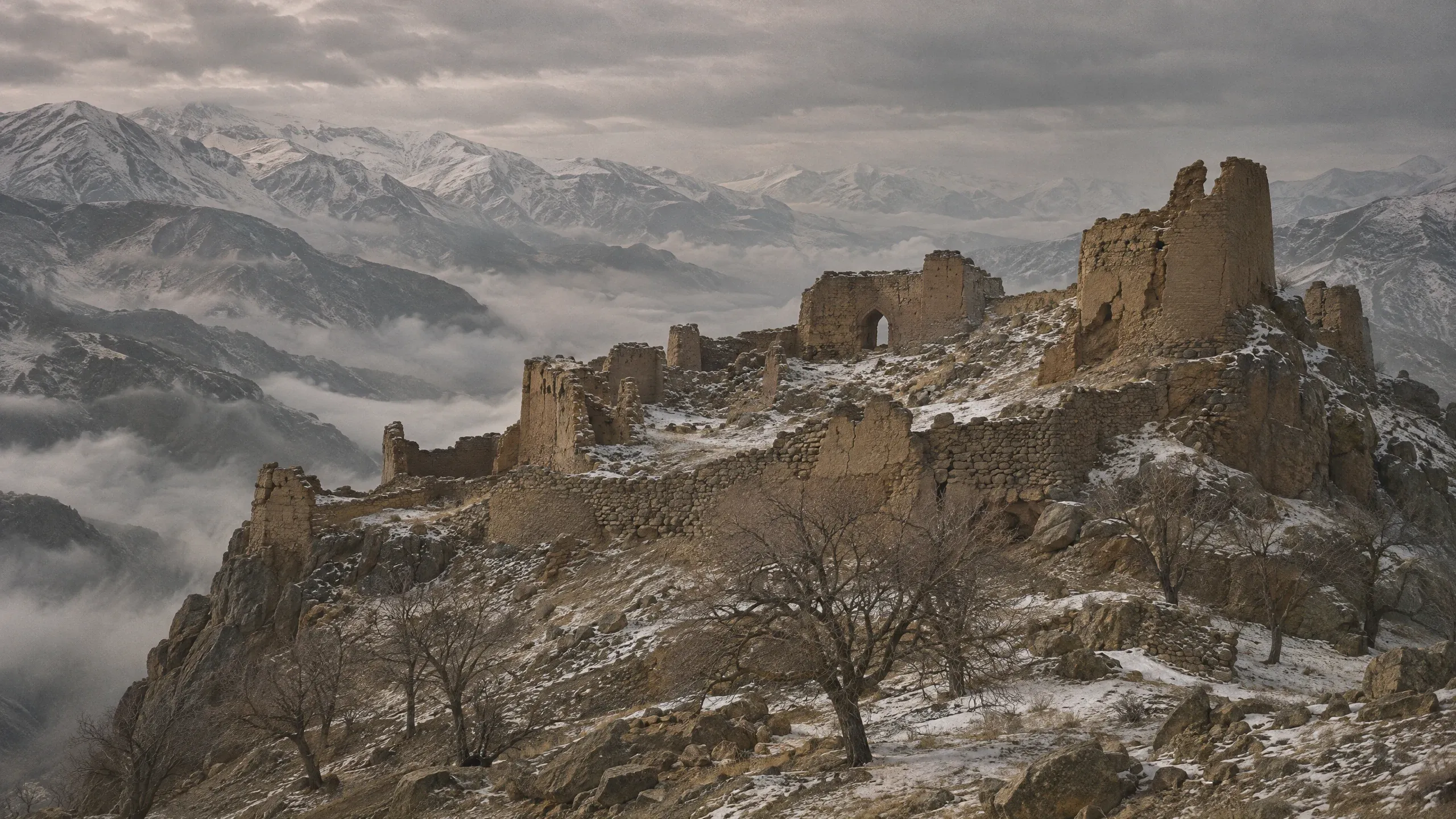
The darkest centuries
When Imam Rukn al-Din Khurshah surrendered to Hulegu in 654/1256 and the Mongols dismantled Alamut and the other castles of Rudbar and Quhistan, the Nizari Ismaili state that Hasan-i Sabbah had founded in 1090 came to an end. Hostile Persian historians, above all Juwayni, who accompanied the Mongol army, wrote as if the community itself had been extinguished. It had not. Khurshah was put to death in Mongolia in 655/1257 and many Nizaris were massacred, but communities survived in Daylam, in Quhistan and in other parts of Persia, while others migrated eastward into Afghanistan, Central Asia and Sind.1
What followed is the least documented period in all of Ismaili history. Farhad Daftary, the leading modern historian of the Ismailis, describes the first two post-Alamut centuries as “particularly obscure”. The Imams went into hiding and lost direct contact with most of their followers; scattered communities developed under local leaders; and Nizaris everywhere adopted taqiyya, the precautionary dissimulation of their real beliefs, presenting themselves as Sunnis, Sufis, Twelver Shi’is or, in South Asia, in forms close to Hinduism. Each disguise left traces in the surviving texts, which makes the record hard to read and easy to misread.2
Following Wladimir Ivanow, Daftary divides the post-Alamut history into periods. The first runs from the fall of Alamut to the middle of the fifteenth century, when the Imams were concealed and the community fragmented. The second, the “Anjudan revival”, begins around the middle of the fifteenth century, when the Qasim-Shahi Imams emerged at the village of Anjudan in central Persia and reorganised the da’wa. The third, the modern period, begins when the Imamate moved to India in the 1840s and is the subject of the chapter From Persia to Bombay.3
This chapter follows the Imams of the Qasim-Shahi line recognised by today’s Nizari Ismailis, from Shams al-Din Muhammad (Imam 28) to Shah Nizar II (Imam 40), whose death in 1722 at Kahak closes the Anjudan era. It also follows the rival Muhammad-Shahi line, the communities of Badakhshan and Central Asia, and the Persian literature that carried Ismaili teaching through these centuries. For many of the Imams of this period almost nothing is known beyond a name, a title and an approximate date; where that is so, this chapter says so.4
What the sources can and cannot tell us
The written record for these centuries is thin and scattered. The Nizaris of Persia produced few historical works after 1256; most of what survives is religious poetry and prose written in Persian, much of it couched in Sufi language. In Syria the Nizaris preserved their own texts, including the works of the da’i Abu Firas Shihab al-Din al-Maynaqi, who died in 937/1530–1531 or 947/1540–1541, and Ottoman tax registers show the Syrian communities as distinct groups. In South Asia, the Nizari Khojas preserved a large devotional literature, the ginans, of which about 800 compositions survive, mostly written in the Khojki script.5
The Persian Nizari literature of the period includes works by Nizari Quhistani (d. c. 720/1320), Abu Ishaq Quhistani (second half of the fifteenth century), Khayrkhwah-i Harati (d. after 960/1553), and Imam Quli Khaki Khurasani (d. after 1056/1646), whose son Ali Quli Raqqami lived at Dizbad in Khurasan. Much of it was preserved by the Nizaris of Badakhshan and the upper Oxus, and was catalogued in the twentieth century by Ivanow.6
A second problem is that the official list of the Nizari Imams for this period was only finalised in the late nineteenth century, and the names, titles and order of several Imams differ among Persian, Central Asian and Indian lists. Some Imams are known by two or three names; some dates are known only from later tradition. In the 1930s and 1970s, Ivanow and Daftary examined the tombstones and wooden cenotaphs at Anjudan and Kahak, which have supplied a few firm dates. Everything else rests on fragments in Safavid chronicles, local histories and the community’s own literature.7
Survival after the Mongols
The Mongol conquest did not end Nizari military resistance at once. In 674/1275–1276 Nizaris of Rudbar, in alliance with a descendant of the Khwarazmshahs, recaptured Alamut and held it for about a year before forces of the Ilkhan Abaqa dislodged them. After that, organised Nizari political life in Persia went underground.8
According to Nizari tradition, Khurshah’s young son Shams al-Din Muhammad had been designated by nass and was hidden before the fall of the castles. He was taken to Adharbayjan in north-western Persia, where he is said to have lived concealed, working as an embroiderer; from this comes the epithet Zarduz (“gold embroiderer”) attached to him in some traditions. Later legend confused him with Shams-i Tabriz, the spiritual guide of Jalal al-Din Rumi, an identification Daftary treats as legendary. He is said to have died around 710/1310 after an Imamate of about fifty years.9
The poet Nizari Quhistani, born at Birjand in Quhistan in 645/1247–1248, offers the only near-contemporary glimpse of the hidden Imam. Nizari served the Kart rulers of Herat and the Mihrabanid rulers of Quhistan. In Shawwal 678/February 1280 he left Tun for a journey of about two years through Adharbayjan and the Caucasus, which he described in a verse travelogue, the Safar-nama, of about 1,200 couplets. Allusions in that poem suggest that he saw the Imam, possibly at Tabriz in 679/1280. He was also the first Nizari author known to use Sufi vocabulary systematically, with terms such as khanaqah, darwish, arif, qalandar, pir and murshid.10
Taqiyya and the Sufi cloak
Taqiyya was an old Shi’i principle. Imam Ja’far al-Sadiq had made it, in Daftary’s words, “an absolute article of Shi’i faith”, allowing believers to conceal their allegiance when open profession endangered them. After 1256 the Nizaris applied it on an unprecedented scale and for an unprecedented length of time. Unlike earlier periods, when the da’wa chose concealment, this time the dispersed communities adopted it on their own initiative, without central direction, because they had lost contact with their Imams.11
The most important disguise was Sufism. As Sufi orders spread through Persia and Central Asia after the Mongol conquest, Nizaris found in Sufi vocabulary a language that shared much with their own esoteric teaching: the distinction between outward law and inner truth, the need for a living spiritual guide, and the idea of a hierarchy of initiation. The Imams themselves came to live outwardly as Sufi pirs, and their followers as murids, disciples. To outside observers, a Nizari community looked like one more Sufi circle.12
The relationship was close enough that the Nizaris came to regard several great Persian mystical poets as their own co-religionists, among them Sana’i, Attar, Jalal al-Din Rumi, Qasim al-Anwar and Aziz al-Din Nasafi. A Nizari commentary was written on the Gulshan-i raz of Mahmud Shabistari, composed in 717/1317; it may be the work of the later Muhammad-Shahi Imam Shah Tahir Dakkani. In Badakhshan the works of Nasir Khusraw were transmitted alongside Sufi poetry, and the boundary between the two traditions became hard to draw.13
Sufi forms were not the only cover. In Persia Nizaris passed as Sunnis before 1501 and as Twelver Shi’is under the Safavids. In Badakhshan, Iloliev argues, post-Alamut da’is who had fled the Mongols adopted usul al-taqiyya and introduced Sufi and Twelver Shi’i ideas into the older “Da’wat-i Nasir” tradition, producing the local “Panj-Tani” faith centred on the five members of the Prophet’s family. In South Asia, the pirs presented Ismaili teaching in Indian idioms that came to be called Satpanth. The whole subject is treated in the topic page on taqiyya.14
Shared ground: Ismailis, Sufis and Shi’i gnosis
The Sufi exterior was not a mere costume. Daftary stresses that it would not have been possible had the two traditions not shared common ground. Both relied on ta’wil, the esoteric interpretation of scripture; both taught that the outward forms of religion conceal an inner truth; and both placed a living guide at the centre of spiritual life. The ground had been prepared during the Alamut period, and after 1256 Sufi teachings and terminology flowed into Persian Nizari writing while some Sufis began to use ideas usually ascribed to the Ismailis. As a result it is often impossible to say whether a given post-Alamut Persian treatise is the work of a Nizari influenced by Sufism or of a Sufi exposed to Ismaili teaching.15
The Gulshan-i raz (“The Rose-Garden of Mystery”) illustrates the overlap. Sa’d al-Din Mahmud Shabistari, a Sufi shaykh born around 686/1287 at Shabistar near Tabriz, composed it in 717/1317 as a poem of about a thousand couplets answering questions put to him by Husayni Sadat Amir, a Sufi master of Herat. It became one of the most popular summaries of Sufi symbolism, and its most famous commentary was written by the Nurbakhshi shaykh Muhammad Lahiji (d. 912/1506). The Nizaris of Persia and Central Asia nevertheless counted the poem as part of their own literature, and an anonymous Nizari commentary offers Ismaili ta’wil of selected passages.16
Twelver Shi’ism developed its own relationship with Sufism in the same centuries. Sayyid Haydar Amuli (d. after 787/1385), a Twelver theologian from Mazandaran strongly influenced by Ibn al-Arabi, argued that the true believer combines shari’a, tariqa and haqiqa, balancing the outward and the inward. Yet Amuli denounced the Ismailis as heretics for, in his view, undermining the law in favour of inner truth. His synthesis prepared the way for the “school of Isfahan” of Mir Damad (d. 1040/1630) and Mulla Sadra (d. 1050/1640), whose “divine wisdom” (hikmat-i ilahi) Daftary compares with the “philosophical Ismailism” of the Fatimid-era Iranian da’is.17
On the radical edge of the same milieu stood movements that the Safavids and Timurids treated as dangerous. The Hurufi movement was founded by Fadl Allah Astarabadi, born in 740/1339–1340, who by 788/1386 proclaimed that the era of prophecy had given way to the manifestation of the divine in man, and above all in himself. The Hurufis practised esoteric interpretation of the letters of the Arabic alphabet. Timur’s jurists sentenced Fadl Allah to death, and he was executed by Timur’s son Miranshah in 796/1394; his movement then spread to Anatolia. The Nuqtawiyya, founded around 800/1397–1398 by Mahmud Pasikhani, were another: they believed in metempsychosis and interpreted resurrection, paradise and hell spiritually, much as the Persian Nizaris had done in the time of the qiyama. Shah Tahmasp I persecuted them late in his reign, and Shah Abbas I killed many of them and their leaders in 1002/1593–1594; survivors took refuge in Mughal India. Daftary notes that Hurufi doctrine drew on Persian Sufism and on Ismailism among other traditions, but the movements were distinct from the Nizari community.18
The split: Muhammad-Shahis and Qasim-Shahis
Sometime in the fourteenth century the Nizari Imamate divided. One line, called the Muhammad-Shahi or Mu’mini, traced the Imamate through Ala al-Din Mu’min Shah; the other, the Qasim-Shahi, traced it through Qasim Shah. The Qasim-Shahi line is the one recognised by the Nizari Ismailis who today follow the Aga Khans; the Muhammad-Shahi line ended about two centuries ago. The Qasim-Shahi sources are silent on the schism itself, and the details have to be reconstructed from Muhammad-Shahi texts.19
The sources disagree on when the split happened. Syrian Nizari oral tradition places it at the death of Shams al-Din Muhammad, with his eldest son Mu’min Shah and his middle son Qasim Shah (also called Kiya Shah) both claiming the succession. Two Muhammad-Shahi texts, the Irshad al-talibin of Muhibb Ali Qunduzi, written in Badakhshan in 929/1523, and the Lama’at al-tahirin of Ghulam Ali ibn Muhammad, written in India in 1110/1698–1699, give genealogies of their line. Daftary notes, however, that the earliest Qasim-Shahi sources themselves name Mu’min Shah as Shams al-Din’s son and successor, followed by Qasim Shah, which would place the dispute a generation later, after Mu’min Shah’s death around 738/1337. The question is examined in detail in The Muhammad-Shahi/Qasim-Shahi split.20
At first the Muhammad-Shahi line seems to have had the larger following. It held the allegiance of most Nizaris in Syria, in Daylam and, initially, in Badakhshan. Its Imams were also the more politically active. A Muhammad-Shahi Imam was very probably the “Khudawand Muhammad” who, according to Zaydi chronicles of Gilan, campaigned in Daylam in the 1370s, held Alamut for a time and surrendered to the Zaydi ruler Sayyid Ali Kiya, before being exiled by Timur to Sultaniyya; Daftary identifies him tentatively with the Muhammad-Shahi Imam Muhammad Shah ibn Mu’min Shah, who died in 807/1404.21
Daylam remained a Nizari region into the sixteenth century. Around 770/1368–1369 a Nizari, Kiya Sayf al-Din Kushayji, ruled in Daylaman until he was killed by Sayyid Ali Kiya, the founder of the Zaydi Kiya’i dynasty of Lahijan. Later, the rulers of the small Banu Iskandar principality of Kujur in Rustamdar were Nizaris: Sultan Muhammad ibn Jahangir succeeded in 975/1567 and died in 998/1589–1590, and his son Jahangir was executed at Qazwin in 1006/1597–1598 on the orders of the Safavid Shah Abbas I. Alamut itself had by then become a Safavid state prison.22
The Qasim-Shahi Imams in hiding
Of the first Qasim-Shahi Imams very little is known. Qasim Shah (Imam 29) is said to have succeeded around 710/1310, to have lived in Adharbayjan, and to have held the Imamate for about sixty years until his death around 771/1369–1370. His successor Islam Shah (Imam 30), also known as Ahmad Shah, was a contemporary of Timur and died around 829/1425–1426. Islam Shah appears to have moved the residence of the Imams from Adharbayjan to the area of Qumm and Mahallat in central Persia, possibly to Anjudan itself.23
The move did not go unnoticed. Sharaf al-Din Ali Yazdi, Timur’s court historian, records that in Rajab 795/May 1393 Timur sent troops against the “heretics” of Anjudan, who were found hiding in underground tunnels that the attackers flooded. At the end of 794/1392 Timur had already massacred Nizaris in Mazandaran, probably Muhammad-Shahis. Daftary reads the Anjudan expedition as evidence that Nizaris were living there by the end of the fourteenth century.24
The Khoja tradition of South Asia preserves the name of Islam Shah. According to the Khojas, Pir Sadr al-Din, the pir credited with converting the first Khojas, was sent from Khurasan by “Shah Islam”; this was the version accepted by Justice Arnould in the Aga Khan Case of 1866. Of Islam Shah’s successor Muhammad ibn Islam Shah (Imam 31) no reliable details survive beyond his name and place in the list.25
Sufi orders and the Shi’i turn in Persia
The Nizari revival took place in a Persia whose religious landscape was changing. After the collapse of the Ilkhanate following the death of Abu Sa’id (r. 1317–1335), Sufi orders spread rapidly, and several of them developed Alid and Shi’i loyalties while remaining outwardly Sunni. Marshall Hodgson called this “tariqa Shi’ism”. Orders such as the Nurbakhshiyya and the Ni’mat Allahiyya, and movements such as the Hurufis and Nuqtawis, blurred the line between Sufi devotion and Shi’i belief.26
The Ni’mat Allahi order would matter greatly to the later Imams. Its founder, Shah Ni’mat Allah Wali, was born in Aleppo in 731/1330, died in 834/1431 near Kirman and was buried at Mahan; he claimed descent from Muhammad ibn Isma’il. Three centuries later the Imams were closely tied to the order (see From Persia to Bombay).27
The culmination of these trends was the Safavid order of Ardabil, which became a militant Shi’i movement. When Shah Isma’il entered Tabriz in 907/1501 and proclaimed Twelver Shi’ism the religion of his state, Persia’s religious situation changed permanently. For the Nizaris this was a mixed development: they could now present themselves as Shi’is, but the Safavid state soon turned against popular Sufism and against Shi’i movements it did not control.28
Anjudan: the revival begins
The first Qasim-Shahi Imam who can be firmly connected with Anjudan is Ali Shah, who took the throne-name Mustansir bi’llah II (Imam 32) and was known in Sufi circles as Shah Qalandar. He succeeded around 868/1463–1464 and died in 885/1480, a date written on the wooden cenotaph in his mausoleum; Nizari tradition gives 880/1475–1476. His octagonal mausoleum, known locally as the tomb of Shah Qalandar, is the oldest of the Imams’ tombs at Anjudan.29
Anjudan lies about 37 kilometres east of Arak and about the same distance west of Mahallat, in the Farahan plain. When Daftary visited it in 1976 it was a village of about a thousand Twelver Shi’i inhabitants. Ivanow, who identified the site in 1937, found an old mosque and three mausoleums there. Daftary suggests why the Imams chose it: it was central, close to the Shi’i centres of Qumm and Kashan, and far from the capitals of the Aq Qoyunlu at Tabriz and the Timurids at Herat. The Imams’ throne-names, Mustansir bi’llah, recalled the Fatimid caliph al-Mustansir, the last Imam recognised by both Nizaris and Musta’lis.30
The revival was a reorganisation of the da’wa. By the fifteenth century, local pirs in many regions had become hereditary and practically independent of the Imams. Mustansir bi’llah II sent da’is to Khurasan, Afghanistan and Badakhshan to reassert the Imam’s authority, collect religious dues and win over Muhammad-Shahi communities. His sermons and counsels, collected under his successor as the Pandiyat-i javanmardi (“Counsels of Chivalry”), circulated in Persian and were later rendered into Sindhi and Gujarati for the Khojas; copies are known from Badakhshan, Hunza and Chinese Turkistan. The subject is treated in The Anjudan revival.31
His successor Abd al-Salam Shah (Imam 33), who died around 899/1493–1494, continued the work; in 895/1490 he addressed a farman to the Muhammad-Shahis of Badakhshan and Afghanistan inviting them to recognise the Qasim-Shahi Imam. His grave has not been found. He was followed by Abbas Shah, known as Gharib Mirza or Mustansir bi’llah III (Imam 34), remembered locally as Shah Gharib. Tradition places his death in 902/1496–1497; a wooden box in his mausoleum is dated Muharram 904/August 1498.32
Teaching in the Anjudan period
The doctrine set out in the Pandiyat and in the works of Abu Ishaq and Khayrkhwah divided religion into three levels: the shari’at (the religious law), the tariqat (the spiritual path) and the haqiqat (the truth). The Nizaris called themselves the ahl-i haqq or ahl-i haqiqat, “people of the truth”. Reaching the haqiqat meant recognising the Imam of the time, and the believer’s highest goal was the didar, the vision of the Imam. Murids were to pay the dah-yik, a tithe of one tenth of their income, to the Imam.33
The da’wa hierarchy described in these texts placed below the Imam a hujja (the hujjat-i a’zam, chief proof), then the da’i, the mu’allim (teacher), the senior and junior ma’dhun (licentiates), and finally the mustajib, the initiate. The hujja held a central place: the Imam could be known only through him. Humanity was divided into the ahl-i tadadd (people of opposition), the ahl-i tarattub (people of gradation, ordinary believers) and the ahl-i wahdat (people of union, who recognised the Imam’s true nature).34
Khayrkhwah-i Harati’s autobiographical Risala gives a rare view of the da’wa from inside. His father, a da’i, was murdered while travelling; Khayrkhwah was appointed in his place at nineteen, visited the Imam at Anjudan for about two weeks, saw pirs arriving with religious dues and the Imam punishing those who embezzled them, and was named da’i of Khurasan. He wrote under the pen name Gharibi and claimed for himself the rank of pir-i kull, chief pir. Daftary notes that he reused Abu Ishaq’s Haft bab in a work attributed to Nasir Khusraw, the Kalam-i pir.35
Under the Safavids
Persecution
The Safavid period opened under Imam Abu Dharr Ali (Imam 35), also called Nur al-Din, a contemporary of Shah Isma’il I and Shah Tahmasp I. Nizari tradition holds that he married a sister or daughter of Tahmasp, which, if true, suggests that the Imams had already established a working relationship with the new dynasty. But the Safavids soon persecuted Sufi and Shi’i groups whose loyalties lay outside the state, and the Nizaris did not escape.36
The clearest case is that of Murad Mirza (Imam 36). The Safavid chronicles, including the Tarikh-i alfi and Qadi Ahmad Qummi, record that he had acquired a large following, including followers in India who sent him money from Sind. Early in 981/1573 Shah Tahmasp ordered Amir Khan Musilu, governor of Hamadan, to suppress him. Murad Mirza was captured in a fortress in the Kamara district, escaped in Jumada II 981/October 1573 with a companion, Muhammad Muqim, and fled towards Qandahar, helped by followers in Fars, Makran and Sind. He was recaptured by Didar Beg and executed together with Muhammad Muqim.37
The persecution explains a gap at Anjudan. The graves of Abu Dharr Ali and Murad Mirza have not been found, and Daftary observes that no Imam can be shown to have lived openly at Anjudan between about 904/1498 and 981/1574. Khayrkhwah mentions an Imam who remained hidden for seven years. The poet Amri Shirazi, whom the Persian Nizaris regard as a co-religionist, had served Tahmasp for thirty years before being blinded for heresy in 973/1565–1566; he was executed at Shiraz as a Nuqtawi in 999/1590–1591 on the orders of Shah Abbas I. Ivanow found in Nizari anthologies poems by Amri eulogising the Nizari Imams of his time, including Murad Mirza, and Daftary suggests he may have been a Nizari, or a crypto-Nizari appearing as a Nuqtawi.38
Accommodation
Relations improved under Shah Abbas I (r. 1588–1629), who was tolerant towards the Nizaris. Murad Mirza’s successor Dhu’l-Fiqar Ali (Imam 37), known as Khalil Allah I, is said to have married a Safavid princess, possibly a sister of Abbas I. A royal edict dated Rajab 1036/March–April 1627, addressed to “Amir Khalil Allah Anjudani”, exempted the Shi’is of Anjudan, then a dependency of Qumm, from certain taxes. The edict treats them as Twelver Shi’is, which Daftary reads as a sign of how completely the community had adopted Twelver Shi’i taqiyya. Khalil Allah I died aged sixty-eight in Ramadan 1043/March 1634.39
His successor Nur al-Dahr Ali (Imam 38), also called Nur al-Din, died in Rajab 1082/November 1671 according to his tombstone. The poet Khaki Khurasani praised both Shah Dhu’l-Fiqar and Nur al-Dahr and refers to their residence at Anjudan, confirming that by then the Imams lived there openly. Other poets of this period, such as Aziz Allah Qummi and Niyazi, show that the da’wa reached from Khurasan to Iraq-i Ajam, Multan and India; a poem by Mahmud Ali of Muminabad lists the da’is of Khurasan, Multan, Lahore and Gujarat.40
The last Imam to live at Anjudan was Khalil Allah II (Imam 39), who died in Dhu’l-Hijja 1090/January 1680. His tombstone is one of five set into the wall of a mausoleum at Anjudan. His successor Shah Nizar II moved the seat of the Imamate to Kahak, about 35 kilometres north-east of Anjudan, ending the Anjudan period after more than two centuries.41
Badakhshan and Central Asia
Ismailism had reached Badakhshan, the mountain country of the upper Oxus now divided between Afghanistan and Tajikistan, long before Alamut fell. The Fatimid da’i Nasir Khusraw, who died around 1080, spent his last years at Yumgan, and the Ismailis of the Pamirs still regard him as their founding pir, the “Pir of Kuhistan”. Iloliev calls the earlier phase the “Da’wat-i Nasir”, Nasir’s mission.42
After 1256, refugee da’is reactivated the da’wa in the region. Local traditions name two of them. The first, Sayyid Shah Malang, came to Shughnan from Khurasan and took control of the area by deposing its ruler; he was followed by a second da’i, Mir Sayyid Hasan Shah Khamush. Lineages of pirs and mirs claiming descent from such figures led the Ismaili communities and small principalities of the Pamirs for centuries, among them the Ismaili mirs of Shughnan. Under Timurid annexation in the fifteenth century and Ozbeg domination in the sixteenth, the Nizaris of Badakhshan relied on these local dynasties and on taqiyya. The resulting “Panj-Tani” religion combined Nasir Khusraw’s teaching, Sufi and Twelver Shi’i elements, and older local practices.43
Badakhshan was at first Muhammad-Shahi territory. In 913/1507 Shah Radi al-Din ibn Tahir, a Nizari leader who had earlier led the Nizaris of Quhistan and who is probably the thirtieth Muhammad-Shahi Imam, came from Sistan to Badakhshan and with local Nizari help established his rule over part of the region. He was killed in spring 915/1509 amid quarrels among his own supporters, and his head was taken to the Timurid amir Mirza Khan at the fortress of Zafar on the left bank of the Kokcha; Mirza Khan and his successors then persecuted the Muhammad-Shahi Nizaris of Badakhshan. The Anjudan Imams’ letters and da’is were aimed precisely at such communities, and the Ismailis of Badakhshan today follow the Qasim-Shahi line, though the stages of that transfer are poorly documented. The Muhammad-Shahi text Irshad al-talibin was written there in 929/1523.44
Badakhshan’s importance for the history of the whole community is also literary. The Nizaris of Badakhshan and the upper Oxus retained a distinct literary tradition and preserved and transmitted the anonymous Umm al-kitab, the writings of Nasir Khusraw, and the Persian Nizari works of the Alamut and post-Alamut periods, including the treatises that fused Ismaili and Sufi expression. Much of what is known of Persian Ismaili thought between the thirteenth and seventeenth centuries survives in manuscripts copied there. The later history of the region’s Ismailis, including the Pamiri communities around Khorog and Hunza, is treated in Ismailis of Central Asia.45
The Muhammad-Shahi line in India and Syria
The most famous Muhammad-Shahi Imam was Shah Tahir Dakkani, the son of Radi al-Din II. Daftary describes him as a learned theologian, poet, stylist and diplomat. His family had a large following in Persia at Khund near Qazwin; Safavid suspicion of that following drove him in 926/1520 to leave Persia by way of Fars and sail to India, landing at Goa. He moved to Bijapur and then, in 928/1522, to Ahmadnagar, where he became the trusted adviser of Burhan Nizam Shah. Under his influence Burhan converted to Shi’ism and in 944/1537 proclaimed Twelver Shi’ism the religion of the Nizam Shahi state. Shah Tahir himself professed Twelver Shi’ism outwardly. He died in 952/1545–1546 or 956/1549 and was buried at Karbala.46
His successors remained in the Deccan and were gradually absorbed into its Twelver Shi’i society. The line continued to the fortieth Muhammad-Shahi Imam, Amir Muhammad al-Baqir, whose last known contact with his Syrian followers was in Sha’ban 1210/February 1796. Most of the Syrian Muhammad-Shahis then went over to the Qasim-Shahi line, recognising Aga Khan III in 1304/1887; a minority remained Muhammad-Shahi, numbering around 15,000 in the region of Masyaf and Qadmus when Daftary wrote.47
The Syrian Nizaris
The Nizaris of Syria followed a different course. They had been a semi-autonomous branch of the Alamut state, holding castles such as Masyaf and Qadmus in the Jabal Bahra west of Hama. By 671/1273 the Mamluk sultan Baybars I had seized all their fortresses, but the Syrian Nizaris were permitted to survive as a semi-autonomous community. Unlike the Persian Nizaris, they adhered almost entirely to the Muhammad-Shahi line until the nineteenth century.48
Syrian Nizari literature is in Arabic and developed independently of the Persian tradition. The community preserved many Fatimid-era Ismaili texts, and Fatimid doctrines remained visible in works of Syrian origin, but it produced only a few original authors in this period. The most prominent was the da’i Abu Firas Shihab al-Din al-Maynaqi, whose Fasl exalts the Alamut-era leader Rashid al-Din Sinan as a saintly hero under divine protection. Under the Ottomans the Nizaris led what Daftary calls an uneventful life; Ottoman land registers record them and their castles, the qila’ al-da’wa. Their later history is treated in Ismailis of Syria.49
South Asia in the same centuries
While the Imams lived in concealment and then at Anjudan, the largest Nizari population took shape in South Asia. Pirs such as Pir Shams, Pir Sadr al-Din and Pir Hasan Kabir al-Din (d. c. 875/1470) taught in Sind, Punjab and Gujarat, and their ginans name the Qasim-Shahi Imams. After a succession dispute among the pirs’ descendants, Imam Shah (d. 919/1513) founded a separate line at Pirana near Ahmadabad. The Anjudan Imams eventually replaced hereditary pirs with appointed representatives and sent the Pandiyat-i javanmardi to India, where it was treated as the work of a twenty-sixth “pir”. The full story is told in The Pirs and South Asia.50
The link between Persia and India was a road of pilgrims and money. Khoja deputations made the long journey to Anjudan to see the Imam and to deliver the dues collected by their mukhis, and the Safavid chronicles’ report that Murad Mirza received money from Sind shows how far back this flow went. It also explains later moves of the Imamate southward, first to Kerman and then to India itself.51
Kahak and the end of the Anjudan era
Shah Nizar II’s Imamate, from 1090/1680 to 1134/1722, marks the transition. Kahak was a small village north-west of Mahallat, near a Safavid caravanserai on the road from Qumm to Arak; in the 1970s it had about 500 Twelver Shi’i inhabitants. The Imam’s mausoleum stands at the western end of the village. Its tombstone gives his death as Dhu’l-Hijja 1134/September 1722, while later Nizari sources place it, wrongly according to Daftary, in 1038/1628. Some tombstones nearby are inscribed in the Khojki script, evidence of Indian Khoja pilgrims and burials.52
From Shah Nizar’s time the connection between the Imams and the Ni’mat Allahi Sufi order becomes clear. He used the Sufi name Ata Allah, and a group of his followers, Khurasani nomads later settled around Sirjan and Kerman, became known as the Ata Allahis. They would provide the Imams with armed support in the eighteenth and nineteenth centuries. The fall of the Safavids in the same year as Shah Nizar’s death, 1722, opened the period of upheaval in which the Imams moved to Kerman, entered Persian politics and finally left for India.53
What these centuries left
The four and a half centuries after Alamut changed the Nizari Ismailis more than any period since the Fatimids. A state with castles, coinage and an army became a set of dispersed communities that survived by concealment. Their religion was expressed in the language of Persian Sufism, in Indian devotional poetry and in Pamiri tradition rather than in Arabic treatises. The Imamate split, and the branch that had at first seemed weaker outlasted the other. And yet the central doctrine, that there is always a living Imam of the time to be recognised, was preserved throughout, and it was this doctrine that the Anjudan Imams rebuilt their da’wa around.54
Footnotes
-
Farhad Daftary, The Isma’ilis: Their History and Doctrines, 2nd ed. (Cambridge University Press, 2007), p. 410. ↩
-
Daftary, The Isma’ilis, 2nd ed. (Cambridge University Press, 2007), pp. 403–404. ↩
-
Daftary, The Isma’ilis, 2nd ed. (Cambridge University Press, 2007), pp. 403–405. ↩
-
Daftary, The Isma’ilis, 2nd ed. (Cambridge University Press, 2007), pp. 413, 418–425. ↩
-
Daftary, The Isma’ilis, 2nd ed. (Cambridge University Press, 2007), pp. 406–409. ↩
-
Daftary, The Isma’ilis, 2nd ed. (Cambridge University Press, 2007), p. 406; Wladimir Ivanow, Ismaili Literature: A Bibliographical Survey (Tehran: Ismaili Society, 1963), https://archive.org/details/ismaili-literature-a-bibliographical-survey. ↩
-
Daftary, The Isma’ilis, 2nd ed. (Cambridge University Press, 2007), pp. 413, 422–425, 457. ↩
-
Daftary, The Isma’ilis, 2nd ed. (Cambridge University Press, 2007), p. 411. ↩
-
Daftary, The Isma’ilis, 2nd ed. (Cambridge University Press, 2007), pp. 411, 413. ↩
-
Daftary, The Isma’ilis, 2nd ed. (Cambridge University Press, 2007), pp. 411–412. ↩
-
Daftary, The Isma’ilis, 2nd ed. (Cambridge University Press, 2007), pp. 82, 404, 410. ↩
-
Daftary, The Isma’ilis, 2nd ed. (Cambridge University Press, 2007), pp. 412, 419. ↩
-
Daftary, The Isma’ilis, 2nd ed. (Cambridge University Press, 2007), pp. 419–420. ↩
-
Daftary, The Isma’ilis, 2nd ed. (Cambridge University Press, 2007), pp. 404, 435, 437; Abdulmamad Iloliev, The Isma’ili-Sufi Sage of Pamir (Cambria Press, 2008), pp. 6–7. ↩
-
Daftary, The Isma’ilis, 2nd ed. (Cambridge University Press, 2007), p. 419. ↩
-
Daftary, The Isma’ilis, 2nd ed. (Cambridge University Press, 2007), p. 419. ↩
-
Daftary, The Isma’ilis, 2nd ed. (Cambridge University Press, 2007), pp. 420–421. ↩
-
Daftary, The Isma’ilis, 2nd ed. (Cambridge University Press, 2007), pp. 421–422; on the Nuqtawis, p. 422. ↩
-
Daftary, The Isma’ilis, 2nd ed. (Cambridge University Press, 2007), p. 413. ↩
-
Daftary, The Isma’ilis, 2nd ed. (Cambridge University Press, 2007), pp. 413–414. ↩
-
Daftary, The Isma’ilis, 2nd ed. (Cambridge University Press, 2007), pp. 414–416. ↩
-
Daftary, The Isma’ilis, 2nd ed. (Cambridge University Press, 2007), pp. 415–417. ↩
-
Daftary, The Isma’ilis, 2nd ed. (Cambridge University Press, 2007), p. 418. ↩
-
Daftary, The Isma’ilis, 2nd ed. (Cambridge University Press, 2007), p. 418. ↩
-
Joseph Arnould, Judgment in the Khojah Case, otherwise known as the Aga Khan Case (Bombay Gazette Steam Press, 1866), section on Pir Sadr al-Din, https://archive.org/details/bk1209; Daftary, The Isma’ilis, 2nd ed. (Cambridge University Press, 2007), pp. 418, 443. ↩
-
Daftary, The Isma’ilis, 2nd ed. (Cambridge University Press, 2007), pp. 421–428. ↩
-
Daftary, The Isma’ilis, 2nd ed. (Cambridge University Press, 2007), pp. 428–429. ↩
-
Daftary, The Isma’ilis, 2nd ed. (Cambridge University Press, 2007), pp. 430–431, 435. ↩
-
Daftary, The Isma’ilis, 2nd ed. (Cambridge University Press, 2007), pp. 422–423, 431. ↩
-
Daftary, The Isma’ilis, 2nd ed. (Cambridge University Press, 2007), pp. 422–423, 431. ↩
-
Daftary, The Isma’ilis, 2nd ed. (Cambridge University Press, 2007), pp. 432–433. ↩
-
Daftary, The Isma’ilis, 2nd ed. (Cambridge University Press, 2007), pp. 423, 433. ↩
-
Daftary, The Isma’ilis, 2nd ed. (Cambridge University Press, 2007), p. 433. ↩
-
Daftary, The Isma’ilis, 2nd ed. (Cambridge University Press, 2007), pp. 439–442. ↩
-
Daftary, The Isma’ilis, 2nd ed. (Cambridge University Press, 2007), pp. 433–434. ↩
-
Daftary, The Isma’ilis, 2nd ed. (Cambridge University Press, 2007), p. 435. ↩
-
Daftary, The Isma’ilis, 2nd ed. (Cambridge University Press, 2007), p. 436. ↩
-
Daftary, The Isma’ilis, 2nd ed. (Cambridge University Press, 2007), pp. 422, 436. ↩
-
Daftary, The Isma’ilis, 2nd ed. (Cambridge University Press, 2007), p. 437. ↩
-
Daftary, The Isma’ilis, 2nd ed. (Cambridge University Press, 2007), pp. 437–438. ↩
-
Daftary, The Isma’ilis, 2nd ed. (Cambridge University Press, 2007), pp. 425, 439, 456. ↩
-
Abdulmamad Iloliev, The Isma’ili-Sufi Sage of Pamir (Cambria Press, 2008), pp. 6–7. ↩
-
Daftary, The Isma’ilis, 2nd ed. (Cambridge University Press, 2007), pp. 451–452; Iloliev, The Isma’ili-Sufi Sage of Pamir (Cambria Press, 2008), p. 7. ↩
-
Daftary, The Isma’ilis, 2nd ed. (Cambridge University Press, 2007), pp. 414, 451–452. ↩
-
Daftary, The Isma’ilis, 2nd ed. (Cambridge University Press, 2007), p. 406; Ivanow, Ismaili Literature (Ismaili Society, 1963). ↩
-
Daftary, The Isma’ilis, 2nd ed. (Cambridge University Press, 2007), pp. 453–455. ↩
-
Daftary, The Isma’ilis, 2nd ed. (Cambridge University Press, 2007), pp. 455–456. ↩
-
Daftary, The Isma’ilis, 2nd ed. (Cambridge University Press, 2007), pp. 301, 406, 408. ↩
-
Daftary, The Isma’ilis, 2nd ed. (Cambridge University Press, 2007), pp. 371, 406, 408. ↩
-
Daftary, The Isma’ilis, 2nd ed. (Cambridge University Press, 2007), pp. 442–450. ↩
-
Daftary, The Isma’ilis, 2nd ed. (Cambridge University Press, 2007), pp. 436, 459, 473. ↩
-
Daftary, The Isma’ilis, 2nd ed. (Cambridge University Press, 2007), pp. 456–457. ↩
-
Daftary, The Isma’ilis, 2nd ed. (Cambridge University Press, 2007), pp. 457–458. ↩
-
Daftary, The Isma’ilis, 2nd ed. (Cambridge University Press, 2007), pp. 403–405, 433, 439–442. ↩