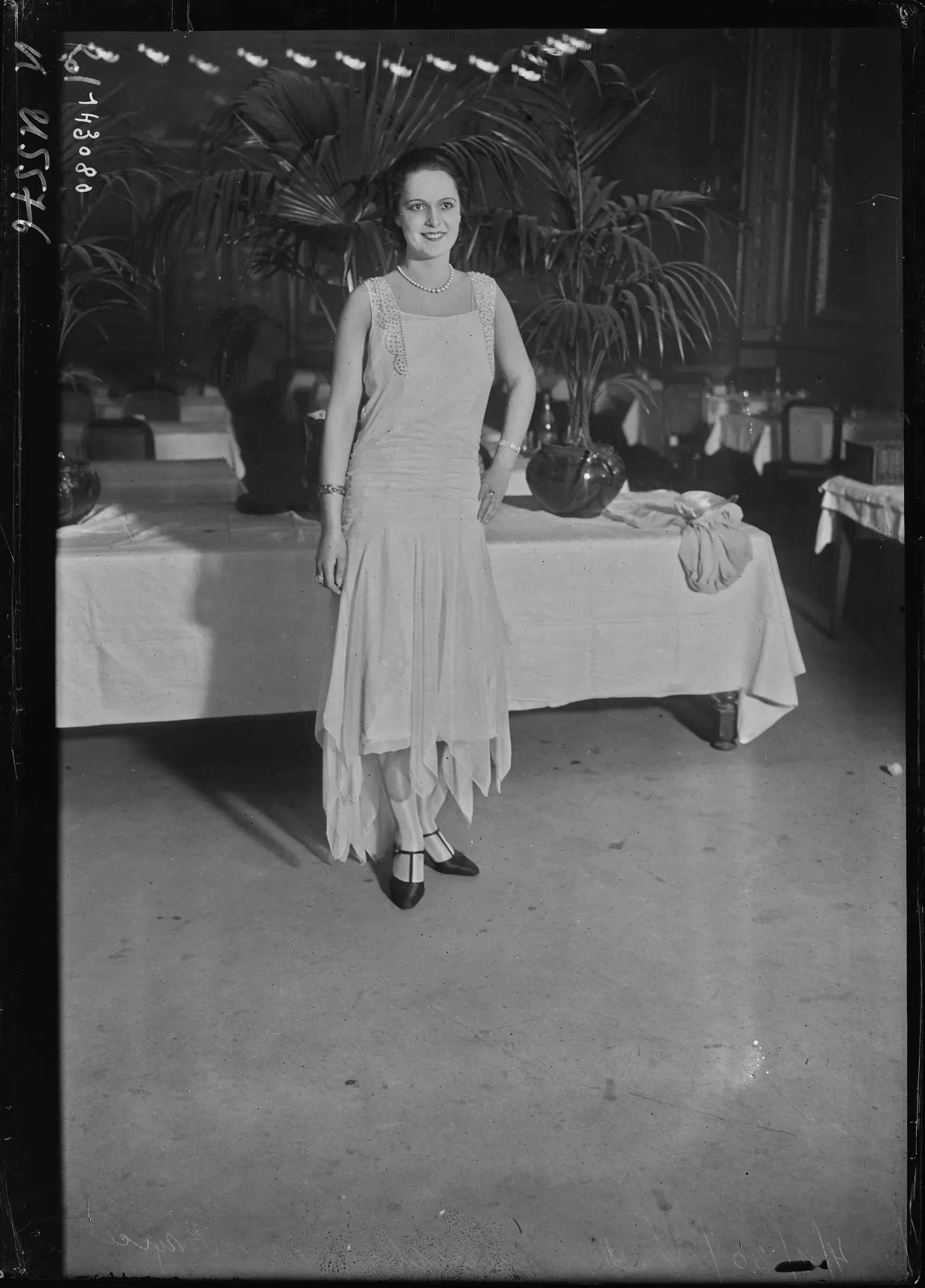
Yvette Labrousse (1906-2000) was the fourth and last wife of Aga Khan III. They married in 1944, and she was known as the Begum Aga Khan. By 1946 her husband had given her the title Mata Salamat, and in 1947 the name Om Habibeh. She converted to Islam in Cairo before the marriage, accompanied the Imam at the Diamond Jubilee ceremonies of 1946 in Bombay and Dar es Salaam, and was with him through the illnesses of his last decade. After his death in 1957 he was buried in a mausoleum at Aswan on the Nile, a place the couple had visited together.1
Background
Greenwall, writing in 1952, gives the press accounts of her background at the time of the marriage. She was described as a former dressmaker in Lyon who had been elected “Queen of Lyons” and, in 1930, “Miss France”. He adds that she was the daughter of a railway worker in Cannes, and quotes her remark that her father “had no ambition; he could have been a station master”. These details come from contemporary newspapers rather than documentary sources.2
Marriage
Aga Khan III and his third wife, Andree, were divorced by mutual consent in a civil court in Geneva in 1943, where he spent the war years. “Thirteen months later,” the memoirs continue, “I married my present wife, whom I had first met in Cairo and whom I had known for many years.” Daftary dates the marriage to 1944. Greenwall records that the press gave her age as thirty-eight and the Imam’s as sixty-eight.3
The Imam wrote that he had never asked a Christian to change her religion in order to marry him, since Islamic law allows Muslims to marry Christians and Jews who keep their own faith. His wife, he states, had already converted to Islam in Cairo “with no attempt on my part at influencing her mind”. He suggests her motives: “the quiet fervour of Muslim believers in their Friday prayers”, “the complete absence of snobbery, prejudice, and racial pride” in Islamic practice, and the beauty of mosques such as that of Sultan Hasan in Cairo.4
War and Cairo
In early 1945, after the liberation of France, the British Ambassador in Paris, Duff Cooper, arranged French police protection for the couple. They travelled through still-unsettled country to Marseilles, where they were guests of the United States Army, and flew in a British military aircraft to Cairo. The memoirs describe Cairo’s crowded wartime social life and the Imam’s many Egyptian friends at court and in politics.5
The Diamond Jubilee
At the Bombay weighing of 1946 the Begum wore a sari set with 1,500 diamonds, which Greenwall valued at £45,000. A plate in his book shows her at the ceremony with her stepson Sadruddin. Prince Aly Khan flew in from Europe. At Dar es Salaam a few months later the ceremony was repeated. Greenwall records that she accompanied the Imam there and that he had by then given her the name Mata Salamat.6
Om Habibeh
According to Greenwall, in 1947 the Imam conferred on her the name Om Habibeh, “Mother of the Beloved”, at Nairobi, where she was formally received as a Muslim. In the summer of 1948 she proposed a safari in East Africa, partly because Aly Khan had described his hunting trips there. She wished to photograph rather than shoot game. Greenwall describes the party, which included Sadruddin, then a Harvard student, and the Imam’s doctor and nurse, as flying from Marseilles to Nairobi.7
The last decade
The memoirs end with a tribute: “She has been my strong and gentle help and comforter through all my serious illnesses of recent years.” The Imam wrote that he had found “in and with my wife a true union of mind and soul”. After the war they travelled together, and he wrote of their return to Egypt: Cairo, Luxor, “Aswan with its especial beauties of air and light”, and Alexandria. They also revisited India, including Darjeeling and Lahore, and Rome and Venice.8
Aswan
Aga Khan III died at Versoix, near Geneva, on 11 July 1957. Algar records that he was buried eight days later in a mausoleum overlooking the Nile at Aswan. Daftary notes that Egypt had been the seat of the Fatimid caliph-imams, the ancestors of the Nizari line. Daftary gives her dates as 1906-2000; she survived her husband by more than four decades. See The Twentieth Century.9
Footnotes
-
Farhad Daftary, The Isma’ilis: Their History and Doctrines, 2nd ed. (Cambridge University Press, 2007), pp. 483-484, 496, https://archive.org/details/bk692; Harry J. Greenwall, His Highness the Aga Khan, Imam of the Ismailis (London: Cresset Press, 1952), pp. 89, 223, https://archive.org/details/his-highness-the-aga-khan-imam-of-the-ismailis. ↩
-
Greenwall, His Highness the Aga Khan, pp. 216-217. ↩
-
Aga Khan III, The Memoirs of Aga Khan: World Enough and Time (London: Cassell, 1954), p. 274, https://archive.org/details/memoirsofagakhan00agak; Daftary, The Isma’ilis, p. 483; Greenwall, His Highness the Aga Khan, p. 216. ↩
-
Aga Khan III, Memoirs, p. 274. ↩
-
Aga Khan III, Memoirs, p. 279. ↩
-
Greenwall, His Highness the Aga Khan, pp. 88-89 and list of plates; Daftary, The Isma’ilis, p. 484. ↩
-
Greenwall, His Highness the Aga Khan, pp. 222-223. ↩
-
Aga Khan III, Memoirs, pp. 274, 308. ↩
-
Hamid Algar, “Aqa Khan III”, Encyclopaedia Iranica, https://www.iranicaonline.org/articles/aqa-khan-title/aqa-khan-iii-aqa-khan-iii/; Daftary, The Isma’ilis, pp. 483, 496. ↩