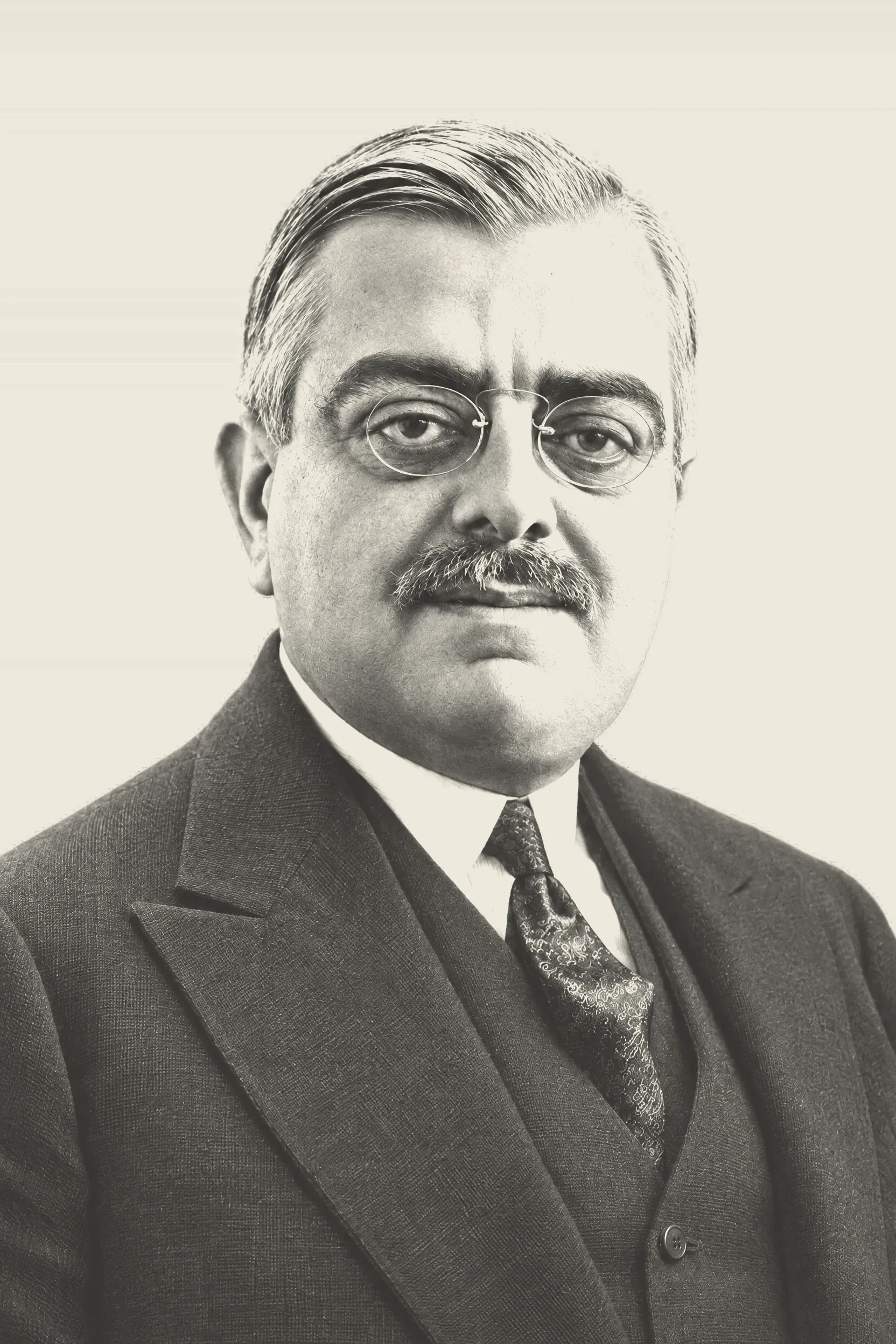
Sultan Muhammad Shah, Aga Khan III, was the 48th Imam of the Nizari Ismailis in the numbering used by the community, and held the office from August 1885 until his death in July 1957. Over those 72 years the Ismailis of Bombay, Karachi, Zanzibar and the East African interior acquired written constitutions, councils, schools, a cooperative bank, an insurance company and an investment trust, while the Imam himself became one of the best-known Muslim public figures of the late British Empire: first president of the All-India Muslim League, leader of the Muslim delegation at the Round Table Conferences on India, and President of the Assembly of the League of Nations in 1937. The fuller narrative of the period is in the chapter The Twentieth Century; this page concentrates on his life and the decisions attributed to him.1
Birth, accession and minority
He was born at Karachi on 2 November 1877, the son of Aga Ali Shah, Aga Khan II, and of Shams al-Muluk, who became known in British India as Lady Ali Shah. His own memoirs record the date and place of birth; the journalist Harry Greenwall, writing in 1952, located it at a house called Honeymoon Lodge in Karachi.2
Aga Khan II died in August 1885 (Dhu’l-Qa’da 1302) after contracting pneumonia on a hunting trip near Poona, and was buried at Najaf. His surviving son was installed in Bombay in the same year as the 48th Imam, aged seven (eight in lunar years, the age Daftary and Algar give). A paternal uncle, Aga Jangi Shah, was his nominal guardian, but Daftary emphasises that the boy grew up under the close supervision of his mother, who also handled much of the community’s business through a council during the minority.3
Until the age of about eighteen he was educated at home in Bombay and Poona under his mother’s direction, with tutors in Arabic, Persian literature, Ismaili doctrine and calligraphy, and later in English and European subjects. In the memoirs he describes these years as dominated by a sense of what he called a “dual responsibility”: leadership of a religious community scattered from Burma and Zanzibar to Syria, Persia, Afghanistan and Chinese Turkestan, and a public role within the wider Muslim population of India.4
The family was not free of violence. Aga Jangi Shah and his son Abbas were murdered at Jidda while on pilgrimage; Daftary dates the murders to 1314/1896, and records that the Imam’s first wife, his cousin Shahzada Begum, a daughter of Jangi Shah, witnessed them. He married her in 1315/1897; the marriage was brief. Algar instead dates the murders to 1326/1908.5
The young Imam in Bombay, 1885-1902
His first public acts were in Bombay. Algar’s Iranica article records that in 1893 he mediated in a Hindu-Muslim dispute over cow slaughter in the city, and that four years later he joined efforts to promote inoculation, which Algar describes as against cholera. The memoirs describe it as a campaign against bubonic plague, which they date to the late summer of 1897: he supported the bacteriologist Waldemar Haffkine at a time when inoculation was widely distrusted, gave him one of his houses for laboratory work, and had himself publicly inoculated so that his followers would follow his example.6
In 1897 he travelled to Simla to present addresses of loyalty to the Viceroy, Lord Elgin, on Queen Victoria’s Diamond Jubilee. In 1898 he made his first journey to Europe, visiting France and Britain, where he dined with the Queen at Windsor and met the future Edward VII. He returned through East Africa in what Daftary calls his first visit to the region; the memoirs date the first East African visit to 1899 and describe Zanzibar, then a British protectorate under a constitutional Sultan, as the first stop.7
A second European tour in 1900 took him to the Shah of Persia, Muzaffar al-Din, in Paris, to Kaiser Wilhelm II at Potsdam and to Sultan Abd al-Hamid II at Istanbul. In 1902 he attended the coronation of Edward VII as a personal guest and was advanced in the coronation honours from Knight Commander (KCIE) to Knight Grand Commander of the Order of the Indian Empire (GCIE). In November 1902 Lord Curzon appointed him to the Viceroy’s Legislative Council, on which he served for two years in Calcutta.8
Courts and community boundaries
The legal status of the Imam over the Khoja Ismailis had been settled in principle by the Aga Khan Case of 1866. A further suit was brought in the Bombay High Court by Hajji Bibi, a daughter of Jangi Shah, and other relatives, who claimed shares of the property held by the Imam. In 1908 Justice Russell ruled for Aga Khan III, holding that the offerings made by the community were his to dispose of, and in the process again distinguished the Ismaili Khojas from the Khojas who had joined the Ithna’ashari (Twelver) Shi’a.9
Those secessions were real and continuing. Algar records that several thousand Khojas left the Imam’s following around 1901 for Twelver Shi’ism, and that a Khojah Reformers’ Society was active in Karachi; Wahab documents parallel splits in Zanzibar, where an Ithna’ashari Khoja community had become the second-largest Indian Muslim group by the 1930s.10
Constitutions, councils and firmans
The administrative instrument most closely associated with Aga Khan III is the written constitution. During his second East African visit in 1905 he issued rules for the community that are generally regarded as the first Ismaili constitution: they defined a hierarchy of councils, with the first council at Zanzibar presided over by the mukhi and supervising the mainland settlements, and they codified personal law on marriage, divorce and inheritance. Asani notes that in this document the Ismailis were for the first time defined in modern legal terms as a religious community of which the Imam was head.11
The model was extended and revised: in East Africa a new constitution of 1926 created separate councils for Tanganyika, Kenya and Uganda with Zanzibar as a coordinating body, and further revisions followed in 1937, 1946 and 1954. Comparable councils were created in India and, after 1947, a separate constitution was issued for Pakistan. The history of these texts, and their replacement by a single constitution in 1986, is treated in The Ismaili Constitution.12
Alongside the constitutions he governed through firmans, directives addressed to particular jamats or to the whole community. Asani observes that in the early twentieth century firmans were collected and printed in Gujarati, Sindhi and Hindustani, and later in English, so that the printed firman became a genre of Ismaili religious literature in its own right.13
In the memoirs he described the organisation as deliberately uneven: a “highly developed” system of councils, educational boards and property agents in East Africa and the colonies of the Indian Ocean, a “looser” form in India and Pakistan, and hereditary local leadership in Central Asia, where offices passed within families of mirs, wazirs and khalifas, and in Syria, where the Imam’s representatives were called amirs.14
Education, women and welfare
Education was the most consistent theme of his directives. In 1903 he took an active part in the All-India Muslim Educational Conference in Bombay and presided over its next session at Delhi in 1904. He campaigned for the Muhammadan Anglo-Oriental College at Aligarh, raising funds across India for its conversion into a Muslim university; Daftary dates the decision to 1912, while the memoirs present it as a culmination of work done in the years around the Delhi Durbar.15
Within the community he founded schools wherever there was a jamat able to sustain one. In Zanzibar, during the 1905 visit, he established the first Khoja Ismaili school, the Shi’a Imami Ismaili Kanyashala, which later became the Aga Khan Girls’ School; Wahab identifies it as the first girls’ school for Indians in Zanzibar, and records a boys’ school opened in 1907 and a girls’ secondary school in 1954. In Persia, the first Ismaili school was opened in 1932 at Dizbad in Khurasan.16
His firmans urged the education of girls and the abandonment of the veil (purdah or chadur), and promoted the participation of women in communal affairs. Daftary describes the reform of women’s position as receiving “high priority”, with numerous firmans on the subject; Zayn Kassam’s chapter in A Modern History of the Ismailis treats it as one strand of a programme continued by his successor.17
The jubilee collections were converted into financial institutions. The memoirs name the Jubilee Insurance company and an investment trust that lent at low interest to Ismaili traders and householders; Daftary dates the insurance company to 1935 and the investment trust to 1946 in East Africa, and adds housing societies and the East African Muslim Welfare Society, of which the Imam was a founding member and which built schools and mosques for African Muslims.18
Political career in India
In October 1906 he led the deputation of Indian Muslims that met the Viceroy, Lord Minto, at Simla to ask for separate electoral representation in any reformed councils. The All-India Muslim League was founded at Dacca at the end of that year to give that demand political organisation; he was not present but was elected its first president, an office he held until 1912 (Algar gives 1913). Daftary and Algar both date his part in the League’s founding to 1907.19
The memoirs record that the most effective Muslim opponent of separate electorates in 1906 was the Bombay barrister Muhammad Ali Jinnah, who came, as Daftary notes, from a Khoja family. The relationship between the two men, which ran from opposition in 1906 to cooperation at the Round Table Conferences and Partition, is examined in Jinnah and the Aga Khan.20
At the Delhi Durbar of 1911-12 George V made him a Knight Grand Commander of the Star of India (GCSI), described in the memoirs as the highest decoration open to an Indian subject. In 1914 he visited Burma, where, according to Algar, he advised his followers to adopt Burmese dress and Buddhist names; Daftary describes the advice as giving up their Indo-Muslim names and habits.21
During the First World War he urged Muslims under British rule to support the Allies and to disregard the Ottoman call to jihad. In 1916 he was given the status of a first-class ruling prince of the Bombay Presidency without territory. In the same year his cousin Aqa Farrukh Shah, sent on a political mission to Persia, was murdered near Kirman; Daftary also records an attempt on the Aga Khan’s own life in Switzerland in 1917 attributed to German agents.22
Ill health kept him in Switzerland for more than three years until the summer of 1919. During that time he wrote India in Transition (1918), which set out his views on the future of India and of South-east Asia and which he later pressed on the Secretary of State, Edwin Montagu.23
In 1923, with the jurist Syed Ameer Ali, he wrote to the Turkish prime minister Ismet Pasha urging the preservation of the caliphate; Algar records that the letter’s publication in the press was used by the Kemalist government as evidence of foreign interference, and the caliphate was abolished in March 1924.24
In 1928 he presided over the All-India Muslim Conference at Delhi. He led the Muslim delegation to the first Round Table Conference in London in 1930, held long discussions with Gandhi during the second in 1931, and remained a delegate until the conferences ended. Daftary calls them the climax of his political career in India. A petition he submitted to the British government in 1934 and again in 1938, asking for a small territorial state, was rejected.25
Geneva and the League of Nations
From 1932 he represented India at the World Disarmament Conference and at the Assembly of the League of Nations. In 1937 he was elected President of the Assembly; he writes that the election was unanimous and that he was asked to remain President until the opening of the 1938 session, which would have required him to convene and preside over any special session.26
Jubilees and family
Three jubilees punctuated the later Imamat; they are discussed in detail in The Diamond Jubilee. The Golden Jubilee was celebrated in Bombay at the turn of 1935-36 and in Nairobi later that year, with the Imam weighed against gold; the memoirs record that the Bombay festivities were curtailed after the death of George V. The Diamond Jubilee, delayed by the war, was held in Bombay in March 1946 and at Dar es Salaam in August 1946, with the Imam weighed against diamonds. The Platinum Jubilee followed in 1954-55, with ceremonies at Karachi and elsewhere.27
He married four times. After Shahzada Begum, he married Theresa Magliano in Cairo in 1908; their son Aly Khan was born in Turin in 1911. In 1929 he married Andree Carron, mother of Prince Sadruddin (1933-2003), and in 1944, after a divorce in 1943, Yvette Labrousse, known in the community as Om Habibeh and as Mata Salamat.28
His mother, Lady Ali Shah, who had governed during his minority and remained an influential figure in the community, died in 1938 and was buried at Najaf. In 1936 Aly Khan married Joan Yarde-Buller; their son Karim was born on 13 December 1936.29
The communities beyond India and Africa
In Syria, the majority of the Nizaris had followed the Muhammad-Shahi line of Imams until the late nineteenth century. In 1304/1887 a Syrian delegation travelled to India in search of a descendant of that line; when none was found, most Syrian Nizaris transferred their allegiance to Aga Khan III, leaving a smaller Muhammad-Shahi group around Masyaf and Qadmus. He financed schools at Salamiyya, including an agricultural school, sent religious teachers from Africa and visited Syria in 1951. The history is set out in The Ismailis of Syria.30
In Persia his representative from 1903 was the teacher and author Muhammad b. Zayn al-Abidin Fida’i Khurasani, who introduced changes in ritual practice and taught in Khurasan until his death in 1923. In Central Asia his emissary Pir Sabz Ali visited Badakhshan and Hunza in 1923, establishing jamatkhanas in Hunza; that journey was the last regular contact before the Soviet border closed the upper Oxus communities off from the Imam until 1991. Their history is treated in The Ismailis of Central Asia and in the pages on Hunza and Khorog.31
The Second World War and Partition
The outbreak of war in 1939 found him in Switzerland, where he spent most of the war and again urged his followers to support Britain. After 1947 he supported the new state of Pakistan, where a large part of his South Asian following lived, and the community there received its own constitution. In 1951 he made his only visit to Persia, where he was the guest of Mohammad Reza Shah at his second wedding and visited Mahallat, the former seat of his grandfather; Algar records that the Iranian government had granted him Iranian nationality in 1949.32
Death and succession
He died at his villa at Versoix, near Geneva, on 11 July 1957, and was later buried in a permanent mausoleum at Aswan, overlooking the Nile in Egypt, the country once ruled by the Fatimid caliph-Imams. His will, dated 1955, named his grandson Karim as the 49th Imam, passing over his sons Aly Khan and Sadruddin. Many in the community had expected Aly Khan to succeed. Karim, Aga Khan IV, was acclaimed in Switzerland in the presence of representatives of the community.33
Assessment
Historians differ on emphasis. Daftary presents his Imamat as the period in which the Nizari Ismailis were transformed into a modern, organised community, with institutions later inherited and expanded by Aga Khan IV. Algar’s Iranica article of 1986, by contrast, stresses his loyalty to British rule and treats his religious authority with scepticism. Both agree on the scale of his public activity and on the importance of the councils, schools and financial institutions created between 1905 and 1957.34
Footnotes
-
Farhad Daftary, The Isma’ilis: Their History and Doctrines, 2nd ed. (Cambridge University Press, 2007), pp. 480-496, https://archive.org/details/bk692. ↩
-
Aga Khan III, The Memoirs of Aga Khan: World Enough and Time (London: Cassell, 1954), ch. 1, https://archive.org/details/memoirsofagakhan00agak; Harry J. Greenwall, His Highness the Aga Khan, Imam of the Ismailis (London: Cresset Press, 1952), p. 9, https://archive.org/details/his-highness-the-aga-khan-imam-of-the-ismailis. ↩
-
Daftary, The Isma’ilis, pp. 480-481, https://archive.org/details/bk692. ↩
-
Daftary, The Isma’ilis, p. 480; Aga Khan III, Memoirs, pp. 32-33, https://archive.org/details/memoirsofagakhan00agak. ↩
-
Daftary, The Isma’ilis, pp. 480-481, https://archive.org/details/bk692. ↩
-
Hamid Algar, “Aqa Khan III”, Encyclopaedia Iranica, II/2 (1986), pp. 170-175, https://www.iranicaonline.org/articles/aqa-khan-title/aqa-khan-iii-aqa-khan-iii/; Aga Khan III, Memoirs, pp. 36-38. ↩
-
Aga Khan III, Memoirs, pp. 39-40, 59-63; Daftary, The Isma’ilis, p. 481. ↩
-
Daftary, The Isma’ilis, p. 481, https://archive.org/details/bk692. ↩
-
Daftary, The Isma’ilis, pp. 481-482. ↩
-
Algar, “Aqa Khan III”, Encyclopaedia Iranica; Saada Wahab, The History of Indians in Zanzibar from the 1870s to 1963 (Gottingen University Press, 2022), pp. 53-54, https://doi.org/10.17875/gup2022-2188. ↩
-
Daftary, The Isma’ilis, pp. 486-487; Ali S. Asani, “From Satpanthi to Ismaili Muslim”, in F. Daftary (ed.), A Modern History of the Ismailis (London: I.B. Tauris/Institute of Ismaili Studies, 2011), pp. 110-111, https://archive.org/details/bk861. ↩
-
Daftary, The Isma’ilis, pp. 484-487. ↩
-
Asani, “From Satpanthi to Ismaili Muslim”, p. 111. ↩
-
Aga Khan III, Memoirs, pp. 182-184, https://archive.org/details/memoirsofagakhan00agak. ↩
-
Daftary, The Isma’ilis, p. 482; Aga Khan III, Memoirs, pp. 119-120; Algar, “Aqa Khan III”, Encyclopaedia Iranica. ↩
-
Wahab, History of Indians in Zanzibar, pp. 101, 106-108, https://doi.org/10.17875/gup2022-2188; Daftary, The Isma’ilis, pp. 493-494. ↩
-
Daftary, The Isma’ilis, p. 488; Zayn R. Kassam, “The Gender Policies of Aga Khan III and Aga Khan IV”, in Daftary (ed.), A Modern History of the Ismailis, pp. 247-264. ↩
-
Aga Khan III, Memoirs, p. 188; Daftary, The Isma’ilis, p. 488. ↩
-
Aga Khan III, Memoirs, pp. 93-95; Daftary, The Isma’ilis, p. 482; Algar, “Aqa Khan III”, Encyclopaedia Iranica. ↩
-
Aga Khan III, Memoirs, pp. 93-94; Daftary, The Isma’ilis, p. 483. ↩
-
Daftary, The Isma’ilis, p. 482; Aga Khan III, Memoirs, p. 120; Algar, “Aqa Khan III”, Encyclopaedia Iranica. ↩
-
Daftary, The Isma’ilis, pp. 482-483; Algar, “Aqa Khan III”, Encyclopaedia Iranica. ↩
-
Aga Khan III, Memoirs, pp. 143-147; Daftary, The Isma’ilis, p. 483. ↩
-
Algar, “Aqa Khan III”, Encyclopaedia Iranica. ↩
-
Daftary, The Isma’ilis, p. 483; Aga Khan III, Memoirs, ch. “Towards Dominion Status: The Round Table Conferences”, pp. 206-234; Algar, “Aqa Khan III”, Encyclopaedia Iranica. ↩
-
Daftary, The Isma’ilis, p. 483; Aga Khan III, Memoirs, ch. “My Work for the League of Nations”, pp. 235-270. ↩
-
Aga Khan III, Memoirs, pp. 244, 285-287; Daftary, The Isma’ilis, pp. 483-484. ↩
-
Daftary, The Isma’ilis, pp. 481-484; Aga Khan III, Memoirs, pp. 274-275. ↩
-
Daftary, The Isma’ilis, pp. 480, 483. ↩
-
Daftary, The Isma’ilis, pp. 488-490, https://archive.org/details/bk692. ↩
-
Daftary, The Isma’ilis, pp. 491-496, https://archive.org/details/bk692. ↩
-
Daftary, The Isma’ilis, pp. 483-485; Algar, “Aqa Khan III”, Encyclopaedia Iranica. ↩
-
Daftary, The Isma’ilis, pp. 496-497; Algar, “Aqa Khan III”, Encyclopaedia Iranica. ↩
-
Daftary, The Isma’ilis, pp. 480-497; Algar, “Aqa Khan III”, Encyclopaedia Iranica. ↩