Name and foundation
‘Askar Mukram, “Mukram’s camp”, was a town of the medieval province of Ahwaz (Khuzistan) in south-western Iran and the administrative centre of a district of the same name. The Arabic sources give different accounts of the name. Al-Baladhuri says it was named after a commander of Mus’ab b. al-Zubayr sent to suppress a local revolt; Yaqut credits Muhammad b. Mi’za’ al-Harithi, a general of al-Hajjaj b. Yusuf, the Umayyad governor of Iraq. Both accounts place the foundation towards the end of the 1st/7th century.1
Site
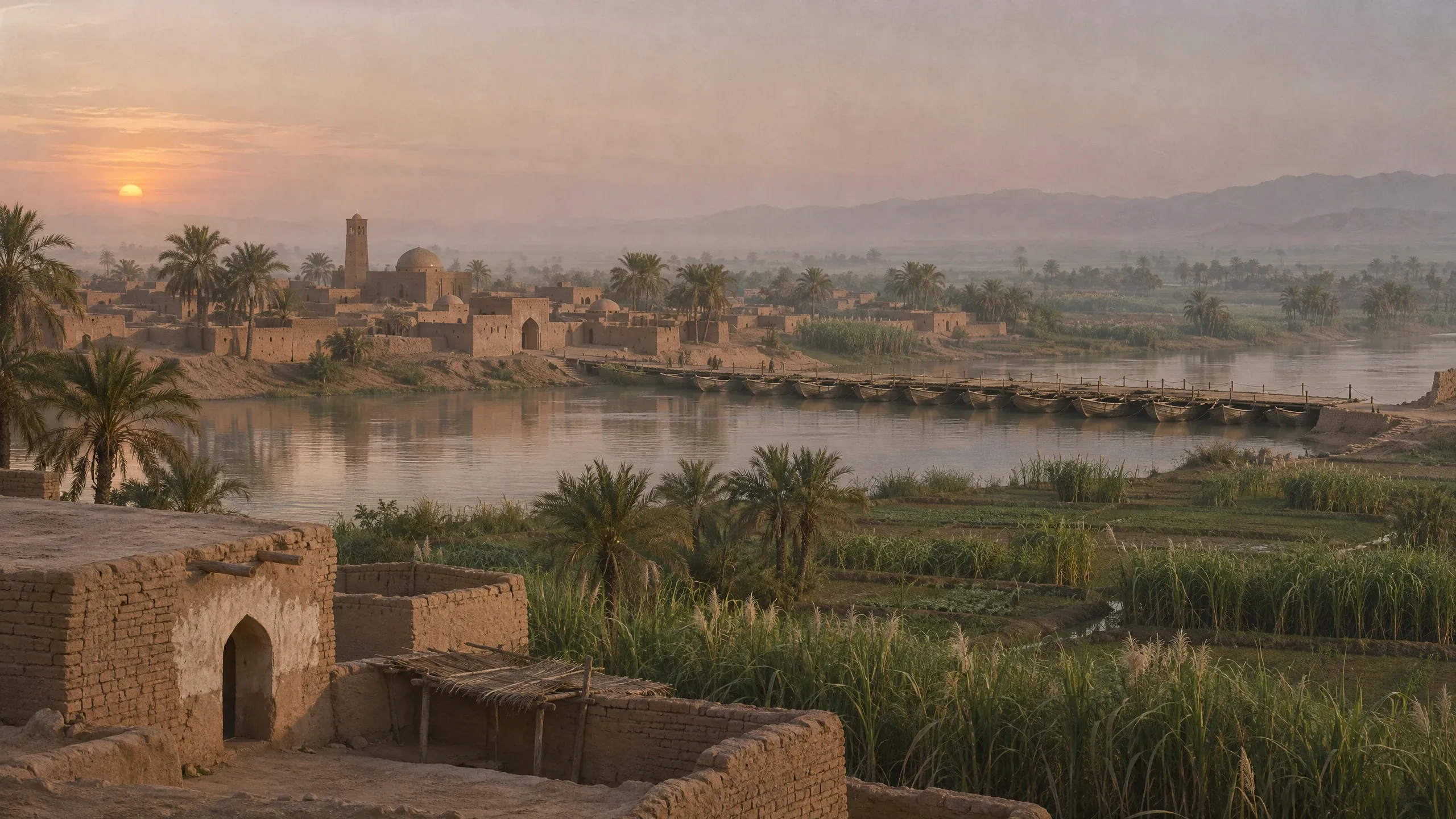
The town lay in the northern part of the Khuzistan plain on both banks of the Nahr Masruqan, the modern Ab-e Gargar, just above its junction with the Karun, the medieval Dujayl. It had been important in Sasanian times, when, according to the Arabic sources, it was called Rustaq Kavad (Arabic Rustaqubadh). It was a major market town with a partly Christian population, and its position covering the approaches to the mountains of Luristan made it a military centre. In the 4th/10th century two bridges of boats crossed the river there, and Ibn Hawqal also describes a permanent brick bridge.2
The Zanj war
’Askar Mukram lay on the front line of the Zanj revolt (255–270/869–883), the great uprising of enslaved labourers in lower Iraq and Khuzistan. The Zanj sacked the town in about 262/875–876. In 266/879–880 caliphal troops broke down a bridge there to stop the rebels crossing to the east. Daftary notes that the Ismaili leaders of Iraq offered an alliance to the Zanj leader in 267/880, which he declined.3
Prosperity and learning
The geographers of the 4th/10th century describe the town as flourishing. Coins were struck there under the Abbasids in 299/911–912 and under the Buyid ’Adud al-Dawla in 340–344/951–956. According to al-Istakhri and the Hudud al-’alam, it was the centre of the sugar industry of Ahwaz, where cane grown elsewhere was processed into red and white sugar and sugarloaf. Many authors also mention its deadly scorpions. Al-Muqaddasi records that the larger part of the town, with the Friday mosque and the main markets, lay on the western bank. The town was also known for its textiles, including tiraz.4
It was also known for its scholars. Theological disputation (kalam) was a popular pastime and the town had Mu’tazili tendencies; Ibn Hawqal reports that even porters argued over Qur’anic interpretation and law as they carried their loads. Scholars of the town bore the nisba al-’Askari. The most famous were the philologists Abu Ahmad al-Hasan b. ’Abd Allah al-’Askari (d. 382/993) and his pupil Abu Hilal al-’Askari (d. after 400/1010).5
The hidden Imam in Khuzistan
In the official Fatimid account of the dawr al-satr, Khuzistan was the first refuge of the hidden Imams. Muhammad b. Isma’il is said to have spent his last years in Khuzistan, sending da’is into neighbouring regions, and he died there soon after 179/795. His son ’Abd Allah sought refuge in various parts of Persia and finally settled at ’Askar Mukram near Ahwaz. Daftary’s Historical Dictionary says that ’Abd Allah seems to have spent a good part of his life there.6
From ’Askar Mukram, ’Abd Allah fled to Basra and then moved to Salamiyya in central Syria, where he posed as an ordinary Hashimid merchant. Daftary places his death there in about 212/827–828. Madelung notes that Ahwaz was “then the seat of the leadership of the Isma’ili movement”. He suggests that ’Abdan, the theologian of the Iraqi da’wa, may have been sent from there or trained there.7
The hostile anti-Ismaili account gives the same route, from Ahwaz to ’Askar Mukram, then Basra and Salamiyya, but assigns it to a non-’Alid founder, ’Abd Allah b. Maymun al-Qaddah, said to have died after 261/874. Daftary rejects this legend. He calls the charges of libertinism and atheism attached to it “totally unfounded” and the Kitab al-siyasa ascribed to the movement a malevolent forgery. The fact that both versions run through ’Askar Mukram shows how central the town was in memories of the early concealment.8
Khuzistan and the Iraqi da’wa
Khuzistan was also the home of one of the most important early da’is. Al-Husayn al-Ahwazi, whose nisba refers to Ahwaz, carried the da’wa into the Sawad of Kufa. There, according to Madelung, he converted Hamdan Qarmat sometime between 260/873–874 and 264/877–878. After al-Ahwazi died or left, Hamdan took charge of the mission in lower Iraq, working with his brother-in-law ’Abdan. Madelung suggests that ’Abdan had been sent from Ahwaz, or at least trained there. The Iraqi da’wa, from which the missions to Yemen, Bahrayn and North Africa later grew, therefore had its roots in the Khuzistani refuge of the hidden Imams.9
Decline
’Askar Mukram was still flourishing in the 8th/14th century, when Hamd Allah Mustawfi recorded it under its Persian name, Lashkar. It later fell into ruin. The site is identified with Band-e Qir, the “bitumen dyke”.10
Footnotes
-
Clifford Edmund Bosworth, “’Askar Mokram,” Encyclopaedia Iranica, vol. II, fasc. 7 (1987), p. 768, https://www.iranicaonline.org/articles/askar-mokram/. ↩
-
Bosworth, “’Askar Mokram,” Encyclopaedia Iranica, vol. II, fasc. 7 (1987), p. 768, https://www.iranicaonline.org/articles/askar-mokram/. ↩
-
Bosworth, “’Askar Mokram,” Encyclopaedia Iranica (1987), p. 768, https://www.iranicaonline.org/articles/askar-mokram/; Farhad Daftary, The Isma’ilis: Their History and Doctrines, 2nd ed. (Cambridge University Press, 2007), p. 108. ↩
-
Bosworth, “’Askar Mokram,” Encyclopaedia Iranica, vol. II, fasc. 7 (1987), p. 768, https://www.iranicaonline.org/articles/askar-mokram/. ↩
-
Bosworth, “’Askar Mokram,” Encyclopaedia Iranica, vol. II, fasc. 7 (1987), p. 768, https://www.iranicaonline.org/articles/askar-mokram/. ↩
-
Daftary, The Isma’ilis, 2nd ed. (Cambridge University Press, 2007), pp. 96, 100; Farhad Daftary, Historical Dictionary of the Ismailis (Scarecrow Press, 2012), s.v. “’Abd Allah al-Akbar”. ↩
-
Daftary, The Isma’ilis, 2nd ed. (Cambridge University Press, 2007), p. 100; Wilferd Madelung, “’Abdan b. al-Rabit,” Encyclopaedia Iranica, vol. I, fasc. 2 (1982), p. 207, https://www.iranicaonline.org/articles/abdan/. ↩
-
Daftary, The Isma’ilis, 2nd ed. (Cambridge University Press, 2007), p. 102. ↩
-
Wilferd Madelung, “Hamdan Qarmat,” Encyclopaedia Iranica, vol. XI, fasc. 6 (2003), pp. 634–635, https://www.iranicaonline.org/articles/hamdan-qarmat/; Madelung, “’Abdan b. al-Rabit,” Encyclopaedia Iranica, vol. I, fasc. 2 (1982), p. 207, https://www.iranicaonline.org/articles/abdan/. ↩
-
Bosworth, “’Askar Mokram,” Encyclopaedia Iranica, vol. II, fasc. 7 (1987), p. 768, https://www.iranicaonline.org/articles/askar-mokram/. ↩