Setting
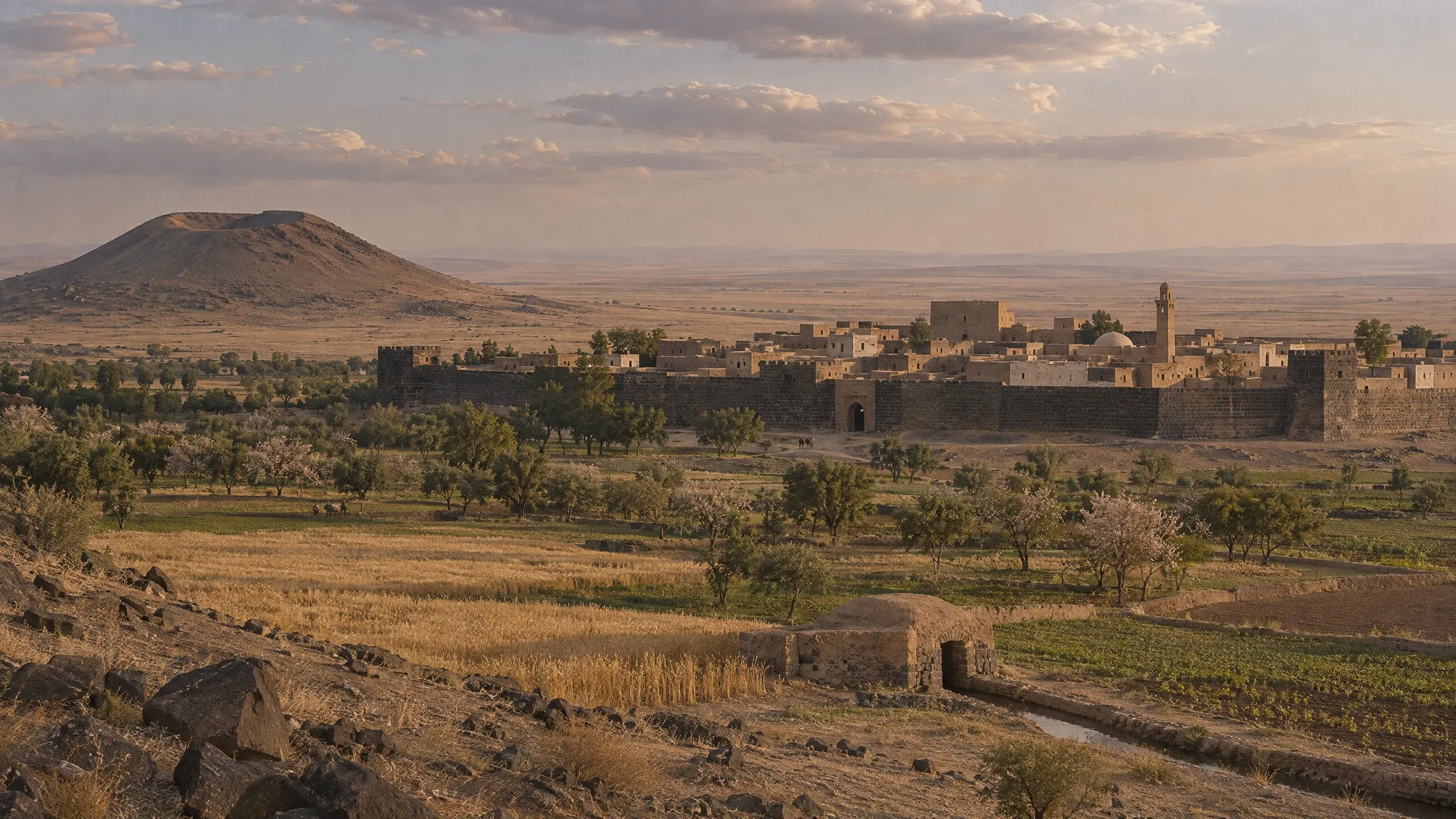
Salamiyya lies in central Syria on the edge of the desert, south-east of Hama in the Orontes district. Daftary’s The Isma’ilis puts it about 35 kilometres from Hama, his Historical Dictionary about 40. A number of Abbasids settled there in the 2nd/8th century. When the Ismaili Imams arrived in the following century, the town was being resettled by the Abbasid Muhammad b. ’Abd Allah b. Salih.1
The hidden headquarters
In the official Fatimid account, ’Abd Allah, son of Muhammad b. Isma’il, took refuge first in Persia and at ’Askar Mukram in Khuzistan, then fled to Basra and finally settled at Salamiyya. There he posed as an ordinary Hashimid and merchant. Ismaili da’is bought a plot of land for him there. Salamiyya became the residence of the Imams and the headquarters of the da’wa for several decades. ’Abd Allah died there in about 212/827–828. He was succeeded by his son Ahmad, then by Ahmad’s son al-Husayn, and then by al-Husayn’s son ’Abd Allah, later the Fatimid caliph al-Mahdi. The Historical Dictionary adds that the elder ’Abd Allah was buried in Salamiyya.2
The leaders in Salamiyya lived under pseudonyms. Daftary notes that their names do not appear in the earliest Ismaili sources and that their genealogy has long been disputed; see dawr al-satr. The future al-Mahdi was born in 259 or 260/873–874. He was about eight when his father died, around 268/881–882. He grew up under the guardianship of his uncle and future father-in-law Muhammad b. Ahmad, known as Sa’id al-Khayr, who tried without success to secure the leadership for his own sons.3
Centre of a single da’wa
From Salamiyya the leaders directed a network of missions. By the early 280s/890s the Ismaili movement was a single da’wa directed from Syria, with branches in Iraq, Persia, Yemen, Bahrayn, Sind and North Africa. The Iraqi organisers Hamdan Qarmat and ’Abdan corresponded with these secret leaders. The later Ismaili author al-Nisaburi (d. after 386/996) wrote an account of the concealed Imam’s settlement in Salamiyya and of al-Mahdi’s journey to North Africa, the Istitar al-imam.4
The schism of 286/899
Soon after ’Abd Allah al-Mahdi took over the leadership, Hamdan noticed changes in the instructions coming from headquarters and sent ’Abdan to Salamiyya to investigate. Only there did ’Abdan learn that the new leader claimed the Imamate for himself and his ancestors. Until then the movement had preached that Muhammad b. Isma’il would return as the Mahdi. Hamdan renounced his allegiance and ordered his da’is to stop preaching, and ’Abdan was murdered at the instigation of the da’i Zikrawayh b. Mihrawayh. These events of 286/899 split the movement into a loyal wing and the dissident Qarmatis.5
Flight and destruction, 289–291/902–904
According to Halm, as Daftary summarises him, Zikrawayh and his sons at first stayed fiercely loyal to the leader in Salamiyya. Without his authorisation they set out to establish a Fatimid state for him in Syria, and in doing so revealed his identity. To escape the Abbasid agents, ’Abd Allah al-Mahdi left Salamiyya secretly and in haste in 289/902. He took with him his young son, the future al-Qa’im, the chief da’i Firuz, his chamberlain Ja’far b. ’Ali and a few attendants, and went first to Ramla in Palestine.6
Zikrawayh’s sons and their bedouin army, who called themselves al-Fatimiyyun, captured Salamiyya, Hims and other towns of the Orontes valley by 290/903. In those towns, for the first time, the Friday sermon (khutba) was read and coins were struck in the name of the Ismaili Imam rather than the Abbasid caliph. A large Abbasid army routed the bedouins in 291/903. Their leader, al-Husayn b. Zikrawayh, then turned against al-Mahdi. He destroyed al-Mahdi’s residence in Salamiyya and killed the relatives and servants who had stayed behind. Captured in 291/904, al-Husayn was taken to Baghdad, where under torture he revealed al-Mahdi’s identity and whereabouts before being executed. Al-Mahdi had meanwhile moved on to Egypt.7
Ruin and refoundation
The Historical Dictionary records that by the early decades of the 13th/19th century Salamiyya was entirely deserted and in ruins. By the 1840s the Nizari amir of Qadmus, Isma’il b. Muhammad, had established his authority over most of the Syrian Nizari community and won the goodwill of the Ottoman sultan ’Abd al-Majid I. Daftary relates that in 1843 the amir petitioned the Ottomans to let the Syrian Nizaris restore Salamiyya, “the town that had served as the central headquarters of the early Isma’ili da’wa”. The Ottomans agreed, and Nizaris from different localities settled in the town and the nearby villages east of Hama. The Historical Dictionary dates the Ottoman permission for permanent settlement to 1265/1849. In 1850 the Ottomans exempted the Nizaris of Salamiyya from military service.8
Modern Salamiyya
The Syrian Nizaris who followed the Qasim-Shahi line of Imams, the Aga Khans, prospered in the farmland around Salamiyya. Aga Khan III founded several schools there, including an agricultural institution, sent religious teachers from Africa, and visited the community in 1951. His son Aly Khan, who died in a car accident in 1960, was buried in a permanent mausoleum at Salamiyya in 1972. Daftary’s 2007 history puts the Aga Khan’s followers in Syria at around 80,000, living in Salamiyya and the surrounding villages. The Historical Dictionary gives the town’s population as around 100,000 in 2010, most of them Nizari Ismailis. That makes it the largest concentration of Nizaris in Syria and of Arabic-speaking Nizaris anywhere.9
Footnotes
-
Farhad Daftary, The Isma’ilis: Their History and Doctrines, 2nd ed. (Cambridge University Press, 2007), p. 100; Farhad Daftary, Historical Dictionary of the Ismailis (Scarecrow Press, 2012), s.v. “Salamiyya”. ↩
-
Daftary, The Isma’ilis, 2nd ed. (Cambridge University Press, 2007), p. 100; Daftary, Historical Dictionary of the Ismailis (Scarecrow Press, 2012), s.v. “’Abd Allah al-Akbar”. ↩
-
Daftary, The Isma’ilis, 2nd ed. (Cambridge University Press, 2007), pp. 100, 107. ↩
-
Daftary, The Isma’ilis, 2nd ed. (Cambridge University Press, 2007), pp. 108, 116; Daftary, Historical Dictionary of the Ismailis (Scarecrow Press, 2012), s.v. “al-Nisaburi, Ahmad b. Ibrahim”. ↩
-
Daftary, The Isma’ilis, 2nd ed. (Cambridge University Press, 2007), pp. 116–117; Wilferd Madelung, “Hamdan Qarmat,” Encyclopaedia Iranica, vol. XI, fasc. 6 (2003), pp. 634–635, https://www.iranicaonline.org/articles/hamdan-qarmat/. ↩
-
Daftary, The Isma’ilis, 2nd ed. (Cambridge University Press, 2007), p. 123. ↩
-
Daftary, The Isma’ilis, 2nd ed. (Cambridge University Press, 2007), p. 123. ↩
-
Daftary, Historical Dictionary of the Ismailis (Scarecrow Press, 2012), s.v. “Salamiyya”; Daftary, The Isma’ilis, 2nd ed. (Cambridge University Press, 2007), p. 489. ↩
-
Daftary, The Isma’ilis, 2nd ed. (Cambridge University Press, 2007), pp. 490, 496; Daftary, Historical Dictionary of the Ismailis (Scarecrow Press, 2012), s.v. “Salamiyya”. ↩