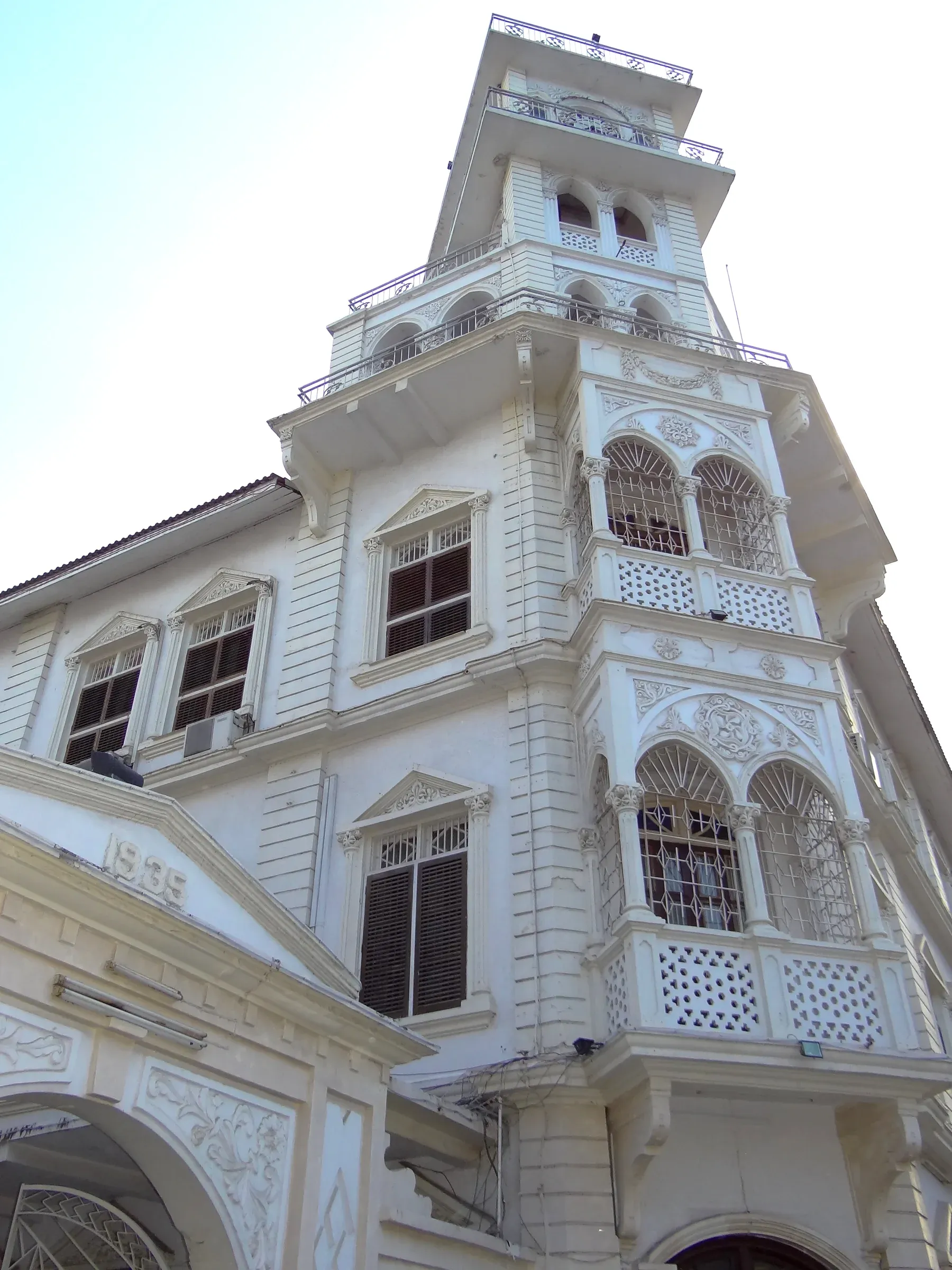
Dar es Salaam, on the coast of mainland Tanzania opposite Zanzibar, was the capital first of German East Africa, then of British Tanganyika and later of independent Tanzania. It became the main centre of the largest mainland Ismaili community in East Africa. Aga Khan III settled a dispute between his followers and the German authorities there in 1899, and was weighed against diamonds there in August 1946 in the second ceremony of his Diamond Jubilee. Aga Khan IV was installed there in 1957. The city’s history is part of The Ismailis of East Africa.1
The coast before the Germans
Khoja Ismaili settlement on the Tanganyika coast began from Zanzibar. Wahab records that around 1860 there were Ismaili households not only on the island but also at Bagamoyo, Kilwa and in villages of the Mrima coast opposite Zanzibar. Daftary describes the Khojas spreading from the island to these coastal towns and then inland along the trade routes.2
The German period
In his memoirs Aga Khan III describes the political map of 1899: the British ran their East African Protectorate from Mombasa, while “the Germans had staked their claims inland from Dar-es-Salaam in the territories now known as Tanganyika”. In Dar es Salaam he found a conflict “between the German authorities and my followers over land trading rights”. The dispute had “smouldered and flickered throughout the nineties”. The Germans suspected the Ismailis of smuggling arms and of having “had a hand in the Arab rebellion of some ten years before”.3
The Imam describes a “certain stiffness” on the part of the German governor when he arrived. Before he left, the dispute was settled and the suspicions, which he thought “probably one cause of the stubbornness of the dispute”, were “thoroughly dissipated”. He left, he wrote, with “a clean slate, so far as differences between my followers and the German administration were concerned”.4
Tanganyika
After the First World War Tanganyika came under British administration. Its Ismaili community grew faster than those of Kenya and Uganda. Daftary records that by the mid-1950s there were about 50,000 Ismailis in East Africa, nearly half of them in Tanganyika, and Aga Khan III gave a figure of 27,000 for Tanganyika in the early 1950s, against 17,000 in Kenya and 6,000 in Uganda. Under the 1926 constitution Tanganyika received its own council, subordinate to the council in Zanzibar.5
Dar es Salaam was among the towns Aga Khan III visited on his African tours. Greenwall records an incident of February 1937, when Esmail Hasmani, a 22-year-old merchant who had been the Imam’s host in Dar es Salaam, was convicted of defrauding local banks of £50,000 and sentenced to seven years’ imprisonment.6
The Diamond Jubilee of 1946
The Diamond Jubilee of Aga Khan III fell due in 1945 but was held in 1946 in two ceremonies: in Bombay in March and in Dar es Salaam five months later, using the same diamonds. The memoirs record that the Dar es Salaam ceremony was attended by the British Resident of Zanzibar, the Governors of Tanganyika, Kenya and Uganda, and the Secretary of State for the Colonies, Arthur Creech Jones. Greenwall’s list of plates includes a photograph of the Imam at Dar es Salaam in 1946 beside the bullet-proof boxes of diamonds against which he was weighed.7
According to Greenwall the festivities lasted ten days, and the Imam was accompanied by the Begum, whom he had named Mata Salamat, and by his two sons. In a speech to a crowd Greenwall gives as 70,000, the Imam said that the value of the diamonds had been “unconditionally presented” to him. After the costs of the celebrations, he would give the whole residue to a Diamond Jubilee Investment Trust, which he described as “not an ordinary investment trust”. Daftary records the founding of an investment trust in East Africa in 1946. See The Diamond Jubilee.8
The 1957 installation
After Aga Khan III’s death in July 1957, Aga Khan IV was installed in takht-nishini ceremonies at Dar es Salaam, Nairobi, Kampala, Karachi and Bombay. Under the 1962 constitution the Territorial Council for Tanganyika had its headquarters at Dar es Salaam. Zanzibar kept its own council until the union of 1964 that created Tanzania. See The Ismaili Constitutions.9
Independent Tanzania
Tanganyika became independent in 1961 and united with Zanzibar in 1964. The CIA’s 1972 report describes Tanzanian policy towards Asians as “socialism with a racial tinge”. Nationalisation from 1967 was followed by exchange controls in April 1971 and, weeks later, the expropriation of rented buildings. The CIA estimated that Tanzania’s Asian population fell from about 70,000 to about 50,000 within months, and that Asian doctors, nurses and civil servants were among those who left.10
Daftary links the emigration from East Africa from the 1970s to the growth of Ismaili communities in Britain and North America. An Ismaili jamat remained in Dar es Salaam, and Tanzania was among the territories with a National Council under the 1986 constitution.11
Footnotes
-
Aga Khan III, The Memoirs of Aga Khan: World Enough and Time (London: Cassell, 1954), pp. 59-60, 285-287, https://archive.org/details/memoirsofagakhan00agak; Farhad Daftary, The Isma’ilis: Their History and Doctrines, 2nd ed. (Cambridge University Press, 2007), pp. 483-487, 497, https://archive.org/details/bk692. ↩
-
Saada Wahab, The History of Indians in Zanzibar from the 1870s to 1963 (Gottingen University Press, 2022), p. 53, https://doi.org/10.17875/gup2022-2188; Daftary, The Isma’ilis, pp. 485-486. ↩
-
Aga Khan III, Memoirs, pp. 59-60. ↩
-
Aga Khan III, Memoirs, p. 60. ↩
-
Daftary, The Isma’ilis, p. 487; Aga Khan III, Memoirs, p. 167. ↩
-
Harry J. Greenwall, His Highness the Aga Khan, Imam of the Ismailis (London: Cresset Press, 1952), p. 80, https://archive.org/details/his-highness-the-aga-khan-imam-of-the-ismailis. ↩
-
Aga Khan III, Memoirs, pp. 285-287; Greenwall, His Highness the Aga Khan, list of plates. ↩
-
Greenwall, His Highness the Aga Khan, pp. 88-89; Daftary, The Isma’ilis, p. 488. ↩
-
Daftary, The Isma’ilis, pp. 496-498. ↩
-
CIA Directorate of Intelligence, Asian Exodus from East Africa, 24 November 1972, section “Tanzania: Socialism with a Racial Tinge”, https://www.cia.gov/readingroom/document/cia-rdp85t00875r001500040040-4. ↩
-
Daftary, The Isma’ilis, pp. 497, 501. ↩