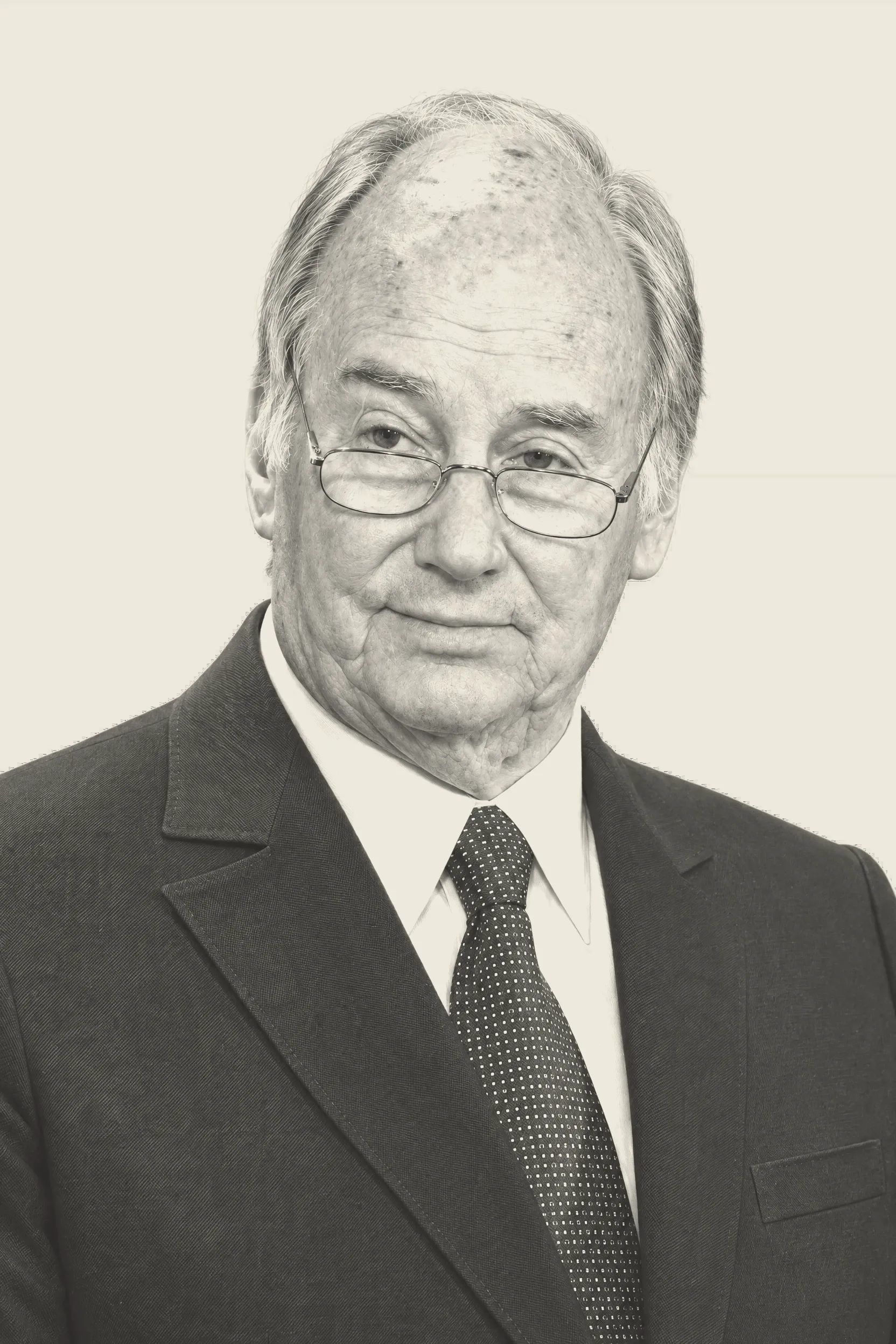
Prince Karim al-Hussaini, Aga Khan IV, was the 49th hereditary Imam of the Shia Imami Ismaili Muslims in the Nizari line, from July 1957 until his death in Lisbon on 4 February 2025. He succeeded his grandfather Aga Khan III, and his Imamat of 67 years spanned decolonisation in Africa and Asia, the expulsion of the Asians of Uganda, the end of Soviet rule in Central Asia and the settlement of a large Ismaili population in Europe and North America. His period is the subject of the chapter The Present; this page treats his life and office.1
Birth, family and education
Karim was born in Geneva on 13 December 1936, the elder son of Prince Aly Khan and his first wife, Joan Yarde-Buller, daughter of the 3rd Baron Churston. His younger brother is Prince Amyn; his half-sister Princess Yasmin is the daughter of Aly Khan’s later marriage to the actor Rita Hayworth. He spent part of his early childhood in Nairobi, was schooled at the Institut Le Rosey in Switzerland and entered Harvard University, where he was an undergraduate when he became Imam. He completed his degree in 1959, a Bachelor of Arts in Islamic history; Britannica notes that he had intended to continue to a doctorate in history before the Imamat changed his plans.12
He was married twice. In 1969 he married Sarah Frances Croker Poole, who took the name Begum Salimah; they divorced in 1995. Their children are Princess Zahra, Prince Rahim, born in 1971 and later Aga Khan V, and Prince Hussain. His second marriage, to Gabriele Renate Thyssen, who took the name Begum Inaara, produced Prince Aly Muhammad. He was survived by four grandchildren. The AKDN obituary dates the marriage to 1998 and the divorce to 2011; Britannica gives 1995 and 2014. This page follows the AKDN dates and records the discrepancy.13
Succession in 1957
Aga Khan III died on 11 July 1957 at Versoix, near Geneva.4 His will named his grandson Karim as successor rather than either of his sons, Aly Khan and Sadruddin. Britannica quotes the passage in which the old Imam explained the choice: “In view of the fundamentally altered conditions in the world in very recent years due to the great changes which have taken place including the discovery of atomic science, I am convinced that it is in the best interests of the Shia Muslim Ismaili Community that I should be succeeded by a young man who has been brought up and developed during recent years and in the midst of the new age and who brings a new outlook on life to his office as Imam.” In Ismaili doctrine the designation (nass) of a successor is the prerogative of the reigning Imam from among his male descendants, and the will was the instrument of that designation.56
The Guardian’s obituary of Prince Sadruddin later wrote that “Sadruddin rarely showed his disappointment. He respected Karim; but the two never became very close and, just occasionally, he betrayed his feeling that life had been unjust.”7
Within about a fortnight of the succession, Queen Elizabeth II granted the new Imam the style “His Highness”, as earlier British sovereigns had done for the first three Aga Khans. Britannica quotes his recollection, given to Sports Illustrated in 1964: “Overnight my whole life changed completely. I woke up with serious responsibilities toward millions of other human beings.”89
Installation and the first visits
Following practice established under his grandfather, the new Imam was formally installed (in community usage, takht nashini, “ascending the throne”) in a series of ceremonies in the principal centres of the community. Photographs published by the Tanzanian newspaper The Citizen record the formal installation in Dar es Salaam in 1957 and his enthronement in Nairobi on 25 October 1957. Britannica notes that he began visiting his scattered followers in the first year of his Imamat.109
The community he inherited was concentrated in East Africa (Kenya, Uganda, Tanganyika and Zanzibar), the Indian subcontinent (Karachi, Bombay, Hunza), Iran, Afghanistan and Syria, with the Ismailis of Soviet Badakhshan cut off from the Imam by the Soviet border. The background to this distribution is treated in The Twentieth Century, Ismailis of East Africa and Ismailis of Central Asia.1
Decolonisation and migration
The first two decades of the Imamat coincided with independence across East Africa and with the nationalisation policies that followed. The decisive episode was the order of President Idi Amin, announced in 1972, that people of Asian ancestry leave Uganda within 90 days. Many of those expelled were Ismailis. Canada sent a team of officials to Kampala, and the Vancouver Sun’s retrospective records that the Canadian mission evacuated 4,420 Ugandan refugees on charter flights between late September and November 1972. Prince Sadruddin was then UN High Commissioner for Refugees. The expulsion is treated in Uganda expulsion, 1972.117
The settlement of Ismailis from East Africa and South Asia in Canada, the United Kingdom, the United States and Portugal gave the community its present western diaspora; its institutions are described under The Ismaili Diaspora. Britannica records that the Aga Khan urged his followers to become citizens of the countries in which they lived, a position consistent with the Imamat’s description of itself as having no territorial or political role.912
The Ismaili Constitution of 1986
Aga Khan III had issued separate constitutions for the Ismailis of different territories. In 1986 Aga Khan IV ordained a single Constitution, which the Ismaili Imamat describes as bringing “for the first time” the social governance of the global community “under a common aegis”. Under it, National, Regional and Local Councils are responsible for social governance; Religious Education Boards (Tariqah boards) provide religious education, research and publication; and Conciliation and Arbitration Boards resolve disputes among members. The Constitution is discussed in The Ismaili Constitution.13
The Imamat’s own statement of the office, quoting the Aga Khan’s 2014 address to the Parliament of Canada, is that “the role of the Ismaili Imam is a spiritual one; his authority is that of religious interpretation. It is not a political role … the Imams do not govern any land.” The same text adds that faith “does not remove Muslims or their Imams from daily, practical matters”.1214
The Aga Khan Development Network
The institutions that became the Aga Khan Development Network (AKDN) grew out of schools, hospitals and cooperative societies founded under Aga Khan III. Under Aga Khan IV they were reorganised and enlarged into a group of agencies working in health, education, habitat, culture and economic development, with a declared mandate to serve people “regardless of origin, race, gender, or religion”. Britannica describes the AKDN as an umbrella for nine agencies; the AKDN obituary states that it is active in more than 30 countries. Its structure and figures are set out under AKDN.115
The obituary credits the network with two universities, more than 200 schools and more than 700 health facilities, an annual non-profit budget of about US$1 billion and some 96,000 employees, and states that it annually supplies electricity to 10 million people and health care to 5 million. These are the network’s own figures. The commercial agency, the Aga Khan Fund for Economic Development, holds companies in banking, insurance, telecommunications, energy, tourism and media.1
Education was the field he treated as foremost. He founded Aga Khan University in Karachi in 1983, which the obituary calls Pakistan’s first private, internationally chartered university, and in 2000 the University of Central Asia, created by a treaty with Tajikistan, the Kyrgyz Republic and Kazakhstan. In 1977 he founded the Institute of Ismaili Studies in London for the study of Shia and Ismaili history and thought.115
Architecture, culture and pluralism
The Aga Khan Award for Architecture, founded in 1977 and given every three years from a prize fund of US$1 million, was the earliest of his cultural programmes. The Aga Khan Trust for Culture added the Historic Cities Programme, which restored urban districts and created parks such as al-Azhar Park in Cairo, and the Aga Khan Music Programme. In 2014 he opened the Aga Khan Museum in Toronto, which the AKDN describes as holding over 1,000 works of the arts of Muslim civilisations.1
He commissioned a series of Ismaili Centres, buildings intended both as jamatkhanas and as places of public encounter: London (opened 1985), Vancouver (1985), Lisbon (1998), Dubai (2008), Dushanbe (2009), Toronto (2014) and Houston, opened after his death in 2025. REjournals gives the opening years of the six earlier Centres as London 1985, Vancouver 1985, Lisbon 1998, Dubai 2008, Dushanbe 2009 and Toronto 2014. In partnership with the Government of Canada he founded the Global Centre for Pluralism in Ottawa in 2006.11617
Diplomacy, honours and private life
The AKDN obituary states that he facilitated diplomatic talks at regional and global level, “including the landmark 1985 summit between Presidents Reagan and Gorbachev in Geneva”; the claim rests on the network’s own account and the nature of the role is not specified there. He addressed both Houses of the Parliament of Canada on 27 February 2014, and received honorary Canadian citizenship. The obituary lists 44 international awards and 24 honorary degrees, and national honours from France, Portugal, Kenya, Canada, the United Kingdom, Iran, India, Pakistan and Senegal. Britannica notes that he held British, French, Swiss and Portuguese citizenship.1142
He was a racehorse owner and breeder on a large scale, with stud farms in France and Ireland. The obituary counts five Derby winners, among them Shergar, winner of the Epsom and Irish Derbies; four winners of the Prix de l’Arc de Triomphe; and a record seven winners of the Prix de Diane. An accomplished skier, he represented Iran at the 1964 Winter Olympics at Innsbruck. Britannica also notes, among his business ventures, a yachting resort in Sardinia, and cites Forbes estimates of his personal fortune that ranged from US$1 billion (2008) upward.19
Jubilees
The anniversaries of his accession were marked as jubilees, each with a programme of visits to the community and new institutional commitments: the Silver Jubilee (1982–83), the Golden Jubilee (2007–08) and the Diamond Jubilee (2017–18). The Golden Jubilee visits included Atlanta in 2008; during the Diamond Jubilee he returned there in March 2018, when Governor Nathan Deal of Georgia presented a state proclamation marking his 60 years as Imam. The Diamond Jubilee closed in Lisbon in July 2018 with the designation of the Seat of the Imamat.1819
The Seat of the Imamat
In June 2015 the Ismaili Imamat and the Republic of Portugal signed an agreement for the establishment of a formal Seat of the Ismaili Imamat in Portugal, following earlier protocols of 2005, 2008 and 2009. In July 2018, at the close of his Diamond Jubilee, he formally designated premises on Rua Marquês de Fronteira in Lisbon as the Seat; on 10 July 2018 he addressed the Portuguese Parliament and described the Seat as a “committed global institution”. The arrangement is described in The Seat of the Imamat. His private secretariat, however, remained at Aiglemont, near Chantilly in France.19
Death and succession
Aga Khan IV died in Lisbon on 4 February 2025, aged 88. On 5 February his will was opened in Lisbon in the presence of family members and community leaders, and his eldest son, Prince Rahim, was announced as the 50th Imam, Aga Khan V. On 10 February 2025 King Charles III granted the new Aga Khan the style “His Highness”.208
After a funeral in Lisbon his body was taken to Aswan in Egypt. On 9 February 2025 Aga Khan V led the funeral procession through the city with the Governor of Aswan; the casket was carried across the Nile to the mausoleum of Aga Khan III, where he was buried. The full account of the succession appears in The Present.2010
Footnotes
-
Aga Khan Development Network, “His Highness Prince Karim Aga Khan IV, 1936–2025” (AKDN, February 2025), sections “Early life & family”, “The Aga Khan Development Network”, “Engagement in education”, “Patron of the arts”, “Sporting pursuits”, “Titles and honours”, https://the.akdn/en/resources-media/whats-new/spotlights/his-highness-prince-karim-aga-khan-iv-19362025. ↩ ↩2 ↩3 ↩4 ↩5 ↩6 ↩7 ↩8 ↩9 ↩10 ↩11
-
Encyclopaedia Britannica, “Aga Khan IV” (2025), opening summary and section “Background and early life”, https://www.britannica.com/biography/Aga-Khan-IV. ↩ ↩2
-
Encyclopaedia Britannica, “Aga Khan IV” (2025), final paragraphs of section “Career as imam”, https://www.britannica.com/biography/Aga-Khan-IV. ↩
-
Encyclopaedia Britannica, “Aga Khan III”, opening summary, https://www.britannica.com/biography/Aga-Khan-III. ↩
-
Encyclopaedia Britannica, “Aga Khan IV” (2025), section “Background and early life” (quoting the will of Aga Khan III), https://www.britannica.com/biography/Aga-Khan-IV. ↩
-
Ismaili Imamat, “The Ismaili Imamat” (official website), opening section on succession, https://ismaili.imamat/. ↩
-
Hella Pick, “Prince Sadruddin Aga Khan” (obituary), The Guardian, 15 May 2003, https://www.theguardian.com/news/2003/may/15/guardianobituaries1. ↩ ↩2
-
The Royal Household, “The King is pleased to grant the new Aga Khan the title His Highness”, 10 February 2025, https://www.royal.uk/news-and-activity/2025-02-10/the-king-is-pleased-to-grant-the-new-aga-khan-the-title-his-highness. ↩ ↩2
-
Encyclopaedia Britannica, “Aga Khan IV” (2025), section “Career as imam”, https://www.britannica.com/biography/Aga-Khan-IV. ↩ ↩2 ↩3 ↩4
-
“In Memoriam: His Highness the Aga Khan IV” (photo essay, captions on the 1957 installation), The Citizen (Dar es Salaam), February 2025, https://www.thecitizen.co.tz/tanzania/photos/in-memoriam-his-highness-the-aga-khan-iv-4930174. ↩ ↩2
-
“We did it the Canadian way”, Vancouver Sun (series on the Ismaili community in British Columbia), https://vancouversun.com/news/ismaili%20anniversary/we-did-it-the-canadian-way. ↩
-
Ismaili Imamat, “The Ismaili Imamat” (official website), introductory statement, https://ismaili.imamat/. ↩ ↩2
-
Ismaili Imamat, “The Ismaili Imamat” (official website), section on the Ismaili Constitution and social governance, https://ismaili.imamat/. ↩
-
Aga Khan IV, “Address to both Houses of the Parliament of Canada in the House of Commons Chamber”, Ottawa, 27 February 2014 (AKDN speeches), https://the.akdn/en/resources-media/resources/speeches/address-both-houses-parliament-canada-house-commons-chamber-his-highness-the-aga-khan. ↩ ↩2
-
Encyclopaedia Britannica, “Aga Khan IV” (2025), section “Career as imam” (on the Institute of Ismaili Studies, the AKDN and AKFED), https://www.britannica.com/biography/Aga-Khan-IV. ↩ ↩2
-
The Ismaili, “Looking back on 25 years of the Ismaili Centre, London” (2010), archived at https://web.archive.org/web/2015/http://www.theismaili.org/cms/989/Looking-back-on-25-years-of-the-Ismaili-Centre-London. ↩
-
“The Ismaili Center, a first of its kind in the United States, opens in Houston”, REjournals, November 2025, https://rejournals.com/the-ismaili-center-a-first-of-its-kind-in-the-united-states-opens-in-houston/. ↩
-
“Aga Khan, spiritual leader of Shia Ismaili Muslims, arrives in Atlanta for historic visit”, Atlanta Journal-Constitution, March 2018, https://www.ajc.com/news/local/aga-khan-spiritual-leader-shia-ismaili-muslims-arrives-atlanta-for-historic-visit/uDQPG0oLjhyYOaXUADNjcL/. ↩
-
The Ismaili, “Mawlana Hazar Imam designates the Seat of the Ismaili Imamat” (July 2018), https://the.ismaili/news/mawlana-hazar-imam-designates-seat-imamat. ↩ ↩2
-
“Aga Khan IV, spiritual leader of Ismaili Muslims, dies aged 88”, BBC News, 5 February 2025, https://www.bbc.co.uk/news/articles/ce3ndgd6076o. ↩ ↩2