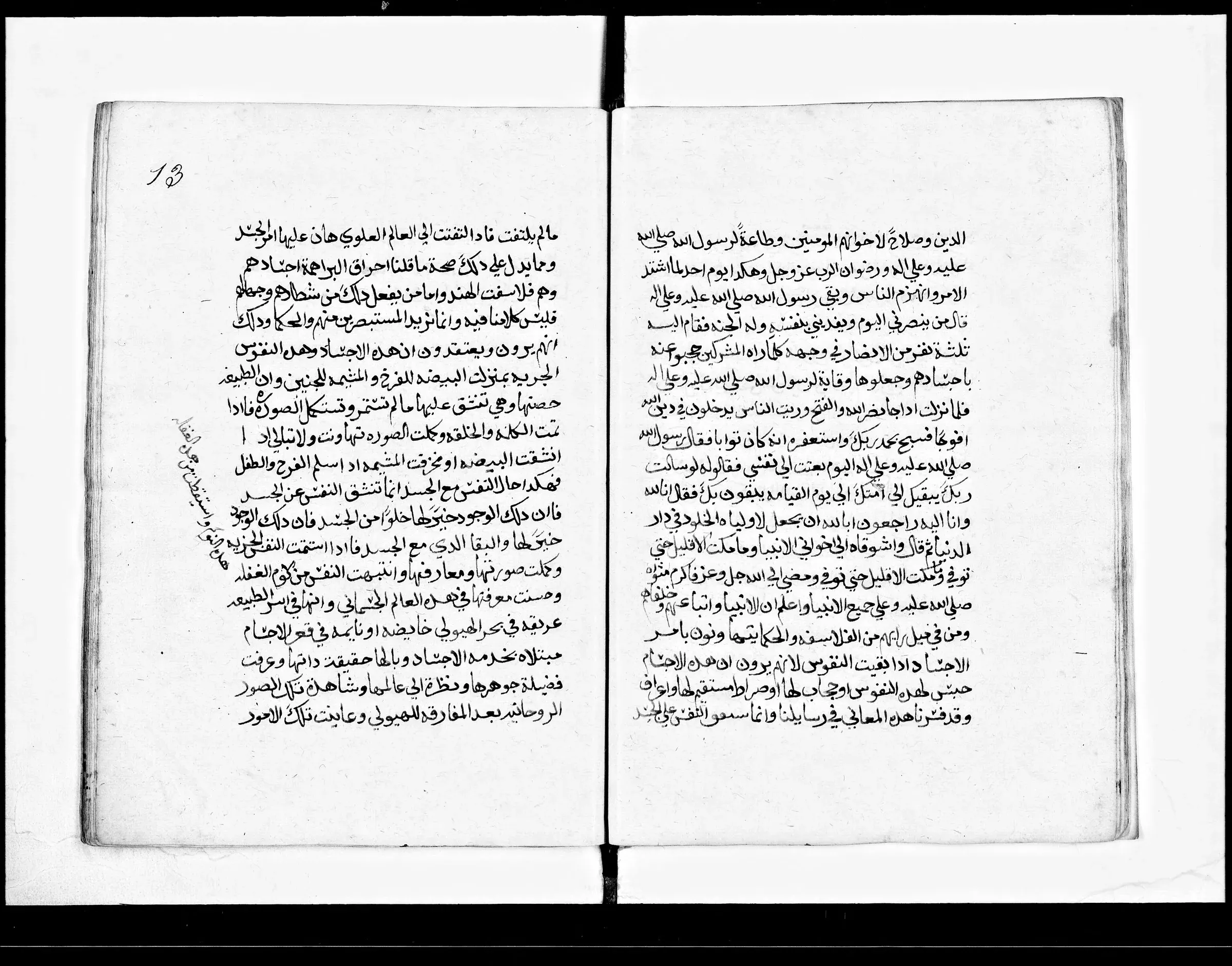
The Brethren of Purity
The Ikhwan al-Safa, usually translated “Brethren of Purity” or “Sincere Brethren”, were an anonymous group of authors who wrote the Rasa’il Ikhwan al-Safa, the “Epistles of the Brethren of Purity”. The work is an encyclopedia of 52 epistles in four books. The first covers the mathematical sciences, including geometry, astronomy, music and logic. The second covers the bodily and natural sciences, the third the psychical and intellectual sciences such as cosmology and eschatology, and the fourth the theological sciences. Daftary writes that together they treat “nearly all the sciences and intellectual traditions known at the time”.1
A separate summary of the corpus, al-Risala al-jami’a (“The Comprehensive Epistle”), was evidently meant for more advanced adepts. A further condensation of it also exists. The Jami’a was wrongly attributed to the Andalusian scholar Maslama al-Majriti, who died around 398/1007.2
An Ismaili work?
Who wrote the Epistles, and when, has long been debated. Daftary notes that their Ismaili connection was recognised as early as 1898 by Paul Casanova, long before most Ismaili literature was recovered. The Historical Dictionary calls that connection “now well established”. A few modern scholars nonetheless deny any link between the Rasa’il and Ismailism.3
Three accounts of authorship
The Tayyibi tradition. Several anachronistic accounts credit the Epistles to various Shi’i Imams. The most detailed comes from the Tayyibi da’i and historian Idris ’Imad al-Din, who gives the official view of the Yemeni da’wa. He attributes the Epistles to Imam Ahmad b. ’Abd Allah, the grandson of Muhammad b. Isma’il and one of the hidden Imams of the period of concealment. Daftary’s summary of the hidden Imams also notes that Ismaili tradition names Ahmad as the author of the Rasa’il.4
Tenth-century testimony. The philosopher Abu Hayyan al-Tawhidi (d. 414/1023), writing around 373/983 in reply to questions from his patron Ibn Sa’dan, vizier to the Buyid Samsam al-Dawla, named several authors. They were secretaries and men of letters in Basra under the Buyids, connected in some way with the Ismaili movement: Abu Sulayman Muhammad b. Ma’shar al-Busti (also called al-Maqdisi), Abu’l-Hasan ’Ali b. Harun al-Zanjani, Abu Ahmad al-Nahrajuri and al-’Awfi. Al-Zanjani, a qadi known to Abu Hayyan, seems to have led the group. Ibn al-Qifti (d. 646/1248) later reproduced this testimony.5
A second contemporary, the Mu’tazili theologian and chief qadi of Rayy ’Abd al-Jabbar al-Hamadhani (d. 415/1025), broadly confirms it. His list drops al-Maqdisi and adds Ibn Abi’l-Baghl, an astrologer, and the chancery secretary Zayd b. Rifa’a. According to Abu Hayyan, Zayd b. Rifa’a was a close friend of the group. On this evidence, Daftary writes, “most scholars are now agreed” that the Epistles were written secretly in Basra in the mid-fourth/tenth century, around the time of the Fatimid conquest of Egypt, by secretaries and men of letters affiliated with Ismailism.6
Abbas Hamdani’s hypothesis. Abbas Hamdani has argued in many studies that al-Tawhidi’s statements are weak. From internal evidence he proposes that the Epistles were compiled between 260/873 and 297/909 by pre-Fatimid Ismaili da’is working with non-Ismaili colleagues. On this view, passages with a later date are subsequent editorial additions. If he is right, the work belongs squarely to the period of concealment.7
Allegiance
Whatever their date, the authors did not write for the Fatimid state. Daftary observes that they evidently did not hold the tenets of Fatimid Ismailism or represent the Fatimid da’wa. The Brethren placed their teaching under the authority of the hidden seventh Imam, Muhammad b. Isma’il. His return was then awaited by the Qarmatis of Bahrayn and the other dissident Ismailis (see the Qarmatians). The Epistles do not mention the Fatimid caliph-imams or their ancestors.8
Basra in the mid-tenth century lay under the virtual domination of the Qarmatis of Bahrayn. Daftary therefore suggests the Epistles probably had the Qarmatis’ tacit approval, if not their active support. Following Samuel Stern, he suggests the authors may have hoped to reunite the non-Fatimid Ismailis, including the Qarmatis of Bahrayn and the dissident communities of the east, on a common, idealised doctrinal basis.9
Sources and method
The Brethren practised religious tolerance and eclecticism. They considered it legitimate to adopt all “the sciences and wisdoms” of the ancient philosophers in building their own synthesis of the knowledge of their time. They drew on a wide range of pre-Islamic traditions and combined them with Islamic teaching, especially as understood by Shi’is of the Ismaili movement. Daftary finds traces of Babylonian astrology and many Judaeo-Christian, Iranian and Indian elements.10
Above all, the Epistles draw on Hellenistic philosophy. Their numerical symbolism is Pythagorean, and they are full of Hermetic, Platonic, Aristotelian, Neopythagorean and especially Neoplatonic ideas. Neoplatonism, with its doctrines of emanation and hierarchy, is the dominant Greek influence. Their cosmology is emanationist and describes a hierarchy of beings in nine stages. Daftary writes that the Brethren tried, “in an original and enlightened fashion”, to harmonise religion and philosophy in order to guide the soul to purification and salvation.11
Two Neoplatonic currents
The Epistles stand beside the Iranian school of “philosophical Ismailism” founded by Muhammad al-Nasafi and developed by Abu Hatim al-Razi and Abu Ya’qub al-Sijistani. Both traditions belong to the broader Ismaili movement of the fourth/tenth century, and both were deeply influenced by Neoplatonism. They differ in audience and status. The Iranian da’is wrote doctrinal treatises within the da’wa hierarchy and debated each other directly. The Brethren wrote an anonymous encyclopedia addressed to educated readers in general.12
The name
The authors call themselves a “brotherhood” (ma’ashara) of sages and address their work to “beginners”. Carmela Baffioni surveys the explanations of the name. Ignaz Goldziher thought it was borrowed from the Indo-Persian fable collection Kalila wa Dimna, where it describes a group of loyal friends. Samuel Stern read it as a reference to an idealised, utopian Ismaili movement. Baffioni finds most convincing the view that links the name to the work’s aim, the salvation of the soul through knowledge and purification of the heart. Ismail Poonawala has suggested that “Ikhwan al-Safa” is simply a pseudonym hiding the authors’ identities.13
Dating hypotheses
Baffioni also reviews the proposed dates. Friedrich Dieterici, in the nineteenth century, proposed 961–986 CE, partly because the Epistles quote the poet al-Mutanabbi (d. 965). Louis Massignon used a verse by Ibn al-Rumi (d. 896) to fix the earliest possible date and the Ikhwan’s definition of the sine, which predates al-Battani’s (d. 929), to fix the latest. He identified the “expected event” the Epistles repeatedly mention with the Fatimid conquest of Egypt. Casanova used astronomical data to move the work a century later, to 1047–1051. Yves Marquet first confirmed Dieterici’s range of 961–980, then argued for a date near 909, reading the expected event as the proclamation of al-Mahdi in Ifriqiya. Hamdani dates the whole work to 873–909, and Poonawala has sided with him.14
Baffioni notes that Wilferd Madelung has recently argued for the Ikhwan’s Ismailism in a new form. Recalling that the Ismailis of Iraq and Iran did not accept ’Abd Allah al-Mahdi’s claim, he suggests that the Ismailis of Basra recognised a member of the family who had stayed hidden in Khurasan, and that this person founded the brotherhood. Daniel De Smet, by contrast, holds that the existence of the hidden Imam Ahmad has no reliable historical basis. He regards the attribution of the Epistles and the Jami’a to him as a late forgery, no earlier than the thirteenth century.15
Signs of Ismaili affiliation
Scholars have pointed to several features as evidence of Ismaili inspiration. They include the hierarchical structure of the universe, references to seven-fold cycles, the distinction between the elect and the masses, and Ismaili symbols such as the bee as an emblem of the Imam. The Epistles regard ’Ali as the Prophet’s rightful heir (wali), deplore the killing at Karbala, read the Qur’an allegorically, and hope that existing governments will fall when the current seven-fold cycle ends. Stanislas Guyard linked a fragment to Ismailism in 1874. Henry Corbin and Marquet affirmed the connection outright. Two treatises in particular have prompted an Ismaili reading: Epistle 48, on the summons (da’wa) to God, and Epistle 50, on kinds of government. Baffioni concludes that no consensus has been reached. Stern, Diwald and De Smet all stress that the Epistles influenced Ismailis only from the twelfth century.16
Two versions of the Jami’a survive. One is attributed to al-Majriti, whom Godefroid de Callatay identifies with Maslama al-Qurtubi. The other is attributed to the hidden Imam Ahmad b. ’Abd Allah. A further Risalat jami’at al-jami’a (“Supercomprehensive Epistle”), also attributed to Ahmad, is never cited in the Epistles themselves. Mourad Kacimi sees it as a product of the later Ismaili adoption of the corpus.17
Hostile reception
The Epistles also circulated outside Ismaili circles, and not always safely. According to Corbin, as reported by Baffioni, the Abbasid caliph al-Mustanjid (r. 555–566/1160–1170) judged the work heretical and ordered existing copies burned. It survived nonetheless and was translated into Persian and Turkish. The Hanbali theologian Ibn Taymiyya (d. 1328) condemned the authors as Shi’i esotericists whose doctrines contradicted Islam. He rejected the attribution of the Epistles to Ja’far al-Sadiq.18
Neglect and revival
The Epistles had no influence on contemporary Ismaili thought, including Fatimid doctrine. Classical Fatimid authors do not mention them, and the Fatimid da’wa did not adopt or endorse them in any significant way. They became important only about two centuries after they were written, in the literature of the Tayyibi Musta’li da’wa in Yemen. The da’i Ibrahim b. al-Husayn al-Hamidi (d. 557/1162) apparently introduced them into Tayyibi literature. After that, Yemeni da’is studied and commented on them widely, as did their Indian successors in the Da’udi Bohra community.19
Why they matter for early Ismaili history
The dating debate decides what the Epistles can tell us. On the majority view, they show how non-Fatimid Ismailis in Buyid Basra, a generation after the schism of 286/899, combined loyalty to the hidden Muhammad b. Isma’il with an open encyclopedic philosophy. On Hamdani’s view, they are one of the very few substantial texts surviving from the da’wa of the hidden Imams. On either view they are, in Daftary’s account, one of the main channels through which Neoplatonism entered Ismaili thought.20
Footnotes
-
Farhad Daftary, The Isma’ilis: Their History and Doctrines, 2nd ed. (Cambridge University Press, 2007), pp. 234–236; Farhad Daftary, Historical Dictionary of the Ismailis (Scarecrow Press, 2012), s.v. “Ikhwan al-Safa’”. ↩
-
Daftary, The Isma’ilis, 2nd ed. (Cambridge University Press, 2007), p. 236; Daftary, Historical Dictionary of the Ismailis (Scarecrow Press, 2012), s.v. “Ikhwan al-Safa’”. ↩
-
Daftary, The Isma’ilis, 2nd ed. (Cambridge University Press, 2007), pp. 235–236; Daftary, Historical Dictionary of the Ismailis (Scarecrow Press, 2012), s.v. “Ikhwan al-Safa’”. ↩
-
Daftary, The Isma’ilis, 2nd ed. (Cambridge University Press, 2007), pp. 100, 235. ↩
-
Daftary, The Isma’ilis, 2nd ed. (Cambridge University Press, 2007), p. 235. ↩
-
Daftary, The Isma’ilis, 2nd ed. (Cambridge University Press, 2007), p. 235; Daftary, Historical Dictionary of the Ismailis (Scarecrow Press, 2012), s.v. “Ikhwan al-Safa’”. ↩
-
Daftary, The Isma’ilis, 2nd ed. (Cambridge University Press, 2007), p. 236. ↩
-
Daftary, The Isma’ilis, 2nd ed. (Cambridge University Press, 2007), pp. 235–236. ↩
-
Daftary, The Isma’ilis, 2nd ed. (Cambridge University Press, 2007), pp. 235–236. ↩
-
Daftary, The Isma’ilis, 2nd ed. (Cambridge University Press, 2007), pp. 236–237; Daftary, Historical Dictionary of the Ismailis (Scarecrow Press, 2012), s.v. “Ikhwan al-Safa’”. ↩
-
Daftary, The Isma’ilis, 2nd ed. (Cambridge University Press, 2007), pp. 235, 237. ↩
-
Daftary, The Isma’ilis, 2nd ed. (Cambridge University Press, 2007), pp. 225, 234–235. ↩
-
Carmela Baffioni, “Ikhwan al-Safa’,” Stanford Encyclopedia of Philosophy (rev. 2025), §2 “Naming and dating” and §1 “Authorship”, https://plato.stanford.edu/entries/ikhwan-al-safa/. ↩
-
Carmela Baffioni, “Ikhwan al-Safa’,” Stanford Encyclopedia of Philosophy (rev. 2025), §2 “Naming and dating”, https://plato.stanford.edu/entries/ikhwan-al-safa/. ↩
-
Carmela Baffioni, “Ikhwan al-Safa’,” Stanford Encyclopedia of Philosophy (rev. 2025), §2 “Naming and dating” and §4 “The extant corpus”, https://plato.stanford.edu/entries/ikhwan-al-safa/. ↩
-
Carmela Baffioni, “Ikhwan al-Safa’,” Stanford Encyclopedia of Philosophy (rev. 2025), §3 “Ideological commitment”, https://plato.stanford.edu/entries/ikhwan-al-safa/; Daftary, The Isma’ilis, 2nd ed. (Cambridge University Press, 2007), p. 235. ↩
-
Carmela Baffioni, “Ikhwan al-Safa’,” Stanford Encyclopedia of Philosophy (rev. 2025), §4 “The extant corpus”, https://plato.stanford.edu/entries/ikhwan-al-safa/. ↩
-
Carmela Baffioni, “Ikhwan al-Safa’,” Stanford Encyclopedia of Philosophy (rev. 2025), §3 “Ideological commitment”, https://plato.stanford.edu/entries/ikhwan-al-safa/; C. E. Bosworth, The New Islamic Dynasties (Edinburgh University Press, 1996), p. 7. ↩
-
Daftary, The Isma’ilis, 2nd ed. (Cambridge University Press, 2007), p. 236. ↩
-
Daftary, The Isma’ilis, 2nd ed. (Cambridge University Press, 2007), pp. 234–237. ↩