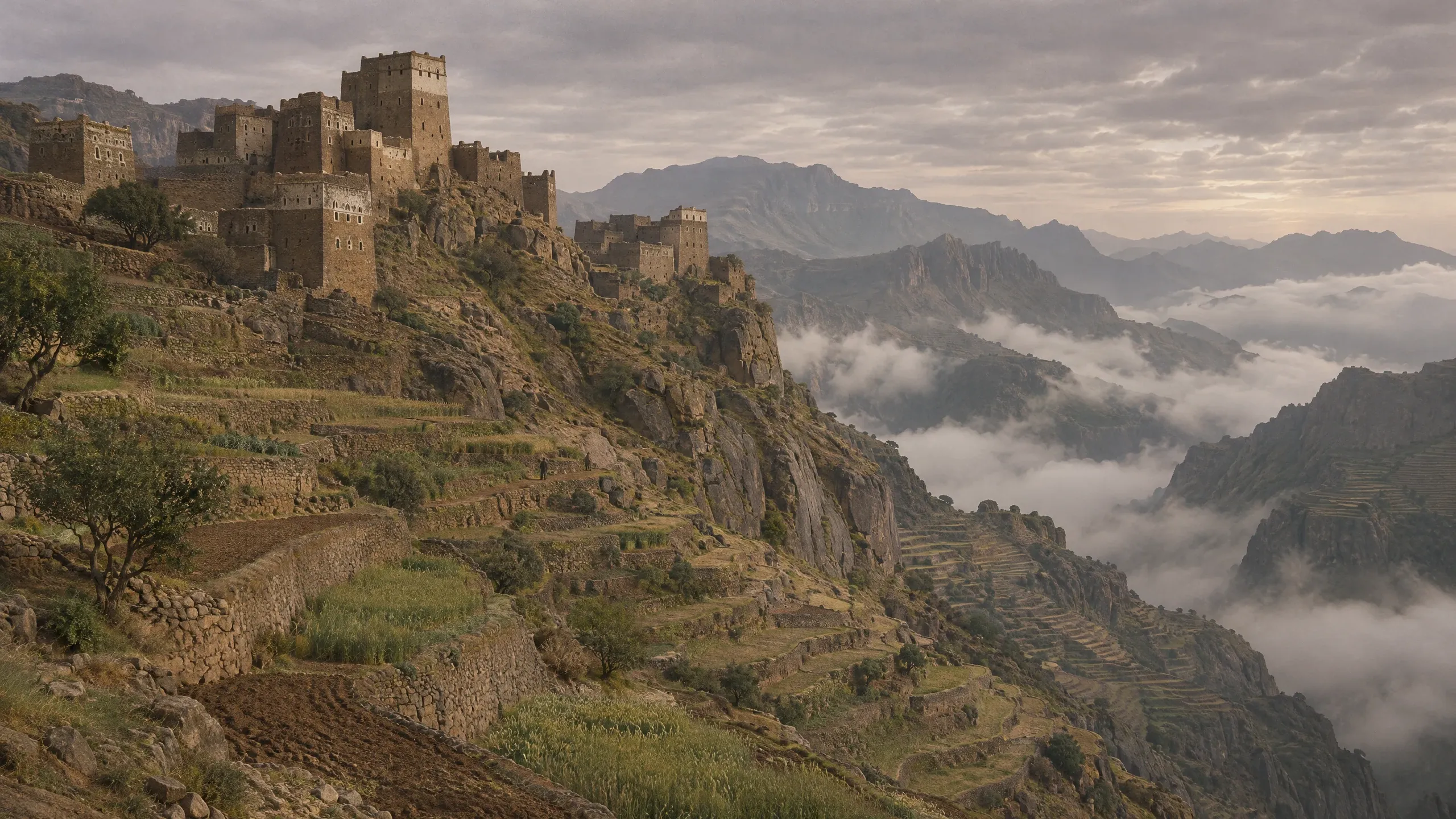
A stronghold for eleven centuries
Daftary writes that the da’wa in Yemen “has remained an important Isma’ili stronghold over the last eleven centuries” and that it was in close contact with the central leadership from the start. The mission began in the last decades of the dawr al-satr, when the hidden Imams were directing the movement from Salamiyya. Yemen later served as the base for missions to Sind, Bahrayn and North Africa.1
The founding da’is
Al-Qadi al-Nu’man gives a full account of how two da’is were recruited and sent to Yemen in 266/879–880. The first, Ibn Hawshab, was a Kufan from a prominent Imami Shi’i family. The second, ’Ali b. al-Fadl, was a Yemeni Shi’i who had been converted while on pilgrimage to the tomb of al-Husayn at Karbala. Madelung places their training within the Iraqi da’wa of Hamdan Qarmat and ’Abdan. The two reached Yemen in 268/881, and as a result of their early success they were preaching publicly by 270/883.2
Halm, drawing on Ibn Hawshab’s own Sira, adds that Ibn Hawshab first lived in Aden disguised as a cotton merchant while Ibn al-Fadl went into the mountains as a hermit and da’i. The mission began to advance in 270/883–884. In that year Ibn Hawshab settled among the Banu Musa in the Wadi La’a, west of the Jabal Maswar massif.3
Mountain refuges
Each da’i founded a fortified base. Ibn Hawshab took several towns in the Jabal Maswar, including Bayt Fa’is, which became his dar al-hijra, the “abode of emigration”, for the growing community. Ibn al-Fadl set up his refuge at Janad. Daftary notes that the Yemeni Ismailis spread from these mountain strongholds into the surrounding regions. He also notes that the later Nizari Ismailis of Persia and Syria used the same strategy, with Alamut as the best-known example. The mission won strong tribal support and met with what Daftary calls “astonishing success”.4
Conquest of the highlands
The Ya’furid amirs of San’a could not stop the da’is. In Ibn Hawshab’s lifetime the Ismailis took Shibam and the mountain of Kawkaban several times, and they captured San’a itself no fewer than five times. When Ibn al-Fadl occupied San’a in 293/905–906, almost all of Yemen was under Ismaili control. The Ismailis were later forced to give up most of their conquests under pressure from the Zaydi imams. The Zaydis, a different branch of the Shi’a, had established a state in northern Yemen in 280/893.5
A base for the da’wa
From Yemen the da’wa reached distant lands. In 270/883 Ibn Hawshab sent his relative al-Haytham to Sind, from where Ismailism spread further into the Indian subcontinent. A da’i named Abu Zakariyya al-Tamami, possibly sent by Ibn Hawshab, went to Bahrayn before Abu Sa’id al-Jannabi arrived there. In 279/892–893 Ibn Hawshab sent the Kufan Abu ’Abd Allah al-Shi’i, who had spent a year with him in Yemen, to Mecca. There Abu ’Abd Allah met Kutama Berber pilgrims and went back with them to North Africa, where he prepared the way for the Fatimid caliphate.6
The schism in Yemen
In the schism of 286/899, the Yemeni community at first stayed fully loyal to ’Abd Allah al-Mahdi. By 291 AH, however, Ibn al-Fadl was showing signs of disloyalty. He had been based at Mudhaykhira in southern Yemen since 292/904. In Muharram 299/August 911, after taking San’a again, he publicly renounced al-Mahdi and proclaimed himself the Mahdi. He besieged Ibn Hawshab for eight months in the Jabal Maswar but could not win him over.7
Ibn Hawshab died on 11 Jumada I 302/2 December 914, still loyal to al-Mahdi; the da’i al-Shawiri then pushed his sons out of the leadership. Ibn al-Fadl died in 303/915, and his movement quickly fell apart. As’ad b. Abi Ya’fur of the Ya’furid dynasty, who had served as Ibn al-Fadl’s deputy in San’a, rose against Ibn al-Fadl’s son al-Fafa (or al-Ghafa). In 304/917 As’ad captured Mudhaykhira and killed al-Fafa and many of his followers, ending the dissident Qarmati movement in Yemen.8
The Sulayhids
The Fatimid da’wa survived in the highlands. In 439/1047 ’Ali b. Muhammad al-Sulayhi rose in revolt at Masar in the mountainous Haraz region south-west of San’a. He was the son of the qadi of Haraz and an Ismaili da’i who had studied under Sulayman b. ’Abd Allah al-Zawahi, chief da’i of Yemen. He recognised the suzerainty of the Fatimids and by 455/1063 had brought all of Yemen under his rule. He was murdered in 459/1067 and succeeded by his son al-Mukarram Ahmad (d. 477/1084).9
From around 467/1074, effective power passed to al-Mukarram’s wife, Queen Arwa bint Ahmad al-Sulayhi. By then most of northern Yemen had been lost to the Zaydis. Around 480/1087 she moved her capital to Dhu Jibla in the southern highlands, where she built a new palace and turned the old one into a mosque. She kept close ties with the Fatimid caliph-Imams al-Mustansir, al-Musta’li and al-Amir, and extended the da’wa on their behalf to western India. Aden was ruled by the Ismaili Zuray’id dynasty, whom al-Mukarram had appointed in 460/1068.10
The Tayyibi da’wa
In 526/1132 the Musta’li Ismailis split over the claim of al-Hafiz to the Fatimid caliphate. Many in Yemen instead recognised al-Tayyib, the son of al-Amir (d. 524/1130). Queen Arwa founded the independent Tayyibi da’wa in Yemen, which outlived both the Sulayhids and the Fatimids. The Tayyibi Imams have remained concealed since al-Tayyib’s time, and a da’i mutlaq, a da’i with supreme authority, leads each community on their behalf. Arwa died in 532/1138, which effectively ended the Sulayhid dynasty, but Yemen remained the main stronghold of the Tayyibi da’wa.11
Modern Yemen
The Tayyibis later split into Da’udi, Sulaymani and ’Alawi branches. The Sulaymani da’is, hereditary in the Makrami family with few exceptions since 1088/1677, made Najran their seat and ruled it with the support of the Banu Yam. In 1289/1872 the Makrami da’is were expelled from Haraz and moved to Najran. Najran was annexed to Saudi Arabia in 1934. For the Nizari Imams after the Fatimid split, see the later chapters of this history.12
Footnotes
-
Farhad Daftary, The Isma’ilis: Their History and Doctrines, 2nd ed. (Cambridge University Press, 2007), pp. 109–110. ↩
-
Daftary, The Isma’ilis, 2nd ed. (Cambridge University Press, 2007), p. 109; Wilferd Madelung, “Hamdan Qarmat,” Encyclopaedia Iranica, vol. XI, fasc. 6 (2003), pp. 634–635, https://www.iranicaonline.org/articles/hamdan-qarmat/. ↩
-
Heinz Halm, “Ebn Hawsab,” Encyclopaedia Iranica, vol. VIII, fasc. 1 (1997), pp. 28–29, https://www.iranicaonline.org/articles/ebn-hawsab/. ↩
-
Halm, “Ebn Hawsab,” Encyclopaedia Iranica (1997), https://www.iranicaonline.org/articles/ebn-hawsab/; Daftary, The Isma’ilis, 2nd ed. (Cambridge University Press, 2007), pp. 109–110. ↩
-
Halm, “Ebn Hawsab,” Encyclopaedia Iranica (1997), https://www.iranicaonline.org/articles/ebn-hawsab/; Daftary, The Isma’ilis, 2nd ed. (Cambridge University Press, 2007), p. 110. ↩
-
Daftary, The Isma’ilis, 2nd ed. (Cambridge University Press, 2007), p. 110; Halm, “Ebn Hawsab,” Encyclopaedia Iranica (1997), https://www.iranicaonline.org/articles/ebn-hawsab/. ↩
-
Daftary, The Isma’ilis, 2nd ed. (Cambridge University Press, 2007), p. 122; Halm, “Ebn Hawsab,” Encyclopaedia Iranica (1997), https://www.iranicaonline.org/articles/ebn-hawsab/. ↩
-
Halm, “Ebn Hawsab,” Encyclopaedia Iranica (1997), https://www.iranicaonline.org/articles/ebn-hawsab/; Daftary, The Isma’ilis, 2nd ed. (Cambridge University Press, 2007), p. 122. ↩
-
Farhad Daftary, Historical Dictionary of the Ismailis (Scarecrow Press, 2012), s.v. “’Ali b. Muhammad al-Sulayhi” and “Sulayhids”. ↩
-
Daftary, Historical Dictionary of the Ismailis (Scarecrow Press, 2012), s.v. “Sulayhids” and “Zuray’ids”. ↩
-
Daftary, Historical Dictionary of the Ismailis (Scarecrow Press, 2012), s.v. “Tayyibis, Tayyibiyya” and “Sulayhids”. ↩
-
Daftary, Historical Dictionary of the Ismailis (Scarecrow Press, 2012), s.v. “Tayyibis, Tayyibiyya”, “Sulaymanis” and Chronology, 1289/1872 and 1934. ↩