Succession
Ahmad b. ’Abd Allah was the son of the hidden Imam ’Abd Allah b. Muhammad, who designated him as successor before dying in Salamiyya in about 212/827–828. In the traditional Fatimid sequence of hidden Imams, Muhammad b. Isma’il, ’Abd Allah, Ahmad, al-Husayn and ’Abd Allah al-Mahdi, he is the second of the three who led the movement between Muhammad b. Isma’il and al-Mahdi. The Nizari count numbers him ninth and calls him al-Taqi, “the God-fearing”.1
Later Ismaili authors agree on a group of three concealed Imams. Quoting the original texts, the Nizari community historian Mumtaz Ali Tajddin cites the Fatimid da’i Hamid al-Din al-Kirmani, who wrote that after Muhammad b. Isma’il “the concealed Imams (a’imma masturin) succeeded to the Imamate … and these were three Imams, viz., Abdullah, Ahmad and Hussain”. He also cites the Indian Ismaili author Hasan b. Nuh al-Bharuchi, whose Kitab al-azhar names “Ahmad bin Abdullah, surnamed at-Taqi”.2
Concealment at Salamiyya
Little reliable information about Ahmad survives. Daftary notes that the names of the hidden Imams are absent from the earliest Ismaili sources found so far. Even al-Mahdi, the only Fatimid caliph who tried to set out his ancestry, did so in a way that added to the confusion. Ahmad lived at Salamiyya, the residence of the Imams and headquarters of the da’wa, where the family posed as ordinary Hashimid merchants.3
The Nizari community history gives traditional details: that Ahmad was born in 174/790, was also called Muhammad al-Habib and Abu’l-Husayn, became Imam in 212/828, was known as an eminent Hashimid trader, and left Salamiyya for some years when the caliph al-Ma’mun ordered his arrest. These details are later tradition, and Daftary does not confirm them.4
The da’wa before its public phase
The period of Ahmad’s leadership falls in the long underground phase of the movement. Daftary writes that the Ismailis spent about a century in concealment before reappearing shortly after the middle of the 3rd/9th century as a revolutionary organisation. By then it had a network of da’is directed by a secret central leadership. Samuel Stern denied that there was strict organisational continuity across this hidden century. Daftary does not attribute any particular campaigns to Ahmad himself.5
The leaders of this period preached on behalf of the awaited Qa’im, Muhammad b. Isma’il. According to Daftary’s reading of the early sources, they did not claim the Imamate for themselves and acted as his hujja, or representative, until the reform of 286/899.6
The Epistles of the Brethren of Purity
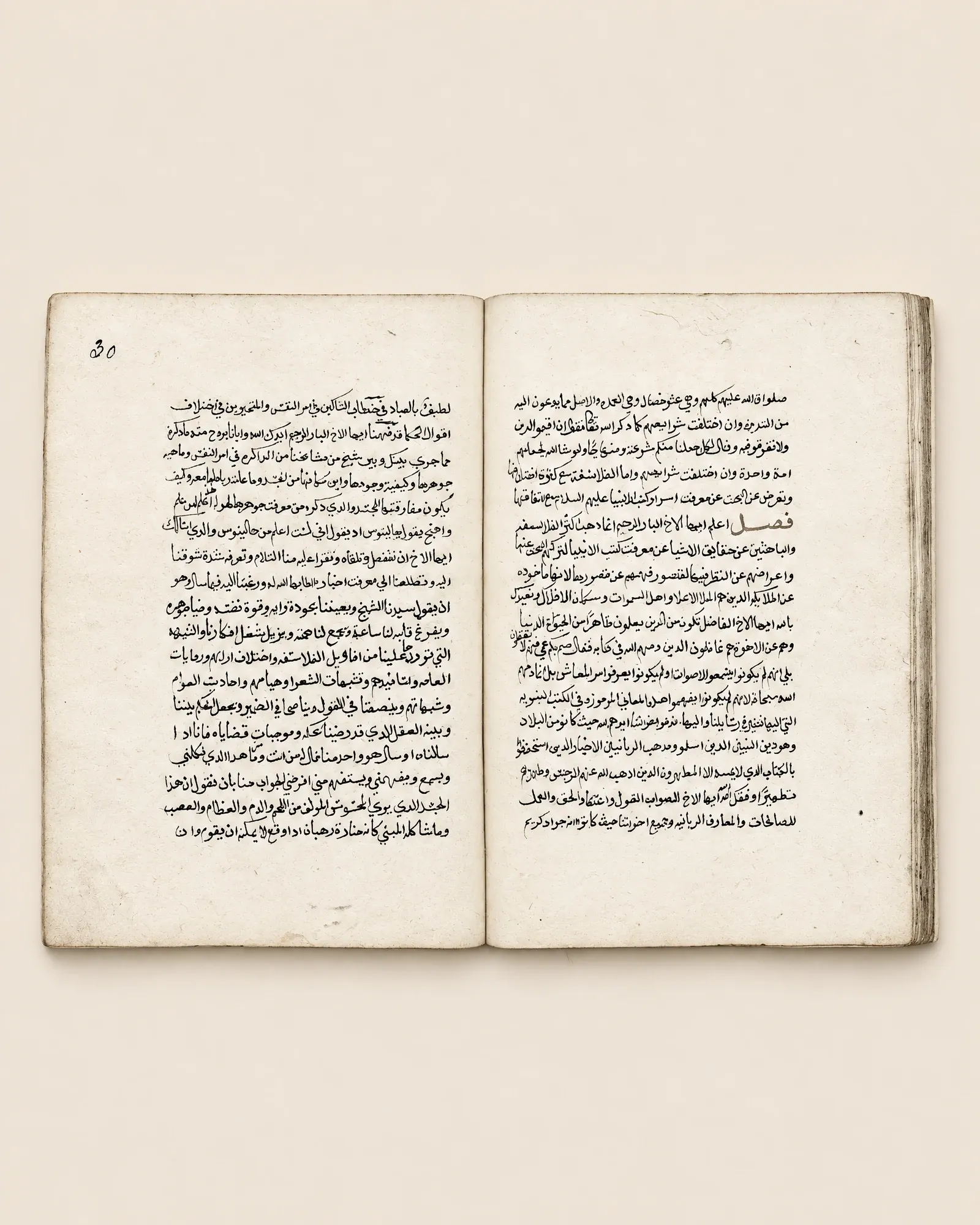
Ahmad’s name is linked above all with the Rasa’il Ikhwan al-Safa’, the Epistles of the Brethren of Purity. Daftary notes that, according to Ismaili tradition, Ahmad wrote the Epistles. The Yemeni da’i Idris ’Imad al-Din (d. 872/1468), reflecting the official view of the Tayyibi da’wa, gives a detailed account attributing them to the Imam Ahmad b. ’Abd Allah, grandson of Muhammad b. Isma’il. Tajddin quotes W. Ivanow’s statement that the second hidden Imam, “the author of the Encyclopaedia of the Ikhwanu’s Safa, or Sahib al-Rasail, as he is usually referred to in the Ismaili theological works, is also known definitely as Ahmad”.7
Most modern scholars date the Epistles differently. The 4th/10th-century philosopher Abu Hayyan al-Tawhidi named a group of secretaries and men of letters in Basra as their authors, answering a question from the Buyid vizier Ibn Sa’dan around 373/983. The Mu’tazili theologian ’Abd al-Jabbar (d. 415/1025) largely confirmed his account. On this evidence, Daftary reports, most scholars agree that the Epistles were produced secretly in Basra in the mid-4th/10th century by a circle affiliated with Ismailism. Abbas Hamdani argued instead for composition by pre-Fatimid da’is between 260/873 and 297/909, with later interpolations. See Ikhwan al-Safa’.8
Ahmad in the polemical and Musta’li accounts
Ahmad also appears in the hostile “black legend” of Ismaili origins. Ibn Rizam and Akhu Muhsin made the movement the work of a non-’Alid, ’Abd Allah b. Maymun al-Qaddah, and said that this ’Abd Allah was succeeded by “his son Ahmad”. In their version, Ahmad’s descendants spread the da’wa to Iraq, Yemen, Bahrayn, Rayy, Tabaristan, Khurasan and Fars. Eventually one of them, Sa’id b. al-Husayn, went to North Africa, falsely claimed descent from Muhammad b. Isma’il and founded the Fatimid dynasty. The legend thus kept the order of the official names, ’Abd Allah, Ahmad and al-Husayn, but gave them a different ancestry. Daftary concludes that the evidence does not support a Qaddahid origin for the Fatimids.9
Musta’li Ismaili authors of the 6th/12th century tried to combine the official line with the Maymun traditions. Al-Khattab b. al-Hasan al-Hamdani (d. 533/1138) presented Maymun al-Qaddah and his son as the trustees (hujjas) of under-age Imams. Three centuries later, Idris ’Imad al-Din named Maymun and his son as guardians and hujjas of the successive Imams Isma’il, Muhammad, ’Abd Allah and Ahmad. In his historical ’Uyun al-akhbar Idris followed the official version. In his esoteric Zahr al-ma’ani he tried to reconcile it with al-Khattab’s account, and Daftary calls the result “very ambiguous indeed”.10
Succession and family
Ahmad was succeeded by his son al-Husayn. Another son, Muhammad b. Ahmad, known as Sa’id al-Khayr, al-Hakim and Abu’l-Shalaghlagh, later became guardian and father-in-law of his nephew ’Abd Allah al-Mahdi. Daftary reports that Muhammad tried several times, without success, to take the leadership for his own sons, all of whom died young.11
The community history places Ahmad’s death at Salamiyya in 225/840. It adds that Muhammad Sa’id al-Khayr’s descendants were killed by the Qarmatis at Salamiyya in 290/902. The date of 225/840 is not confirmed by the academic sources used here and is shown as approximate.12
Footnotes
-
Farhad Daftary, The Isma’ilis: Their History and Doctrines, 2nd ed. (Cambridge University Press, 2007), pp. 100, 507. ↩
-
Mumtaz Ali Tajddin Sadik Ali, Brief History of the Shia Ismaili Imams (Karachi, 2009), p. 27, https://archive.org/details/bk892. ↩
-
Daftary, The Isma’ilis, 2nd ed. (Cambridge University Press, 2007), pp. 100–101. ↩
-
Tajddin, Brief History of the Shia Ismaili Imams (Karachi, 2009), p. 30, https://archive.org/details/bk892. ↩
-
Daftary, The Isma’ilis, 2nd ed. (Cambridge University Press, 2007), p. 98. ↩
-
Daftary, The Isma’ilis, 2nd ed. (Cambridge University Press, 2007), pp. 99, 117. ↩
-
Daftary, The Isma’ilis, 2nd ed. (Cambridge University Press, 2007), pp. 100, 235; Tajddin, Brief History of the Shia Ismaili Imams (Karachi, 2009), p. 30, https://archive.org/details/bk892. ↩
-
Daftary, The Isma’ilis, 2nd ed. (Cambridge University Press, 2007), pp. 235–236. ↩
-
Farhad Daftary, The Isma’ilis: Their History and Doctrines, 2nd ed. (Cambridge University Press, 2007), pp. 102, 106. ↩
-
Daftary, The Isma’ilis, 2nd ed. (Cambridge University Press, 2007), pp. 105–106. ↩
-
Daftary, The Isma’ilis, 2nd ed. (Cambridge University Press, 2007), p. 100. ↩
-
Tajddin, Brief History of the Shia Ismaili Imams (Karachi, 2009), p. 31, https://archive.org/details/bk892. ↩