Abu Ali al-Mansur al-Hakim bi-Amr Allah was the sixteenth Ismaili Imam and the sixth Fatimid caliph. He is the most controversial ruler of the dynasty. His twenty-four-year reign saw the founding of the Dar al-’Ilm, the greatest expansion of the da’wa in Iraq and Persia, a long series of edicts on religion and public morals, the rise of the movement that became the Druze, and an unexplained disappearance.12
Accession and the regency of Barjawan
Al-Hakim was born in 375/985, the first Fatimid caliph born in Egypt. He was designated heir in 383/993 after the death of his elder brother Muhammad, and succeeded his father al-Aziz on 28 Ramadan 386/14 October 996, at the age of eleven.23 The army was divided between the Berber Maghariba, led by the Kutama, and the Mashariqa of Turks and Daylamis.3 The Kutama chief al-Hasan ibn Ammar was first made wasita, intermediary between the caliph and his officials, without the title of vizier; the Christian vizier Isa ibn Nasturus was executed.4
In Ramadan 387/October 997 al-Hakim’s tutor, the eunuch Barjawan, allied with the Turks and seized power as wasita, ruling for four years with the Christian secretary Fahd ibn Ibrahim.4 His general Jaysh ibn Samsam defeated the Byzantines at Afamiya, and a ten-year truce was concluded with Basil II from 391/1001.4 In 390/1000 al-Hakim had Barjawan killed and took power himself; in the last twenty years of the reign more than fifteen men held the office of wasita or vizier.52
Reputation
Al-Hakim’s decrees were numerous and often reversed, and many officials, including Barjawan, Fahd ibn Ibrahim and the commander al-Fadl ibn Salih, were executed.56 Daftary argues that the image of an eccentric tyrant comes largely from the Melkite Christian historian Yahya al-Antaki (d. 458/1066) and hostile Sunni authors. Modern studies present al-Hakim as a ruler generally popular with his subjects, who tried to appease different groups and took a close interest in the da’wa and the education of da’is.52
Edicts on religion
By 395/1004 al-Hakim had begun measures against Christians and Jews, directed mainly at the Melkites; churches were demolished, and in 400/1009 he ordered the destruction of the Church of the Holy Sepulchre in Jerusalem, which ended the truce with Byzantium. Basil II banned trade with the Fatimids in 406/1015–1016.56 In 404/1013 those who had been forced to convert were allowed to return to their faith or emigrate, and churches were later restored.6 Measures against Sunnis also fluctuated: the cursing of the first caliphs was inscribed on mosque walls in 395/1004–1005, repealed two years later and reintroduced in 403/1013.6 His ethico-social edicts regulated food, drink, dress and public conduct.61
Revolts and Syria
In 395/1004 Abu Rakwa, who claimed Umayyad descent, raised the Zanata and the Banu Qurra near Barqa and besieged Alexandria. He was defeated at Fayyum by al-Fadl ibn Salih, fled to Nubia, and was executed in Cairo in 397/1007; al-Hakim then adopted more liberal policies.7 In Palestine the Jarrahid Mufarrij ibn Daghfal rebelled in 402/1011–1012, took Ramla and in 403/1012 proclaimed the sharif of Mecca, Abu’l-Futuh, as anti-caliph. The revolt ended with Mufarrij’s death in 404/1013.7 Fatimid hegemony was extended as far as Aleppo, whose first Fatimid governor entered the city in 407/1017.82
In Ifriqiya, by contrast, the Ismaili communities of Qayrawan, Mahdiya, Tunis and Tripoli were massacred in 407/1016–1017 after the accession of the Zirid al-Mu’izz ibn Badis, with the connivance of the Zirids and the encouragement of Maliki jurists.8
Dar al-’Ilm and the majalis
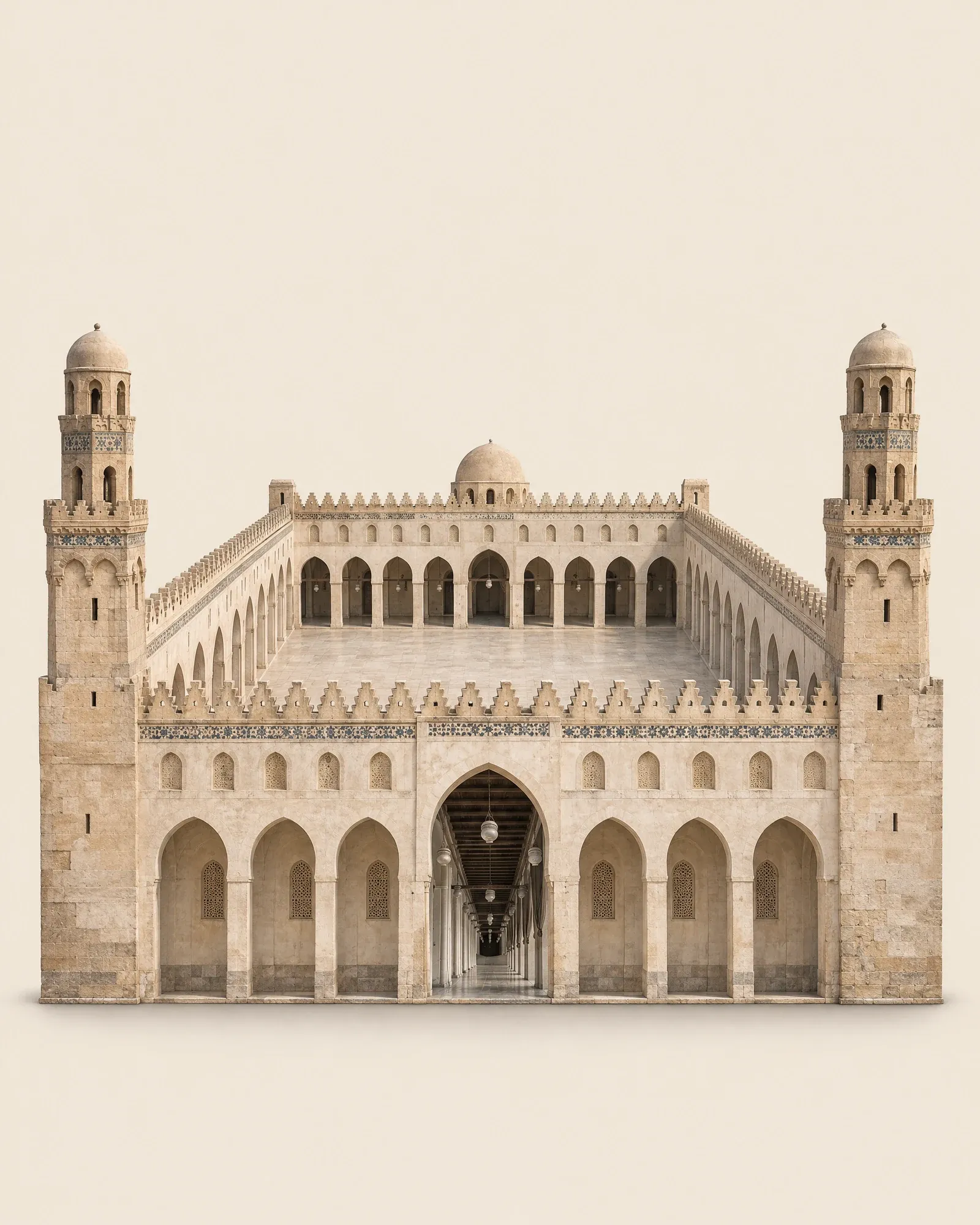
In 395/1005 al-Hakim founded the Dar al-’Ilm, also called Dar al-Hikma, in part of the Fatimid palace. Scholars of different persuasions taught the Qur’an, hadith, law, grammar, logic, astronomy and mathematics; it held a major library, and da’is were trained there. Al-Hakim attended lectures himself.62 He also had the majalis al-hikma, the “sessions of wisdom”, organised for separate audiences, including officials, the elite and women, with a session for women at al-Azhar.92 He completed the great mosque in Cairo that bears his name.12
The eastern da’wa
The da’wa expanded greatly under al-Hakim. In Iraq and Persia it targeted rulers and tribal chiefs.810 Its most accomplished representative was Hamid al-Din al-Kirmani, who worked mainly in Baghdad and Basra.10 In 401/1010–1011 the Uqaylid amir Qirwash ibn al-Muqallad had the khutba read for al-Hakim in Mosul, Kufa and al-Mada’in, as did Ali al-Asadi at Hilla, until the Abbasid caliph al-Qadir forced Qirwash to withdraw.11 In 402/1011 al-Qadir issued the Baghdad manifesto, signed by Sunni and Shi’i scholars, which denied the Fatimids’ Alid descent and was read in the mosques; he also commissioned refutations of Ismaili doctrine.11 In 403/1012–1013 al-Hakim tried without success to win over Mahmud of Ghazna.11
Asceticism and succession
From 403/1012–1013 al-Hakim forbade prostration before him, dressed simply and rode a donkey without guards. In 404/1013 he named as heir Abd al-Rahim ibn Ilyas, a great-grandson of al-Mahdi, rather than his own son Ali, and made him governor of Damascus.12 He became known for walks at night, particularly on the Muqattam hills east of Cairo.13
The origins of the Druze
Some da’is, many from Persia and Central Asia, began to preach that al-Hakim was divine. The movement was organised in 408/1017, the first year of the Druze era, by al-Hasan ibn Haydara al-Akhram, who was assassinated in 408/1018 while riding in al-Hakim’s retinue.12 It was resumed in 410/1019 by Hamza ibn Ali and his rival al-Darazi, from whom the name Druze derives; al-Darazi disappeared in 410/1019, probably killed.14 There is no evidence that al-Hakim encouraged the movement, and he never claimed divinity in his decrees. The da’wa opposed it: al-Kirmani was brought to Cairo, and in al-Risala al-wa’iza of 408/1017 he affirmed that al-Hakim was a divinely appointed Imam, not God, and that the shari’a remained in force.1415
Disappearance
On the night of 27 Shawwal 411/13 February 1021 al-Hakim left for the Muqattam hills and did not return. He was thirty-six. His donkey and his clothes, pierced by dagger cuts, were found.162 Some sources say he was killed on the orders of his half-sister Sitt al-Mulk, others at the instigation of Hamza; the Druze believe he went into occultation.16 About forty days later Sitt al-Mulk proclaimed his sixteen-year-old son Ali caliph as al-Zahir.1617
Footnotes
-
Farhad Daftary, Historical Dictionary of the Ismailis (Scarecrow Press, 2012), s.v. “al-Hakim”. ↩ ↩2 ↩3
-
Farhad Daftary, “Ḥākem be-Amr-Allāh”, Encyclopaedia Iranica, vol. XI, fasc. 6 (2003), pp. 572–573, https://www.iranicaonline.org/articles/hakem-be-amr-allah. ↩ ↩2 ↩3 ↩4 ↩5 ↩6 ↩7 ↩8 ↩9
-
Farhad Daftary, The Isma’ilis: Their History and Doctrines, 2nd ed. (Cambridge University Press, 2007), p. 178. ↩ ↩2
-
Farhad Daftary, The Isma’ilis: Their History and Doctrines, 2nd ed. (Cambridge University Press, 2007), p. 179. ↩ ↩2 ↩3
-
Farhad Daftary, The Isma’ilis: Their History and Doctrines, 2nd ed. (Cambridge University Press, 2007), p. 180. ↩ ↩2 ↩3 ↩4
-
Farhad Daftary, The Isma’ilis: Their History and Doctrines, 2nd ed. (Cambridge University Press, 2007), p. 181. ↩ ↩2 ↩3 ↩4 ↩5 ↩6
-
Farhad Daftary, The Isma’ilis: Their History and Doctrines, 2nd ed. (Cambridge University Press, 2007), p. 182. ↩ ↩2
-
Farhad Daftary, The Isma’ilis: Their History and Doctrines, 2nd ed. (Cambridge University Press, 2007), p. 183. ↩ ↩2 ↩3
-
Farhad Daftary, The Isma’ilis: Their History and Doctrines, 2nd ed. (Cambridge University Press, 2007), p. 215. ↩
-
Farhad Daftary, The Isma’ilis: Their History and Doctrines, 2nd ed. (Cambridge University Press, 2007), p. 184. ↩ ↩2
-
Farhad Daftary, The Isma’ilis: Their History and Doctrines, 2nd ed. (Cambridge University Press, 2007), p. 185. ↩ ↩2 ↩3
-
Farhad Daftary, The Isma’ilis: Their History and Doctrines, 2nd ed. (Cambridge University Press, 2007), p. 186. ↩ ↩2
-
Farhad Daftary, The Isma’ilis: Their History and Doctrines, 2nd ed. (Cambridge University Press, 2007), p. 190. ↩
-
Farhad Daftary, The Isma’ilis: Their History and Doctrines, 2nd ed. (Cambridge University Press, 2007), p. 187. ↩ ↩2
-
Farhad Daftary, The Isma’ilis: Their History and Doctrines, 2nd ed. (Cambridge University Press, 2007), p. 188. ↩
-
Farhad Daftary, The Isma’ilis: Their History and Doctrines, 2nd ed. (Cambridge University Press, 2007), p. 191. ↩ ↩2 ↩3
-
Farhad Daftary, The Isma’ilis: Their History and Doctrines, 2nd ed. (Cambridge University Press, 2007), p. 192. ↩