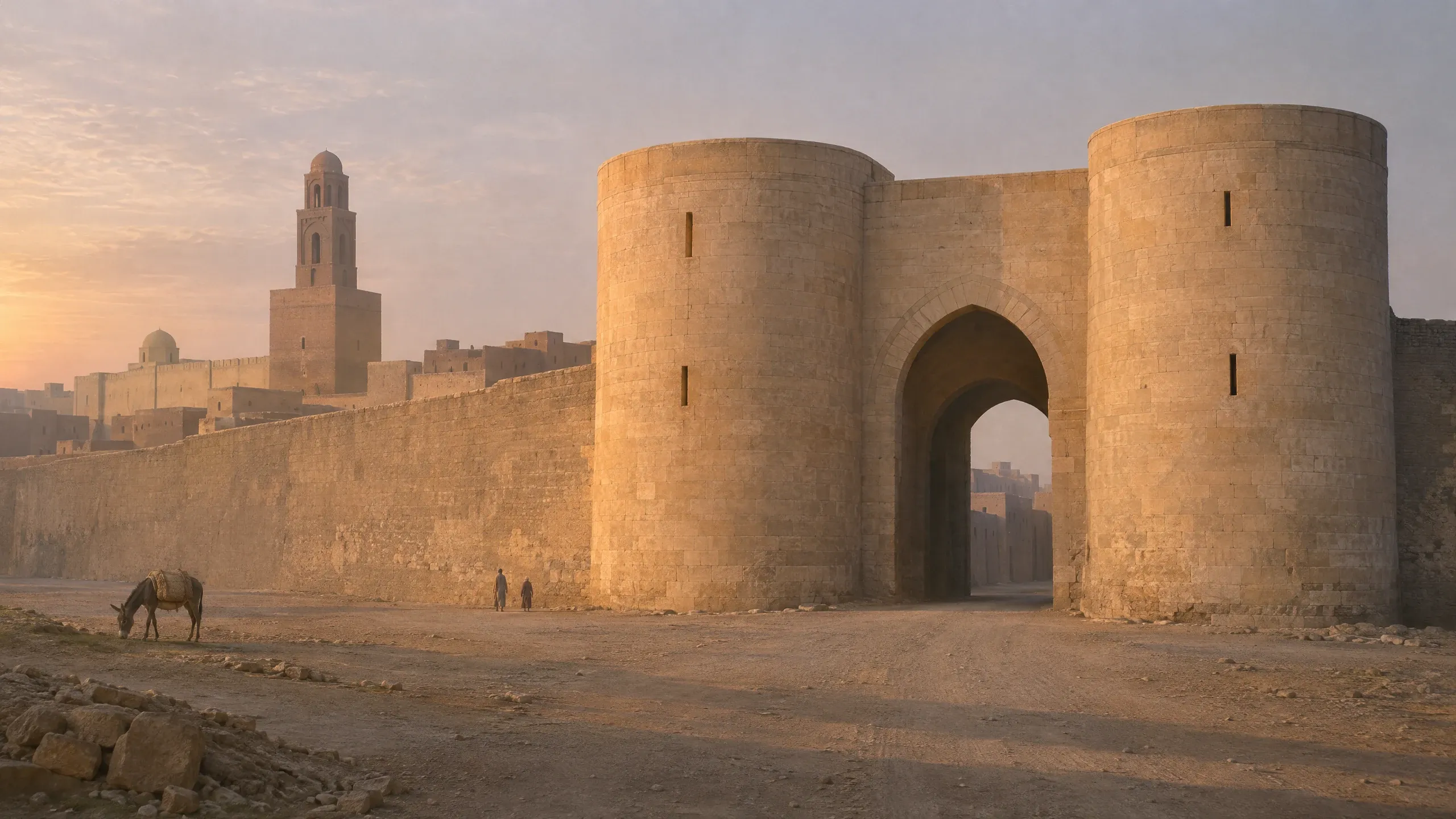
Cairo, in Arabic al-Qahira, was founded in 969 by the Fatimid general Jawhar as the royal city of the Imam-caliph al-Mu’izz, on open ground north of Fustat, the old capital of Egypt. From 973 it was the seat of the Fatimid Imams and the headquarters of the Ismaili da’wa. Its Fatimid plan remains the nucleus of the historic city, which UNESCO inscribed as a World Heritage site in 1979.123 The city’s monuments and institutions are treated at length in Fatimid Cairo.
Foundation
Jawhar entered Fustat, the capital of Ikhshidid Egypt, in Sha’ban 358/July 969. He proclaimed a general amnesty, dropped the Abbasid caliph al-Muti’ from the Friday sermon, and introduced Shi’i forms of worship only gradually, aware that Shafi’i Sunnis and Coptic Christians formed the majority of the population.1 He camped his army north of Fustat and at once began a new city.1
Walker describes a fortified enclave along the Nile north of the mosque of Ibn Tulun that was rapidly becoming a city. Its plan had been brought by Jawhar from Ifriqiya, and in imitation of the palace city of Sabra al-Mansuriyya it was at first named al-Mansuriyya, with a northern gate called al-Futuh, a southern gate called Zuwayla and a central congregational mosque named al-Azhar.41 Walker notes that separating the Shi’i army of occupation from crowded Sunni Fustat was also useful to the new rulers.4
Jawhar marked out the sites of two royal palaces, one for the Imam-caliph and one for his heir, separated by a wide open space, following plans drawn up by al-Mu’izz himself. Buildings were also erected for the government offices and the army.1 In Jumada I 359/April 970 he laid the foundations of the mosque of al-Azhar, completed two years later.1
The arrival of the Imam
Al-Mu’izz entered Cairo in Ramadan 362/June 973 with his four sons, his relatives, most of the Ismaili notables and da’is, including al-Qadi al-Nu’man, and many Kutama tribesmen. He brought the dynasty’s treasure and the coffins of his predecessors, marking the end of the North African phase of the dynasty.5 On his arrival the city received the name al-Qahira al-Mu’izziyya, “the Victorious City of al-Mu’izz”, shortened to al-Qahira.21 When al-Mu’izz died in 365/975 he was buried in the mausoleum near the palace in which his ancestors’ remains had been placed.6
The new capital was soon tested. The Qarmati leader al-Hasan al-A’sam invaded Egypt a second time in 363/974 and besieged Cairo, but was betrayed by his allies and withdrew.6
A royal city
Sanders describes early Cairo as two palaces and a congregational mosque, al-Azhar, enclosed by a brick wall, a city with an unmistakably Ismaili character.7 The palace stood at the symbolic centre of the city, just as the Imam stood at the centre of Ismaili belief; the Imam was described as an emanation of divine light, and the new mosques received names evoking light.8 Al-Azhar was not connected to the palace but stood nearby to the south-east. A second congregational mosque, begun outside the northern brick walls by al-Aziz and completed by al-Hakim in 1010, was known both as the Mosque of al-Hakim and as al-Anwar; its inscribed portal and two minarets expressed the caliph’s position as Imam.8
Cairo was essentially a closed city with no independent commercial life. Civilians who served the court, including physicians and senior Jewish and Christian officials, lived there; by the twelfth century the city was beginning to develop its own commerce, and the vizier al-Ma’mun al-Bata’ihi founded a dar al-wakala for Syrian and Iraqi merchants and a new mint in the 1120s.7 UNESCO notes that the Fatimid city was laid out in quarters (haras) for the groups who came with the dynasty, such as the Barqiyya and the Jawwaniyya, along a main north–south street, the Qasaba, now Shari’ al-Mu’izz.3
Cairo and Fustat
Sanders treats Fustat-Cairo as the twin political, administrative and commercial capital of the Fatimid state, while stressing that the two cities, barely two miles apart, kept distinct characters. Fustat remained Egypt’s economic centre and main emporium, with a larger and more mixed population of Sunni Muslims, Christians and Jews; customs duties were paid there, and its mosque of Amr was the Friday mosque of its Muslim population.79
Learning and the da’wa
Cairo became the centre of Ismaili teaching. Public sessions on law, based on al-Qadi al-Nu’man’s Da’a’im al-Islam, were held at al-Azhar and the other great mosques, while the majalis al-hikma for initiates met in a hall of the palace.10 Al-Hakim founded the Dar al-’Ilm, the “House of Knowledge”, in 395/1005, in a section of the Fatimid palace.11 The credit for using al-Azhar as a place of higher learning belongs to the vizier Ibn Killis under al-Aziz.12 Nasir Khusraw, who stayed in Cairo from 1047 to 1050, described the splendour of its palaces, gates, gardens and shops in his Safar-nama.13
Crisis and the walls of Badr al-Jamali
During the great crisis under al-Mustansir, Turkish troops looted the Fatimid palaces and destroyed the palace libraries in 461/1068–1069, and Fustat was twice pillaged and burned on the orders of the Turkish commander Nasir al-Dawla.14 Badr al-Jamali, who arrived from Syria in 466/1074, restored order and in 469/1077 drove back the Turkmen chief Atsiz, who had attacked Cairo itself.1415
Sanders records that in the late eleventh and early twelfth centuries Cairo’s walls were extended and rebuilt with monumental stone gates.7 UNESCO identifies these with the fortifications of Badr al-Jamali, whose surviving gates are Bab Zuwayla in the south and Bab al-Nasr and Bab al-Futuh in the north.3 The Fatimid mosques of al-Azhar, al-Hakim, al-Aqmar and Salih Tala’i and mausoleums such as that of Sayyida Ruqayya survive within the historic city.3
Footnotes
-
Farhad Daftary, The Isma’ilis: Their History and Doctrines, 2nd ed. (Cambridge University Press, 2007), p. 159. ↩ ↩2 ↩3 ↩4 ↩5 ↩6 ↩7
-
Paul E. Walker, “The Isma’ili Da’wa and the Fatimid Caliphate”, in Carl F. Petry (ed.), The Cambridge History of Egypt, vol. 1 (Cambridge University Press, 1998), p. 141. ↩ ↩2
-
UNESCO World Heritage Centre, “Historic Cairo”, World Heritage List no. 89, https://whc.unesco.org/en/list/89/. ↩ ↩2 ↩3 ↩4
-
Paul E. Walker, “The Isma’ili Da’wa and the Fatimid Caliphate”, in Carl F. Petry (ed.), The Cambridge History of Egypt, vol. 1 (Cambridge University Press, 1998), p. 139. ↩ ↩2
-
Farhad Daftary, The Isma’ilis: Their History and Doctrines, 2nd ed. (Cambridge University Press, 2007), p. 162. ↩
-
Farhad Daftary, The Isma’ilis: Their History and Doctrines, 2nd ed. (Cambridge University Press, 2007), p. 163. ↩ ↩2
-
Paula A. Sanders, “The Fatimid state, 969–1171”, in Carl F. Petry (ed.), The Cambridge History of Egypt, vol. 1 (Cambridge University Press, 1998), p. 166. ↩ ↩2 ↩3 ↩4
-
Paula A. Sanders, “The Fatimid state, 969–1171”, in Carl F. Petry (ed.), The Cambridge History of Egypt, vol. 1 (Cambridge University Press, 1998), pp. 172–173. ↩ ↩2
-
Paula A. Sanders, “The Fatimid state, 969–1171”, in Carl F. Petry (ed.), The Cambridge History of Egypt, vol. 1 (Cambridge University Press, 1998), p. 167. ↩
-
Farhad Daftary, The Isma’ilis: Their History and Doctrines, 2nd ed. (Cambridge University Press, 2007), pp. 214–215. ↩
-
Farhad Daftary, The Isma’ilis: Their History and Doctrines, 2nd ed. (Cambridge University Press, 2007), p. 181. ↩
-
Farhad Daftary, The Isma’ilis: Their History and Doctrines, 2nd ed. (Cambridge University Press, 2007), p. 177. ↩
-
Farhad Daftary, The Isma’ilis: Their History and Doctrines, 2nd ed. (Cambridge University Press, 2007), p. 206. ↩
-
Farhad Daftary, The Isma’ilis: Their History and Doctrines, 2nd ed. (Cambridge University Press, 2007), p. 194. ↩ ↩2
-
Farhad Daftary, The Isma’ilis: Their History and Doctrines, 2nd ed. (Cambridge University Press, 2007), p. 197. ↩