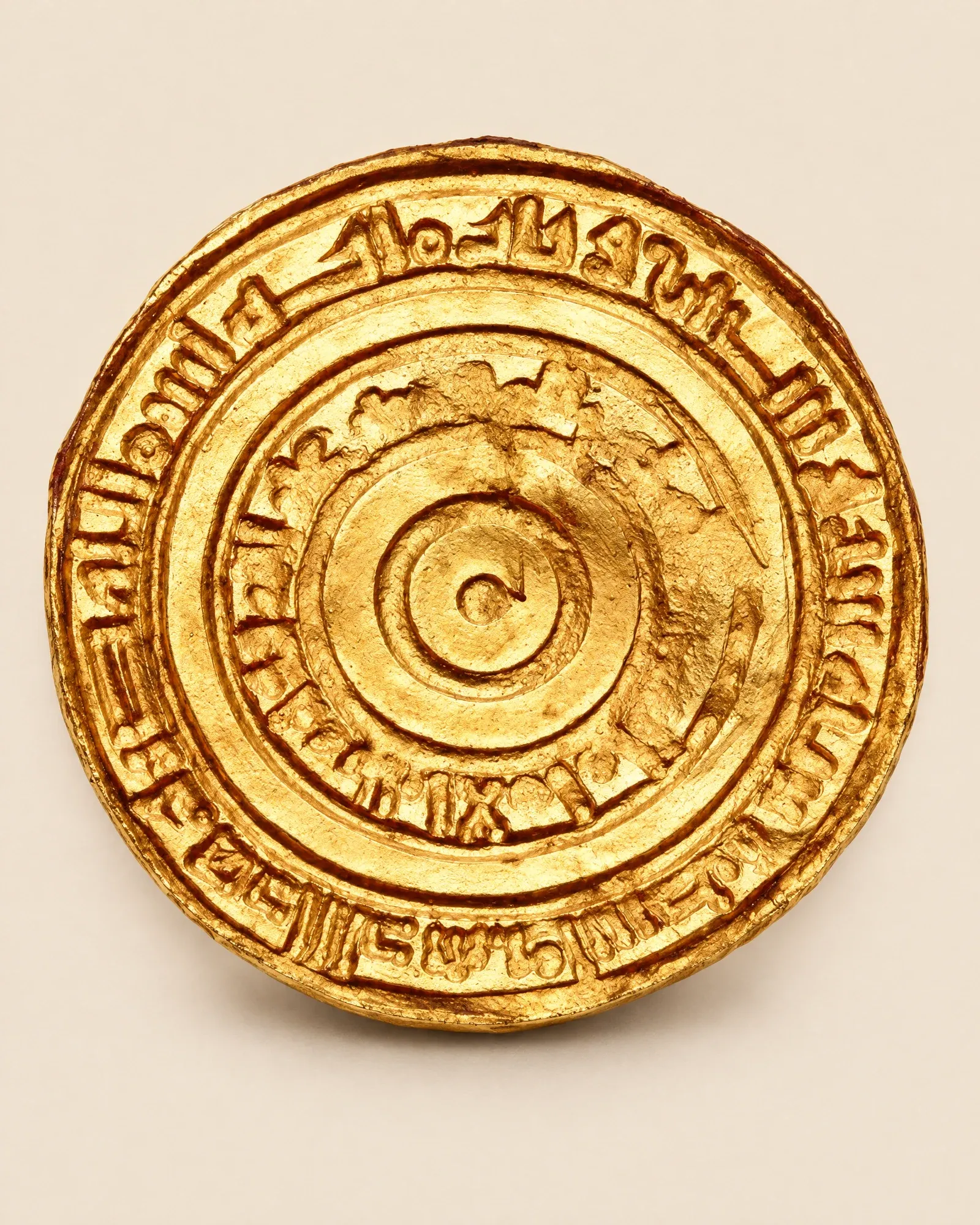
Abu Mansur Nizar al-Aziz bi’llah was the fifteenth Ismaili Imam and the fifth Fatimid caliph. The first of his dynasty to begin his reign in Egypt, he spent twenty-one years extending Fatimid power in Syria, built a professional administration under the vizier Ibn Killis, and presided over a court known for employing Christians and Jews in high office. By the end of his reign Fatimid suzerainty reached its greatest extent.12
Succession
Nizar was born in 344/955, the third son of al-Mu’izz.1 The eldest son, Tamim, born in 337/948–949, was passed over; he was suspected of contacts with disloyal members of the family. Around 357/968 al-Mu’izz secretly designated his second son, Abd Allah, telling only the chamberlain Jawdhar, who kept the secret for seven months. When Abd Allah died in 364/975, Nizar was named heir about a year before his father’s death. Tamim, a poet, lived on in Cairo until 374 or 375/984–986, and al-Aziz led the prayer at his funeral.34 The Sira of Jawdhar documents these family tensions.3
Syria and the Qarmatis
Syria was al-Aziz’s main foreign objective, but he avoided direct confrontation with the Abbasids and their Buyid overlords.14 In 364/975 the Turkish officer Alftakin, a former Buyid commander, had seized Damascus and proclaimed the Abbasids.5 In 365/976 al-Aziz sent Jawhar against him. Jawhar was besieged at Ascalon for about seventeen months and allowed to return to Egypt in 367/977 only on humiliating terms; he died in 381/992.4
Al-Aziz then took the field himself. Near Ramla in 368/978 he defeated Alftakin and the Qarmatis. Alftakin was captured and taken into Fatimid service, and the Qarmatis of Bahrayn were reduced to a local power.4 Alftakin was poisoned in 372/982, reportedly at the instigation of Ibn Killis.6 Palestine and southern Syria remained turbulent: the Jarrahid chief Mufarrij ibn Daghfal killed the Hamdanid Abu Taghlib in 369/979, and the Fatimid commander Baltakin defeated rebels in 372–373/982–983.6
Aleppo and Byzantium
Northern Syria was the frontier between the Fatimids and Byzantium, and the Hamdanid emirate of Aleppo sat between them. A Fatimid siege was lifted in 373/983 when the Byzantines intervened; in 376/986 the Hamdanid Sa’d al-Dawla briefly recognised al-Aziz.6 In 385/995 the Fatimid general Mangutakin besieged Aleppo again, and the emperor Basil II came in person to relieve it.2 Relations were not only hostile: al-Aziz concluded a treaty with Basil II that removed commercial restrictions.2
The extent of the empire
By the end of the reign Fatimid sovereignty was recognised, at least nominally, from the Atlantic and the western Mediterranean to the Red Sea, in the Hijaz, Yemen, Syria and Palestine. The khutba was read for al-Aziz in Multan, and in 382/992 briefly in Mosul under the Uqaylids.21 The Qarmatis of Bahrayn, weakened by defeats at the hands of the Buyids in 375/985 and of al-Asfar of the Banu’l-Muntafiq in 378/988, gave him nominal allegiance in 382/992.7 In Ifriqiya, however, the Zirid governor al-Mansur ibn Buluggin (373–386/984–996) began to detach himself from Cairo.2
Turkish troops
Al-Aziz was the first Fatimid caliph to recruit Turkish soldiers, against the wishes of the Berber officers who had formed the core of the army.6 The rivalry between the Berber faction, the Maghariba, and the eastern faction of Turks and Daylamis, the Mashariqa, became the central problem of his son’s reign.8
Ibn Killis and the administration
Ya’qub ibn Killis, a convert from Judaism who had served Kafur, became vizier in 367/977 and received the title al-wazir al-ajall in 368/978. He was the first vizier of the dynasty and served for more than twelve years.2 He organised the finances and administration, patronised scholars, and wrote al-Risala al-waziriyya, a legal treatise based on the rulings of al-Mu’izz and al-Aziz. He is credited with turning al-Azhar into a place of regular teaching (see al-Azhar).910 After his death in 380/991 al-Aziz had six viziers in six years.9 The court also patronised letters: al-Shabushti, author of a well-known book on monasteries, served as al-Aziz’s librarian, and al-Muhallabi composed a geographical work for him.11
An open court
Most sources describe al-Aziz as a wise ruler who used capable men regardless of their religion.2 The last of his viziers, Isa ibn Nasturus (385–386/995–996), a Coptic Christian, was the dynasty’s first Christian vizier; Jews also held high posts, among them Manashsha ibn Ibrahim in Syria, though no Jew was appointed to the vizierate.9 Al-Aziz had a Christian wife, perhaps the mother of al-Hakim. Her brothers Orestes and Arsenius became the Melkite patriarch of Jerusalem and metropolitan of Cairo in 375/986. The Coptic patriarch Ephraim was allowed to rebuild the church of St Mercurius near Fustat, and theological debates were held between Severus, bishop of Ashmunayn, and the chief judge Ibn al-Nu’man.9
Al-Aziz also encouraged the Shi’i commemorations of Ashura and of Ghadir Khumm, introduced in Egypt under al-Mu’izz.9 The office of chief judge remained in the family of al-Qadi al-Nu’man: his son Ali, the first to bear the official title qadi al-qudat, held it for nine years under al-Aziz.3
Death
Al-Aziz died at Bilbays in Ramadan 386/October 996, at the first halt of a campaign he was leading in person against northern Syria, after a reign of about twenty-one years.81 His son Abu Ali al-Mansur, aged about eleven, received the oath of allegiance at Bilbays and entered Cairo the next day as al-Hakim bi-Amr Allah. The first Fatimid born in Egypt, he had been designated heir in 383/993 after the death of his brother Muhammad.8
Footnotes
-
Farhad Daftary, Historical Dictionary of the Ismailis (Scarecrow Press, 2012), s.v. “al-Aziz”. ↩ ↩2 ↩3 ↩4 ↩5
-
Farhad Daftary, The Isma’ilis: Their History and Doctrines, 2nd ed. (Cambridge University Press, 2007), p. 176. ↩ ↩2 ↩3 ↩4 ↩5 ↩6 ↩7
-
Farhad Daftary, The Isma’ilis: Their History and Doctrines, 2nd ed. (Cambridge University Press, 2007), p. 172. ↩ ↩2 ↩3
-
Farhad Daftary, The Isma’ilis: Their History and Doctrines, 2nd ed. (Cambridge University Press, 2007), p. 173. ↩ ↩2 ↩3 ↩4
-
Farhad Daftary, The Isma’ilis: Their History and Doctrines, 2nd ed. (Cambridge University Press, 2007), p. 163. ↩
-
Farhad Daftary, The Isma’ilis: Their History and Doctrines, 2nd ed. (Cambridge University Press, 2007), p. 175. ↩ ↩2 ↩3 ↩4
-
Farhad Daftary, The Isma’ilis: Their History and Doctrines, 2nd ed. (Cambridge University Press, 2007), p. 185. ↩
-
Farhad Daftary, The Isma’ilis: Their History and Doctrines, 2nd ed. (Cambridge University Press, 2007), p. 178. ↩ ↩2 ↩3
-
Farhad Daftary, The Isma’ilis: Their History and Doctrines, 2nd ed. (Cambridge University Press, 2007), p. 177. ↩ ↩2 ↩3 ↩4 ↩5
-
Farhad Daftary, The Isma’ilis: Their History and Doctrines, 2nd ed. (Cambridge University Press, 2007), p. 159. ↩
-
Marius Canard, “Fatimids”, Encyclopaedia of Islam, 2nd ed., vol. II (Brill, 1965), p. 862. ↩