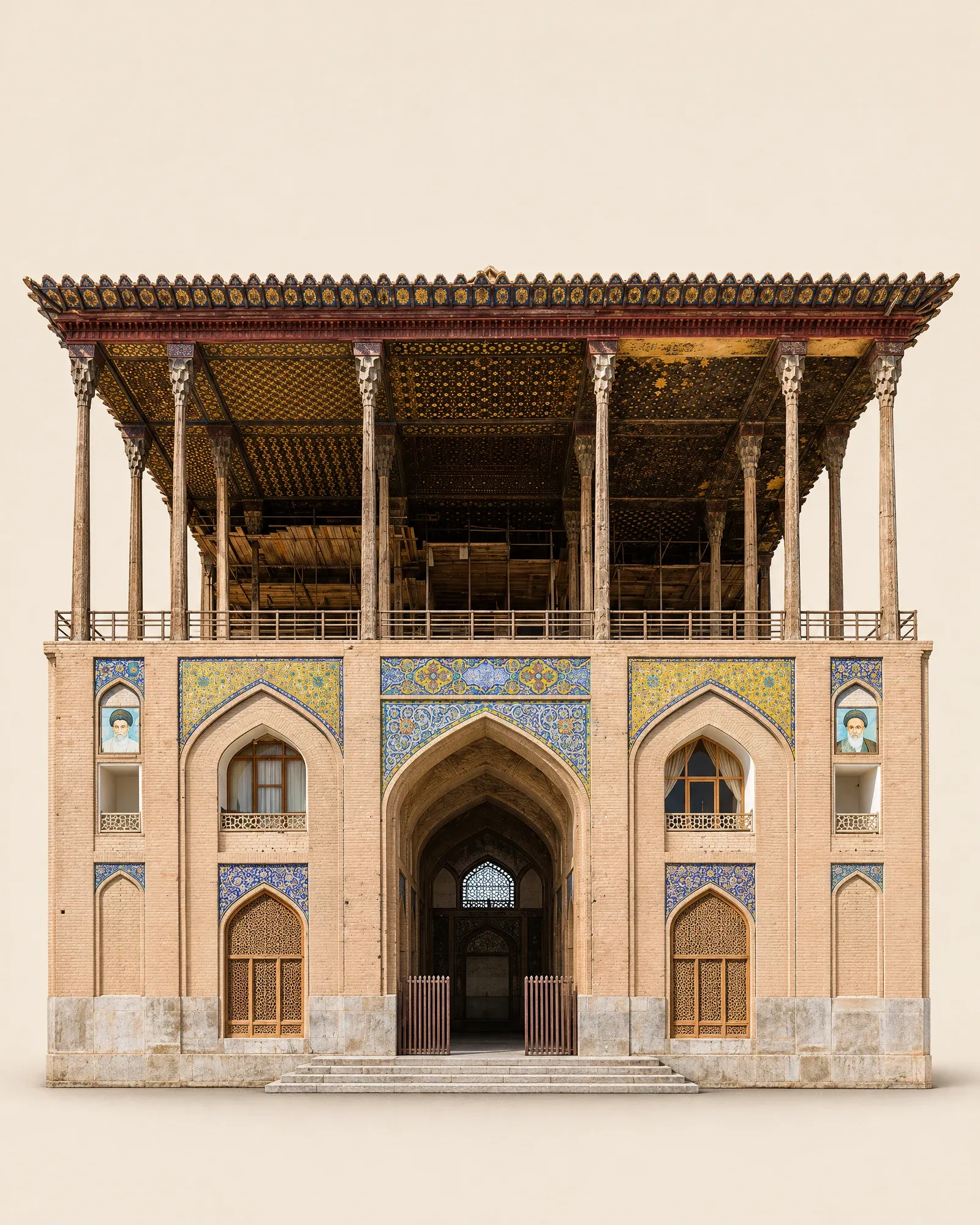
Return to Anjudan
Dhu’l-Fiqar Ali, also known as Khalil Allah I, succeeded Murad Mirza as the thirty-seventh Imam of the Qasim-Shahi line after Murad’s execution by Shah Tahmasp in 981/1574. Under him the Imamate entered a new and quieter phase. Daftary writes that the Imams after Murad Mirza once again appeared at Anjudan, from where they conducted the affairs of their community quietly and without involvement in politics, and that the Imams of the later Anjudan period developed friendly relations with the Safavids.1
The Imam’s name appears in several forms. In the traditional sequence he is Dhu’l-Faqar Ali, also called Khalil Allah I. The Safavid edict of 1627 addresses him as Amir Khalil Allah Anjudani. The poet Khaki Khurasani, who visited Anjudan, praises him as Shah Dhu’l-Faqar and possibly also as Haydar, while the later Nizari historian Fida’i Khurasani quotes poems in his praise.2
The respite under Shah Abbas I
The change of fortune followed political change in Persia. Tahmasp’s successors, Isma’il II (984–985/1576–1577), who tried unsuccessfully to restore Sunnism, and Muhammad Khudabanda (985–995/1577–1587), were absorbed by dynastic disputes and domestic strife that almost destroyed the dynasty, and the religious movements that had survived the first two Safavid kings received a respite. Order was restored only by Shah Abbas I (995–1038/1587–1629), who suppressed the unruly Qizilbash tribes, reformed the administration, patronised the arts and moved the capital from Qazwin to Isfahan in 1006/1598.3
By Abbas’s time, Daftary notes, the Safavid claim to divine authority had faded, the Sufi orders had almost disappeared from Persia and Twelver rituals had gained wide currency. Abbas continued to persecute Sunnis, most Sufi orders and radical Shi’i movements such as the Nuqtawiyya, but he was tolerant of certain minority groups, including the Nizaris, who were from then on not molested by the Safavids. The contrast with the Nuqtawis is stark: in 1002/1593–1594 Abbas killed many of them and their leaders, among them Darwish Khusraw Qazwini and Mir Sayyid Ahmad Kashi, whom the shah himself put to the sword in Kashan, a town where Murad Mirza had found supporters only twenty years before. Khalil Allah I’s Imamate began, then, in the shadow of Murad’s execution, but under Abbas the Imams found a security they had not known since Alamut.4
A Safavid marriage
Khalil Allah I married a Safavid princess, possibly a sister of Shah Abbas I. The match continued a pattern: his grandfather Abu Dharr Ali seems to have married a sister or daughter of Shah Tahmasp I. Two centuries later the Qajar Fath Ali Shah would give a daughter to Aga Khan I. Marriage into the ruling house was both a protection and a sign of the Imams’ status, in Persian eyes, as respected Husaynid sayyids.5
The edict of 1627
The clearest evidence of the Imam’s relationship with the Safavids is an inscription that Daftary recovered at Anjudan in 1976. The stone reproduces the text of a royal edict issued by Shah Abbas I in Rajab 1036/March–April 1627. It had originally been set up in the main mosque of Anjudan and is addressed to Amir Khalil Allah Anjudani, the Imam of the time. By the edict, the Shi’is of Anjudan, described as a dependency of the dar al-mu’minin of Qumm, were exempted from certain taxes, like the other Shi’is around Qumm.6
The edict is also evidence of taqiyya. In it the Shi’is of Anjudan are treated as Ithna’asharis, Twelvers. Daftary concludes that by this time the Persian Nizaris had successfully adopted the cover of Twelver Shi’ism, in addition to Sufism, as a form of dissimulation. The edict addresses the Imam simply as an amir of Anjudan; nothing in it acknowledges him as the head of a community spread from Khurasan to India. The disguise, which Daftary dates back to the early Safavid period, remained in use among the Persian Nizaris until the early twentieth century.7
The poets of his court
Nizari literature revived under Khalil Allah I. Imam Quli Khaki Khurasani, a poet from Dizbad, a village in the mountains between Mashhad and Nishapur, who died after 1056/1646, was a contemporary of this Imam and his successor. Khaki repeatedly eulogises Shah Dhu’l-Faqar (Khalil) and his son Shah Nur al-Dahr, names Anjudan as their residence and apparently visited it. He refers to the Imam’s followers and spreading influence in Khurasan and Iraq-i Ajam, the central Persian provinces, and in Multan and India. Like other Nizari poets of the time, Khaki used Sufi expressions to veil his Ismaili ideas; so did his son Ali Quli Raqqami Khurasani, also called Dizbadi, who continued his father’s work in the next generation.8
Fida’i Khurasani also quotes poems in praise of Shah Dhu’l-Faqar by two Nizari poets of his time, Aziz Allah Qummi and a certain Niyazi, who was also a da’i. Together these poets attest a functioning network of da’is and devotees around the Imam at Anjudan in the early seventeenth century.9
Death
Daftary identifies Dhu’l-Fiqar Ali (Khalil Allah I) with the Khalil Allah whose tombstone at Anjudan records his death at the age of sixty-eight in Ramadan 1043/March 1634, seven years after the edict. If the identification is correct, he was born around 1566, was still a child when Murad Mirza was executed, and held the Imamate for about sixty years, longer than any Imam of the Anjudan period. He was succeeded by his son Nur al-Dahr Ali, under whom the Anjudan da’wa reached the widest geographical extent recorded in the Nizari poetry of the period.10
Footnotes
-
Farhad Daftary, The Isma’ilis: Their History and Doctrines, 2nd ed. (Cambridge University Press, 2007), p. 437. ↩
-
Daftary, The Isma’ilis, 2nd ed. (Cambridge University Press, 2007), pp. 425, 437–438. ↩
-
Daftary, The Isma’ilis, 2nd ed. (Cambridge University Press, 2007), pp. 436–437. ↩
-
Daftary, The Isma’ilis, 2nd ed. (Cambridge University Press, 2007), pp. 422, 436–437. ↩
-
Daftary, The Isma’ilis, 2nd ed. (Cambridge University Press, 2007), pp. 431, 435, 437, 463–464. ↩
-
Daftary, The Isma’ilis, 2nd ed. (Cambridge University Press, 2007), pp. 437–438 and fig. 15. ↩
-
Daftary, The Isma’ilis, 2nd ed. (Cambridge University Press, 2007), p. 437; Farhad Daftary, Ismailis in Medieval Muslim Societies (I.B. Tauris / Institute of Ismaili Studies, 2005), pp. 195–196, https://archive.org/details/bk862. ↩
-
Daftary, The Isma’ilis, 2nd ed. (Cambridge University Press, 2007), pp. 437–438, 441. ↩
-
Daftary, The Isma’ilis, 2nd ed. (Cambridge University Press, 2007), p. 438. ↩
-
Daftary, The Isma’ilis, 2nd ed. (Cambridge University Press, 2007), p. 437. ↩