Overview
The Anjudan revival is the name historians give to the recovery of the Qasim-Shahi Nizari Ismaili Imamate from the middle or later 9th/15th century until the end of the 11th/17th century. For two centuries after the fall of Alamut in 654/1256 the Imams lived hidden and their followers dissimulated; the period has been called the darkest in the community’s history. From about the 1460s the Imams settled at Anjudan, a village in central Persia, reorganised the da’wa, reasserted their authority over distant communities, and presided over the first Persian doctrinal literature written since Alamut. The period coincides with most of the Safavid era, and ended when the Imams moved to Kahak around 1680.1
Rediscovery
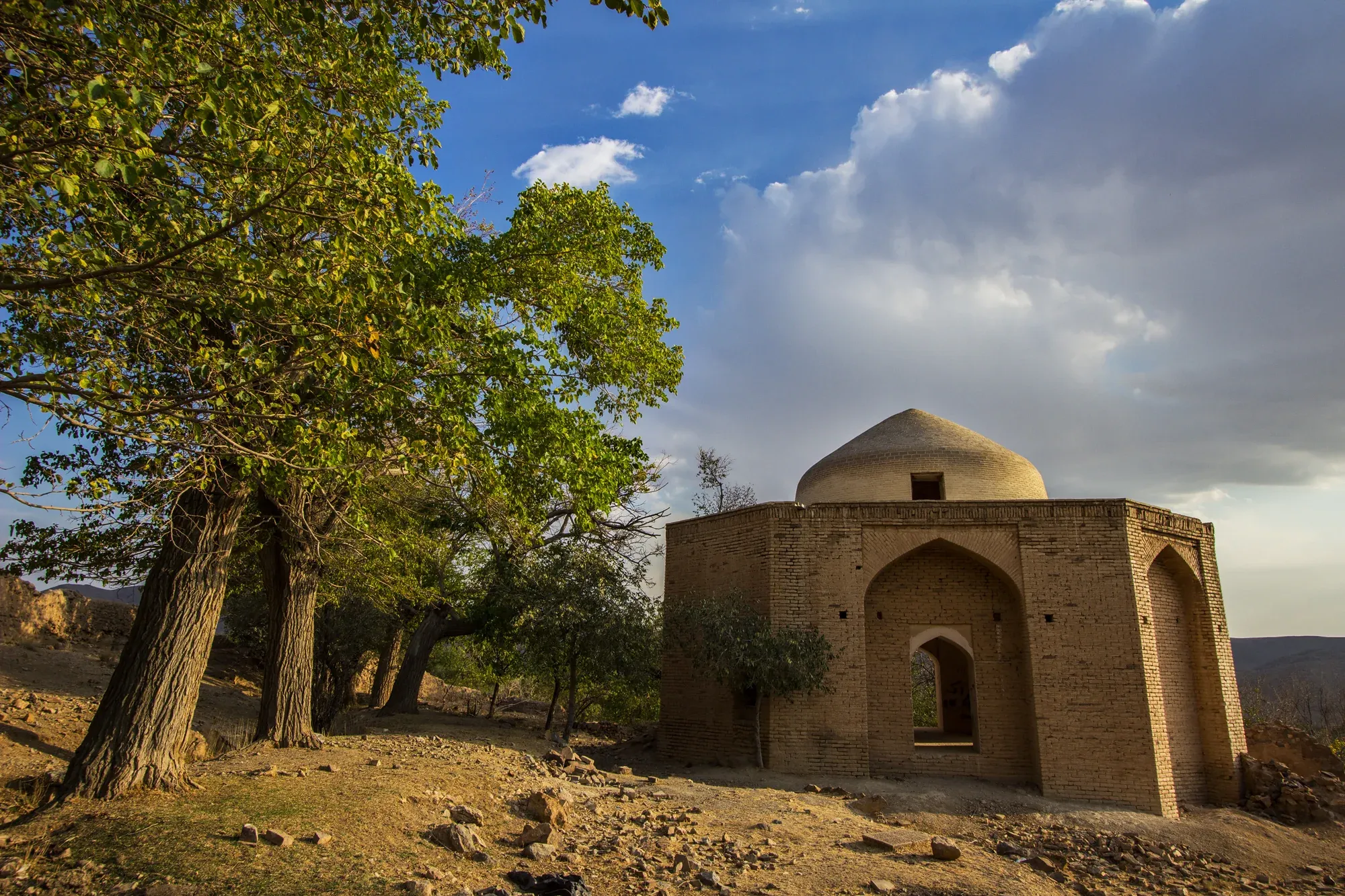
The term and much of the evidence come from modern fieldwork. Wladimir Ivanow identified the Nizari antiquities of Anjudan in 1937: an old mosque and three mausoleums holding the tombs of several Imams and their relatives. The villagers, Twelver Shi’is, did not know who was buried there; one tomb was known only as that of Shah Qalandar, another as Shah Gharib. When the Qajar monarch Nasir al-Din Shah visited Anjudan in Dhu’l-Qa’da 1309/June 1892, he did not suspect its Ismaili past. By the time Daftary visited in 1976, some of the remains Ivanow had described had disappeared.2
Why Anjudan
Anjudan, or Anjidan, lies at the foot of a low rocky range 37 kilometres east of Arak and about the same distance west of Mahallat, in the plain of Farahan. Daftary suggests that the Imams chose it after a careful search: it was central, yet removed from the seats of the main Sunni powers of the time, the Aq Qoyunlu at Tabriz and the later Timurids at Herat, and it was close to Qumm and Kashan, the traditional Shi’i centres of Persia known as the dar al-mu’minin, “abode of the faithful”.3
The timing mattered too. Shi’i sentiment was spreading in fifteenth-century Persia, through Sufi orders and popular movements, and in 907/1501 the Safavid Shah Isma’il I proclaimed Twelver Shi’ism the religion of his state. In this climate the veneration of Ali and the early Husaynid Imams by the Nizaris aroused no particular alarm.4
The Imams of Anjudan
The first Imam definitely connected with Anjudan is Ali Shah, the thirty-second Qasim-Shahi Imam, who took the throne-name Mustansir bi’llah II and the Sufi name Shah Qalandar. He succeeded around 868/1463 and died in 885/1480, the date on the wooden box over his grave; his octagonal mausoleum is the oldest Nizari monument at Anjudan. He was followed by Abd al-Salam Shah, who died by tradition in 899/1493–1494, and by Abbas Shah, Gharib Mirza, who also took the title Mustansir bi’llah and died by Muharram 904/August 1498. Counting the Fatimid caliph, he was the third Ismaili Imam to bear it. The titles, Daftary notes, show that the Imams were consciously recalling the old glories of the Ismailis.5
The line continued with Abu Dharr Ali, Murad Mirza, Dhu’l-Fiqar Ali, Nur al-Dahr Ali and Khalil Allah II, who died in 1090/1680 and was the last Imam buried at Anjudan.6
The Sufi guise
The revival did not end taqiyya. The Imams and their followers still presented themselves as a Sufi order, one of many then spreading in Persia, and used the Sufi language of master and disciple. To outsiders the Imams appeared as Sufi murshids, shaykhs, pirs or qutbs, and as pious Husaynid sayyids; their followers posed as murids guided along the tariqa towards the haqiqa. It became customary for the Imams to take Sufi names such as Shah Qalandar and Shah Gharib and, like Sufi masters, to add Shah and Ali to their names. Mustansir bi’llah II may have been the first Qasim-Shahi Imam to associate with the Ni’mat Allahi order, though concrete evidence is lacking; the formal connection came more than two centuries later.7
Reorganising the da’wa
The revival was above all a reorganisation of the da’wa. In the first post-Alamut centuries, when the Imams had no direct contact with most followers, communities in Persia, Central Asia and India came under local leaders known by the Sufi term pir. Some were appointed by the Imams with wide powers, others chosen locally; in most places the office became hereditary, and some dynasties of pirs became effectively independent, financially as well, living on the dues they collected. They were most autonomous in the regions farthest from the Imams: Afghanistan, Badakhshan and the Indian subcontinent. The Anjudan Imams set out to undermine these pirs and replace them with loyal appointees. Mustansir bi’llah II and his successors sent da’is to Khurasan, Afghanistan and Badakhshan to reassert the Imam’s authority, collect the religious dues and win over communities that followed the rival Muhammad-Shahi line, and they regularly summoned regional da’is to Persia for consultation and instruction. The need for funds and for loyal da’is is a constant theme of the Imam’s sermons. A farman of Abd al-Salam Shah dated 895/1490, preserved in a manuscript found in Kerman, invites the Muhammad-Shahis of Badakhshan and Kabul to return to the Qasim-Shahi Imams. See The Muhammad-Shahi and Qasim-Shahi split.8
The counsels of Mustansir bi’llah II, collected under his successor as the Pandiyat-i javanmardi (“Counsels of Chivalry”), circulated widely. They were translated into Sindhi and Gujarati for the Khojas, and copies are known from Badakhshan, Hunza and Chinese Turkistan.9
An eyewitness at Anjudan
The best view of the revived da’wa comes from Khayrkhwah-i Harati, a da’i from Herat who died after 960/1553. When his father, summoned by the Imam to be appointed da’i of Khurasan, Badakhshan and Kabul, was murdered on the road, the young Khayrkhwah was taken to the Imam instead. During a fortnight at Anjudan he watched pirs arrive from different communities with their dues, and the Imam check them carefully and punish those who had misappropriated the haqq-i imam. He was appointed da’i of Khurasan and adjoining lands. His account shows rivalry among the pirs, regular travel by da’is from the Indian subcontinent to see the Imam, and an Imam who had greatly reasserted his authority.10
A literary revival
The Anjudan period produced the first Persian doctrinal works since Alamut. The earliest were by Abu Ishaq Quhistani, whose Haft bab dates from the time of Gharib Mirza, and by Khayrkhwah-i Harati a few decades later. Badakhchani reads the appearance of Abu Ishaq’s book as the sign that the period of concealment begun in 654/1256 was practically over. Khayrkhwah himself wrote that hitherto “a veil was drawn over the visage of truth”, but that the Imam had now “allowed the veil to be lifted”, permitting written communication. Later authors include the poet Imam Quli Khaki Khurasani (d. after 1056/1646) and his son Ali Quli Raqqami. Their works were preserved mainly by the Nizaris of Central Asia.11
Doctrine
The teaching of the period divided religion into three levels: the shari’at, the religious law; the tariqat, the spiritual path; and the haqiqat, the truth. The Nizaris called themselves ahl-i haqq or ahl-i haqiqat, “people of the truth”. Reaching the haqiqat meant recognising the Imam of the time, and the believer’s highest goal was the didar, the vision of the Imam. Murids paid the dah-yik, a tithe of one tenth of their income.12
The da’wa hierarchy set out in these texts placed a hujja below the Imam, then the da’i, the mu’allim, the senior and junior ma’dhun, and the ordinary believer, the mustajib, now often called murid. The hujja gained a central role: the Imam could be known only through him, and Khayrkhwah, who used hujja and pir interchangeably, claimed that rank. The term pir soon fell out of use in Persia after the Anjudan period but survived among the Central Asian and Indian Nizaris.13
Under the Safavids
The Safavid state brought both danger and opportunity. The Safavids persecuted Sufi and Shi’i groups whose loyalties lay outside the state. Murad Mirza, who had a large following including Indian murids who sent him money from Sind, was hunted down on Shah Tahmasp’s orders, escaped in 981/1573, and was recaptured and executed; Daftary finds no Imam who can be shown to have lived openly at Anjudan between about 904/1498 and 981/1574. Under Shah Abbas I relations improved. A royal edict of Rajab 1036/March–April 1627, addressed to “Amir Khalil Allah Anjudani”, exempted the Shi’is of Anjudan from certain taxes and treated them as Twelvers, a sign of how fully the community had taken on Twelver Shi’i taqiyya.14
Reach
By the seventeenth century the da’wa centred on Anjudan reached from Khurasan to Iraq-i Ajam, Multan and India. The poet Khaki Khurasani praised Shah Dhu’l-Fiqar and Nur al-Dahr and refers to their residence at Anjudan; a poem by Mahmud Ali of Muminabad lists the da’is of Khurasan, Multan, Lahore and Gujarat. Khayrkhwah refers to the pilgrimages of Indian da’is to see the Imam at Anjudan and notes that the Nizari Khojas by then greatly outnumbered their Persian co-religionists; the Pandiyat-i javanmardi was in time transcribed in Khojki for them.15
End of the period
Khalil Allah II, who died in Dhu’l-Hijja 1090/January 1680, was the last Imam to live at Anjudan. His successor Shah Nizar II moved the seat to Kahak, about 35 kilometres to the north-east, ending a period of more than two centuries. The move came, for unknown reasons, in the early decades of his Imamate (1090–1134/1680–1722). By then the Qasim-Shahi Imams had won the allegiance of the Nizari majority in Afghanistan, Central Asia and the Indian subcontinent, and had put down deep roots in Mahallat and the villages around Anjudan.16
Footnotes
-
Farhad Daftary, The Isma’ilis: Their History and Doctrines, 2nd ed. (Cambridge University Press, 2007), pp. 405–406, 422–423, 431; Shafique N. Virani, “The Scent of the Scarlet Pimpernels: Ismaili Leaders of the 11th/17th Century”, in Farhad Daftary and Janis Esots, eds, The Renaissance of Shi’i Islam (I.B. Tauris / Institute of Ismaili Studies, 2022), p. 33. ↩
-
Daftary, The Isma’ilis, 2nd ed. (Cambridge University Press, 2007), p. 423. ↩
-
Daftary, The Isma’ilis, 2nd ed. (Cambridge University Press, 2007), pp. 423, 431. ↩
-
Daftary, The Isma’ilis, 2nd ed. (Cambridge University Press, 2007), p. 431. ↩
-
Daftary, The Isma’ilis, 2nd ed. (Cambridge University Press, 2007), pp. 423, 431. ↩
-
Daftary, The Isma’ilis, 2nd ed. (Cambridge University Press, 2007), pp. 435–439. ↩
-
Daftary, The Isma’ilis, 2nd ed. (Cambridge University Press, 2007), p. 431. ↩
-
Daftary, The Isma’ilis, 2nd ed. (Cambridge University Press, 2007), pp. 432–433; W. Ivanow, Ismaili Literature: A Bibliographical Survey (Ismaili Society, Tehran, 1963), p. 141, no. 701. ↩
-
Daftary, The Isma’ilis, 2nd ed. (Cambridge University Press, 2007), pp. 432–433. ↩
-
Daftary, The Isma’ilis, 2nd ed. (Cambridge University Press, 2007), pp. 434, 445. ↩
-
Daftary, The Isma’ilis, 2nd ed. (Cambridge University Press, 2007), pp. 406, 433–434; S. J. Badakhchani, “A Reconsideration of Post-Alamut Nizari Ismaili Literature in Iran: Prose and Poetry”, in Daftary and Esots, eds, The Renaissance of Shi’i Islam (2022), p. 21; Virani, “The Scent of the Scarlet Pimpernels” (2022), p. 33. ↩
-
Daftary, The Isma’ilis, 2nd ed. (Cambridge University Press, 2007), p. 433. ↩
-
Daftary, The Isma’ilis, 2nd ed. (Cambridge University Press, 2007), pp. 439–441. ↩
-
Daftary, The Isma’ilis, 2nd ed. (Cambridge University Press, 2007), pp. 435–437. ↩
-
Daftary, The Isma’ilis, 2nd ed. (Cambridge University Press, 2007), pp. 437–438, 445–446. ↩
-
Daftary, The Isma’ilis, 2nd ed. (Cambridge University Press, 2007), pp. 439, 456. ↩