Location
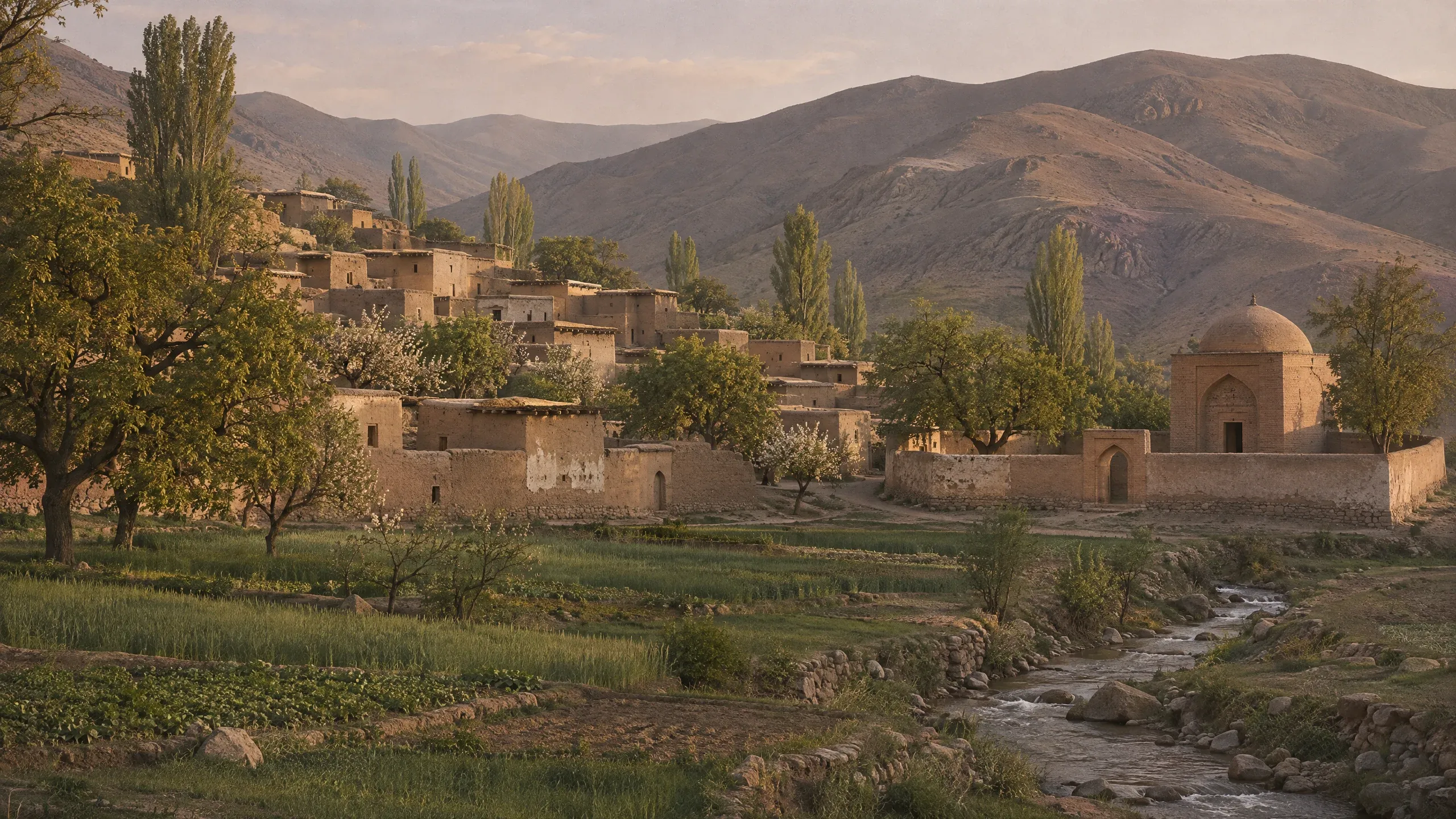
Anjudan is a village in central Iran, about thirty-seven kilometres east of Arak and roughly the same distance west of Mahallat, in the district of Mushkabad on the plain of Farahan. Its present population, about a thousand people, are Twelver Shi’is. Kahak, the village to which the Imams later moved, lies about thirty-five kilometres to the north-east, separated from Anjudan by a series of shallow ranges.1
For roughly two centuries, from the second half of the fifteenth century to 1090/1680, Anjudan was the residence of the Qasim-Shahi Nizari Imams and the headquarters of their da’wa. Daftary calls the movement they led from there the Anjudan revival, the second of the three periods into which he divides post-Alamut Nizari history.2
Before the Imams
The Imams’ links with the area may predate their settlement. Islam Shah, who died around 829/1425, moved the residence of the Qasim-Shahi Imams from Adharbayjan to the region of Qumm and Mahallat and may have established the first foothold at Anjudan. According to the Timurid historian Sharaf al-Din Ali Yazdi (d. 858/1454), Timur, marching from Isfahan towards Hamadan and Baghdad in 795/1393, spent a few days at Anjudan and attacked the Nizaris of the locality, a sign that an Ismaili community was already established there.3
Seat of the Imamate
Mustansir bi’llah II, who succeeded around 868/1463–1464 and died in 885/1480, is the first Imam definitely connected with Anjudan. He and his successors lived there under Sufi guise, Mustansir himself as Shah Qalandar. From Anjudan they reasserted direct authority over the Nizari communities of Persia, Central Asia and India, replacing hereditary local leaders with appointed da’is and summoning regional representatives for instruction. Under Abd al-Salam Shah the Pandiyat-i javanmardi was compiled there and sent to the Khojas of India.4
Persecution under the early Safavids interrupted the Imams’ residence. Abu Dharr Ali and Murad Mirza evidently did not live permanently at Anjudan, and in 981/1573 Shah Tahmasp’s governor of Hamadan killed many Nizaris of Anjudan and its surroundings. Under Shah Abbas I the Imams returned. A royal edict of Rajab 1036/March–April 1627, set up in Anjudan’s main mosque and recovered by Daftary in 1976, addressed the Imam as Amir Khalil Allah Anjudani and exempted the Shi’is of Anjudan, as a dependency of Qumm, from certain taxes, treating them as Twelvers.
The village’s role as a place of pilgrimage is described by Khayrkhwah-i Harati, who was taken there in the first half of the sixteenth century for the didar, the sight of the Imam. He does not name Anjudan, but the nearby places he mentions, including Mahallat, show where he was. During his fortnight’s stay he watched pirs arrive from different regions with the dues of their communities and saw how carefully the Imam checked them, punishing those who had misappropriated the haqq-i imam. The Imam appointed Khayrkhwah da’i of Khurasan and the neighbouring lands. By the second half of the seventeenth century the poet Mahmud Ali could list the Imam’s da’is from Khurasan and Badakhshan to Multan, Lahore and Gujarat.5
The monuments
The Ismaili past of Anjudan was rediscovered only in 1937, when Wladimir Ivanow found there an old mosque and three mausoleums containing the tombs of several Imams and their relatives. Daftary visited in 1976; some of what Ivanow had seen had gone, and the buildings were abandoned and dilapidated. When the Qajar king Nasir al-Din Shah visited Anjudan in Dhu’l-Qa’da 1309/June 1892, he did not suspect its history, and the villagers today do not know who is buried in the tombs.6
The oldest Nizari monument at Anjudan is the octagonal mausoleum known locally as Shah Qalandar, built under Abd al-Salam Shah for his father Mustansir bi’llah II, whose wooden cenotaph gave the date 885/1480; Nizari tradition dates his death to 880/1475–1476. A second octagonal mausoleum, known as Shah Gharib, holds the grave of Gharib Mirza, whose wooden cenotaph, dated Muharram 904/August 1498, was later dismantled by intruders. Five tombstones are set into its walls, among them that of Khalil Allah II, who died in Dhu’l-Hijja 1090/January 1680. An adjoining chamber, now gone, held the grave of Nur al-Dahr Khalil Allah. No grave of Abd al-Salam Shah has been found.7
Abandonment
Shah Nizar II, who succeeded Khalil Allah II in 1090/1680, transferred his residence and the headquarters of the da’wa to Kahak in the early decades of his Imamate, for reasons that are not known. Anjudan was abandoned permanently by the Imams. Daftary marks the move as the end of the Anjudan period, which had lasted about two centuries. Shah Nizar was buried at Kahak, where his mausoleum, with a tombstone dated 1134/1722, still stands, and the Imams remained there until the mid-eighteenth century, when Hasan Ali moved to Shahr-i Babak in the province of Kerman. Anjudan’s tombs were left to the care of villagers who no longer remembered whose they were.8
Footnotes
-
Farhad Daftary, The Isma’ilis: Their History and Doctrines, 2nd ed. (Cambridge University Press, 2007), pp. 423, 456. ↩
-
Daftary, The Isma’ilis, 2nd ed. (Cambridge University Press, 2007), pp. 405–406, 423. ↩
-
Daftary, The Isma’ilis, 2nd ed. (Cambridge University Press, 2007), p. 418. ↩
-
Daftary, The Isma’ilis, 2nd ed. (Cambridge University Press, 2007), pp. 423, 426, 432–433. ↩
-
Daftary, The Isma’ilis, 2nd ed. (Cambridge University Press, 2007), pp. 434, 436–438; Daniel Beben and Daryoush Mohammad Poor, The First Aga Khan: Memoirs of the 46th Ismaili Imam (I.B. Tauris / Institute of Ismaili Studies, 2018), Introduction, p. 21. ↩
-
Daftary, The Isma’ilis, 2nd ed. (Cambridge University Press, 2007), p. 423. ↩
-
Daftary, The Isma’ilis, 2nd ed. (Cambridge University Press, 2007), pp. 423–425. ↩
-
Daftary, The Isma’ilis, 2nd ed. (Cambridge University Press, 2007), pp. 423, 456–458. ↩