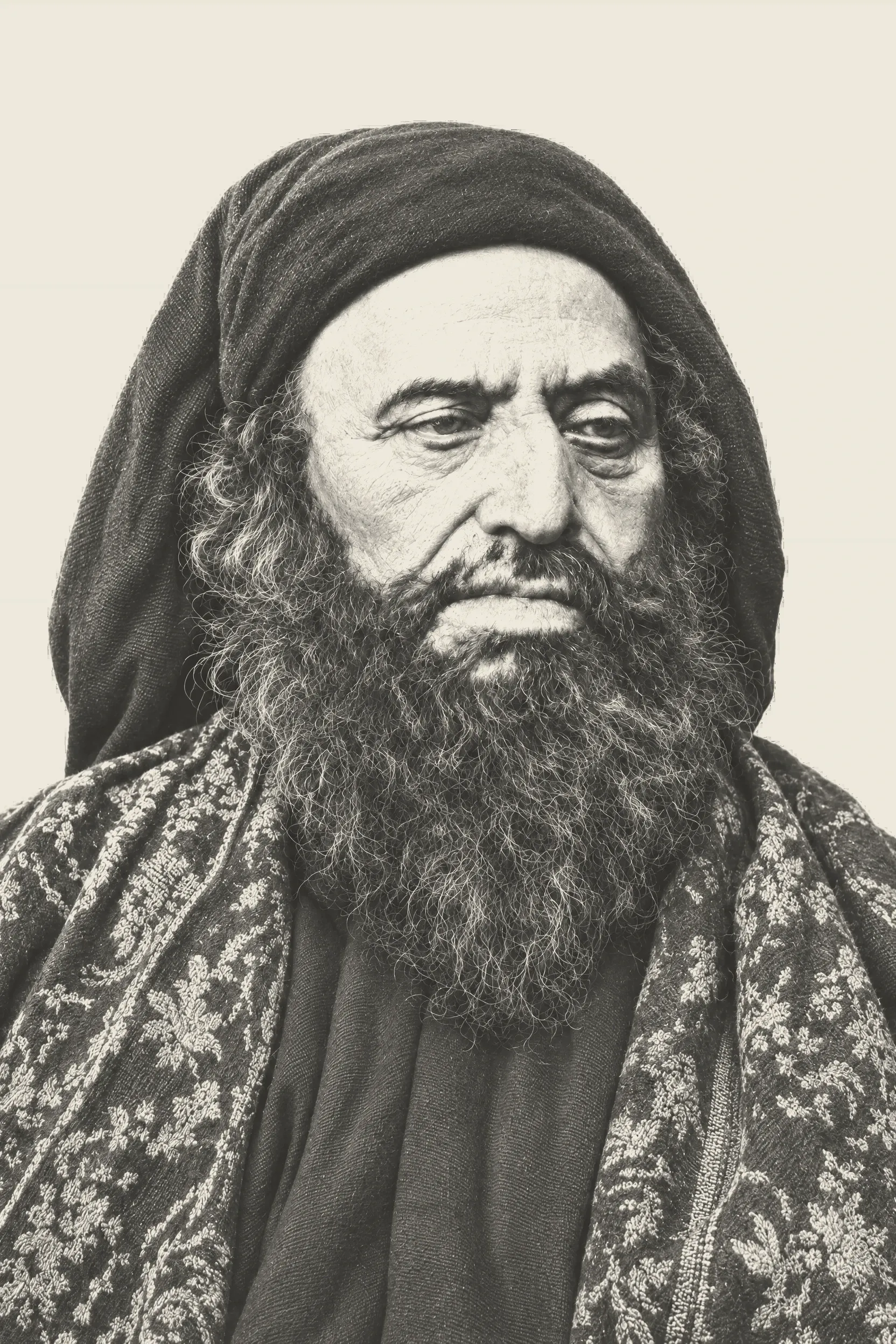
Overview
Hasan Ali Shah, the forty-sixth Imam of the Nizari Ismailis and the first to bear the title Aga Khan, led the Imamate for sixty-four years, from 1232/1817 to 1298/1881. His life connects two worlds. He was born a Persian notable at Kahak, held high office under the Qajars, fought them in Kerman and died a resident of British Bombay. Daftary dates the beginning of the modern period of Nizari history to his settlement in India, where for the first time the Imam lived among the Khojas, the largest part of his following.1
He is also the first Imam since the Alamut period to leave an autobiography. The ’Ibrat-afza, composed in 1266/1850 on his behalf by Mirza Ahmad Viqar-i Shirazi, narrates his career in Persia and his flight to India; it was edited and translated, with a detailed introduction, by Daniel Beben and Daryoush Mohammad Poor in 2018.2
Birth and family
Muhammad Hasan, known as Hasan Ali Shah, was born at Kahak in 1219/1804, the eldest son of Shah Khalil Allah and Bibi Sarkara, daughter of the Nizari sayyid and Ni’mat Allahi poet Muhammad Sadiq Mahallati (Sidq Ali Shah). His maternal uncle Izzat Ali Shah was a prominent Ni’mat Allahi dervish who spent most of his life at Mahallat. The family’s estates lay around Mahallat and Kahak, and its members had been notables of central Persia since the seventeenth century.3
Succession and the title Aga Khan
He was thirteen when his father was killed by a mob at Yazd in 1232/1817. His father had left the family at Kahak to live on its estates, but a dispute between local Nizaris and Imani Khan Farahani, husband of the Imam’s daughter Shah Bibi, who managed the lands, left them unprovided for, and Hasan Ali Shah and his mother moved to Qumm, where their situation deteriorated. His mother went to the court at Tehran to seek justice.4
Her appeal succeeded. Fath Ali Shah had Shah Khalil Allah’s murderer punished, though no one was executed; added to the family’s lands around Mahallat; gave the young Imam his daughter Sarv-i Jahan Khanum in marriage; appointed him governor of Qumm; and granted him the honorific title (laqab) Aqa Khan, “lord and master”. The title, simplified in Europe to Aga Khan, became hereditary among his successors, and he became generally known as Aqa Khan Mahallati. The elements of the title are both of Turkic origin: aqa, “elder brother”, used in Qajar Persia for a chief or respected elder, and khan, by then a general title of respect in Persia. See The Aga Khan title.5
Governor of Kerman
He lived in honour at the Qajar court until Fath Ali Shah’s death in Jumada II 1250/October 1834. By then he had his own armed following, with which he restored order on his way to Tehran to pay homage to the new shah, Muhammad Shah (1250–1264/1834–1848). In 1251/1835 Muhammad Shah, with his chief minister Qa’im-maqam Farahani, appointed him governor of Kerman, the post his grandfather Abu’l-Hasan Ali had held under the Zands. The poet Qa’ani, the greatest panegyrist of the Qajar period and a friend of the Imam, wrote a qasida for the occasion.6
Kerman was then held by the rebellious sons of Shuja al-Saltana, a pretender to the throne, and raided by Afghan and Baluchi bands. The Aga Khan restored order without payment from the treasury and reduced Bam and Narmashir, long held by rebels, with the help of the Ata Allahi and Khurasani tribesmen who recognised him as their Imam. His younger brother Abu’l-Hasan Khan, known as the Sardar, “commander”, led his forces.7
Dismissal and the siege of Bam
In 1252/1837, less than two years after his arrival, he was dismissed and replaced by Firuz Mirza Nusrat al-Dawla, a younger brother of the shah. He refused to accept the decision and withdrew into the citadel of Bam, summoning the Sardar from Baluchistan and his other brother Muhammad Baqir Khan from Rawar. Government forces under Suhrab Khan besieged him for fourteen months; Muhammad Baqir Khan was wounded and captured. Through the intercession of Faridun Mirza, governor of Fars, the Aga Khan surrendered, but he was seized and his possessions plundered. He was held captive at Kerman for eight months, though allowed to receive the dues brought by deputations from Khurasan, Badakhshan and India. Towards the end of 1254/1838 he was permitted to plead his case at Tehran, and Muhammad Shah pardoned him on condition that he retire to Mahallat, where he had built a large fortified compound for his family and dependants.8
Daftary attributes the dismissal mainly to rivalry for the leadership of the Ni’mat Allahi order. After the death of the qutb Majdhub Ali Shah in 1238/1823, most Ni’mat Allahis followed Mast Ali Shah, whom the Aga Khan supported and had sheltered at Dawlatabad near Mahallat. Mast Ali Shah once boasted to Muhammad Shah, “I have a murid like the Agha Khan who himself has thousands of murids in most countries of the world.” Ni’mat Allahi sources claim that the Aga Khan had been initiated into the order in his youth as Ata Allah Shah, which Nizari sources do not confirm and which, Daftary notes, would have been unusual for an Imam. Muhammad Shah’s new chief minister, Hajji Mirza Aqasi, himself aspired to lead the order; he drove Mast Ali Shah from court and intrigued against the Aga Khan, whose refusal to marry a daughter to the son of Aqasi’s protégé Abd al-Muhammad Mahallati sharpened the enmity.9
The revolt of 1840–1841
In 1256/1840 the Aga Khan obtained permission to make the pilgrimage to Mecca. Sending his mother ahead to the shrine cities of Iraq, he left Mahallat early in Rajab 1256/September 1840 with his brothers, nephews and many followers, but made for Yazd rather than the coast, sending ahead documents reinstating him as governor of Kerman. The governor of Yazd, Bahman Mirza, learned from Hajji Mirza Aqasi that they were spurious and attacked him at Mahriz; he was defeated. In the ’Ibrat-afza the Aga Khan presents these attacks as unprovoked, part of a pattern of Qajar treachery.10
He moved to Shahr-i Babak, his inherited property, and forced Afghan refugees from Qandahar, who had occupied its fortress, to surrender. He relieved Muhammad Baqir Khan at Zaydabad in Sirjan, wintered at Minab near Bandar Abbas and, early in 1257/1841, defeated a Qajar force of 4,000 under Isfandiyar Khan near Dashtab. But the governor of Kerman, Fadl Ali Khan Qarabaghi, raised some 24,000 men and decisively defeated him at Rigan on the Baluchistan border. The Aga Khan escaped across the Dasht-i Lut to Sarbisha and crossed into Afghanistan, reaching Lash va Juvayn in 1257/1841. Daftary marks this as the end of the Persian period of the Imamate, some seven centuries after the founding of Alamut. Whether the British encouraged him remains debated.11
Qandahar and Sind
At Qandahar, occupied by an Anglo-Indian army during the First Anglo-Afghan War, the political agent Major Henry Rawlinson granted him a daily stipend of 100 rupees. He offered Sir William Macnaghten, the British envoy at Kabul, to take and govern Herat on behalf of the British and Shah Shuja, a plan overtaken by the Afghan uprising of January 1842; in July 1842 he helped General William Nott evacuate the Qandahar garrison. Deputations from Kabul, Badakhshan, Bukhara and Sind came to him there.12
In the autumn of 1842 he moved to Sind, put his cavalry at British disposal and, when the Talpur amir Nasir Khan refused to cede Karachi, warned Major James Outram of a planned night attack. After the battle of Miyani in February 1843 Sind was annexed to British India, and Sir Charles Napier granted the Aga Khan an annual pension of £2,000. He lived at Jerruck and aided the British against Baluchi chiefs. In 1844 he sent Muhammad Baqir Khan to seize Bampur in Persian Baluchistan; the Sardar held out there until defeated in 1262/1846, was later pardoned by Nasir al-Din Shah and managed the family’s lands at Mahallat until his death in 1297/1880.13
To Bombay
In Ramadan 1260/October 1844 he left Karachi, spent a year among the Khojas of Kutch and Kathiawar, and reached Bombay in Safar 1262/February 1846. Persia demanded his extradition under the treaty of 1814; the British refused but moved him to Calcutta in 1263/1847 while they negotiated. After Muhammad Shah’s death he returned to Bombay in Muharram 1265/December 1848. Nasir al-Din Shah’s minister Amir Kabir threatened him with arrest at the border; after Amir Kabir’s fall the Aga Khan sent the shah an elephant and a giraffe, and some family lands were restored, but his return was never arranged. He settled permanently in India.14
Imam of the Khojas
Aga Khan I was the first Imam of his line to set foot in India. The Khojas now had direct access to him and paid their dues more readily to his durkhana in Bombay, which allowed him to build residences in Bombay, Poona and Bangalore and support a large household. He led prayers in the Bombay jamatkhana on major occasions and held a durbar every Saturday. The British addressed him as His Highness, and the Prince of Wales, the future Edward VII, visited him at Aga Hall. Over three decades he brought the Khojas’ communal institutions under his control.15
His authority was contested by a dissident faction, the Barbhai, who rejected his claim to the dues and community property. In 1847 Sir Erskine Perry ruled in an inheritance case that Khoja custom, not Islamic law, should govern, which the Aga Khan had opposed. In 1862 the dissidents sued him in Bombay, claiming the Khojas were Sunnis. Sir Joseph Arnould of the Bombay High Court, after hearing the case in April and June, ruled on 12 November 1866 that the Khojas were “Shia Imami Ismailis” and the Aga Khan their spiritual head, the hereditary descendant of the Imams of Alamut and entitled to the dues and control of the community’s property. Daftary concludes that his authority was never seriously challenged again. See The Aga Khan Case of 1866.16
Last years and death
He spent his last years in Bombay with seasonal stays in Poona, kept fine stables and was a familiar figure at the Bombay racecourse. He maintained ties with the Qajars and kept his Ni’mat Allahi friendships, hosting Rahmat Ali Shah at Mahallat in earlier years. He died in Jumada I 1298/April 1881 and was buried in a shrine built for him at Hasanabad in the Mazagaon area of Bombay. He married several times and was succeeded by his eldest son, Aqa Ali Shah, Aga Khan II, his only son by the Qajar princess Sarv-i Jahan Khanum.17
Footnotes
-
Farhad Daftary, The Isma’ilis: Their History and Doctrines, 2nd ed. (Cambridge University Press, 2007), pp. 473, 476. ↩
-
Daniel Beben and Daryoush Mohammad Poor, The First Aga Khan: Memoirs of the 46th Ismaili Imam (I.B. Tauris / Institute of Ismaili Studies, 2018), Foreword and Introduction; Daftary, The Isma’ilis, 2nd ed. (Cambridge University Press, 2007), p. 473. ↩
-
Daftary, The Isma’ilis, 2nd ed. (Cambridge University Press, 2007), pp. 462–463. ↩
-
Daftary, The Isma’ilis, 2nd ed. (Cambridge University Press, 2007), pp. 463–464. ↩
-
Daftary, The Isma’ilis, 2nd ed. (Cambridge University Press, 2007), pp. 463–464; Beben and Mohammad Poor, The First Aga Khan (2018), Introduction, p. 29 and n. 78. ↩
-
Daftary, The Isma’ilis, 2nd ed. (Cambridge University Press, 2007), p. 464; Beben and Mohammad Poor, The First Aga Khan (2018), Introduction, p. 29. ↩
-
Daftary, The Isma’ilis, 2nd ed. (Cambridge University Press, 2007), p. 464. ↩
-
Daftary, The Isma’ilis, 2nd ed. (Cambridge University Press, 2007), pp. 465–466; Beben and Mohammad Poor, The First Aga Khan (2018), Introduction, p. 30. ↩
-
Daftary, The Isma’ilis, 2nd ed. (Cambridge University Press, 2007), pp. 465–467. ↩
-
Daftary, The Isma’ilis, 2nd ed. (Cambridge University Press, 2007), p. 468; Beben and Mohammad Poor, The First Aga Khan (2018), Introduction, p. 42. ↩
-
Daftary, The Isma’ilis, 2nd ed. (Cambridge University Press, 2007), pp. 468–469; Beben and Mohammad Poor, The First Aga Khan (2018), Introduction and ’Ibrat-afza, account of the Kerman campaign. ↩
-
Daftary, The Isma’ilis, 2nd ed. (Cambridge University Press, 2007), pp. 469–470; Beben and Mohammad Poor, The First Aga Khan (2018), Foreword, p. xxvii. ↩
-
Daftary, The Isma’ilis, 2nd ed. (Cambridge University Press, 2007), pp. 470–472. ↩
-
Daftary, The Isma’ilis, 2nd ed. (Cambridge University Press, 2007), pp. 472–473. ↩
-
Daftary, The Isma’ilis, 2nd ed. (Cambridge University Press, 2007), pp. 473–474; Beben and Mohammad Poor, The First Aga Khan (2018), Foreword, pp. xxvii–xxviii. ↩
-
Daftary, The Isma’ilis, 2nd ed. (Cambridge University Press, 2007), pp. 474–476; Joseph Arnould, Judgment … in the Khojah Case, otherwise known as the Aga Khan Case (Bombay Gazette Steam Press, 1866), https://archive.org/details/bk1209. ↩
-
Daftary, The Isma’ilis, 2nd ed. (Cambridge University Press, 2007), pp. 467–468, 473, 476–477. ↩