Foundation
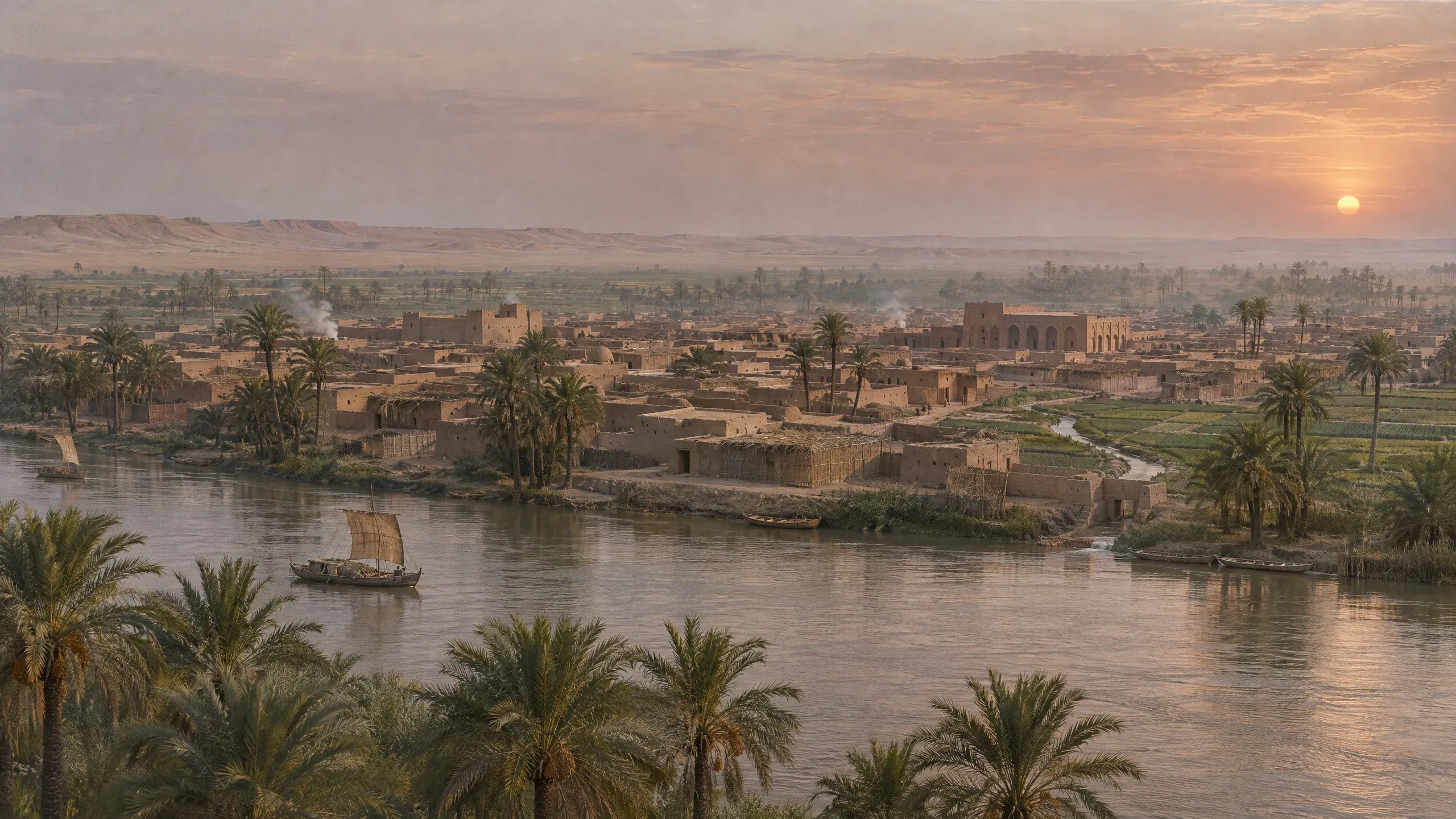
Kufa lies on the Euphrates some 140 kilometres south of Baghdad in a straight line. It was founded as a garrison city (misr) in 17/638 by Sa’d b. Abi Waqqas after his victory over the Sasanians at al-Qadisiyya, and it replaced nearby al-Hira as the administrative centre of several former Sasanian provinces. Unlike other garrison towns, it was settled not by one dominant tribe but by small groups from both southern and northern Arabia. Many were early converts who had fought in the first campaigns and drew stipends (‘ata’) under the system set up by the caliph ’Umar. Daftary notes that tribes of southern Arabian (Yamani) origin predominated, which helped make Kufa the main recruiting ground of the early Shi’a.1
Opposition to ’Uthman
Kufa became a centre of opposition to the caliph ‘Uthman (r. 23–35/644–656). The early settlers resented the arrival of some 40,000 later converts (rawadif) on lower stipends and disputed whether surplus provincial revenue should be sent to Medina. They organised themselves as the qurra’, the “Qur’an readers”, with the warrior Malik b. al-Harith al-Ashtar as their spokesman. They deposed the governor Sa’id b. al-’As, replaced him with Abu Musa al-Ash’ari, marched to Medina, and took part in the events that led to the murder of ’Uthman in 35/656.2
Ali’s capital
Ali ibn Abi Talib made Kufa, the base of his qurra’ supporters, his capital after the battle of the Camel in 36/656. He reorganised its seven tribal divisions in favour of the Yamanis. Most Kufan tribal notables (ashraf), however, cared more about preserving the stipend system and pressed him to compromise with Mu’awiya. After Siffin (37/657), some of the qurra’ abandoned him and became the Kharijites. Ali was killed by a Kharijite while praying in the mosque of Kufa in 40/661; he was buried outside the city at what became Najaf. Daftary notes that Iraqis later remembered his rule, when Kufa was the capital of the caliphate, as a golden age.3
The city of the Shi’a
Kufa remained largely quiet under Mu’awiya except for the pro-’Alid protest of Hujr b. ’Adi al-Kindi, who was executed in 51/671. The population grew from about 20,000–30,000 to around 140,000 Arabs in the early Umayyad period. When Mu’awiya died in 60/680, Kufan Shi’i leaders meeting in the house of Sulayman b. Surad sent al-Husayn many letters inviting him to lead them. The new governor ’Ubayd Allah b. Ziyad intimidated the tribal chiefs and executed al-Husayn’s envoy Muslim b. ’Aqil. The Kufans did not come to al-Husayn’s aid, and he was killed at Karbala in 61/680.4
In remorse, the Kufan Penitents (Tawwabun) under Sulayman b. Surad marched out in 65/684 and were destroyed by the Umayyads at ’Ayn al-Warda. Litvak argues that their sacrifice gave the massacre at Karbala religious significance. Al-Mukhtar b. Abi ’Ubayd al-Thaqafi then rose in Kufa in 66–67/685–687 in the name of Muhammad b. al-Hanafiyya, a son of Ali. He drew support from dissident tribesmen, non-Arab converts (mawali) and slaves, but alienated the ashraf. He was killed in Ramadan 67/April 687 when Mus’ab b. al-Zubayr took the city, and some 6,000 of his followers were executed.5
Umayyad and Abbasid Kufa
The Umayyads recovered Kufa in 72/691. Their governor al-Hajjaj b. Yusuf ruled it harshly. After the rebellion of Ibn al-Ash’ath was crushed in 82/701, he built Wasit to the south as the new administrative centre of Iraq. In 122/740 the Kufans promised support to Zayd b. Ali, son of Zayn al-’Abidin, but deserted him, and he was killed. Kufa was also one of the centres of the Abbasid revolution. Abu’l-‘Abbas al-Saffah was proclaimed caliph there in Rabi’ I 132/October 749 according to Litvak; Daftary gives 12 Rabi’ II 132/28 November 749. Because the city was so strongly pro-’Alid, he moved his capital to al-Hira, and al-Mansur’s foundation of Baghdad in 145/762 began Kufa’s political decline.6
Learning
Kufa was a leading centre of hadith transmission and of jurisprudence based on reasoning (ra’y). Its most famous jurist was Abu Hanifa (d. 150/767), founder of the Hanafi school. The Kufic script, the city’s grammarians and the historian Abu Mikhnaf (d. 157/774) were all associated with it. It was also the main centre of Shi’i learning. Over eighty per cent of the more than three thousand people whom al-Tusi (d. 460/1067) lists as transmitting from Ja’far al-Sadiq bear the nisba al-Kufi.7
Cradle of the Ismailis
The radical Shi’i circles of Kufa formed the setting in which the Ismailis first appeared. Abu’l-Khattab, whom Ja’far al-Sadiq at first made his chief da’i in Kufa and later repudiated, was killed there with seventy followers in the mosque in 138/755–756. When Ja’far died in 148/765, the two groups that formed the earliest Ismailis were both based in Kufa: al-Isma’iliyya al-khalisa and the Mubarakiyya. Muhammad b. Isma’il kept secret contact with his Kufan followers after he went into hiding.8
A century later, the da’wa reappeared in the Sawad, the agricultural hinterland of Kufa. There the da’i al-Husayn al-Ahwazi converted Hamdan Qarmat in about 261/874–875 or 264/877–878. Daftary records that Hamdan built a fortified dar al-hijra (“abode of emigration”) near Kufa in 277/890–891. Ibn Hawshab came from the Nahr Nars district of the Kufan countryside and Abu ’Abd Allah al-Shi’i from Kufa itself.9
Decline
Kufa’s decline was complete by the 4th/10th century. The Qarmatis attacked it in 293/905, 312/924 and 315/927, and it hardly recovered. The Buyids promoted Najaf in its place as the centre of Shi’i devotion. In 386/996 the Buyid amir Baha’ al-Dawla gave Kufa as a fief to the ’Uqaylid Bedouin. The foundation of al-Hilla by the Mazyadids in 495/1102 confirmed its eclipse. Under Ottoman rule it was administered from Najaf. Around 1916 it had about 3,000 inhabitants, and at the start of the 21st century about 119,000.10
Footnotes
-
Meir Litvak, “Kufa,” Encyclopaedia Iranica, online edition (2017), https://www.iranicaonline.org/articles/kufa/; Farhad Daftary, The Isma’ilis: Their History and Doctrines, 2nd ed. (Cambridge University Press, 2007), pp. 42–43. ↩
-
Litvak, “Kufa,” Encyclopaedia Iranica (2017), https://www.iranicaonline.org/articles/kufa/; Daftary, The Isma’ilis, 2nd ed. (Cambridge University Press, 2007), pp. 43–44. ↩
-
Litvak, “Kufa,” Encyclopaedia Iranica (2017), https://www.iranicaonline.org/articles/kufa/; Daftary, The Isma’ilis, 2nd ed. (Cambridge University Press, 2007), pp. 44–47. ↩
-
Litvak, “Kufa,” Encyclopaedia Iranica (2017), https://www.iranicaonline.org/articles/kufa/; Wilferd Madelung, “Hosayn b. ’Ali i. Life and significance in Shi’ism,” Encyclopaedia Iranica, vol. XII, fasc. 5 (2004), https://www.iranicaonline.org/articles/hosayn-b-ali-i/; Daftary, The Isma’ilis, 2nd ed. (Cambridge University Press, 2007), p. 49. ↩
-
Litvak, “Kufa,” Encyclopaedia Iranica (2017), https://www.iranicaonline.org/articles/kufa/; Daftary, The Isma’ilis, 2nd ed. (Cambridge University Press, 2007), pp. 50–52. ↩
-
Litvak, “Kufa,” Encyclopaedia Iranica (2017), https://www.iranicaonline.org/articles/kufa/. Farhad Daftary, The Isma’ilis, 2nd ed. (Cambridge University Press, 2007), p. 78. ↩
-
Litvak, “Kufa,” Encyclopaedia Iranica (2017), https://www.iranicaonline.org/articles/kufa/. ↩
-
Daftary, The Isma’ilis, 2nd ed. (Cambridge University Press, 2007), pp. 85, 89–90, 95. ↩
-
Daftary, The Isma’ilis, 2nd ed. (Cambridge University Press, 2007), pp. 107–109; Heinz Halm, “Ebn Hawsab,” Encyclopaedia Iranica, vol. VIII, fasc. 1 (1997), pp. 28–29, https://www.iranicaonline.org/articles/ebn-hawsab/. ↩
-
Litvak, “Kufa,” Encyclopaedia Iranica (2017), https://www.iranicaonline.org/articles/kufa/. ↩