Name and setting
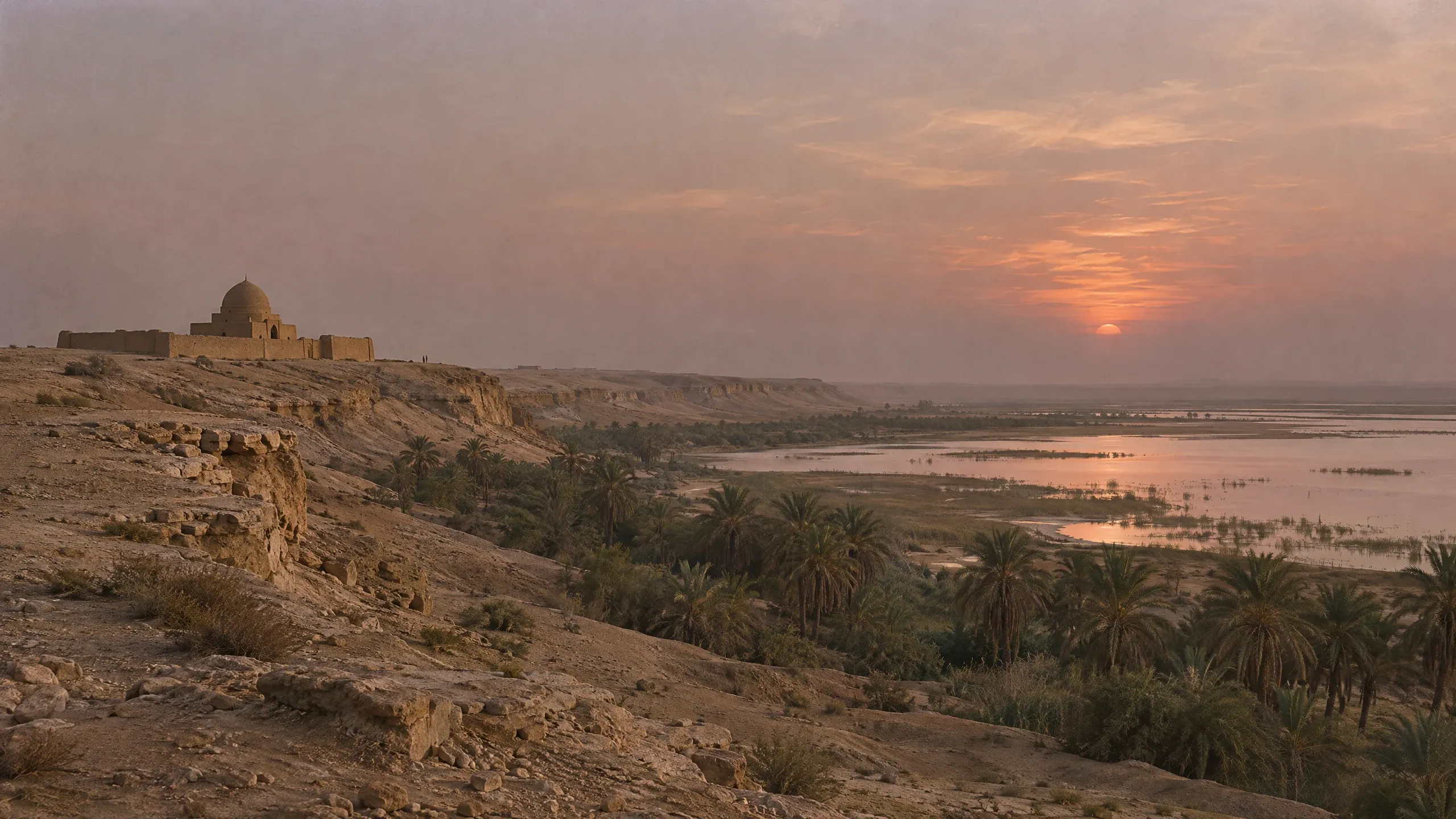
Najaf, known in Arabic as al-Najaf al-Ashraf (“the most noble Najaf”), is a town in southern Iraq beside the old garrison city of Kufa and the still older Lakhmid Christian city of al-Hira. It stands on a raised plateau above a fertile depression called Bahr al-Najaf, the “Sea of Najaf”. The word najaf means a height that water cannot reach. In early times the place was also called al-Ghari. Ali ibn Abi Talib is buried there, together with graves attributed to Adam, Nuh, Hud and Salih.1
Daftary’s Historical Dictionary describes Ali’s shrine at Najaf as the most important place of pilgrimage for the Shi’is. Rose Aslan adds that the city has been one of the main centres of Shi’i scholarship and religious authority for a thousand years, at times rivalling Qom.2
Ali’s grave
The history of Najaf begins with Ali’s death. He was struck down in the mosque of Kufa by the Kharijite ’Abd al-Rahman b. Muljam and died on 21 Ramadan 40/25 January 661. According to tradition, he was buried in secret on the plateau outside the city so that his enemies could not dig up and desecrate his body. Before his burial the area held only a few Christian monasteries and tribal settlements. Excavations by the Kokushikan University expedition between 1986 and 1989 and later surveys have found monasteries and other Christian sites in and around the modern city, including beside the runway of Najaf airport.3
The location was disputed. Leading Shi’i scholars such as al-Kulayni (d. 329/941), al-Sharif al-Radi (d. 406/1016) and al-Shaykh al-Mufid (d. 413/1022) affirmed it. Some Sunni scholars, among them Ibn Qutayba (d. 276/889), al-Tabari (d. 310/923) and al-Khatib al-Baghdadi (d. 463/1071), questioned it. Aslan writes that the grave’s location was at first known only to Ali’s descendants and their close companions. Shi’i hadiths relate that most of the Imams visited it.4
The first buildings
A popular legend recorded by al-Mufid and others says that the Abbasid caliph Harun al-Rashid found the hidden grave while hunting gazelle in the desert and built the first structure over it. Aslan suggests that the grave became publicly known perhaps sometime in the 3rd/9th century. After that, rulers, many of them Persian, endowed it and gradually made Najaf a destination for pilgrims from many lands.5
Around 312/924 the Hamdanid ruler of Mosul, ‘Abd Allah Abu’l-Hayja’ b. Hamdan (d. 317/929), built a tall citadel to protect the tomb and raised a high dome over it, hung with fine textiles and carpets. The Buyid ruler ‘Adud al-Dawla (r. 338–372/949–983) built the first true shrine. He was buried there with his sons Baha’ al-Dawla and Sharaf al-Dawla, and his mausoleum was still standing in the time of Hamd Allah Mustawfi (d. after 740/1340). Defensive walls were added later. In 443/1051, during sectarian violence in Baghdad, a Sunni mob came from the capital and set the shrine on fire, one of many attacks on it over the centuries.6
A centre of learning
Najaf became an established pilgrimage destination and a centre of Shi’i scholarship around the 5th/11th century. In 447/1055 the leading Shi’i theologian of Baghdad, Abu Ja’far Muhammad b. al-Hasan al-Tusi, fled to Najaf after a Sunni mob burned his house and library. He spent the rest of his life there teaching. Most historians of Najaf regard him as the founder of its first seminary (hawza). The Buyids promoted Najaf in place of declining Kufa as the centre of Shi’i devotion, and under Ottoman rule Kufa itself was administered from Najaf.7
Shi’is from as far away as India were brought for burial in the Wadi al-Salam cemetery outside the old walls. In 1263 the Mongol governor of Baghdad dug a canal from the Euphrates to relieve the city’s water shortage. Shah Isma’il I of Iran had it cleared after his conquest of Baghdad in 914/1508. The shrine burned in 1354 and was rebuilt in 1358. Timur, who attacked Baghdad in 1400, spared Najaf and Karbala, visited both and endowed their shrines.8
Ottoman Najaf
Under Ottoman rule (1534–1920) the shrine cities of Iraq, though often contested between Safavids and Ottomans, developed into full shrine complexes with gilded domes and minarets. Aslan notes that Sunnis as well as Shi’is patronised the shrine and visited it. The Ottomans often suppressed the Shi’i population of Iraq, but they revered Ali and endowed his tomb. Sultan Suleyman the Magnificent visited it in 941/1534.9
Najaf in Ismaili memory
Ismailis share with other Shi’is the veneration of Ali, whom they honour as wali Allah, the “friend of God”, and as the Prophet’s legatee (wasi). In later Ismaili literature he holds a rank above the other Imams as the foundation of the Imamate (asas al-imama). Najaf is therefore part of a sacred geography that all Shi’i communities share, together with the shrine of al-Husayn at Karbala.10
Footnotes
-
Rose Aslan, “Najaf,” Encyclopaedia Iranica, online edition (2015), https://www.iranicaonline.org/articles/najaf/. ↩
-
Farhad Daftary, Historical Dictionary of the Ismailis (Scarecrow Press, 2012), s.v. “’Ali b. Abi Talib”; Aslan, “Najaf,” Encyclopaedia Iranica (2015), https://www.iranicaonline.org/articles/najaf/. ↩
-
Aslan, “Najaf,” Encyclopaedia Iranica (2015), https://www.iranicaonline.org/articles/najaf/; Farhad Daftary, The Isma’ilis: Their History and Doctrines, 2nd ed. (Cambridge University Press, 2007), p. 46. ↩
-
Aslan, “Najaf,” Encyclopaedia Iranica (2015), https://www.iranicaonline.org/articles/najaf/. ↩
-
Aslan, “Najaf,” Encyclopaedia Iranica (2015), https://www.iranicaonline.org/articles/najaf/. ↩
-
Aslan, “Najaf,” Encyclopaedia Iranica (2015), https://www.iranicaonline.org/articles/najaf/. ↩
-
Aslan, “Najaf,” Encyclopaedia Iranica (2015), https://www.iranicaonline.org/articles/najaf/; Meir Litvak, “Kufa,” Encyclopaedia Iranica (2017), https://www.iranicaonline.org/articles/kufa/. ↩
-
Aslan, “Najaf,” Encyclopaedia Iranica (2015), https://www.iranicaonline.org/articles/najaf/. ↩
-
Aslan, “Najaf,” Encyclopaedia Iranica (2015), https://www.iranicaonline.org/articles/najaf/. ↩
-
Daftary, Historical Dictionary of the Ismailis (Scarecrow Press, 2012), s.v. “’Ali b. Abi Talib”; Daftary, The Isma’ilis, 2nd ed. (Cambridge University Press, 2007), p. 97. ↩