A trustee Imam
Al-Hasan b. Ali holds a distinctive place in the Ismaili lists of Imams. The Twelver Shi’a and the Musta’li Ismailis count him as the second Imam, after his father Ali ibn Abi Talib. Daftary explains that in the later Ismaili literature Ali was raised above the rank of an ordinary Imam as the “foundation of the Imamate” (asas al-imama), so the Musta’lis begin their count with al-Hasan. The Nizaris, emphasising the equality of all Imams, count Ali as first and al-Husayn as second. They exclude al-Hasan as a temporary or trustee (mustawda’) Imam, as distinct from the permanent (mustaqarr) Imams through whom the Imamate is transmitted. This site follows the Nizari count, so al-Hasan appears here without a number.1
The distinction reflects descent. The Imamate recognised by all Ismaili branches passed from al-Husayn to his son Zayn al-’Abidin and then to his descendants. Al-Hasan’s descendants, the Hasanids, produced many claimants and rebels, but Daftary notes that they never claimed an Imamate based on designation (nass). Al-Hasan is nonetheless an ancestor of the Ismaili Imams in another line: his daughter Fatima was the mother of Muhammad al-Baqir, and his granddaughter Fatima was the mother of Isma’il b. Ja’far.2
Birth and childhood
According to the traditional sources, al-Hasan was born in Medina on 15 Ramadan 3/2 March 625, the eldest surviving son of Ali and the Prophet’s daughter Fatima. He grew up in the Prophet’s household until his grandfather’s death, when he was seven. The Prophet chose the names of both grandsons, although Ali had intended other names such as Harb, and sacrificed a ram for the poor at the birth of each.3
Many reports describe the Prophet’s open affection for him: carrying him on his shoulders, letting him ride on his back during prostration, and pausing a sermon to caress him when he climbed the pulpit. Widely reported is the Prophet’s saying that his two grandsons would be the lords of the youth of Paradise (sayyida shabab ahl al-janna), and his prediction that al-Hasan would make peace between two factions of Muslims. Al-Hasan was commonly said to resemble his grandfather more than anyone else did.4
Under ’Umar, ’Uthman and Ali
According to Ibn Isfandiyar, al-Hasan took part with ’Abd Allah b. ’Umar in a Kufan campaign to Amul in Tabaristan during the caliphate of ’Umar. In 30/651 he is said to have refused his father’s request that he carry out the legal flogging for drunkenness of al-Walid b. ’Uqba, governor of Kufa and half-brother of the caliph ’Uthman. With other sons of leading Companions he was among the defenders of ’Uthman’s residence during the siege of 35/656 and laid down his weapons on the last day at the caliph’s order. He is reported to have criticised his father repeatedly for not defending ’Uthman more vigorously.5
Al-Hasan opposed his father’s assertive war policy, which he believed divided the community. At al-Rabadha, on the march against the rebels in Basra, he reportedly begged Ali in tears to withdraw. Ali sent him with ’Ammar b. Yasir to Kufa to rally support, and al-Hasan raised six to seven thousand men and brought them to Dhu Qar. He was present at the battles of the Camel (36/656) and Siffin (37/657), but not as a prominent participant. In a testament dated 10 Jumada I 39/2 November 658 Ali placed him in charge of his land endowments (sadaqat) in Arabia, to be followed by al-Husayn.6
Caliph in Kufa
Ali was struck down by a Kharijite in the mosque of Kufa and died on 21 Ramadan 40/25 January 661. Daftary writes that some 40,000 Kufans acclaimed al-Hasan as caliph. Madelung notes that Ali had not formally appointed him as successor, but that this does not mean he did not intend him to succeed. Al-Hasan, in Madelung’s account, was ready to give up the rights of the Prophet’s family for the peace and unity of the community, but knew he would need an honourable peace with an amnesty for his supporters.7
After two months of inactivity he wrote to Mu’awiya, the governor of Syria, calling on him to give allegiance, since as the Prophet’s grandson he had the better right to rule. Mu’awiya replied courteously that he would yield were it not for his own greater experience of government. He asked al-Hasan to accept his authority and offered him the succession after his death, the treasury of Iraq, the revenue of any Iraqi province he chose and consultation in all affairs. When al-Hasan did not reply, Mu’awiya sent a more threatening letter and mobilised to invade Iraq.8
Mutiny and wounding
Al-Hasan sent a vanguard under ’Ubayd Allah b. ’Abbas to Maskin to block the Syrian advance and followed with the main army. At Sabat near al-Mada’in he preached a sermon that revealed his wish for peace, and part of his army mutinied: his pavilion was looted and a man pulled his cloak from his shoulders. Loyal men of Rabi’a and Hamdan restored order. Further on, a man with Kharijite views, al-Jarrah b. Sinan al-Asadi, wounded him in the thigh with a pickaxe, accusing him of associating partners with God as his father had. Al-Hasan was carried to al-Mada’in to recover. At Maskin, ’Ubayd Allah b. ’Abbas deserted at night on the promise of a million dirhams, and Qays b. Sa’d took command and held the Syrian advance.9
The treaty
Mu’awiya then opened serious negotiations and finally sent al-Hasan a blank sheet sealed at the bottom, inviting him to write his own terms. According to the account preserved by al-Baladhuri, al-Hasan wrote that he surrendered rule to Mu’awiya on condition that Mu’awiya act according to the Book of God, the Sunna of the Prophet and the conduct of the righteous caliphs; that he would not appoint his successor, which would instead be decided by a council (shura); and that everyone would be safe in person, property and family. Al-Hasan relinquished control of Iraq in Rabi’ II 41/August 661, after a reign of seven months.10
At the public surrender in Kufa, Mu’awiya demanded that al-Hasan rise and apologise. Al-Hasan instead reminded the people that he and al-Husayn were the Prophet’s only grandsons and that he had ceded a right that belonged to him to spare their blood. Mu’awiya, in his own speech, disowned the promises he had made. Daftary’s Historical Dictionary also records that Mu’awiya disowned all his promises once he had taken power. The Umayyad dynasty that followed ruled from 41/661 to 132/750.11
Medina
Al-Hasan returned to Medina. When Mu’awiya sent after him, at al-Qadisiyya, asking him to fight a band of Kharijites, al-Hasan refused: he had given up the war against Mu’awiya to reconcile the community and would not fight for him. Relations deteriorated. Al-Hasan rarely if ever visited Damascus, and some of Ali’s most ardent supporters denounced him for having humiliated the faithful. Many Shi’is still hoped for his succession after Mu’awiya, and they continued to regard him as their Imam. Hujr b. ’Adi became the visible spokesman of the Kufan Shi’a, protesting against the official cursing of Ali from the pulpits.12
In his last decade al-Hasan contracted many marriages, usually keeping the four free wives permitted by law, and his frequent divorces earned him the nickname mitlaq. Madelung dismisses later stories of seventy or ninety wives as absurd and follows Ibn Sa’d, who lists fifteen sons and nine daughters by six wives and three concubines. He treated the marriages made in Ali’s lifetime as political alliances arranged in his father’s interest. He was meticulous in religious observance and made many pilgrimages to Mecca on foot.13
Death and burial
According to the most reliable reports, al-Hasan died on 5 Rabi’ I 50/2 April 670; Daftary gives 49/669. The early sources are nearly unanimous that he was poisoned. Most accuse his wife Ja’da, daughter of the Kinda chief al-Ash’ath b. Qays, and Mu’awiya is usually named as the instigator. Madelung observes that Mu’awiya would naturally be suspected because the death removed an obstacle to the succession of his son Yazid, and that he did not hide his pleasure at the news. Al-Hasan refused to name his suspect to al-Husayn, lest the wrong man be killed in revenge.14
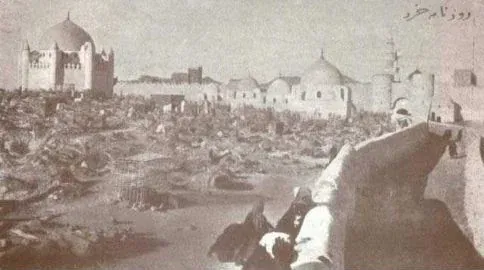
He had asked to be buried beside the Prophet or, if that threatened bloodshed, beside his mother in the Baqi’ cemetery. Marwan b. al-Hakam swore he would not allow it while ‘Uthman lay in the Baqi’. Al-Husayn called on the Quraysh alliance of the hilf al-fudul, and fighting was close until Muhammad b. al-Hanafiyya and others persuaded him to honour al-Hasan’s wish to avoid bloodshed. Al-Hasan was buried beside Fatima. His domed tomb became a place of pilgrimage for all Shi’is and was destroyed by the Wahhabis in 1806 and again in 1927.15
Legacy
Al-Hasan’s peace with Mu’awiya left the Kufan Shi’is without a ruling Imam. Al-Husayn kept the treaty while Mu’awiya lived, and the Kufans transferred their allegiance to him after al-Hasan’s death. When Mu’awiya appointed Yazid as his heir, breaking the treaty, al-Husayn’s refusal to recognise Yazid led to Karbala.16
Footnotes
-
Farhad Daftary, The Isma’ilis: Their History and Doctrines, 2nd ed. (Cambridge University Press, 2007), p. 97; Farhad Daftary, Historical Dictionary of the Ismailis (Scarecrow Press, 2012), s.v. “al-Hasan b. ’Ali b. Abi Talib”. ↩
-
Daftary, The Isma’ilis, 2nd ed. (Cambridge University Press, 2007), pp. 83, 91; Wilferd Madelung, “Baqer, Abu Ja’far Mohammad,” Encyclopaedia Iranica, vol. III, fasc. 7 (1988), p. 725, https://www.iranicaonline.org/articles/baqer-abu-jafar-mohammad/. ↩
-
Wilferd Madelung, “Hasan b. ’Ali b. Abi Taleb,” Encyclopaedia Iranica, vol. XII, fasc. 1 (2003), pp. 26–28, https://www.iranicaonline.org/articles/hasan-b-ali/. ↩
-
Madelung, “Hasan b. ’Ali,” Encyclopaedia Iranica, vol. XII, fasc. 1 (2003), p. 26, https://www.iranicaonline.org/articles/hasan-b-ali/. ↩
-
Madelung, “Hasan b. ’Ali,” Encyclopaedia Iranica, vol. XII, fasc. 1 (2003), https://www.iranicaonline.org/articles/hasan-b-ali/. ↩
-
Madelung, “Hasan b. ’Ali,” Encyclopaedia Iranica, vol. XII, fasc. 1 (2003), https://www.iranicaonline.org/articles/hasan-b-ali/. ↩
-
Daftary, The Isma’ilis, 2nd ed. (Cambridge University Press, 2007), pp. 46, 48; Madelung, “Hasan b. ’Ali,” Encyclopaedia Iranica (2003), https://www.iranicaonline.org/articles/hasan-b-ali/. ↩
-
Madelung, “Hasan b. ’Ali,” Encyclopaedia Iranica, vol. XII, fasc. 1 (2003), https://www.iranicaonline.org/articles/hasan-b-ali/. ↩
-
Madelung, “Hasan b. ’Ali,” Encyclopaedia Iranica, vol. XII, fasc. 1 (2003), https://www.iranicaonline.org/articles/hasan-b-ali/. ↩
-
Madelung, “Hasan b. ’Ali,” Encyclopaedia Iranica (2003), https://www.iranicaonline.org/articles/hasan-b-ali/; Daftary, Historical Dictionary of the Ismailis (Scarecrow Press, 2012), s.v. “al-Hasan b. ’Ali b. Abi Talib”. ↩
-
Madelung, “Hasan b. ’Ali,” Encyclopaedia Iranica (2003), https://www.iranicaonline.org/articles/hasan-b-ali/; Daftary, Historical Dictionary of the Ismailis (Scarecrow Press, 2012), s.v. “al-Hasan b. ’Ali b. Abi Talib”; Daftary, The Isma’ilis, 2nd ed. (Cambridge University Press, 2007), p. 48. ↩
-
Madelung, “Hasan b. ’Ali,” Encyclopaedia Iranica (2003), https://www.iranicaonline.org/articles/hasan-b-ali/; Daftary, The Isma’ilis, 2nd ed. (Cambridge University Press, 2007), p. 49. ↩
-
Madelung, “Hasan b. ’Ali,” Encyclopaedia Iranica, vol. XII, fasc. 1 (2003), https://www.iranicaonline.org/articles/hasan-b-ali/. ↩
-
Madelung, “Hasan b. ’Ali,” Encyclopaedia Iranica (2003), https://www.iranicaonline.org/articles/hasan-b-ali/; Daftary, The Isma’ilis, 2nd ed. (Cambridge University Press, 2007), p. 49. ↩
-
Madelung, “Hasan b. ’Ali,” Encyclopaedia Iranica (2003), https://www.iranicaonline.org/articles/hasan-b-ali/; Daftary, Historical Dictionary of the Ismailis (Scarecrow Press, 2012), s.v. “al-Hasan b. ’Ali b. Abi Talib”. ↩
-
Daftary, The Isma’ilis, 2nd ed. (Cambridge University Press, 2007), p. 49; Wilferd Madelung, “Hosayn b. ’Ali i. Life and significance in Shi’ism,” Encyclopaedia Iranica, vol. XII, fasc. 5 (2004), https://www.iranicaonline.org/articles/hosayn-b-ali-i/. ↩