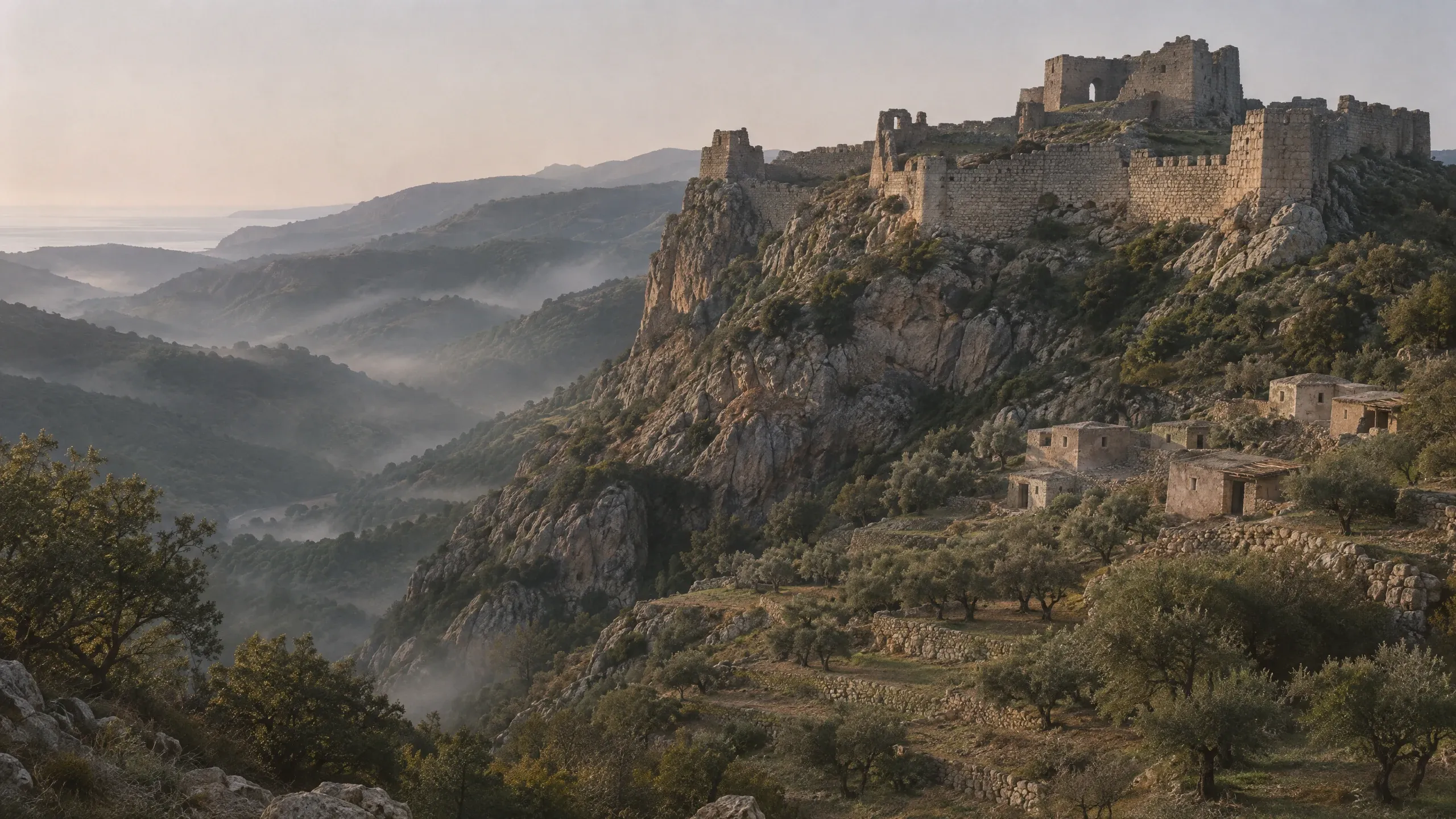
Qadmus is a castle and small town in the Jabal Bahra’ (today’s Jabal Ansariyya) in north-western Syria. Daftary’s dictionary places it about 30 kilometres east of Baniyas on the coast and 30 kilometres west of Masyaf. It was the first fortress the Nizari Ismailis acquired in the region, bought in 527/1132. It became one of their main strongholds and often housed the chief da’i of Syria. The Mamluks took it in 1273. Qadmus has remained a Nizari settlement ever since, and since the nineteenth century has been a centre of the Muhammad-Shahi branch.1 (The coordinates given here are approximate.)
Purchase, 1132
By the late 1120s the Syrian Nizaris had lost their bases in Aleppo and Damascus. In Damascus in 523/1129 a massacre of more than 6,000 people followed the murder of their ally, the vizier al-Mazdaqani. Their leaders turned to the mountains. In 527/1132–33, under a leader called Abu’l-Fath, they bought Qadmus from Sayf al-Mulk b. ’Amrun, lord of Kahf. He had taken it back from the Franks a year earlier.2
Lewis notes that the purchase came just after the Franks failed to win control of the area. He describes the years that followed as a period of “quiet consolidation”, when the Nizaris attracted little attention from the chroniclers and very few of their leaders’ names are known. Abu’l-Fath is remembered only as the purchaser of Qadmus. The last chief da’i before Sinan, Abu Muhammad, is similarly little more than a name in the sources.3
This began what Daftary calls the third phase of Nizari activity in Syria, centred on the Jabal Bahra’, the hill country between Hama and the coast. Kahf was bought from Sayf al-Mulk’s son Musa a few years later. Khariba followed in 531/1136–37 and Masyaf in 535/1140–41.4
A residence of the chief da’is
Daftary describes Qadmus as a major stronghold and often the residence of the chief da’i. It was one of the qila’ al-da’wa, together with Masyaf, Kahf, Khawabi, Rusafa, Maniqa and Qulay’a.5 Daftary’s dictionary notes that, unlike the large Persian fortresses, the Syrian Nizari castles were mostly smaller sites. They were built to defend a community living in the surrounding villages, not as bases for expansion.6
Rashid al-Din Sinan, chief da’i from about 1164 to 1193, divided his time between Masyaf, Kahf and Qadmus, never settling in one seat. Sinan strengthened the castles and acquired new ones, such as ’Ullayqa near the Hospitaller castle of Marqab. He also rebuilt Rusafa and Khawabi. Qadmus was thus one of the three centres from which the Syrian Nizaris were governed at the height of their power.7
Surrender to Baybars
After the Mongol invasion of 1260 and the Mamluk victory at ’Ayn Jalut, the Syrian Nizaris still held eight permanent strongholds, Qadmus among them. Sultan Baybars brought them step by step under his control. He taxed their revenues, collected their tribute and, from 1270, appointed and removed their chief da’is.8
After two Nizaris from ’Ullayqa were arrested in February 1271 on suspicion of plotting against the sultan, Baybars took over the castles. ’Ullayqa and Rusafa surrendered in May 1271. By Dhu’l-Qa’da 671 / May 1273 Khawabi, Qulay’a, Maniqa and Qadmus had surrendered too, and Kahf fell two months later. Daftary’s dictionary dates the submission of Qadmus to 671/1273. Baybars left the Nizari population in place under Mamluk commanders, unlike the Mongols in Persia.9
Lewis records that the reinstated chief da’i Najm al-Din and his son Shams al-Din are both named in an inscription in the mosque of Qadmus from about this time, the early 1270s. It is among the last documents of Nizari independence in Syria.10
Nizari town
Daftary’s dictionary notes that Qadmus stayed a Nizari town, home especially to the community’s leaders or amirs. Under the Ottomans the Syrian Nizaris were divided by rivalry between the amirs of Masyaf and of Qadmus, and repeatedly fought the neighbouring Nusayris. In the 1840s Amir Isma’il b. Muhammad of Qadmus brought most of the community under his authority. With Ottoman permission he resettled them at Salamiyya, east of Hama, from 1843.11
After the Ottoman conquest of Syria in the sixteenth century, the first Ottoman land and population surveys recorded the qila’ al-da’wa, a group of villages west of Hama that included Qadmus and Kahf. Their inhabitants are noted as a distinct sect only because they paid a special tax. Lewis observes that they then disappear from the record until the early nineteenth century.12
The Nizaris who stayed in Qadmus and Masyaf mostly followed the Muhammad-Shahi (Mu’mini) line of Imams, which had died out elsewhere. The last Nusayri attacks on them came in 1919–1920, when Qadmus was briefly taken and badly damaged. Daftary estimates that about 15,000 Muhammad-Shahis, locally known as the Ja’fariyya, live in Qadmus, Masyaf and a few nearby villages. They follow the Shafi’i school in legal matters and await the return of a hidden Imam.13
Footnotes
-
Farhad Daftary, Historical Dictionary of the Ismailis (Scarecrow Press, 2012), s.v. “Qadmus”. ↩
-
Farhad Daftary, The Isma’ilis: Their History and Doctrines, 2nd ed. (Cambridge University Press, 2007), pp. 348–349. ↩
-
Bernard Lewis, The Assassins: A Radical Sect in Islam (Weidenfeld & Nicolson, 1967), pp. 108–109. ↩
-
Daftary, The Isma’ilis, pp. 349–350; Daftary, Historical Dictionary, s.v. “Kahf”. ↩
-
Daftary, The Isma’ilis, p. 350. ↩
-
Daftary, Historical Dictionary, s.v. “Architecture”. ↩
-
Daftary, The Isma’ilis, p. 368. ↩
-
Daftary, The Isma’ilis, pp. 399–400. ↩
-
Daftary, The Isma’ilis, p. 401; Daftary, Historical Dictionary, s.v. “Qadmus”. ↩
-
Lewis, The Assassins, p. 122. ↩
-
Daftary, Historical Dictionary, s.v. “Qadmus”; Daftary, The Isma’ilis, p. 489. ↩
-
Lewis, The Assassins, p. 123; Daftary, The Isma’ilis, p. 489. ↩
-
Daftary, The Isma’ilis, p. 490. ↩