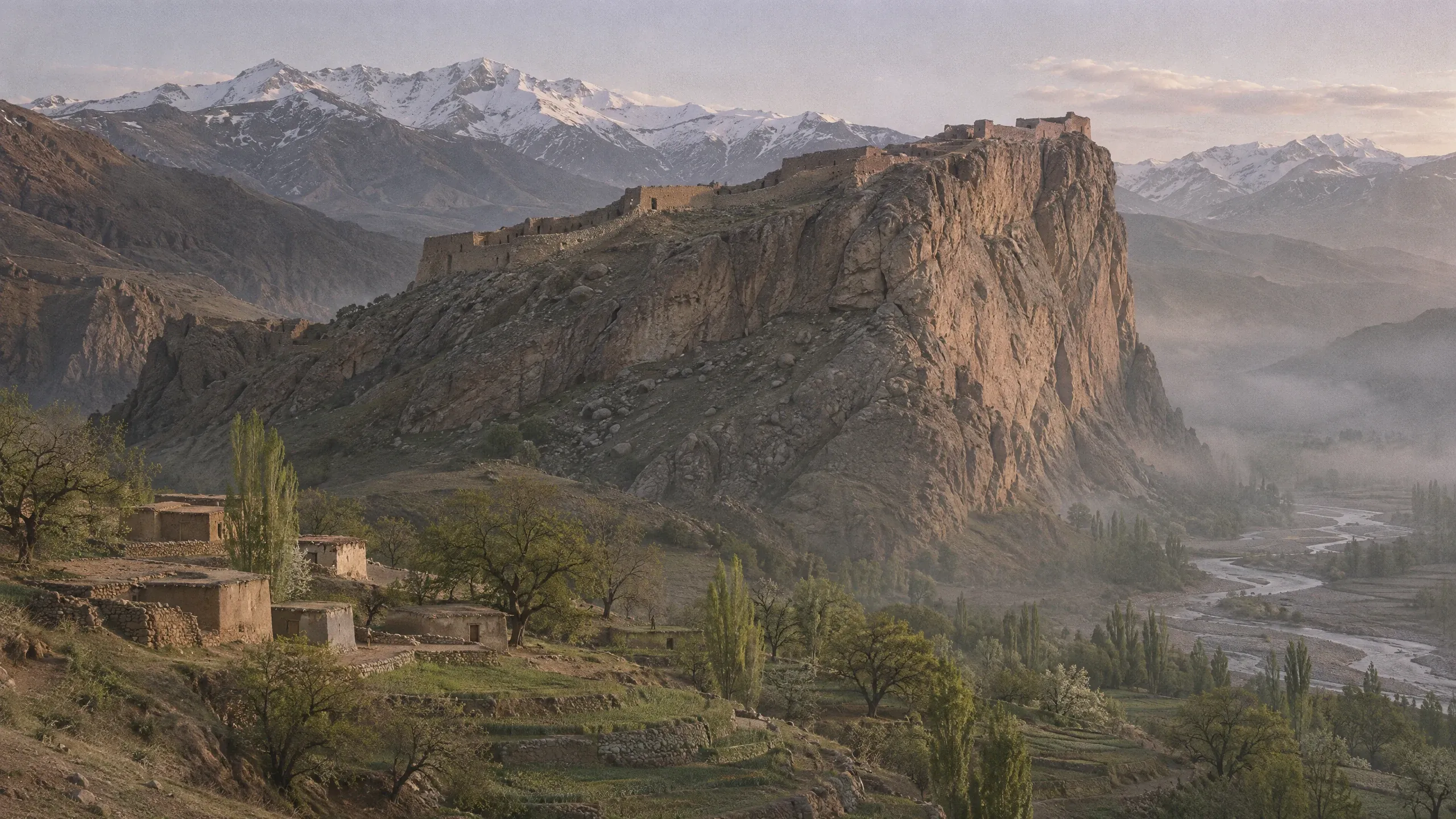
Alamut is a mountain fortress in the central Alborz, about 35 kilometres north-east of Qazwin, near the village of Gazurkhan. From 1090 to 1256 it was the seat of the Nizari Ismaili state, and Ismaili historiography names the whole period after it. Eight rulers governed from the castle, from Hasan-i Sabbah to Rukn al-Din Khurshah. The Nizari sources call them collectively the “lords of Alamut” (khudawands).1 Its library was famous, and its reputation for being impregnable lasted until the Mongols took it apart in the winter of 1256.
The rock
The fortress stands on top of a high, narrow rock in front of the massive Hawdigan range. It was in the district medieval geographers called Daylaman, later Rudbar, and the Alamut river below it is a tributary of the Shahrud. The only access is a narrow, winding path on the north face. Daftary notes that Alamut was never taken by force; when it fell in 1256, it was surrendered.2
Juvayni saw the rock in 1256 and compared it to “a kneeling camel with its neck resting on the ground”. A local story explained the name as aluh amut, Daylami for “eagle’s teaching”: an eagle was said to have shown a Daylami ruler the site. Daftary treats this as folk etymology.3
Before Hasan-i Sabbah
In the Alamut library Juvayni found a history of Jil and Daylam written for the Buyid Fakhr al-Dawla. It said that one of the Justanid kings of Daylam began building a castle on the mountain in 246/860–61. Daftary’s dictionary names him as Wahsudan b. Marzuban (d. c. 251/865). Juvayni also quotes the historian Sallami: during the Daylami domination of Iraq the governor of Alamut, a man called Siyah-Chashm (“Black Eye”), was a convert of the Ismailis of Egypt.4
The Justanids ruled Daylam from their seat in the Alamut valley. Their lands later passed to the Musafirids, who followed the Qarmati form of Ismailism. Before 1090 Alamut had been held for the Saljuq sultan Malikshah by a Zaydi ’Alid named Mahdi, a descendant of al-Hasan al-Utrush.5
The capture of 1090
Hasan-i Sabbah chose Alamut around 480/1087, after deciding that Daylam, a long-standing refuge for ’Alids and hard for Saljuq armies to reach, gave the da’wa its best chance. His da’is had already converted much of the surrounding population and part of the garrison. On the eve of Wednesday 6 Rajab 483 / 4 September 1090 he entered the castle in secret. He lived there for a while under the name Dihkhuda, teaching the children of the garrison. When Mahdi realised what had happened, Hasan let him leave and gave him a draft for 3,000 gold dinars, drawn on the ra’is Muzaffar, the future commander of Girdkuh.6
Daftary treats this event as the founding of the Nizari state. Hasan repaired the walls, storerooms and water supply, extended irrigation in the valley and had trees planted. Saljuq forces soon arrived. In 485/1092 the amir Arslan Tash besieged Hasan, who had about seventy men. A local da’i, Dihdar Abu ’Ali Ardistani, brought in 300 more men through the siege lines, and a sortie at the end of Sha’ban 485 / September–October 1092 drove the Saljuqs off. Because the garrison held when it had been ready to give up, Alamut became known as baldat al-iqbal, “the city of good fortune”.7
Thirty-four years of Hasan-i Sabbah
Hasan did not leave Alamut for the remaining thirty-four years of his life. The Nizari tradition quoted by the Persian historians says he lived in modest quarters, reading, writing and directing the da’wa. Sultan Muhammad Tapar attacked Rudbar several times between about 1107 and 1118. The amir Anushtagin Shirgir spent eight years destroying the crops of the district and besieging its castles. Juvayni, no friend of the Nizaris, says the castle, “whose garrison and resources were then but small”, was besieged several times over eleven years “and all to no avail”. The siege ended in 1118 when news came of the sultan’s death.8
Hasan was buried near Alamut, as were his successors Buzurg-Ummid and Muhammad b. Buzurg-Ummid. Their tombs were places of pilgrimage until the Mongols destroyed them.9
The Qiyama
On 17 Ramadan 559 / 8 August 1164 the fourth lord, Hasan II, proclaimed the Qiyama, the spiritual “Resurrection”, at the foot of the castle. A pulpit was set up facing west, and four banners marked the points of the compass. Alamut stayed the centre of the Nizari world through the Qiyama, the return to the shari’a under Jalal al-Din Hasan and the doctrine of satr developed under Ala al-Din Muhammad.10
Water, stores and engineering
Juvayni’s description of Alamut, written for his Mongol masters as they tore it down, admires its engineering in spite of his hostility. He describes long, wide galleries and deep tanks cut into the rock without stone or mortar, and storerooms for wine, vinegar, honey and “all sorts of liquids and solids”. One looter waded into a honey tank and almost drowned. A conduit brought water from a river to the foot of the castle. From there a channel cut into the rock ran half way round the castle and fed rock-cut tanks below, so that the water “would be stored in them by its own impetus” and kept flowing. Juvayni also says stores laid down since Hasan-i Sabbah’s time, over more than 170 years, had not spoiled.11
Daftary’s dictionary places Alamut among the large Persian castles, alongside Lamasar, Girdkuh and Qa’in. These were planned for long sieges: a small garrison could defend them, they had their own water and food, and a friendly population lived nearby. Their roofed cisterns lined with limestone reflect the Nizaris’ skill as water engineers. The large castles were also administrative and cultural centres with libraries and scientific instruments.12
The library
Hasan-i Sabbah founded a library at Alamut, and later Nizari rulers added to it. Juvayni writes that its fame “had spread throughout the world”. It held religious works, the documents of the Nizari state (including Sultan Sanjar’s decrees, which Juvayni read there), histories and scientific instruments. Outside scholars used it, especially in the thirteenth century. Its history and destruction are covered under the Alamut library.13
Surrender and demolition, 1256
Rukn al-Din Khurshah surrendered to Hülegü at Maymundiz on 29 Shawwal 654 / 19 November 1256. His agents then went round Rudbar ordering the castles to submit, and about forty were dismantled. The commander of Alamut, named Muqaddim (Muqaddim al-Din in Rashid al-Din), refused at first. Hülegü left Prince Balaghai to besiege the castle and went on to Lamasar. After Khurshah interceded for them, the defenders received a safe-conduct.14
The Mongols broke up the mangonels and removed the gates. The garrison was given three days to bring down its belongings. At the end of Dhu’l-Qa’da 654 / early December 1256 Mongol soldiers and levies climbed up, took what was left and set fire to the buildings. Juvayni describes the walls and ramparts, “strengthened by plastered walls and lead-covered ramparts”, as so solid that the demolition crews’ iron tools bounced off them. While waiting below Lamasar he obtained Hülegü’s leave to go through the library. He kept copies of the Qur’an, other “choice books” and astronomical instruments, and burned the rest.15
Later history
The Mongols later partly rebuilt Alamut for their own use. Daftary’s dictionary says it afterwards came into the hands of the Zaydis and other local dynasties of northern Persia. The Safavids used it as a state prison until the fortress was abandoned in the early eighteenth century. Daftary describes the fall of Alamut as the beginning of a “different and often obscure phase” of Nizari history, in which the community survived as a minority without the political position it had held when Alamut was its capital.16
Footnotes
-
Farhad Daftary, Historical Dictionary of the Ismailis (Scarecrow Press, 2012), s.v. “Alamut”; Farhad Daftary, The Isma’ilis: Their History and Doctrines, 2nd ed. (Cambridge University Press, 2007), pp. 317, 402. ↩
-
Daftary, Historical Dictionary, s.v. “Alamut”; Daftary, The Isma’ilis, pp. 317–318. ↩
-
’Ata-Malik Juvayni, The History of the World-Conqueror, tr. J. A. Boyle (Manchester University Press, 1958), vol. 2, p. 718; Daftary, The Isma’ilis, p. 318. ↩
-
Juvayni, World-Conqueror, vol. 2, p. 719; Daftary, Historical Dictionary, s.v. “Daylam”. ↩
-
Daftary, Historical Dictionary, s.v. “Daylam”, “Musafirids”; Daftary, The Isma’ilis, p. 314. ↩
-
Daftary, The Isma’ilis, pp. 313–316. ↩
-
Daftary, The Isma’ilis, pp. 316–319. ↩
-
Daftary, The Isma’ilis, pp. 337, 344; Juvayni, World-Conqueror, vol. 2, p. 636. ↩
-
Daftary, The Isma’ilis, pp. 344, 355, 358. ↩
-
Daftary, The Isma’ilis, pp. 358–359, 375–380. ↩
-
Juvayni, World-Conqueror, vol. 2, pp. 719–720. ↩
-
Daftary, Historical Dictionary, s.v. “Architecture”. ↩
-
Daftary, Historical Dictionary, s.v. “Alamut”; Juvayni, World-Conqueror, vol. 2, pp. 681, 719; Daftary, The Isma’ilis, p. 355. ↩
-
Daftary, The Isma’ilis, pp. 395–396; Juvayni, World-Conqueror, vol. 2, pp. 717–718. ↩
-
Juvayni, World-Conqueror, vol. 2, pp. 635–636, 718–719; Daftary, The Isma’ilis, p. 396. ↩
-
Daftary, Historical Dictionary, s.v. “Alamut”; Daftary, The Isma’ilis, p. 402. ↩