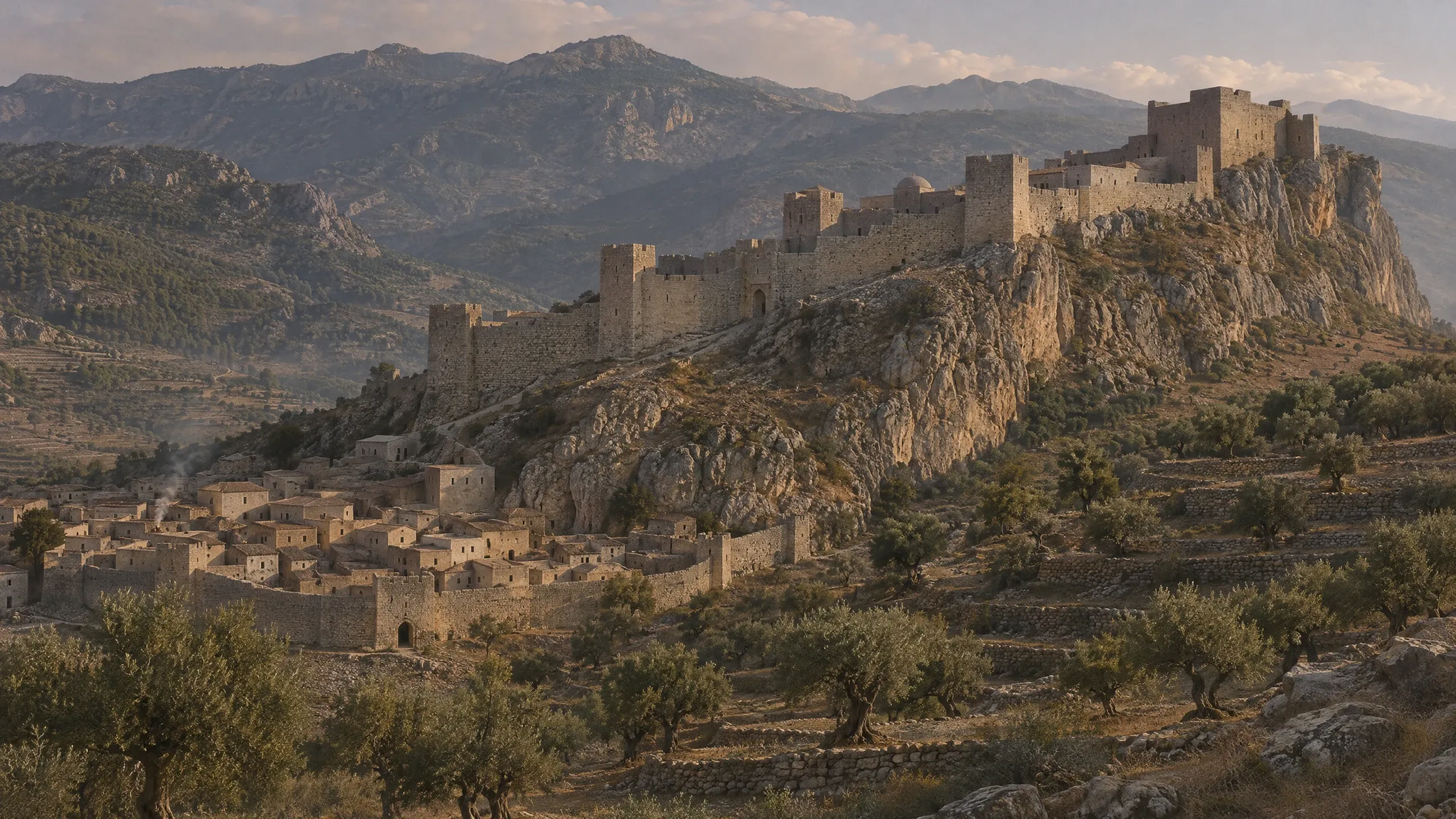
Masyaf, also written Masyad, is a castle and small town on the eastern slopes of the Jabal Bahra’ (today’s Jabal Ansariyya), about 40 kilometres west of Hama. The Nizari Ismailis took it in 535/1140–41. It became the usual seat of the chief da’is who led the Syrian Nizaris on behalf of Alamut, and was the most important of the eight to ten castles the Crusaders knew as the lands of the “Old Man of the Mountain”.1 Saladin besieged it in 1176. Its building inscriptions are a main source for the names of the Syrian chief da’is. The Mamluk sultan Baybars took control of it in 1270, and Nizaris still live in the town today.2 (The coordinates given here are approximate.)
Acquisition
The Syrian Nizaris first worked in the cities of Aleppo and Damascus, and were driven out of both by the late 1120s. They then built up a group of castles in the Jabal Bahra’, the hill country between Hama and the coast. Under a leader called Abu’l-Fath they bought Qadmus in 527/1132–33 and took Kahf and Khariba soon after. In 535/1140–41 they captured Masyaf by killing Sunqur, who held it for the Banu Munqidh of Shayzar.3
Daftary lists the main Syrian strongholds as Masyaf, Qadmus, Kahf, Khawabi, Rusafa, Maniqa and Qulay’a, known collectively as the qila’ al-da’wa, “castles of the mission”. William of Tyre wrote that the Syrian Nizaris held ten castles and numbered 60,000 people. Daftary treats this as one Crusader’s estimate.4
Seat of the chief da’is
The chief da’i of Syria was appointed from Alamut and normally lived at Masyaf or Kahf.5 Daftary’s dictionary notes that the Syrian castles were generally smaller than the great Persian fortresses. Unlike the Persian castles, many of them carry building inscriptions, which give the names of the chief da’is responsible for the work.6
Rashid al-Din Sinan, chief da’i from about 1164 to 1193, moved between Masyaf, Kahf and Qadmus instead of staying in one seat. Daftary’s dictionary says Kahf was his main headquarters, but Masyaf is the castle most linked with his confrontation with Saladin.7
Saladin’s siege, 1176
In 1174–75 Gumushtigin, regent of Aleppo for the young Zangid al-Malik al-Salih, hired Sinan to have Saladin killed. Fida’is attacked Saladin’s camp in the winter of 570/1174–75 and again on 22 May 1176 during the siege of ’Azaz. In August 1176, Lewis notes, Saladin marched on the Nizari lands and besieged Masyaf.8
The siege lasted only a short time. Saladin’s maternal uncle, Shihab al-Din Mahmud b. Takash, governor of Hama, negotiated a truce. The sources disagree over who asked for it. Saladin’s secretary ‘Imad al-Din and most Arabic sources say the Nizaris asked the prince of Hama to intercede. Another biographer points to a Frankish raid on the Biqa’ valley that required Saladin’s presence. Kamal al-Din’s history of Aleppo has Saladin himself seeking peace. After it, the Nizaris took no further action against Saladin, and the two seem to have worked together against the Zangids of Aleppo. Later Nizari tradition, recorded by Abu Firas, surrounded the episode with stories of Sinan’s supernatural powers. Lewis and Daftary both treat these as hagiography.9
The inscriptions
Sinan’s successor, the Persian da’i Abu Mansur b. Muhammad, restored Alamut’s full authority over the Syrian community. Inscriptions at Masyaf and Kahf preserve the names of several chief da’is between 620/1223 and 656/1258. They include Kamal al-Din al-Hasan b. Mas’ud, Majd al-Din, Siraj al-Din Muzaffar b. al-Husayn, Taj al-Din Abu’l-Futuh b. Muhammad and Radi al-Din Abu’l-Ma’ali. In 624/1227 envoys of Emperor Frederick II brought gifts worth about 80,000 dinars to Majd al-Din.10
Mongols and Mamluks
In 658/1260 the Mongols overran Syria after taking Baghdad, and the governors of Masyaf and three other Nizari castles surrendered to them. After the Mamluk victory at ’Ayn Jalut on 3 September 1260, the Nizaris got the castles back. The rising Mamluk sultan Baybars then brought the community step by step under his control. He granted its lands to the Ayyubid prince of Hama, taxed the gifts that reached the Nizaris from Frankish and Yemeni rulers, and from 665/1267 collected the tribute they had paid to the Hospitallers. He also began appointing and dismissing their chief da’is.11
In 668/1270 the elderly chief da’i Najm al-Din failed to pay homage to Baybars, and the sultan deposed him. Baybars named Najm al-Din’s son-in-law, Sarim al-Din Mubarak of ’Ullayqa, as his deputy over the castles, but ordered that Masyaf be handed to one of his own amirs, ’Izz al-Din al-’Adimi. Sarim al-Din took charge of the castles in Jumada II 668 / February 1270, but then seized Masyaf by a trick, against the sultan’s orders, and killed many of its residents, who had refused him entry. At Baybars’s request the ruler of Hama drove him out and sent him to Cairo as a prisoner, and Masyaf passed under direct Mamluk control.12
The rest of the castles followed. ’Ullayqa and Rusafa surrendered in May 1271, Khawabi, Qulay’a, Maniqa and Qadmus by May 1273, and Kahf, the last, in Dhu’l-Hijja 671 / July 1273. Baybars, unlike the Mongols in Persia, let the Nizaris remain in their villages under the watch of Mamluk commanders.13
Later centuries
Under the Mamluks and the Ottomans the Nizaris of Masyaf paid a special tax and were led by hereditary amirs. Rivalry between the amirs of Masyaf and those of Qadmus weakened the community, and the neighbouring Nusayris (Alawis) occupied Nizari fortresses more than once. In 1808 the Nusayris murdered the Nizari amir of Masyaf, Mustafa Mulhim, and seized the castle. The senior da’i, Shaykh Sulayman b. Haydar, led many Nizaris away to Hims and Hama. The Nizaris later recovered Masyaf through Ottoman intervention. In the 1830s Ibrahim Pasha’s expedition damaged Nizari castles and villages.14
From 1843, Amir Isma’il b. Muhammad of Qadmus gathered most Syrian Nizaris at Salamiyya, east of Hama, and that town became the main centre of the Qasim-Shahi Nizaris in Syria. Masyaf kept a community of the Muhammad-Shahi (Mu’mini) line, locally known as the Ja’fariyya. Daftary estimates about 15,000 of them in Masyaf, Qadmus and nearby villages, who follow the Shafi’i school in legal matters.15
Footnotes
-
Farhad Daftary, The Isma’ilis: Their History and Doctrines, 2nd ed. (Cambridge University Press, 2007), pp. 350, 353. ↩
-
Daftary, The Isma’ilis, pp. 369, 389, 400–401, 490. ↩
-
Daftary, The Isma’ilis, pp. 347–350; Bernard Lewis, The Assassins: A Radical Sect in Islam (Weidenfeld & Nicolson, 1967), pp. 108–109. ↩
-
Daftary, The Isma’ilis, p. 350. ↩
-
Daftary, The Isma’ilis, p. 353. ↩
-
Farhad Daftary, Historical Dictionary of the Ismailis (Scarecrow Press, 2012), s.v. “Architecture”. ↩
-
Daftary, The Isma’ilis, p. 368; Daftary, Historical Dictionary, s.v. “Kahf”. ↩
-
Daftary, The Isma’ilis, p. 369; Lewis, The Assassins, p. 116. ↩
-
Daftary, The Isma’ilis, pp. 369–370; Lewis, The Assassins, pp. 116–117. ↩
-
Daftary, The Isma’ilis, pp. 388–390. ↩
-
Daftary, The Isma’ilis, pp. 398–400. ↩
-
Daftary, The Isma’ilis, pp. 400–401. ↩
-
Daftary, The Isma’ilis, p. 401. ↩
-
Daftary, The Isma’ilis, p. 489. ↩
-
Daftary, The Isma’ilis, pp. 489–490. ↩