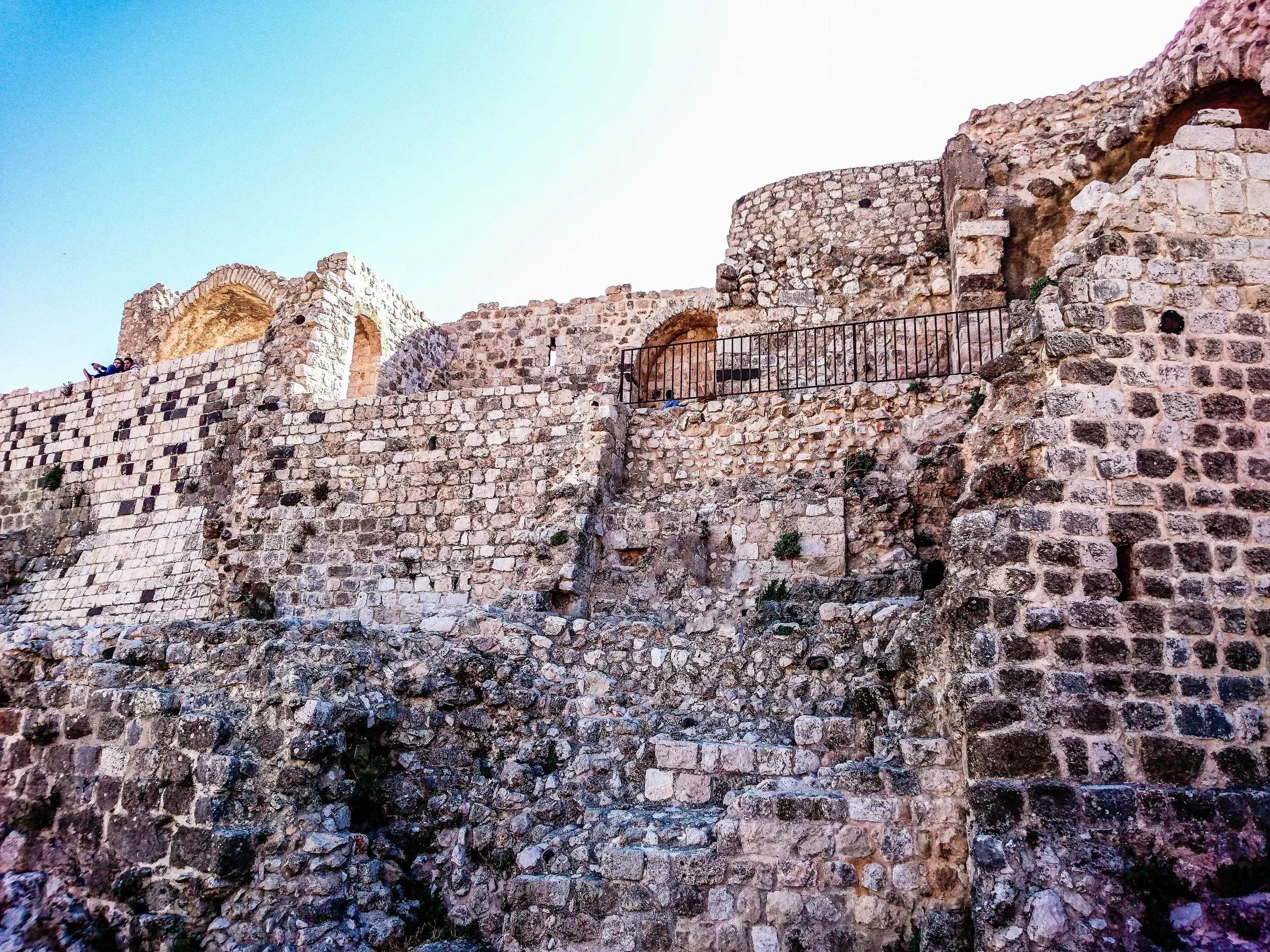
Rashid al-Din Sinan (d. 1193) led the Nizari Ismailis of Syria for about thirty years. Daftary’s dictionary calls him “the greatest of the medieval Nizari Ismaili da’is in Syria”. He governed a small group of mountain castles in the Jabal Bahra’, among them Masyaf, Kahf and Qadmus. He kept the community safe by shifting alliances with the Crusaders, the Zangids and Saladin, and by the threat of his fida’is. Crusader writers called him “the Old Man of the Mountain”, and the Assassins legend took shape around him.1
Origins and training
Sinan b. Salman (or Sulayman) b. Muhammad Abu’l-Hasan al-Basri, known as Rashid al-Din, was born into an Imami (Twelver) Shi’i family in the 520s/1126–1135. His birthplace was ’Aqr al-Sudan, a village near Basra on the road to Wasit. He grew up in Basra, worked there as a schoolmaster and became a Nizari Ismaili while still young.2
He then went to Alamut and studied there with the heir of Muhammad b. Buzurg-Ummid, the future Hasan II. Daftary says he studied Ismaili doctrine, the teachings of the philosophers and the Epistles of the Ikhwan al-Safa’, and became a close companion of the young Hasan.3 Much of what is known about his life comes from a hagiographical account by the later Syrian Nizari author Abu Firas Shihab al-Din. Daftary notes that it credits Sinan’s achievements directly to God, as if he enjoyed divine protection, and it has to be read with that in mind.2
Arrival in Syria
Soon after Hasan II succeeded in 557/1162, he sent Sinan to Syria. Sinan travelled carefully through Mosul and Raqqa and then Aleppo, which was ruled by Nur al-Din Mahmud b. Zangi, and reached the fortress of Kahf in the Jabal Bahra’. He stayed there for some time and became very popular with the local Nizaris.3
Then the head of the Syrian da’wa, Shaykh Abu Muhammad, died. A local figure, Khwaja ’Ali b. Mas’ud, took over without approval from Alamut and was murdered by a faction led by Abu Mansur, Abu Muhammad’s nephew, and the ra’is Fahd. Sinan then took the leadership on Alamut’s orders. This began what Daftary calls the second period of Syrian Nizari history.4
Building a principality
The Syrian Nizaris had acquired their castles in the Jabal Bahra’ only in the 1130s and 1140s, by purchase or by force. Sinan rebuilt Rusafa and Khawabi and captured ’Ullayqa near the Hospitaller castle of Marqab. He did not keep a single fixed seat but moved between Masyaf, Kahf and Qadmus. Daftary’s dictionary says Kahf served as his headquarters for nearly three decades.5
He also formed a corps of fida’is (fidawis), devotees ready to carry out dangerous missions against the community’s enemies. The dictionary notes that their absolute obedience, together with greatly exaggerated reports of their attacks, gave rise to European legends about the sect and its chief.1
Between the Crusaders and the Sunni powers
Daftary argues that Sinan’s main concern was the Sunni rulers who were bringing Syria under their control. Nur al-Din and later Saladin, then leading the Muslim war against the Crusaders, were potentially more dangerous to the Nizaris than the Franks.6
Relations with the Franks were also complicated. The Nizaris were paying the Templars a tribute of 2,000 besants. In about 569/1173 Sinan sent an envoy to King Amalric I of Jerusalem. On the way back the envoy was killed by a Templar knight, Walter of Mesnil, on the orders of the Grand Master Odo of Saint-Amand. Amalric had Walter arrested at Sidon and apologised to Sinan, but the king died in 570/1174. William of Tyre wrote that the Nizaris had offered to become Christians. Daftary regards that claim as fiction.7
Sinan and Saladin
Relations with Nur al-Din were tense; there are reports of hostile letters between them. After Nur al-Din died in 1174, Saladin took Damascus. In Aleppo, Gumushtigin, regent for Nur al-Din’s young son al-Malik al-Salih, paid Sinan to have Saladin killed. Fida’is reached Saladin’s camp in Jumada II 570 / December 1174–January 1175 and failed. They attacked again on 11 Dhu’l-Qa’da 571 / 22 May 1176 during the siege of ’Azaz. Saladin’s armour saved him and he was only slightly wounded.8
Saladin then besieged Masyaf briefly. A truce was arranged through his maternal uncle Shihab al-Din Mahmud b. Takash, governor of Hama. After that, the sources point to cooperation between Sinan and Saladin. Their enemies in Aleppo suffered: the vizier Shihab al-Din b. al-’Ajami was killed in the great mosque of Aleppo in 573/1177. When al-Malik al-Salih seized al-Hajira in 575/1179–80, Sinan’s agents set fires in the Aleppo markets.9
Doctrine and the Qiyama in Syria
Sinan proclaimed the Qiyama in Syria at some point after Hasan II announced it at Alamut in 1164. Daftary notes that this had limited effect and is not mentioned in the Syrian Nizari texts. He also notes reports that Nur al-Din Muhammad tried several times to remove Sinan, which suggests tension between the Syrian leader and Alamut.10
In 572/1176–77 Ibn al-’Adim reports a group called the Sufat (“the pure”) in the Jabal al-Summaq, accused of libertinism; Sinan suppressed them. Some later Syrian Nizari writings speak of transmigration (tanasukh). Daftary takes these passages as symbolic and probably influenced by the neighbouring Nusayris.11
Conrad of Montferrat
The most famous killing linked to Sinan’s time was that of Conrad of Montferrat, the newly elected king of Jerusalem. He was stabbed in Tyre in Rabi’ II 588 / April 1192 by two men disguised as monks. Who was behind it is disputed. Many Muslim sources and some Western ones blamed Richard I of England. Ibn al-Athir says Saladin paid Sinan to kill both Conrad and Richard. Abu Firas presents it as Sinan’s own decision, taken to help Saladin. At Saladin’s request, the Nizari territories were included in his treaty with Richard later that year.12
Death and legacy
Sinan died at Kahf in 589/1193, or less probably a year earlier. Daftary describes him as an outstanding organiser, strategist and statesman who brought the Syrian Nizaris to the height of their power and fame. His successor, a Persian da’i named Abu Mansur b. Muhammad (Nasr al-’Ajami), restored Alamut’s full authority over the Syrian community.13
Sinan’s reputation in Europe was shaped by enemies. The name “Old Man of the Mountain” (Arabic shaykh al-jabal) was first used for Sinan in Crusader accounts, and Marco Polo and others later applied it to the lords of Alamut. Lewis and Daftary both trace the European picture of drugged, blindly obedient assassins to these Crusader-era tales, not to the Ismaili sources.14
Footnotes
-
Farhad Daftary, Historical Dictionary of the Ismailis (Scarecrow Press, 2012), s.v. “Rashid al-Din Sinan”. ↩ ↩2
-
Farhad Daftary, The Isma’ilis: Their History and Doctrines, 2nd ed. (Cambridge University Press, 2007), pp. 366, 372; Daftary, Historical Dictionary, s.v. “Rashid al-Din Sinan”. ↩ ↩2
-
Daftary, The Isma’ilis, pp. 366, 368. ↩
-
Daftary, The Isma’ilis, pp. 349–350, 368; Daftary, Historical Dictionary, s.v. “Kahf”. ↩
-
Daftary, The Isma’ilis, p. 368. ↩
-
Daftary, The Isma’ilis, p. 368. ↩
-
Daftary, The Isma’ilis, p. 369. ↩
-
Daftary, The Isma’ilis, pp. 369–370. ↩
-
Daftary, The Isma’ilis, p. 370. ↩
-
Daftary, The Isma’ilis, p. 372. ↩
-
Daftary, The Isma’ilis, p. 372. ↩
-
Daftary, The Isma’ilis, pp. 372, 388; Daftary, Historical Dictionary, s.v. “Rashid al-Din Sinan”. ↩
-
Daftary, The Isma’ilis, p. 368; Daftary, Historical Dictionary, s.v. “Assassins”; Bernard Lewis, The Assassins: A Radical Sect in Islam (Weidenfeld & Nicolson, 1967), ch. 1. ↩