Badr al-Jamali was an Armenian general whom the Fatimid Imam-caliph al-Mustansir summoned from Syria in 466/1073–1074 to end the military anarchy and famine that had brought the dynasty close to collapse. As vizier and “commander of the armies” (amir al-juyush) he restored order and ruled Egypt for twenty years; Daftary writes that the Fatimid caliphate was in effect saved by him.12 His vizierate also changed the balance of the state: from his arrival the political authority of the caliph was drastically reduced.3
Origins and Syrian career
Badr was originally a slave of the Syrian amir Jamal al-Dawla, from whom he took the name al-Jamali.1 Al-Imad gives his full name as Abu’l-Najm Badr al-Jamali al-Mustansiri, identifies his first master as Jamal al-Dawla ibn Ammar, and notes that as a freedman he entered the caliph’s army and rose through it as a career officer.4
He was twice Fatimid governor of Damascus, in 455/1063 and 458/1066.1 Daftary notes that his efforts to enforce Fatimid authority there in 455–456/1063–1064 and 458–460/1066–1068 proved futile.5 Al-Imad records that his first governorship ended in a revolt against his strict application of the law, and that he later fled a military insurrection; when al-Mustansir called on him he was governor of Acre.61
The crisis of al-Mustansir
Egypt was then in the worst crisis of its Fatimid history. The Nile was low for seven consecutive years, from 457/1065 to 464/1072, and Turkish troops plundered the land; people were reduced to eating dogs and cats, and al-Mustansir sold his treasures to meet the demands of the Turkish commander Nasir al-Dawla.1 The palaces were looted and the Fatimid libraries of Cairo destroyed in 461/1068–1069, and Fustat was twice pillaged and burned.1 Al-Imad counts sixteen short-lived viziers between 454/1062 and 466/1073, a period marked by war between the Turkish and black African regiments.7
After Nasir al-Dawla was assassinated by a rival Turkish commander in 465/1073, al-Mustansir secretly appealed to Badr.1 According to al-Imad, Badr set conditions: that he bring his own army, that he destroy the existing Egyptian army, and that he hunt down the former viziers he blamed for the ruin of the state.8 He accepted on condition of bringing his Armenian troops and sailed from Syria in winter.19
The seizure of power
Badr arrived in Cairo in Jumada I 466/January 1074 and, through intrigue, killed the rebellious Turkish leaders, who had not suspected his mission.1 Al-Imad, following al-Maqrizi, describes his landing at Damietta with 10,000 men, his entry into Cairo with his troops arriving singly so as not to appear as conquerors, and a banquet after which each of the Turkish amirs was killed on his way home and his property confiscated for the caliph’s treasury.910 Britannica summarises that in one night his officers rounded up the leading generals and officials and put them to death.11
He then purged the army of men suspected of misconduct and turned against former viziers and a number of judges.10 Daftary records that he speedily restored order in the provinces.1
Vizier of the sword and the pen
Badr acquired the highest positions of state. He was vizier and commander of the armies, amir al-juyush, his best-known title, but also head of the civil, judicial and religious administrations: his titles included qadi al-qudat, chief judge, and da’i al-du’at, chief da’i.112 He took over the office of chief da’i from al-Mu’ayyad al-Shirazi about two months before al-Mu’ayyad’s death.13
Al-Imad classes his office as a wizarat tafwid, a vizierate of delegated authority, combining military and administrative careers in what she calls a “vizier of the sword and the pen”.1415 Daftary notes that until Badr the Fatimid viziers were essentially executive agents of the sovereign; from 466/1074 the caliphs became in effect figureheads in the hands of their viziers, the real masters of the Fatimid dawla.316
Restoration of Egypt
According to al-Imad, Badr shipped food to repopulated districts, subdued Upper Egypt, reorganised the government bureaus under his own men and restored the khutba for al-Mustansir in Mecca and Jerusalem.1017 Daftary credits him with restoring the administration and finances of the country, so that Egypt enjoyed peace and relative prosperity for the last twenty years of al-Mustansir’s reign.122
His Armenian contingent, which al-Imad says eventually numbered over 20,000 men, became the basis of his power but added one more ethnic faction to an army of Turks, Sudanese and Maghribis.18
Syria and the walls of Cairo
In Syria Badr could not stem the Seljuk advance. The Turkmen chief Atsiz, once in Fatimid service, took Jerusalem in 463/1071 and Damascus in 468/1076, and in 469/1077 attacked Cairo itself, where Badr defeated him and drove him back. Damascus was never recovered, and by the end of al-Mustansir’s reign only Ascalon and a few coastal towns such as Acre and Tyre remained Fatimid.5
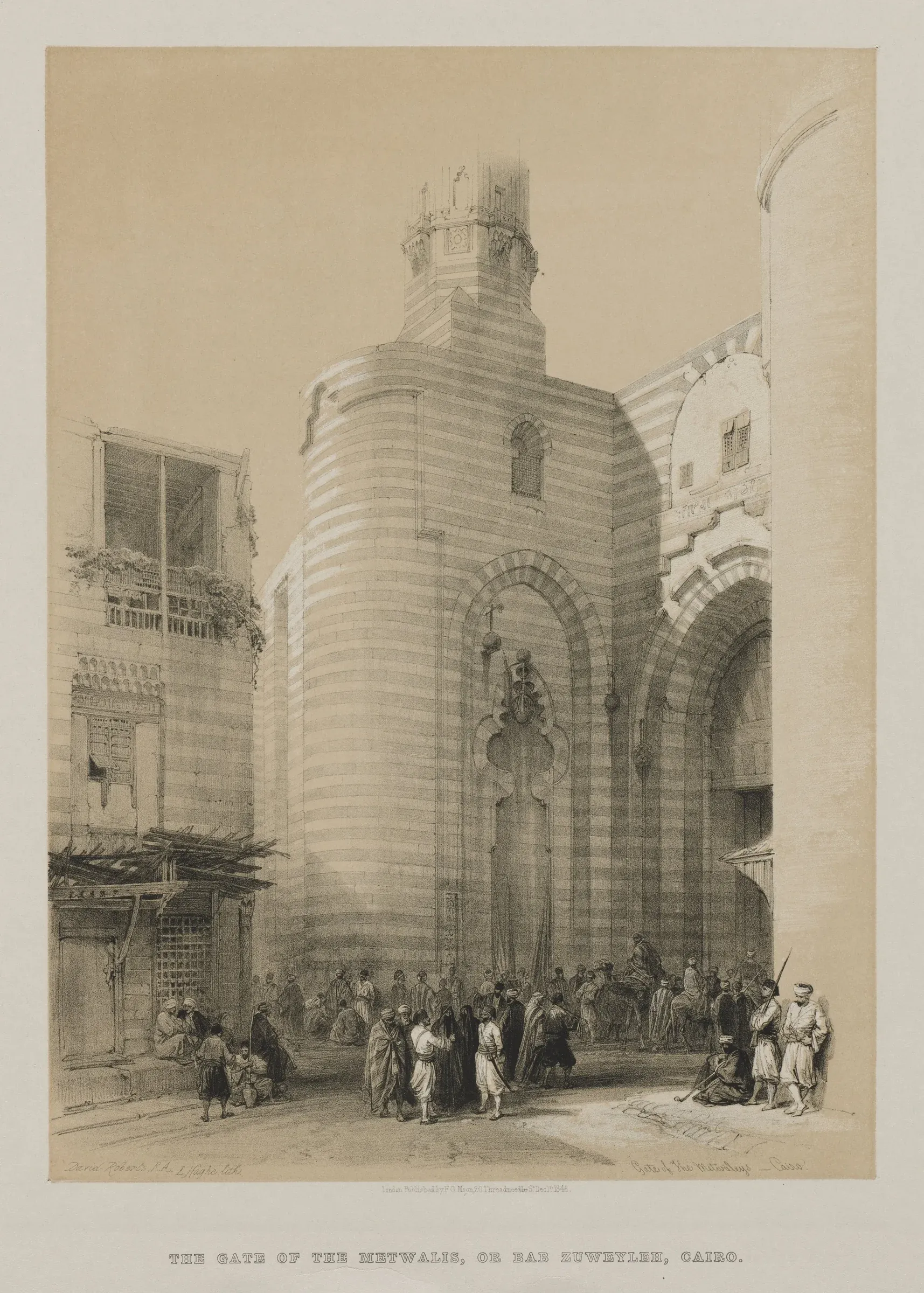
In Cairo the walls were extended and rebuilt in the late eleventh century with monumental stone gates.19 UNESCO identifies the surviving Fatimid gates, Bab Zuwayla, Bab al-Nasr and Bab al-Futuh, as part of Badr al-Jamali’s walls.20
Death and succession
Badr died at an advanced age in Rabi’ I 487/March–April 1094, after arranging for his son al-Afdal to succeed him; the army ensured that his wishes were carried out.2 Al-Imad instead dates his death to 488/1095.4 Al-Imad notes that he was in office for some twenty-one years and may have been silenced by a stroke in his final year.15 A few months later, on al-Mustansir’s death, al-Afdal set aside the designated heir Nizar and placed his younger brother al-Musta’li on the throne, the origin of the Nizari–Musta’li split.21
Footnotes
-
Farhad Daftary, The Isma’ilis: Their History and Doctrines, 2nd ed. (Cambridge University Press, 2007), p. 194. ↩ ↩2 ↩3 ↩4 ↩5 ↩6 ↩7 ↩8 ↩9 ↩10 ↩11
-
Farhad Daftary, The Isma’ilis: Their History and Doctrines, 2nd ed. (Cambridge University Press, 2007), p. 211. ↩ ↩2 ↩3
-
Farhad Daftary, The Isma’ilis: Their History and Doctrines, 2nd ed. (Cambridge University Press, 2007), p. 211, on the vizierate. ↩ ↩2
-
Leila S. al-Imad, The Fatimid Vizierate, 969–1172 (Klaus Schwarz Verlag, 1990), https://archive.org/details/TheFatimidVizierate9691172, p. 97. ↩ ↩2
-
Farhad Daftary, The Isma’ilis: Their History and Doctrines, 2nd ed. (Cambridge University Press, 2007), p. 197. ↩ ↩2
-
Leila S. al-Imad, The Fatimid Vizierate, 969–1172 (Klaus Schwarz Verlag, 1990), https://archive.org/details/TheFatimidVizierate9691172, p. 99. ↩
-
Leila S. al-Imad, The Fatimid Vizierate, 969–1172 (Klaus Schwarz Verlag, 1990), https://archive.org/details/TheFatimidVizierate9691172, pp. 101–102. ↩
-
Leila S. al-Imad, The Fatimid Vizierate, 969–1172 (Klaus Schwarz Verlag, 1990), https://archive.org/details/TheFatimidVizierate9691172, pp. 103–104. ↩
-
Leila S. al-Imad, The Fatimid Vizierate, 969–1172 (Klaus Schwarz Verlag, 1990), https://archive.org/details/TheFatimidVizierate9691172, p. 104. ↩ ↩2
-
Leila S. al-Imad, The Fatimid Vizierate, 969–1172 (Klaus Schwarz Verlag, 1990), https://archive.org/details/TheFatimidVizierate9691172, p. 105. ↩ ↩2 ↩3
-
“Badr al-Jamali”, Encyclopaedia Britannica, https://www.britannica.com/biography/Badr-al-Jamali. ↩
-
Farhad Daftary, The Isma’ilis: Their History and Doctrines, 2nd ed. (Cambridge University Press, 2007), p. 195. ↩ ↩2
-
Farhad Daftary, The Isma’ilis: Their History and Doctrines, 2nd ed. (Cambridge University Press, 2007), p. 204. ↩
-
Leila S. al-Imad, The Fatimid Vizierate, 969–1172 (Klaus Schwarz Verlag, 1990), https://archive.org/details/TheFatimidVizierate9691172, p. 100. ↩
-
Leila S. al-Imad, The Fatimid Vizierate, 969–1172 (Klaus Schwarz Verlag, 1990), https://archive.org/details/TheFatimidVizierate9691172, pp. 106–108. ↩ ↩2
-
Farhad Daftary, The Isma’ilis: Their History and Doctrines, 2nd ed. (Cambridge University Press, 2007), p. 212. ↩
-
Leila S. al-Imad, The Fatimid Vizierate, 969–1172 (Klaus Schwarz Verlag, 1990), https://archive.org/details/TheFatimidVizierate9691172, pp. 105–106. ↩
-
Leila S. al-Imad, The Fatimid Vizierate, 969–1172 (Klaus Schwarz Verlag, 1990), https://archive.org/details/TheFatimidVizierate9691172, p. 98. ↩
-
Paula A. Sanders, “The Fatimid state, 969–1171”, in Carl F. Petry (ed.), The Cambridge History of Egypt, vol. 1 (Cambridge University Press, 1998), p. 166. ↩
-
UNESCO World Heritage Centre, “Historic Cairo”, World Heritage List no. 89, https://whc.unesco.org/en/list/89/. ↩
-
Farhad Daftary, The Isma’ilis: Their History and Doctrines, 2nd ed. (Cambridge University Press, 2007), p. 241. ↩