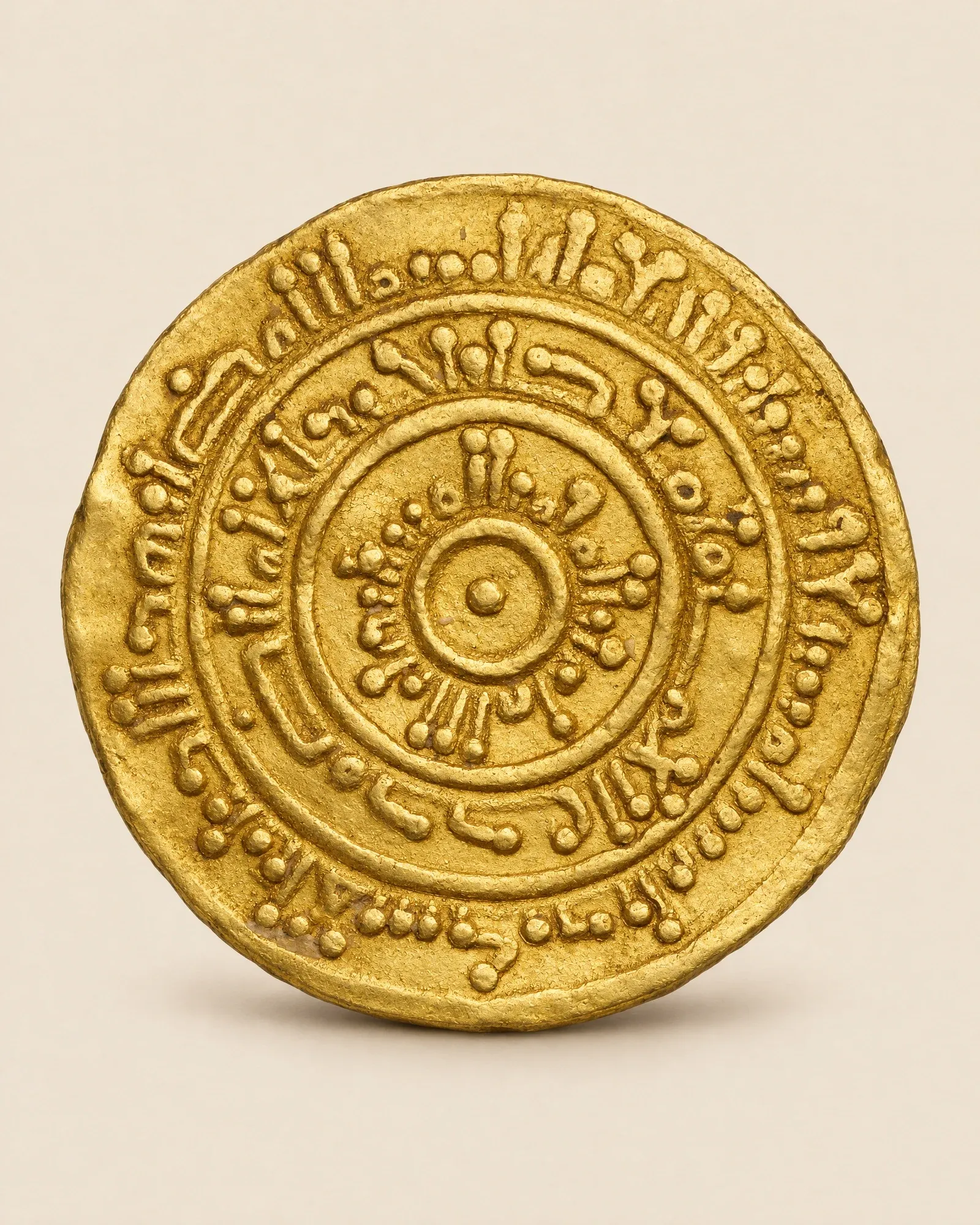
Abu Tamim Ma’add al-Mustansir bi’llah was the eighth Fatimid caliph and the eighteenth Ismaili Imam. He reigned for almost sixty lunar years, from 427/1036 to 487/1094, the longest reign of the Fatimid dynasty. His reign included the greatest extent of the da’wa, a year in which his name was proclaimed in Baghdad, the worst crisis Fatimid Egypt suffered, and a disputed succession that permanently divided the Ismailis.12
Accession and the regency
Ma’add was born in 420/1029, the son of al-Zahir, designated heir at eight months in 421/1030, and succeeded at the age of seven.31 For the first nine years the vizier al-Jarjara’i governed. After his death in 436/1044 power passed to the caliph’s mother, Rasad, a Sudanese former slave, who worked with Abu Sa’d al-Tustari, the Jewish merchant who had brought her to Egypt. The vizier Sadaqa ibn Yusuf had Abu Sa’d murdered in 439/1047, and the queen mother had Sadaqa killed the next year.1
The army was split between Turks and Berbers on one side and the black Sudanese regiments, favoured by the queen mother, on the other.1 In 442/1050 the judge al-Yazuri became vizier and held office for eight years, until his execution in 450/1058.1
Syria and Byzantium
Fatimid power in Syria reached its zenith in 429/1038, when Anushtigin al-Duzbari took Aleppo, and in the same year a thirty-year peace with Byzantium permitted the rebuilding of the Church of the Holy Sepulchre.45 Aleppo was lost to the Mirdasid Thimal ibn Mirdas in 433/1041, and northern Syria was lost for good by 452/1060.4 When famine struck in 446/1054, al-Mustansir asked Constantine IX Monomachus for grain.67
The khutba in Baghdad
In Ramadan 447/December 1055 the Saljuq Tughril entered Baghdad and deposed the Buyids.4 The Turkish general al-Basasiri, opposed to the Abbasid vizier Ibn al-Muslima, turned to Cairo. The da’i al-Mu’ayyad fi’l-Din al-Shirazi negotiated with al-Basasiri and Arab amirs and delivered Fatimid money and arms.89 In Dhu’l-Qa’da 450/December 1058 al-Basasiri entered Baghdad, had the khutba read for al-Mustansir and sent the Abbasid insignia to Cairo; he left the city in Dhu’l-Qa’da 451/December 1059 and was killed near Kufa.85
Yemen, India and the eastern da’wa
In 439/1047 Ali ibn Muhammad al-Sulayhi founded the Sulayhid dynasty in Yemen, which ruled as Fatimid vassals until 532/1138.10 After Ahmad al-Mukarram’s death in 477/1084, al-Mustansir appointed his widow, Queen Arwa, hujja of Yemen, the first woman to hold such rank in the da’wa. Da’is sent from Yemen founded the community in Gujarat from 460/1067–1068, the origin of the Tayyibi Bohras.1112 The da’wa reached its peak in Iraq, Fars, Isfahan, Rayy and Khurasan, where the young Hasan-i Sabbah was converted.13 It also met repression: the Ismailis of Bukhara and Transoxania were massacred by the Qarakhanid Bughra Khan in 436/1044–1045.14 In eastern Arabia the Qarmati state of Bahrayn collapsed; Abd Allah ibn Ali al-‘Uyuni, who took al-Ahsa’ in 469/1076 and finally defeated the Qarmatis in 470/1077, acknowledged al-Mustansir and was placed under Sulayhid protection.15
The Persian poet and philosopher Nasir Khusraw reached Cairo in Safar 439/August 1047, stayed until 441/1050, saw al-Mustansir, and returned to Khurasan as hujja.1617 Al-Mu’ayyad became chief da’i in 450/1058 and head of the Dar al-’Ilm from 454/1062; al-Mustansir led his funeral prayer in 470/1078.9
The Maghrib and Sicily
Around 440/1048 the Zirid al-Mu’izz ibn Badis renounced the Fatimids for the Abbasids. According to tradition al-Yazuri persuaded al-Mustansir to send the Banu Hilal and Banu Sulaym into Ifriqiya; by 449/1057 the Zirids had abandoned Qayrawan for Mahdiya.1213 Kalbid Sicily recognised Fatimid suzerainty only nominally, and after the Norman conquest of 463/1070–1071 Barqa became the western limit of Fatimid territory.13
The great crisis
In 454/1062 war broke out between Turks and Berbers and the Sudanese troops, who were defeated in 459/1067 and driven into Upper Egypt.1 The Nile was low for seven years, 457–464/1065–1072. People ate dogs and cats; al-Mustansir sold the palace treasures; Turkish troops looted the palaces and destroyed the Fatimid libraries in 461/1068–1069; Fustat was twice pillaged and burned, and members of the caliph’s family fled to Syria and Iraq.186 The Turkish leader Nasir al-Dawla had the khutba read for the Abbasid caliph in Alexandria and Lower Egypt in 462/1070 before his assassination in 465/1073.18 In 462/1069–1070 the sharif of Mecca also transferred the khutba to the Abbasids, and the Hijaz was permanently lost by 473/1081.7
Badr al-Jamali
Al-Mustansir called on Badr al-Jamali, the Armenian governor of Acre, who arrived with Armenian troops in Jumada I 466/January 1074 and eliminated the Turkish leaders.18 As amir al-juyush, vizier, chief judge and chief da’i, he held full delegated powers and brought twenty years of peace and relative prosperity. From then on the caliphs were figureheads.1842 Syria was largely lost to Turkoman and Saljuq commanders: Atsiz took Jerusalem in 463/1071 and Damascus in 468/1076 and attacked Cairo in 469/1077, when Badr repulsed him.5
Death and the succession
Badr died in Rabi’ I 487/1094, having arranged for his son al-Afdal to succeed him.2 Al-Mustansir died in Cairo on 18 Dhu’l-Hijja 487/28 December 1094.19 His eldest son, Nizar, born in 437/1045, had received the nass. Al-Afdal instead enthroned Nizar’s younger half-brother Ahmad, his own brother-in-law, as al-Musta’li the next day. According to Daftary, al-Mustansir never revoked Nizar’s designation. Nizar fled to Alexandria, rose in revolt early in 488/1095 and was proclaimed caliph there, but surrendered at the end of the year and was imprisoned in Cairo.19 The resulting split between the Nizaris and the Musta’lians is the subject of the next chapter.219
Footnotes
-
Farhad Daftary, The Isma’ilis: Their History and Doctrines, 2nd ed. (Cambridge University Press, 2007), p. 193. ↩ ↩2 ↩3 ↩4 ↩5 ↩6
-
Farhad Daftary, The Isma’ilis: Their History and Doctrines, 2nd ed. (Cambridge University Press, 2007), p. 211. ↩ ↩2 ↩3 ↩4
-
Farhad Daftary, Historical Dictionary of the Ismailis (Scarecrow Press, 2012), s.v. “al-Mustansir”. ↩
-
Farhad Daftary, The Isma’ilis: Their History and Doctrines, 2nd ed. (Cambridge University Press, 2007), p. 195. ↩ ↩2 ↩3 ↩4
-
Farhad Daftary, The Isma’ilis: Their History and Doctrines, 2nd ed. (Cambridge University Press, 2007), p. 197. ↩ ↩2 ↩3
-
Marius Canard, “Fatimids”, Encyclopaedia of Islam, 2nd ed., vol. II (Brill, 1965), p. 858. ↩ ↩2
-
Farhad Daftary, The Isma’ilis: Their History and Doctrines, 2nd ed. (Cambridge University Press, 2007), p. 198. ↩ ↩2
-
Farhad Daftary, The Isma’ilis: Their History and Doctrines, 2nd ed. (Cambridge University Press, 2007), p. 196. ↩ ↩2
-
Farhad Daftary, The Isma’ilis: Their History and Doctrines, 2nd ed. (Cambridge University Press, 2007), p. 204. ↩ ↩2
-
Farhad Daftary, The Isma’ilis: Their History and Doctrines, 2nd ed. (Cambridge University Press, 2007), p. 199. ↩
-
Farhad Daftary, The Isma’ilis: Their History and Doctrines, 2nd ed. (Cambridge University Press, 2007), p. 200. ↩
-
Farhad Daftary, The Isma’ilis: Their History and Doctrines, 2nd ed. (Cambridge University Press, 2007), p. 201. ↩ ↩2
-
Farhad Daftary, The Isma’ilis: Their History and Doctrines, 2nd ed. (Cambridge University Press, 2007), p. 202. ↩ ↩2 ↩3
-
Farhad Daftary, The Isma’ilis: Their History and Doctrines, 2nd ed. (Cambridge University Press, 2007), p. 203. ↩
-
Farhad Daftary, The Isma’ilis: Their History and Doctrines, 2nd ed. (Cambridge University Press, 2007), p. 210. ↩
-
Farhad Daftary, The Isma’ilis: Their History and Doctrines, 2nd ed. (Cambridge University Press, 2007), p. 205. ↩
-
Farhad Daftary, The Isma’ilis: Their History and Doctrines, 2nd ed. (Cambridge University Press, 2007), p. 206. ↩
-
Farhad Daftary, The Isma’ilis: Their History and Doctrines, 2nd ed. (Cambridge University Press, 2007), p. 194. ↩ ↩2 ↩3 ↩4
-
Farhad Daftary, “Nezār b. al-Mostanṣer”, Encyclopaedia Iranica, online edition (2014), https://www.iranicaonline.org/articles/nezar-al-mostanser. ↩ ↩2 ↩3