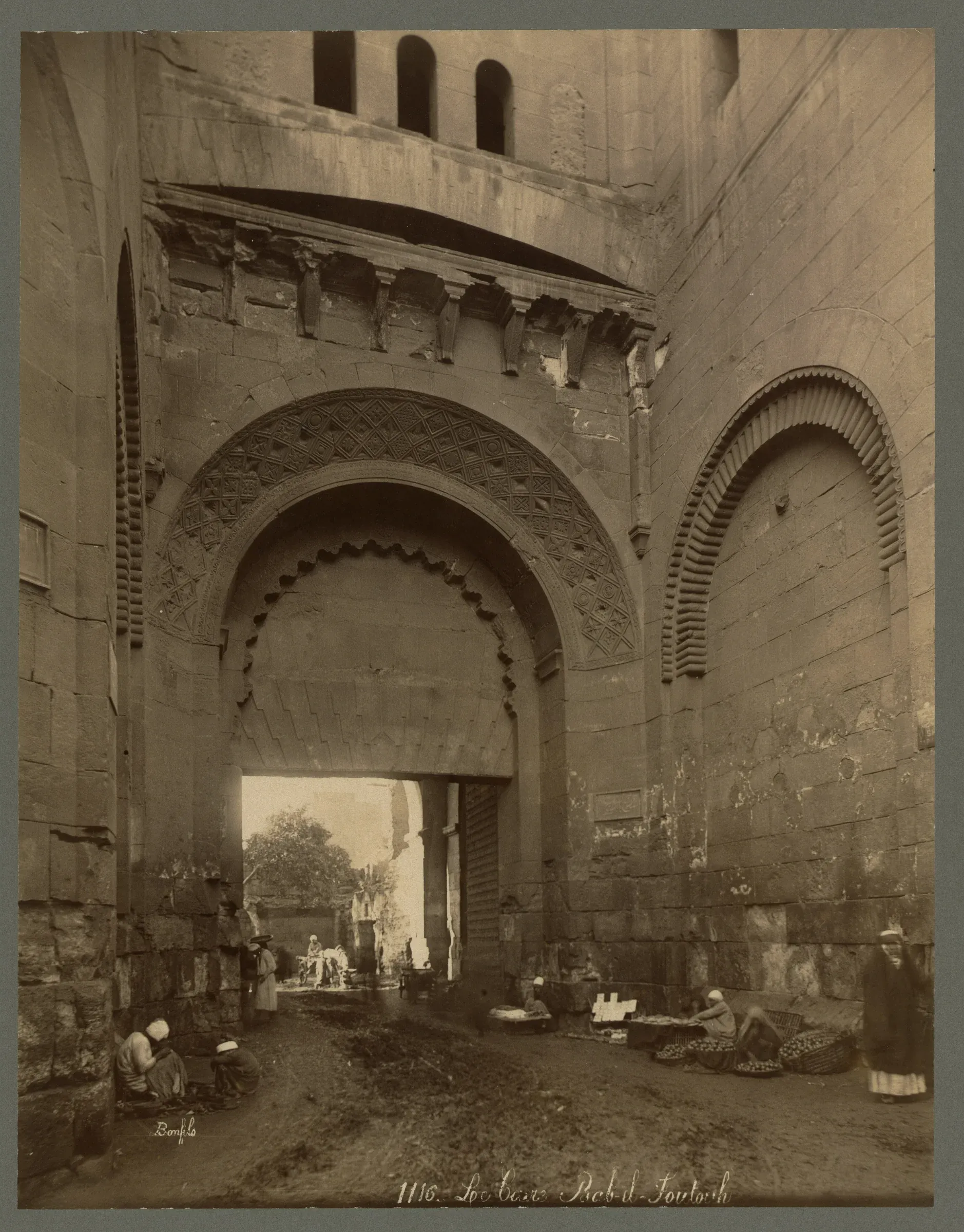
Fatimid Cairo, al-Qahira, was founded in 969 as a royal city beside the old capital of Egypt, Fustat. For two centuries it held the palaces of the Imam-caliphs, their army and their court, while Fustat remained the commercial heart of the country.123 This page describes the city as a place: its plan, palaces, quarters, mosques and festivals, largely through the eyewitness account of Nasir Khusraw, who lived there in 1047–1050. For the political history of the foundation see Cairo.
Foundation and name
After entering Fustat in Sha’ban 358/July 969, Jawhar camped his army to the north and began building a new city. Daftary records that it was first called al-Mansuriyya, after the Fatimid capital in Ifriqiya, and later renamed al-Qahira al-Mu’izziyya, “the Victorious one of al-Mu’izz”.1 Behrens-Abouseif connects the name with al-Qahir, the planet Mars, said to have been in the ascendant when the signal was given to break ground.4
Like its North African predecessor, the new city had northern and southern gates called Bab al-Futuh and Bab Zuwayla. Jawhar marked out two palaces, for the Imam-caliph and for his heir, separated by a wide open space, following plans drawn up by al-Mu’izz himself, and built offices for the government and the army.1 In Jumada I 359/April 970 he laid the foundations of al-Azhar.1
Nasir Khusraw, writing eighty years later, records a different explanation: al-Mu’izz named his camp al-Qahira because his army had won victory there, and forbade his soldiers to enter the old city or its houses.5 He also repeats a story told to him about the crossing of the Nile in 358/969, and says that the boats in which al-Mu’izz arrived still lay abandoned on dry land when his informant saw them in 441/1049.6
The plan of the royal city
Behrens-Abouseif describes al-Qahira as a palatial city enclosing quarters for the different groups of the Fatimid army: Greeks, other Europeans, Berbers, Armenians, Sudanese and Turks. The palace complex faced a large ceremonial esplanade midway along the main north–south street.4 Sanders summarises early Cairo as two palaces and a congregational mosque, al-Azhar, inside a brick wall, a city of “unmistakably Isma’ili character”.3
Sanders argues that the palace stood at the symbolic centre of the city as the Imam stood at the centre of Ismaili belief, and that architecture, topography and inscriptions together made Cairo an Ismaili city.7 The main avenue that passed between them was known as Bayn al-Qasrayn, “between the two palaces”.8
Nasir Khusraw lists ten quarters: Barjawan, Zuwayla, al-Jawdariyya, al-Umara, al-Dayalima, al-Rum, al-Batiliyya, Qasr al-Shawk, Abid al-Shira and al-Masamida. Several of these names refer to military groups, such as the Daylamites, the Greeks, the Bateli and Masmudi soldiers of North African origin and purchased slaves.9
He found that the city had five gates, Bab al-Nasr, Bab al-Futuh, Bab al-Qantara, Bab Zuwayla and Bab al-Khalij, but “no wall”, because its buildings were stronger and higher than ramparts. Most houses were five storeys high and some six, each detached from its neighbours, with gardens, orchards and even roof gardens watered by wheels.1011 Drinking water came from the Nile on the backs of camels, and he was told that the water carriers of Old and New Cairo owned 50,000 of them.10
The palaces
No Fatimid palace survives. Behrens-Abouseif notes that travellers and historians regarded the palaces as the greatest Fatimid architectural achievement, and that our visual knowledge of Fatimid building is limited to a few shrines, mosques and gates.12 The caliphs and their ancestors were buried within the palace precincts, and their tombs were visited as shrines on religious and official occasions.12
Nasir Khusraw describes the palace as standing in the middle of the city within an open space, so that no building touched it; from outside the city it looked like a mountain. A thousand watchmen, half mounted and half on foot, sounded trumpets and drums at the evening prayer and patrolled until dawn.5 He was told that 12,000 hired servants worked there and that 30,000 people lived in its twelve buildings, and he names ten gates of the harem, from Bab al-Dhahab to Bab al-Zallaqa.5
Behrens-Abouseif quotes his description of a hall with a throne covered in gold on three sides, decorated with hunting scenes, and of a tree and a thousand figurines made of sugar. She also cites a description of the palace by a French ambassador in 1167, with coloured marble floors, gold and silver water pipes, a menagerie and an aviary, and al-Maqrizi’s long account of its treasure halls and library.2
Mosques and shrines
Nasir Khusraw counted four Friday mosques in Cairo: al-Azhar, al-Nur, the mosque of al-Hakim, and the mosque of al-Mu’izz on the Nile bank outside the city.11 Sanders notes that the mosque of al-Hakim, begun outside the original walls by al-Aziz and finished by al-Hakim, soon equalled al-Azhar in ceremonial importance, and that the mosques built by the Fatimids took names evoking the luminosity attributed to the Imam.37 See Fatimid art and architecture.
The Fatimids also built mashhads, memorial shrines to descendants of the Prophet. Behrens-Abouseif suggests that shrines such as those of Sayyida Nafisa, Sayyida Zaynab and al-Husayn, venerated by Sunnis and Shi’is alike, helped bridge the religious gap between the Ismaili rulers and their largely Sunni subjects while adding to the prestige of the dynasty.12
Cairo and Fustat
Sanders writes that Fustat and Cairo formed a single capital in relation to the rest of Egypt but kept distinct characters. Cairo was essentially a closed city without independent commercial life, though civilians serving the court, including some senior Jewish and Christian officials, lived there.3 Fustat was Egypt’s emporium, where customs were paid and merchants from the ports came to buy, and it had the larger and more mixed population of Sunni Muslims, Christians and Jews.313
Behrens-Abouseif adds that commoners employed in the royal city returned to Fustat, by then called simply Misr, at the end of the working day.14 Nasir Khusraw describes Fustat’s buildings of up to fourteen storeys, and says that he saw so much wealth there that his words would not be believed if he tried to describe it.2 He put the distance between Old and New Cairo at less than a mile, with their orchards overlapping.11
The caliphs also used the older city’s mosques. Nasir Khusraw reports that al-Hakim had bought the mosque of Ibn Tulun from Ibn Tulun’s descendants for 30,000 dinars, and paid 5,000 more for its minaret, and that the caliph prayed there in Ramadan and on Fridays.15 Sanders notes that al-Hakim began leading Friday prayer in the congregational mosques of both cities.7
Wealth and the economy of the court
Nasir Khusraw estimated that Cairo had at least 20,000 shops, all owned by the ruler and rented for between two and ten dinars a month, and he was told that the ruler leased out 8,000 buildings in Old and New Cairo.5 He reports that scholars, poets, jurists and nobles at the court received fixed stipends of 500 to 2,000 dinars.16
He describes the army as paid in fixed salaries from taxes sent annually to the central treasury, so that no soldier made demands on tax collectors or peasants.17 Sanders similarly describes the centralisation of tax collection under the first Fatimid administration in Egypt.18
The opening of the canal
The festival Nasir Khusraw describes at greatest length is the opening of the Khalij, the canal that ran from Fustat past the palace, when the Nile flood reached its height. A pavilion of Byzantine brocade large enough to shade a hundred horsemen was set up at the head of the canal, and 10,000 horses with gold saddles and inscribed saddle-cloths were led in procession.17
The caliph al-Mustansir, whom Nasir Khusraw saw as a clean-shaven young man, rode a camel with a plain saddle, dressed in white with a costly sash and turban, under a jewelled parasol, with censers of ambergris and aloes on either side. The people prostrated themselves as he passed, and the vizier and chief judge followed. At the head of the canal he threw a spear at the dam, which workers then broke open to let in the water.16 The first boat to enter the canal carried deaf-mutes, who received alms, and the caliph kept twenty-one decorated boats in a basin beside the palace.9
Change after the crisis
In the late eleventh and early twelfth centuries Cairo’s walls were rebuilt in stone with monumental gates by Badr al-Jamali.319 Behrens-Abouseif writes that after plague, famine and an earthquake depopulated Fustat, Badr allowed markets to move into al-Qahira and wealthy citizens to build houses in the formerly exclusive city.14 By the twelfth century Cairo was developing its own commerce, and the vizier al-Ma’mun al-Bata’ihi founded a dar al-wakala for Syrian and Iraqi merchants and a new mint in the 1120s.3
Medieval Egyptian historians kept the distinction between Misr and al-Qahira. The name al-Qahira belonged to the city founded in 969, while Egyptians have always called their capital Masr, the popular form of Misr.20 The historic city is now a UNESCO World Heritage Site.21
Footnotes
-
Farhad Daftary, The Isma’ilis: Their History and Doctrines, 2nd ed. (Cambridge University Press, 2007), p. 159. ↩ ↩2 ↩3 ↩4
-
Doris Behrens-Abouseif, Islamic Architecture in Cairo: An Introduction (E. J. Brill, 1989), pp. 6–7, https://archive.org/details/islamic-architecture-in-cairo. ↩ ↩2 ↩3
-
Paula A. Sanders, “The Fatimid state, 969–1171”, in Carl F. Petry (ed.), The Cambridge History of Egypt, vol. 1 (Cambridge University Press, 1998), p. 166. ↩ ↩2 ↩3 ↩4 ↩5 ↩6 ↩7
-
Doris Behrens-Abouseif, Islamic Architecture in Cairo: An Introduction (E. J. Brill, 1989), pp. 5–6, https://archive.org/details/islamic-architecture-in-cairo. ↩ ↩2
-
Naser-e Khosraw, Naser-e Khosraw’s Book of Travels (Safarnama), trans. W. M. Thackston Jr., Persian Heritage Series 36 (Bibliotheca Persica, 1986), p. 44, https://archive.org/details/thackston-naser-e-khosraw. ↩ ↩2 ↩3 ↩4
-
Naser-e Khosraw, Naser-e Khosraw’s Book of Travels (Safarnama), trans. W. M. Thackston Jr., Persian Heritage Series 36 (Bibliotheca Persica, 1986), p. 43, https://archive.org/details/thackston-naser-e-khosraw. ↩
-
Paula A. Sanders, “The Fatimid state, 969–1171”, in Carl F. Petry (ed.), The Cambridge History of Egypt, vol. 1 (Cambridge University Press, 1998), pp. 172–173. ↩ ↩2 ↩3
-
Doris Behrens-Abouseif, Islamic Architecture in Cairo: An Introduction (E. J. Brill, 1989), ch. 5, p. 58, https://archive.org/details/islamic-architecture-in-cairo. ↩
-
Naser-e Khosraw, Naser-e Khosraw’s Book of Travels (Safarnama), trans. W. M. Thackston Jr., Persian Heritage Series 36 (Bibliotheca Persica, 1986), p. 50, https://archive.org/details/thackston-naser-e-khosraw. ↩ ↩2
-
Naser-e Khosraw, Naser-e Khosraw’s Book of Travels (Safarnama), trans. W. M. Thackston Jr., Persian Heritage Series 36 (Bibliotheca Persica, 1986), p. 45, https://archive.org/details/thackston-naser-e-khosraw. ↩ ↩2
-
Naser-e Khosraw, Naser-e Khosraw’s Book of Travels (Safarnama), trans. W. M. Thackston Jr., Persian Heritage Series 36 (Bibliotheca Persica, 1986), p. 46, https://archive.org/details/thackston-naser-e-khosraw. ↩ ↩2 ↩3
-
Doris Behrens-Abouseif, Islamic Architecture in Cairo: An Introduction (E. J. Brill, 1989), pp. 9–10, https://archive.org/details/islamic-architecture-in-cairo. ↩ ↩2 ↩3
-
Paula A. Sanders, “The Fatimid state, 969–1171”, in Carl F. Petry (ed.), The Cambridge History of Egypt, vol. 1 (Cambridge University Press, 1998), p. 167. ↩
-
Doris Behrens-Abouseif, Islamic Architecture in Cairo: An Introduction (E. J. Brill, 1989), pp. 7–8, https://archive.org/details/islamic-architecture-in-cairo. ↩ ↩2
-
Naser-e Khosraw, Naser-e Khosraw’s Book of Travels (Safarnama), trans. W. M. Thackston Jr., Persian Heritage Series 36 (Bibliotheca Persica, 1986), p. 51, https://archive.org/details/thackston-naser-e-khosraw. ↩
-
Naser-e Khosraw, Naser-e Khosraw’s Book of Travels (Safarnama), trans. W. M. Thackston Jr., Persian Heritage Series 36 (Bibliotheca Persica, 1986), p. 49, https://archive.org/details/thackston-naser-e-khosraw. ↩ ↩2
-
Naser-e Khosraw, Naser-e Khosraw’s Book of Travels (Safarnama), trans. W. M. Thackston Jr., Persian Heritage Series 36 (Bibliotheca Persica, 1986), p. 47–48, https://archive.org/details/thackston-naser-e-khosraw. ↩ ↩2
-
Paula A. Sanders, “The Fatimid state, 969–1171”, in Carl F. Petry (ed.), The Cambridge History of Egypt, vol. 1 (Cambridge University Press, 1998), p. 158. ↩
-
Doris Behrens-Abouseif, Islamic Architecture in Cairo: An Introduction (E. J. Brill, 1989), ch. 5, pp. 67–68, https://archive.org/details/islamic-architecture-in-cairo. ↩
-
Doris Behrens-Abouseif, Islamic Architecture in Cairo: An Introduction (E. J. Brill, 1989), p. 8, https://archive.org/details/islamic-architecture-in-cairo. ↩
-
UNESCO World Heritage Centre, “Historic Cairo”, World Heritage List no. 89, https://whc.unesco.org/en/list/89/. ↩