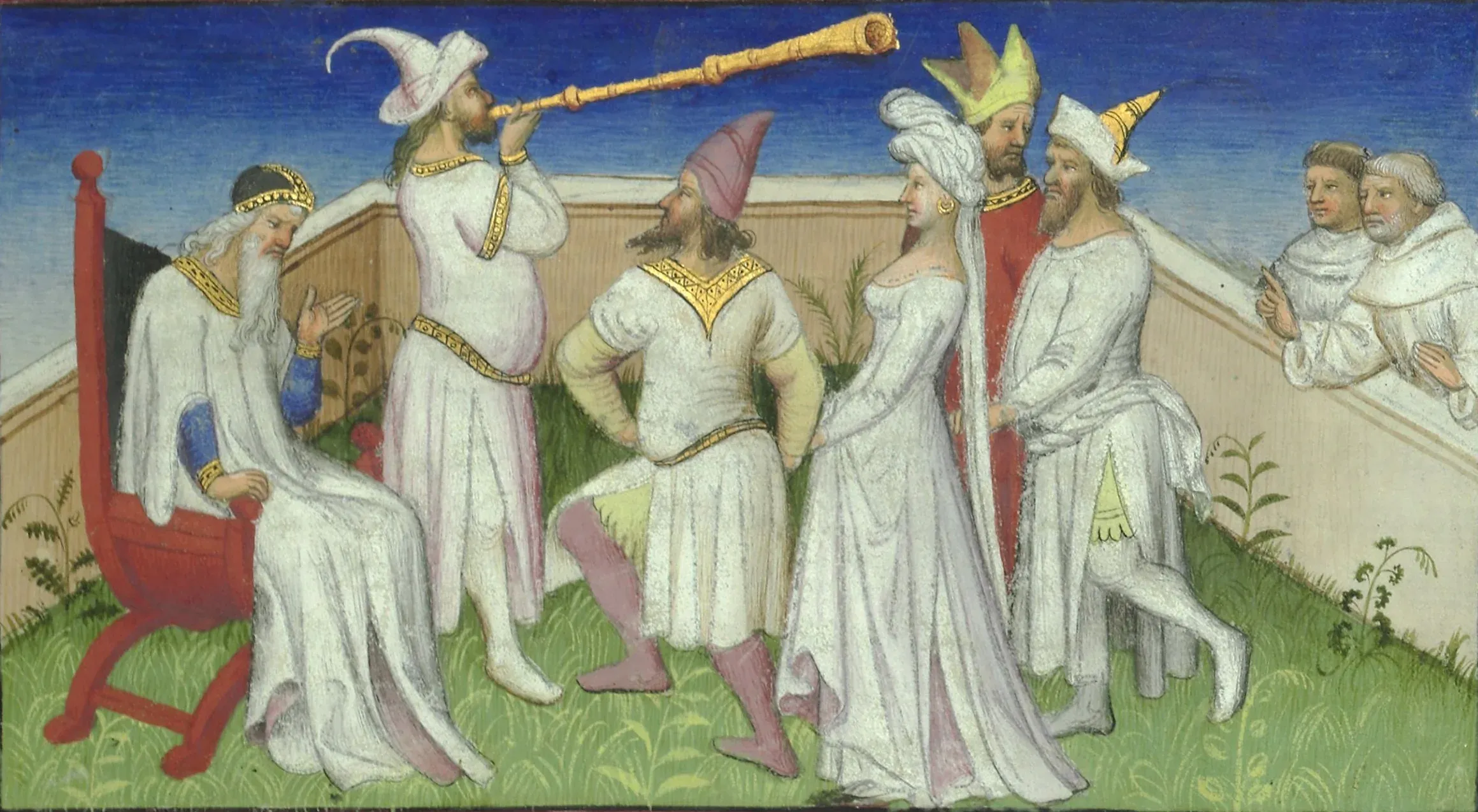
In medieval Europe the Nizari Ismailis of Syria and Persia were known as the “Assassins”. Their leader was the “Old Man of the Mountain”, who was said to drug young men with hashish, show them a counterfeit paradise and send them to kill on his command. The word assassin entered European languages as a common noun for a murderer, especially of a public figure.
Modern scholarship has shown that these stories grew from two sources. One was Muslim terms of abuse. The other was the rumours of Crusaders who had no access to the Nizaris’ own beliefs. The tales reached their best-known form in Marco Polo’s account of Alamut. Daftary calls “Assassins” “an unfortunate misnomer”. This page traces how the legend was built and what the evidence supports.1
A word of abuse
The European word comes from Arabic. In 1809 the French orientalist Silvestre de Sacy showed that the forms used in Crusader sources (Assassini, Assissini, Heyssisini and others) derived from the Arabic hashishi, plural hashishiyya. He found Arabic texts in which the Nizaris were called hashishi. Lewis notes that there is still “no text in which the Ismailis are called hashshash”, the form that would mean a hashish user or dealer.2
The earliest known use of the term for the Nizaris comes from their Ismaili rivals. In 516/1122 the Fatimid caliph al-Amir issued an anti-Nizari epistle, al-Hidaya al-Amiriyya, in which the Nizaris of Syria were called hashishiyya, “without any explanation”. The term was later applied to the Syrian Nizaris as an insult. Some Zaydi sources from northern Persia used hashishi of the Persian Nizaris too.3
Daftary stresses that in every Muslim source using the word, it has only a figurative, abusive meaning: “low-class rabble” or “irreligious social outcasts”. None of these sources accuses the Nizaris of actually using hashish. The literal reading came later, from Europeans who did not know what the insult meant.3 Lewis reaches a similar conclusion. He suggests the name was probably “a derisive comment on their conduct rather than a description of their practices”. For Western observers, stories of drugs may also have explained behaviour they could not otherwise understand.4
The fida’is and the reality of assassination
The legend grew from something real. The Nizaris did use the targeted killing of enemies as a political weapon. Daftary notes that assassination had been used by earlier groups, such as the Kharijis, and by the Nizaris’ own contemporaries, including the Saljuqs and the Crusaders. The Nizaris gave it an unusually prominent role. As a result, almost any important murder of the period came to be attributed to them, whether they were responsible or not.5
The men who carried out these missions were called fida’is, “those who offer their lives”. The Nizaris kept rolls of honour of their missions at Alamut. Killings were usually carried out in public to intimidate, and the fida’is often died in the attempt. Daftary finds it doubtful that a special corps of fida’is existed in the early years, though one may have developed later. He states that there is no evidence they were taught foreign languages or used hashish.5
The killings brought heavy reprisals. Suspected Ismailis were burned on a bonfire in Isfahan around 486/1093, and further massacres followed there and in Quhistan.6 The best-known targets included the Saljuq vizier Nizam al-Mulk in 1092, two Abbasid caliphs, the Fatimid caliph al-Amir and, in 1192, Conrad of Montferrat (see Hasan-i Sabbah and Rashid al-Din Sinan).7
The first European reports
Daftary traces the European legends to the Crusaders’ encounters with the Syrian Nizaris in the twelfth century. Medieval Europeans knew almost nothing about Islam and could not see the Nizaris’ beliefs from the inside. The stories therefore centred on how the fida’is were recruited and trained, to explain behaviour that seemed irrational.8
The Spanish rabbi Benjamin of Tudela, in Syria in 1167, was one of the first Europeans to write about them. He described a people devoted to their elder, whom they regarded as a prophet, called them the Hashishin and placed their chief seat at Qadmus. Their neighbours feared them, he wrote, because they would kill even kings at the cost of their own lives. He also mentioned the Persian Nizaris under the name Mulhet, a corruption of the Arabic mulhid, “heretic”, and did not realise that either group was Muslim.9
In 1175 an envoy of the emperor Frederick I Barbarossa, named Burchard or Gerhard, reported on Syria. He described a race of Saracens in the mountains “on the confines of Damascus, Antioch and Aleppo”, called Heyssessini in their own language and segnors de montana, who lived in near-impregnable castles. Their lord, he wrote, “inspires the greatest fear in the Saracen princes … and also in the neighbouring Christians”. Lewis notes that the report survives through the chronicler Arnold of Lübeck.10
The Old Man of the Mountain
The Crusaders called the Syrian chief da’i the “Old Man of the Mountain” (Vetus de Montanis, Senex de Monte). The first to bear the title was Sinan, who led the Syrian Nizaris from Masyaf, Kahf and Qadmus from about 1164 to 1193. Later European writers, Marco Polo among them, used it for the lords of Alamut. Daftary suggests that the Arabic equivalent, shaykh al-jabal, may be a later translation from the Latin rather than a title the Nizaris used themselves.11
The murder of Conrad of Montferrat, newly elected king of Jerusalem, at Tyre in April 1192 had a strong effect on the Franks. He was killed by two men disguised as monks, said to have been sent by the Old Man. Contemporaries disputed who had ordered the killing. Many Muslim and some Western sources blamed Richard I of England, while Ibn al-Athir said that Saladin had paid Sinan. Coming just before Sinan’s death, the murder became a staple of the legend.12
Four legends
Daftary groups the stories into four “separate but interconnected” tales:
- The training legend: young devotees were raised from childhood in total obedience.
- The paradise legend: the chief drugged them and let them wake in a secret garden that they were told was paradise.
- The hashish legend: the drug was hashish.
- The death-leap legend: at their master’s command fida’is threw themselves from the castle walls to show visitors their obedience.
None of them is supported by Nizari or contemporary Muslim sources. The tales were added to in stages and finally combined into one account “popularized by Marco Polo”.13
Marco Polo
The Venetian traveller passed through Persia in 1273, seventeen years after the Mongols had destroyed Alamut. He described the valley and its fortress. The Old Man, “called in their language Aloadin” (that is, ‘Ala’ al-Din), had enclosed a valley between two mountains and made it “a garden, the largest and most beautiful that ever was seen”. It had pavilions and palaces covered with gilding and painting. In Polo’s account, young men were drugged, carried into this garden and later sent out to kill in the hope of returning to it.14
Lewis notes that Polo’s term for the Persian Nizaris, like William of Rubruck’s Muliech a few years earlier, comes from mulhid, the usual Muslim word of abuse for Ismailis.14 Daftary notes that Polo’s garden story was taken up by several writers in the early fourteenth century. The Franciscan Odoric of Pordenone (d. 1331), returning from China around 1328, passed through a country he called Melistorte, probably another corruption of malahida. He repeated Polo’s narrative almost word for word.15
Orientalists and the legend
The legend survived into modern scholarship. De Sacy’s 1809 memoir solved the etymology, but it did not challenge the substance of the tales.16 In 1818 the Austrian orientalist Joseph von Hammer-Purgstall published a history of the Nizaris of the Alamut period, translated into French and English in the 1830s. Daftary notes it was the most widely read Western work on the Ismailis of its time.
Lewis calls the book “very much a tract for the times”, a warning against “the pernicious influence of secret societies”. Hammer described the Nizaris as a “union of impostors and dupes” and an “order of murderers”. His views shaped European ideas of the Nizaris for more than a century.17
What historians now know
Since the twentieth century the study of the Nizaris has changed. Daftary names Wladimir Ivanow as the founder of modern Nizari studies. Marshall Hodgson’s The Order of Assassins (1955) and Lewis’s The Assassins (1967) reconstructed the history from Persian and Arabic chronicles.18 These studies show the Nizaris as a religious community with its own doctrine of ta’lim, a network of castles, libraries and scholars, and a state that lasted 166 years. They used assassination as one weapon among others, but they were not a drug-crazed cult.19
The legends themselves are best read as evidence of how outsiders saw the Nizaris, not of what the Nizaris did. Juvayni, the Persian historian who visited Alamut in 1256 and wrote with open hostility, describes its storerooms, water channels and library in detail. He does not describe the garden of Polo’s tale.20
Footnotes
-
Farhad Daftary, The Isma’ilis: Their History and Doctrines, 2nd ed. (Cambridge University Press, 2007), pp. 12–13; Bernard Lewis, The Assassins: A Radical Sect in Islam (Weidenfeld and Nicolson, 1967), ch. 1, pp. 1–19. ↩
-
Lewis, The Assassins, pp. 10–11. ↩
-
Lewis, The Assassins, pp. 11–12. ↩
-
Daftary, The Isma’ilis, p. 329. ↩
-
Daftary, The Isma’ilis, pp. 319, 346, 356, 372. ↩
-
Daftary, The Isma’ilis, p. 12. ↩
-
Daftary, The Isma’ilis, pp. 12–13. ↩
-
Daftary, The Isma’ilis, p. 13; Lewis, The Assassins, pp. 3–4. ↩
-
Daftary, The Isma’ilis, pp. 19, 368. ↩
-
Daftary, The Isma’ilis, pp. 13, 372. ↩
-
Daftary, The Isma’ilis, p. 12. ↩
-
Daftary, The Isma’ilis, p. 19. ↩
-
Daftary, The Isma’ilis, pp. 22–23; Lewis, The Assassins, pp. 10–11. ↩
-
Daftary, The Isma’ilis, pp. 24–25; Lewis, The Assassins, p. 12. ↩
-
Daftary, The Isma’ilis, p. 310. ↩
-
Daftary, The Isma’ilis, pp. 328–329, 355, 396. ↩
-
’Ata-Malik Juvayni, The History of the World-Conqueror, tr. J. A. Boyle (Manchester University Press, 1958), vol. 2, pp. 718–721. ↩