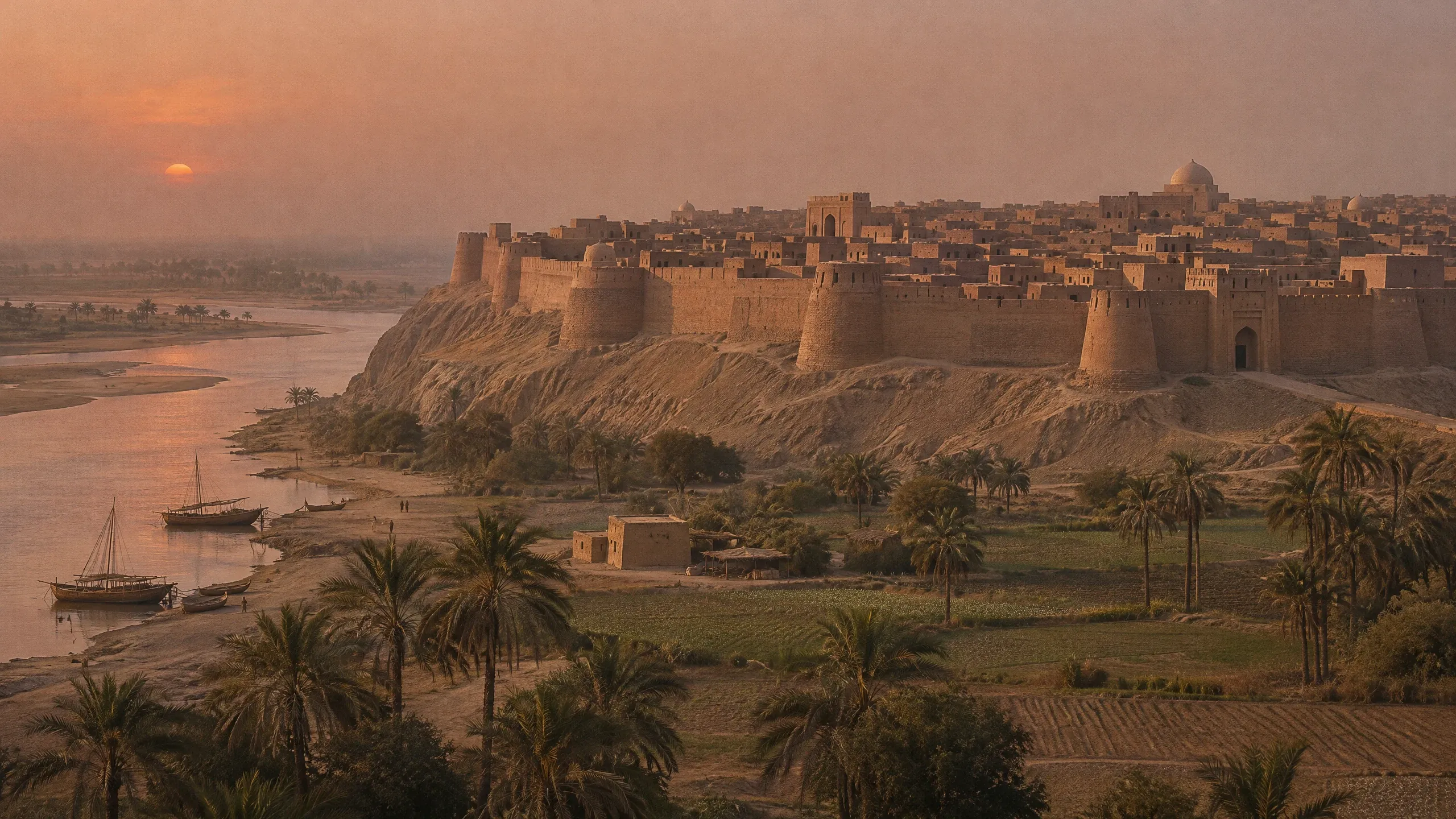
Multan, on the Chenab in the southern Punjab, was the only place in the eastern Islamic lands where the early Ismaili da’wa gained political power. From about 958 an Ismaili ruler there recognised the Fatimid caliph al-Mu’izz, and the Friday sermon was read in the name of the Fatimids. The state lasted until Sultan Mahmud of Ghazna annexed Multan in 401/1010–1011 and massacred many of its Ismailis.123
Before the Ismailis
Multan was an ancient city. Britannica records that it was the chief seat of the Malavas in the fourth century BCE, was subdued by Alexander the Great in 326 BCE, and came under Umayyad rule about 712 CE, after which it remained for three centuries an outpost of Islam in India. Its name may derive from Mulasthana, a name possibly connected with its ancient sun temple.4
The da’wa in Sind
Ismaili da’is had been active in Sind since the late ninth century. Daftary notes that the early da’wa in the east won over many notables but failed to gain any eastern province through the conversion of its ruler, with the single exception of Sind, where the Ismailis, recognising Fatimid suzerainty, won over the local ruler and made Multan their capital.1
Under al-Mu’izz the Fatimids worked to bring the dissident eastern Ismailis, who had not accepted the Fatimid imamate, back into their fold. The da’i Abu Ya’qub al-Sijistani endorsed the Fatimid Imams in his later works, and much of the Ismaili community of Khurasan, Sistan and Makran came to support the Fatimid cause. In the same period al-Mu’izz established a Fatimid foothold in Sind.2
The Fatimid vassal state
Around 347/958 a Fatimid vassal state was founded in Sind with its seat at Multan, which served as the dar al-hijra, the “abode of emigration” and local centre, for the Ismailis of the region. It was the work of a Fatimid da’i who had converted the local ruler.23 This da’i showed dissident Qarmati tendencies, and while al-Mu’izz was considering his removal he was killed in a riding accident.3
Around 354/965 he was succeeded by the da’i Halam (or Jalam) ibn Shayban, who was fully loyal to the Fatimids. The sovereignty of al-Mu’izz was then proclaimed openly in Multan, and the khutba was read in the name of the Fatimid caliphs instead of the Abbasids.3 Under al-Aziz, when Fatimid sovereignty reached its greatest nominal extent, from the Atlantic to the Hijaz and Yemen, the khutba was still read in his name in Multan.5
Britannica, following the hostile Sunni terminology of the medieval sources, describes tenth-century Multan as a centre of the “Qarmatian heretics”.4 Daftary’s account distinguishes the Fatimid-aligned Ismailis of Multan from the dissident Qarmatis, while noting the Qarmati sympathies of the first da’i.3
Mahmud of Ghazna
The Ghaznavid sultan Mahmud (r. 388–421/998–1030) presented himself as the champion of Sunni orthodoxy. He recognised the Abbasid caliph al-Qadir in the khutba of Khurasan and sent presents to Baghdad from the plunder of India. Bosworth notes that he stressed his personal role as enforcer of orthodoxy against heretics such as the Ismailis of Multan, and that at the end of his life he announced a campaign against the Fatimids of Egypt and Syria.6
In 396/1005–1006 Mahmud invaded Multan and made its last Ismaili ruler, Abu’l-Futuh Da’ud ibn Nasr, his tributary. In 401/1010–1011 Multan was annexed to the Ghaznavid state, Abu’l-Futuh was taken prisoner, and the Ismailis of Multan and the surrounding region were massacred.3 Another ruler in Sind, of the Habbarid dynasty of Mansura, converted to Fatimid Ismailism around 401 AH and apparently made it the official religion of his state; Mahmud overthrew him when he invaded Mansura in 416/1025.3
Survival in Sind
Ismailism survived in the Indus valley in a reduced form. Daftary records that soon after the fall of Multan the leaders of the Druze movement gained followers in the region, and that Fatimid Ismailism later became the creed of the Sumras, a local dynasty of Sind.37 Under al-Mustansir, the Sulayhids of Yemen played a central part in renewed efforts to spread the da’wa on the subcontinent, which were directed mainly to Gujarat.7
Later history
Multan remained a frontier city on the southern route into India, exposed to repeated invasion. The Ghurid Shihab al-Din attacked the Ismailis of Multan in 571/1175; Bosworth records that the Ghurid Mu’izz al-Din Muhammad captured Multan before besieging the last Ghaznavid ruler in Lahore in 582/1186.86 Daftary notes that various forms of Ismailism persisted in Multan despite persecution, and that the later Nizari da’wa in Sind is traditionally associated with Pir Shams al-Din, whose grave is preserved in Multan under the name of Shah Shams al-Din Sabzawari.9 Britannica lists the later rulers of the city: the Delhi sultanate, the Mughals, the Afghans from 1779, the Sikhs from 1818 and the British from 1849.4
Footnotes
-
Farhad Daftary, The Isma’ilis: Their History and Doctrines, 2nd ed. (Cambridge University Press, 2007), p. 116. ↩ ↩2
-
Farhad Daftary, The Isma’ilis: Their History and Doctrines, 2nd ed. (Cambridge University Press, 2007), p. 166. ↩ ↩2 ↩3
-
Farhad Daftary, The Isma’ilis: Their History and Doctrines, 2nd ed. (Cambridge University Press, 2007), p. 167. ↩ ↩2 ↩3 ↩4 ↩5 ↩6 ↩7 ↩8
-
“Multan”, Encyclopaedia Britannica, https://www.britannica.com/place/Multan. ↩ ↩2 ↩3
-
Farhad Daftary, The Isma’ilis: Their History and Doctrines, 2nd ed. (Cambridge University Press, 2007), p. 176. ↩
-
C. E. Bosworth, “Ghaznavids”, Encyclopaedia Iranica, vol. X, fasc. 6 (2001), https://www.iranicaonline.org/articles/ghaznavids. ↩ ↩2
-
Farhad Daftary, The Isma’ilis: Their History and Doctrines, 2nd ed. (Cambridge University Press, 2007), p. 200. ↩ ↩2
-
Farhad Daftary, The Isma’ilis: Their History and Doctrines, 2nd ed. (Cambridge University Press, 2007), p. 374. ↩
-
Farhad Daftary, The Isma’ilis: Their History and Doctrines, 2nd ed. (Cambridge University Press, 2007), p. 385. ↩