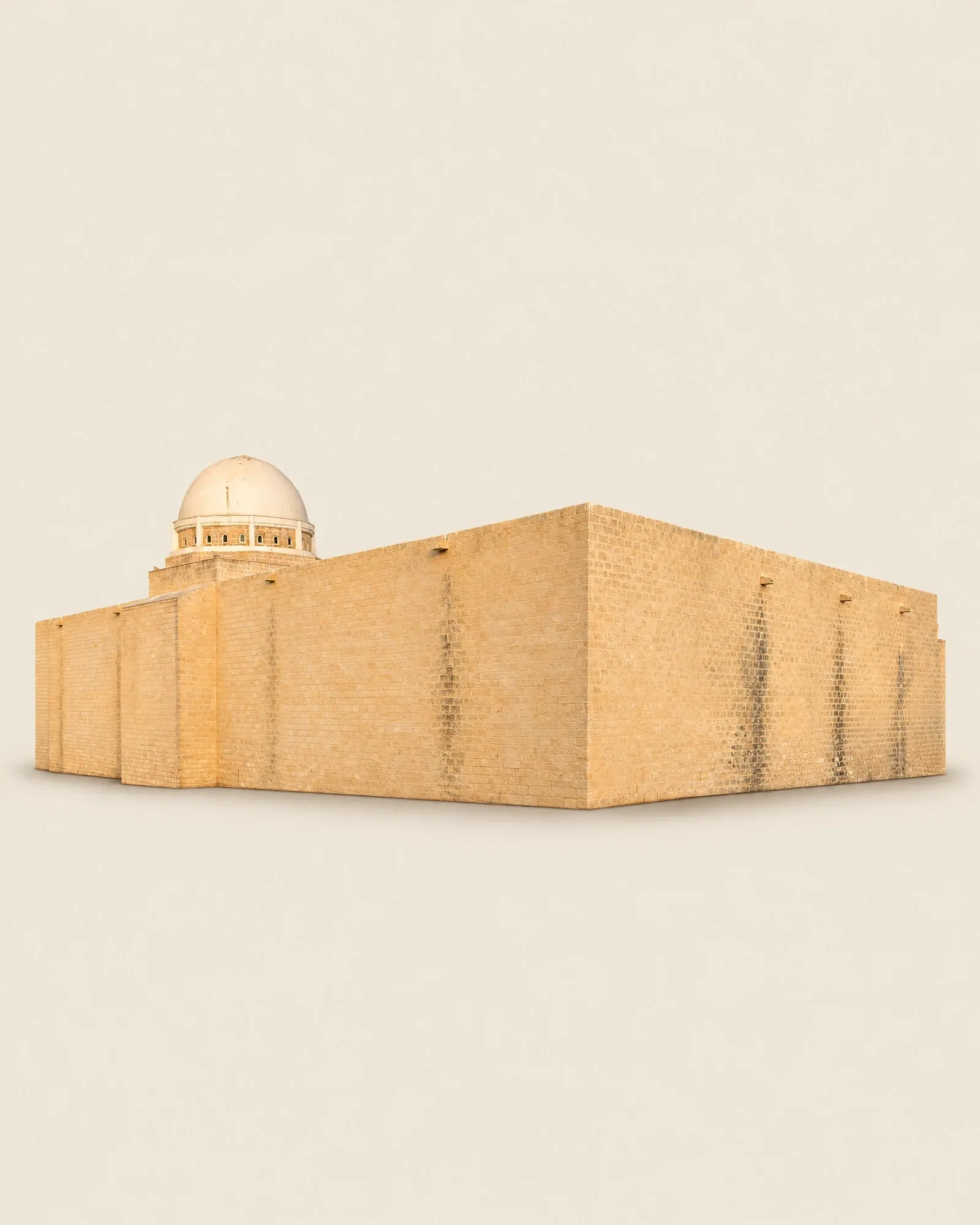
Abu’l-Qasim Muhammad al-Qa’im bi-Amr Allah was the twelfth Ismaili Imam and the second Fatimid caliph. He spent his childhood on the road with his father al-Mahdi, commanded the dynasty’s armies as heir, and ruled from Mahdiya, where his father had built a palace for him beside his own,1 for twelve years, the last of them under siege by the greatest revolt the North African state faced.23
Childhood and the journey west
Abu’l-Qasim was born at Salamiyya in Syria, according to Daftary’s Historical Dictionary in 289/902, the year his father left the town.2 He travelled with al-Mahdi through Ramla and Fustat and across North Africa, and with the chamberlain Ja’far reached Sijilmasa in Shawwal 292/August 905. He lived there with his father for four years until the Kutama army arrived in 909.45
Heir and commander
After the proclamation of the caliphate Abu’l-Qasim became his father’s principal commander. With al-Mahdi he faced the Kutama revolt in support of a rival Mahdi that followed the execution of Abu Abd Allah al-Shi’i in 911.6 He led the second invasion of Egypt in 919: his army took Alexandria and held out in the country for two years, until the Fatimid fleet was destroyed by ships from Cilicia and the Abbasid commander Mu’nis drove the army back across the desert with heavy losses.7 Daftary attributes both of al-Mahdi’s Egyptian expeditions, of 301–302/913–915 and 307–309/919–921, to Abu’l-Qasim’s command; only Barqa was kept.82
In the central Maghrib he strengthened the Zab by founding a fortified capital at Msila (al-Masila) in 925 under Ali ibn Hamdun, and in 927 and 928 he campaigned against the Maghrawa Berbers as far as Tahart.9 Brett notes the tradition that in his last ten years al-Mahdi deferred to his son “as to one greater than himself”.9
Accession and title
Abu’l-Qasim succeeded his father in Rabi’ I 322/March 934 and took the regnal title al-Qa’im bi-Amr Allah, “he who rises by the command of God”. Brett observes that the title, with its messianic associations, suggests he rather than his father was regarded as the awaited one.109 He may have been the first Fatimid caliph to use the jewelled parasol (mizalla) that became one of the dynasty’s emblems of sovereignty.11
His accession did not bring a change of religious course. Under al-Qa’im the jurist al-Qadi al-Nu’man first rose to prominence; Brett describes al-Nu’man’s work as firmly grounded in Muslim scholarship and designed to show that the Imam had come to fulfil, not abrogate, the law.11 At the beginning of the reign a rival claimant to the title of Qa’im, Ibn Talut, rebelled among the Berbers of Tripoli.12
Wars by sea and land
The Fatimid navy, based at Mahdiya, carried the war to Christian Europe. In 322/934 al-Qa’im sent a fleet of twenty ships to Italy; it sacked Genoa the following year, and Sardinia and Corsica were occupied for a time.1311 In Sicily troubles began in 936 and were not suppressed until 941.14
In the west, the general Maysur led an expedition into Morocco in 935. It failed to break the influence of Cordoba, whose ally Musa ibn Abi’l-Afiya had defected, but placed a loyal governor in Tahart and encouraged Ziri ibn Manad, chief of the Sanhaja, to build a citadel at Ashir, laying the basis of a long alliance.9 A third expedition to Egypt, launched after al-Qa’im’s accession, took Alexandria but was repelled by Muhammad ibn Tughj al-Ikhshid; Daftary dates it to 323/935, Brett to 936.1516
The eastern world during his reign
Al-Qa’im ruled while the Abbasid caliphate was disintegrating, but he did not exploit it. In Egypt Muhammad ibn Tughj established the Ikhshidid dynasty and received the title al-Ikhshid in 939; in 944 the Hamdanids of Mosul took Aleppo; and in 945 the Buyids, Shi’is from the Caspian mountains, occupied Baghdad. The Buyids refused to recognise the Fatimid caliphate and chose instead to rule as protectors of the Abbasids.1612 Brett argues that the failure of 936 showed the Fatimids were not yet prepared to take advantage of this instability, and that by the 940s agitation for an Alid ruler in Egypt was largely confined to the army.1612
The revolt of Abu Yazid
The defining event of the reign was the revolt of Abu Yazid Makhlad ibn Kaydad, a Nukkari Ibadi of the Zanata Banu Ifran. Known as sahib al-himar, “the man on the donkey”, he had preached in Qastiliya from 316/928 and built a following among the Hawwara of the Aures mountains, from which he emerged in 332/943.1031217 Brett attributes his success partly to resentment of Fatimid taxation, which Maliki jurists considered unlawful, and partly to harsh treatment of the Aures tribes.17
Abu Yazid took Qayrawan in Safar 333/October 944, with the support of its Maliki scholars, struck coins in his own name and killed the Fatimid commander-in-chief Maysur.317 In January 945 he laid siege to Mahdiya. For eight months al-Qa’im’s authority extended no further than the iron gates of his capital, but the city held. When the siege was lifted, Fatimid troops broke out while Ali ibn Hamdun and Ziri ibn Manad attacked the rebels from the rear.1718
Death
Al-Qa’im died in Mahdiya in Shawwal 334/May 946, after a reign of twelve years, as the tide was turning against Abu Yazid.3 His son and successor Isma’il, al-Mansur, kept his death secret while he completed the defeat of the revolt.219 Abu Yazid was finally defeated at Kiyana in Muharram 336/August 947, little more than a year after al-Qa’im’s death, and died of his wounds.19
Footnotes
-
Farhad Daftary, Historical Dictionary of the Ismailis (Scarecrow Press, 2012), s.v. “Mahdiyya”. ↩
-
Farhad Daftary, Historical Dictionary of the Ismailis (Scarecrow Press, 2012), s.v. “al-Qa’im”. ↩ ↩2 ↩3 ↩4
-
Farhad Daftary, The Isma’ilis: Their History and Doctrines, 2nd ed. (Cambridge University Press, 2007), p. 146. ↩ ↩2 ↩3 ↩4
-
Farhad Daftary, The Isma’ilis: Their History and Doctrines, 2nd ed. (Cambridge University Press, 2007), p. 125. ↩
-
Farhad Daftary, The Isma’ilis: Their History and Doctrines, 2nd ed. (Cambridge University Press, 2007), p. 126. ↩
-
Michael Brett, “The Fatimid revolution (861–973) and its aftermath in North Africa”, in J. D. Fage (ed.), The Cambridge History of Africa, vol. 2 (Cambridge University Press, 1978), p. 602. ↩
-
Michael Brett, “The Fatimid revolution (861–973) and its aftermath in North Africa”, in J. D. Fage (ed.), The Cambridge History of Africa, vol. 2 (Cambridge University Press, 1978), p. 603. ↩
-
Farhad Daftary, The Isma’ilis: Their History and Doctrines, 2nd ed. (Cambridge University Press, 2007), p. 142. ↩
-
Michael Brett, “The Fatimid revolution (861–973) and its aftermath in North Africa”, in J. D. Fage (ed.), The Cambridge History of Africa, vol. 2 (Cambridge University Press, 1978), p. 605. ↩ ↩2 ↩3 ↩4
-
Farhad Daftary, The Isma’ilis: Their History and Doctrines, 2nd ed. (Cambridge University Press, 2007), p. 145. ↩ ↩2
-
Michael Brett, “The Fatimid revolution (861–973) and its aftermath in North Africa”, in J. D. Fage (ed.), The Cambridge History of Africa, vol. 2 (Cambridge University Press, 1978), p. 606. ↩ ↩2 ↩3
-
Michael Brett, “The Fatimid revolution (861–973) and its aftermath in North Africa”, in J. D. Fage (ed.), The Cambridge History of Africa, vol. 2 (Cambridge University Press, 1978), p. 608. ↩ ↩2 ↩3 ↩4
-
Farhad Daftary, The Isma’ilis: Their History and Doctrines, 2nd ed. (Cambridge University Press, 2007), p. 144. ↩
-
Michael Brett, “The Fatimid revolution (861–973) and its aftermath in North Africa”, in J. D. Fage (ed.), The Cambridge History of Africa, vol. 2 (Cambridge University Press, 1978), p. 613. ↩
-
Farhad Daftary, The Isma’ilis: Their History and Doctrines, 2nd ed. (Cambridge University Press, 2007), p. 143. ↩
-
Michael Brett, “The Fatimid revolution (861–973) and its aftermath in North Africa”, in J. D. Fage (ed.), The Cambridge History of Africa, vol. 2 (Cambridge University Press, 1978), p. 607. ↩ ↩2 ↩3
-
Michael Brett, “The Fatimid revolution (861–973) and its aftermath in North Africa”, in J. D. Fage (ed.), The Cambridge History of Africa, vol. 2 (Cambridge University Press, 1978), p. 609. ↩ ↩2 ↩3 ↩4
-
Michael Brett, “The Fatimid revolution (861–973) and its aftermath in North Africa”, in J. D. Fage (ed.), The Cambridge History of Africa, vol. 2 (Cambridge University Press, 1978), p. 610. ↩
-
Farhad Daftary, The Isma’ilis: Their History and Doctrines, 2nd ed. (Cambridge University Press, 2007), p. 147. ↩ ↩2