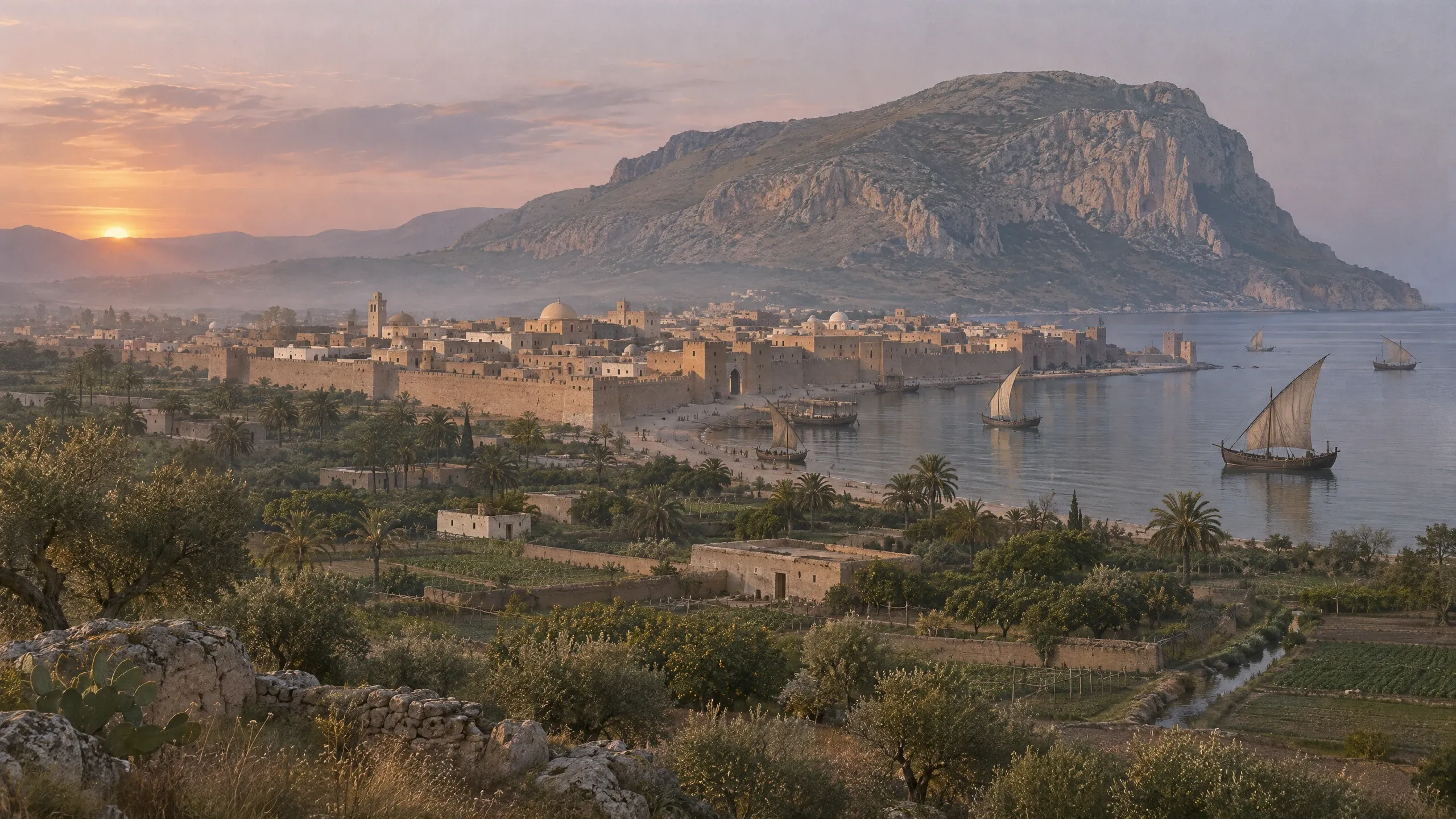
Sicily, the largest island of the Mediterranean, passed to the Fatimids in 909 as part of the Aghlabid inheritance. After two decades of revolts, al-Mansur entrusted it in 336/948 to al-Hasan ibn Ali al-Kalbi, whose descendants, the Kalbids, governed it from Palermo for almost a century under Fatimid suzerainty. The island was the western front of the Fatimid contest with Byzantium and a base for naval raids on Italy, France and the western islands.12
The Aghlabid inheritance
The Aghlabids of Ifriqiya had taken most of Sicily from the Byzantines in a gradual conquest completed by 264/878, but Byzantium kept possessions in the east of the island and in Calabria.1 Raids, conquests and migrations had left a population of Lombards, Greeks, Arabs and Berbers, adherents of Christianity, Islam and Judaism, and Daftary describes this heterogeneity as a source of constant friction.1 Under the Aghlabids the island was governed by an amir residing in Palermo, an arrangement the Fatimids kept.1 Brett notes that even in the time of Ibrahim II Sicily had been ruled from North Africa only with difficulty.3
Revolt and reconquest, 910–916
The first Fatimid governor was Ibn Abi’l-Fawaris, a former amir who had supported the Fatimid cause. In 297/910 he was replaced by al-Hasan ibn Ahmad, known as Ibn Abi Khinzir, formerly the Fatimid chief of police at Qayrawan.1 In 299/912 the Arabs and Berbers of Palermo and Girgenti (Agrigento) rose against him and rejected his successor, Ali ibn Umar al-Balawi.1
The Sicilians chose their own governor, Ibn Qurhub, a wealthy notable connected with the Aghlabid family, who declared for the Abbasid caliph al-Muqtadir. During his brief rule many Maliki Sunnis fleeing the new Shi’i rulers of Ifriqiya settled on the island.1 The Berbers of Girgenti, joined by others, then turned on Ibn Qurhub and in 304/916 handed him over to al-Mahdi, who had him executed. Sicily returned to Fatimid rule, though disturbances continued.2
The Kalbid amirs
Brett records renewed troubles from 936 to 941 and again during the revolt of Abu Yazid.3 After that revolt al-Mansur appointed al-Hasan ibn Ali al-Kalbi, of the Maghribi family of the Banu Abi’l-Husayn, to suppress the recurring anti-Fatimid activity.2 Brett places him alongside Ziri ibn Manad and Ja’far ibn Ali as a lieutenant with enough independence to pass his office to his son, and notes that he and his successors resumed the Aghlabid raids on the Italian mainland with considerable success.3
Daftary describes the Kalbid period as one of the most prosperous in the history of Muslim Sicily. The island developed close trade with Ifriqiya, and Palermo, with its many mosques, became a centre of the traditional Islamic sciences; Fatimid Sicily also played a part in the transmission of Islamic culture to Europe.2 Brett gives an example of the link between state and trade: the Fatimid raid on Almeria in 955–956 was reportedly revenge for the capture of a Fatimid ship sailing from Sicily to Ifriqiya by a larger vessel of the Umayyad Abd al-Rahman III.4
Religion on the island
Daftary notes that the Fatimid da’wa does not seem to have penetrated Sicily. The Kalbid amirs and their circle probably adhered to Ismailism, at least outwardly, because they recognised Fatimid suzerainty, but there is no evidence of da’is seeking converts, and the island’s Muslims remained mainly Maliki Sunnis. Some Ismailis, mostly refugees from Ifriqiya who left after the Fatimids moved to Egypt, lived among the population.2
A base against Byzantium
The early Fatimids used Sicily and Mahdiya as bases for raids on the coasts of Italy and France and on the western Mediterranean islands.2 Under al-Mahdi Fatimid forces raided Lombardy and Calabria, forcing the Byzantines to pay an annual tribute, and attacked the territories of Salerno and Naples.2 In 322/934 al-Qa’im sent twenty ships from Mahdiya to Italy; the expedition sacked Genoa the following year. Fatimid fleets also raided southern France and briefly occupied Sardinia and Corsica.2
In 345/956–957 the Fatimids defeated the Byzantines in Italy, and Constantine VII sent tribute and an embassy to al-Mu’izz in 346/957–958.2 In 351/962 the second Kalbid governor, Ahmad ibn al-Hasan, campaigned against the semi-independent Christian towns of the east and captured Taormina, renamed Mu’izziyya after the caliph.5
Rametta and the peace of 967
When the emperor Nikephoros II Phokas refused the customary tribute and renewed the war, joint Fatimid and Kalbid forces defeated the Byzantines on land and sea in 354/964, and Rametta, the last Byzantine stronghold on the island, was taken.5 Britannica dates the completion of the Arab conquest of Sicily to 965.6 Under a peace treaty of 356/967 the Muslims gained the right to levy the jizya on the island’s Christians.5 Brett observes that Byzantium thereby resigned itself to the loss of the island, leaving both empires free to pursue their ambitions in the Levant as al-Mu’izz prepared the conquest of Egypt.7
Decline of the Kalbids
After a decade of peace, sporadic conflict resumed, with frequent Kalbid raids into Calabria and Apulia; Daftary notes that the Fatimids also cooperated with Byzantium against the German emperor Otto I in southern Italy.5 In the eleventh century civil war broke out among the Kalbids. The Zirids intervened in 1036 in an attempt to install their own ruler, and the Byzantine general George Maniakes invaded the east of the island and remained until his death in 1043. In 1038, as part of a general treaty, the Fatimids recognised Byzantine ambitions in Sicily.8 Brett suggests that the Zirid al-Mu’izz ibn Badis may have hoped that the island would at last fall to him.9
The Norman conquest
Civil war and Byzantine intervention opened the way to the Norman conquest, which Britannica dates from 1060.26 By then, Daftary writes, the Fatimids had long lost interest in Sicily and found it easy to maintain friendly relations with the Normans. With the conquest of the island in 463/1070–1071, Barqa in Libya became the western limit of the Fatimid state under al-Mustansir.10 In 543/1148 Roger II of Sicily drove the last Zirid, al-Hasan ibn Ali, out of Mahdiya.10
Footnotes
-
Farhad Daftary, The Isma’ilis: Their History and Doctrines, 2nd ed. (Cambridge University Press, 2007), p. 143. ↩ ↩2 ↩3 ↩4 ↩5 ↩6 ↩7
-
Farhad Daftary, The Isma’ilis: Their History and Doctrines, 2nd ed. (Cambridge University Press, 2007), p. 144. ↩ ↩2 ↩3 ↩4 ↩5 ↩6 ↩7 ↩8 ↩9 ↩10
-
Michael Brett, “The Fatimid revolution (861–973) and its aftermath in North Africa”, in J. D. Fage (ed.), The Cambridge History of Africa, vol. 2 (Cambridge University Press, 1978), p. 613. ↩ ↩2 ↩3
-
Michael Brett, “The Fatimid revolution (861–973) and its aftermath in North Africa”, in J. D. Fage (ed.), The Cambridge History of Africa, vol. 2 (Cambridge University Press, 1978), p. 616. ↩
-
Farhad Daftary, The Isma’ilis: Their History and Doctrines, 2nd ed. (Cambridge University Press, 2007), p. 145. ↩ ↩2 ↩3 ↩4
-
“Sicily: History”, Encyclopaedia Britannica, https://www.britannica.com/place/Sicily/History. ↩ ↩2
-
Michael Brett, “The Fatimid revolution (861–973) and its aftermath in North Africa”, in J. D. Fage (ed.), The Cambridge History of Africa, vol. 2 (Cambridge University Press, 1978), p. 620. ↩
-
Michael Brett, “The Fatimid revolution (861–973) and its aftermath in North Africa”, in J. D. Fage (ed.), The Cambridge History of Africa, vol. 2 (Cambridge University Press, 1978), p. 631. ↩
-
Michael Brett, “The Fatimid revolution (861–973) and its aftermath in North Africa”, in J. D. Fage (ed.), The Cambridge History of Africa, vol. 2 (Cambridge University Press, 1978), p. 633. ↩
-
Farhad Daftary, The Isma’ilis: Their History and Doctrines, 2nd ed. (Cambridge University Press, 2007), p. 202. ↩ ↩2