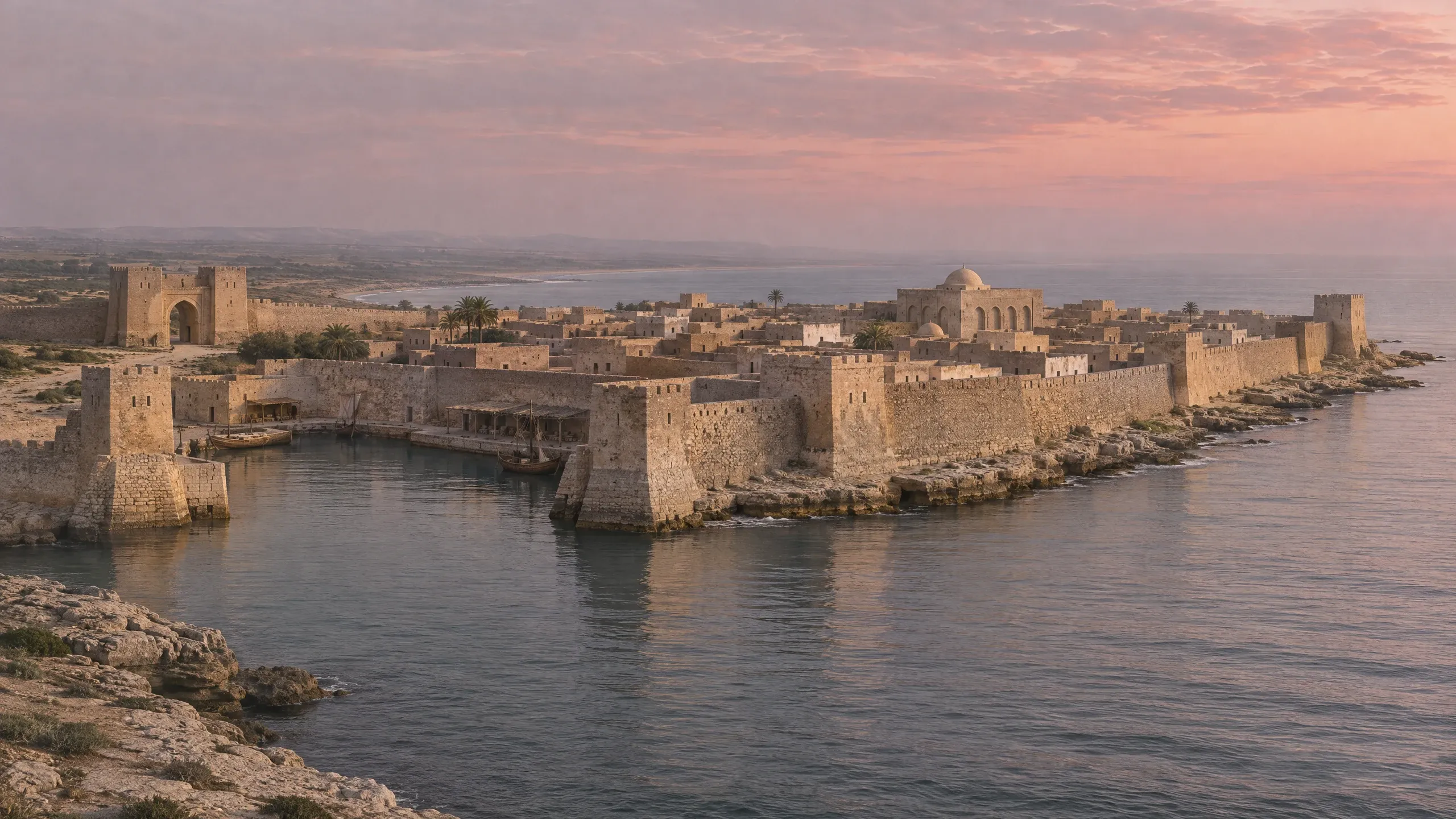
Mahdiya, “the city of the Mahdi”, stands on the narrow rocky peninsula of Cape Afrique on the eastern coast of Tunisia, south of Sousse. Abd Allah al-Mahdi founded it as a fortified palace city, capital and naval base, and moved his court there from Raqqada in 308/921. It remained the Fatimid capital until al-Mansur moved to Sabra al-Mansuriyya in 337/948.123
Foundation
The sources give different dates for the foundation. Daftary dates the start of construction to 300/912 and the caliph’s move to 308/921; Britannica gives 912 and 921; Hadda gives 916 for the foundation and 921 for the caliph’s settlement there.234 Hadda explains the choice of a coastal site by the problems that arose in Raqqada, where the new regime faced the hostility of Sunni Qayrawan, and by the need for a defensible base from which to control the territory.4
Brett describes Mahdiya as a city “built to promote the eastern enterprise”, the planned conquest of Egypt. The site was a sharp promontory about 180 metres across at its neck, barred by a wall with an immense iron gate; the city was at once a palace fortress, a capital and a naval base with a harbour cut into the rock.1 From the beginning it consisted of the royal city on the peninsula and a popular suburb, Zawila, outside the walls to the west.4
Walls and gates
Hadda calls Mahdiya the most heavily fortified city of the medieval Maghrib. The tenth-century geographer Ibn Hawqal praised its stone walls and its two gates, which he compared only to those of al-Rafiqa on the Euphrates.5 On the landward side the defence consisted of three lines of walls with a wide ditch in front, which cut the peninsula off from the mainland. The Kitab ghara’ib al-funun, an illustrated Arabic cosmography preserved in the Bodleian Library, records that al-Qa’im had ditches dug around the suburbs when Abu Yazid approached.5
The main wall was 15 metres high and 6 metres thick, with octagonal bastions at the corners and square towers along its length. At its centre an 18-metre gatehouse, the Bab al-Futuh, opened onto a long vaulted passage now called the Sqifa al-Kahla, the “dark vestibule”, which led to the inner wall and the royal city.5 Al-Bakri describes two iron gates without any wood, decorated with figures of animals. A sea wall three metres wide and ten metres high, with towers every twenty metres, followed the coast around the peninsula.5 Fenwick gives the width of the outer landward wall as 10 metres, with six towers.6
Harbour and arsenal
The harbour on the south side of the peninsula is a rectangular basin of about 70 by 128 metres cut into the rock, enclosed by walls and entered through a 15-metre opening between two square towers that could be closed with an iron chain. Al-Bakri called it one of the wonders of the world, able to hold thirty ships.7 Al-Qadi al-Nu’man attributes it to al-Mahdi, but geological study and underwater finds of Punic and Roman pottery suggest that the Fatimids restored and enlarged an older harbour.7
East of the great mosque lay the arsenal (dar al-sina’a), which al-Bakri says could hold more than two hundred ships and had two long vaulted galleries for naval stores. Excavations by Alexandre Lézine uncovered part of its south-east wall and a vaulted gallery.8 From this base the Fatimid fleet sailed to Sicily, raided Italy, and supported the expeditions against Egypt in 913–915 and 919–921.29
The great mosque and palaces
The great mosque was built around 912 and later heavily remodelled.6 Brett notes a symbolic innovation: its courtyard was entered not from the sides but through a monumental gateway opposite the entrance to the prayer hall.1 The miniature of Mahdiya in the Kitab ghara’ib al-funun shows two caliphal palaces west of the harbour; the southern palace has been partly excavated and has yielded geometric floor mosaics.67 Mahdiya still preserves Fatimid remains of the walls, harbour, mosque and palace complex.4
The siege of 945
Abu Yazid’s Khariji revolt brought the dynasty close to collapse. After taking Qayrawan he besieged Mahdiya from January 945 for eight months, during which, in Brett’s words, the power of al-Qa’im “extended no further than the great iron doors of his fortress city”. The city held, and al-Mansur broke the revolt in 947.1011
After the Fatimids
When the seat of government moved to Sabra al-Mansuriyya, Mahdiya remained a port and dockyard, but Brett suggests that the new port declined once the capital returned to the Qayrawan area.1112 After the defeat of the Zirids by the Banu Hilal at Haydaran, al-Mu’izz ibn Badis installed his son Tamim as governor of Mahdiya and transferred his treasure there; he fled to it in 1057, and for years the Zirids were confined to Mahdiya and Sousse.1314 Normans from Sicily occupied the town in the mid-twelfth century.3
Footnotes
-
Michael Brett, “The Fatimid revolution (861–973) and its aftermath in North Africa”, in J. D. Fage (ed.), The Cambridge History of Africa, vol. 2 (Cambridge University Press, 1978), p. 603. ↩ ↩2 ↩3
-
Farhad Daftary, The Isma’ilis: Their History and Doctrines, 2nd ed. (Cambridge University Press, 2007), p. 142. ↩ ↩2 ↩3
-
“Mahdia”, Encyclopaedia Britannica, https://www.britannica.com/place/Mahdia. ↩ ↩2 ↩3
-
Lamia Hadda, “Le fortificazioni di Mahdiya nel Kitab Ghara’ib al-funun wa-mulah al-’uyun (X–XII secolo)”, in M. G. Bevilacqua and D. Ulivieri (eds), Defensive Architecture of the Mediterranean, vol. XIII (Pisa University Press / edUPV, 2023), p. 161 (abstract). ↩ ↩2 ↩3 ↩4
-
Lamia Hadda, “Le fortificazioni di Mahdiya nel Kitab Ghara’ib al-funun wa-mulah al-’uyun (X–XII secolo)”, in M. G. Bevilacqua and D. Ulivieri (eds), Defensive Architecture of the Mediterranean, vol. XIII (Pisa University Press / edUPV, 2023), pp. 162–163, section 2, “Le mura”. ↩ ↩2 ↩3 ↩4
-
Corisande Fenwick, “Ifriqiya and the Central Maghreb”, in The Oxford Handbook of Islamic Archaeology (Oxford University Press, 2020), author manuscript p. 10, https://discovery.ucl.ac.uk/10067414/. ↩ ↩2 ↩3
-
Lamia Hadda, “Le fortificazioni di Mahdiya nel Kitab Ghara’ib al-funun wa-mulah al-’uyun (X–XII secolo)”, in M. G. Bevilacqua and D. Ulivieri (eds), Defensive Architecture of the Mediterranean, vol. XIII (Pisa University Press / edUPV, 2023), p. 163, section 3, “Il porto e l’arsenale”. ↩ ↩2 ↩3
-
Lamia Hadda, “Le fortificazioni di Mahdiya nel Kitab Ghara’ib al-funun wa-mulah al-’uyun (X–XII secolo)”, in M. G. Bevilacqua and D. Ulivieri (eds), Defensive Architecture of the Mediterranean, vol. XIII (Pisa University Press / edUPV, 2023), pp. 163–164, section 3, “Il porto e l’arsenale”. ↩
-
Farhad Daftary, The Isma’ilis: Their History and Doctrines, 2nd ed. (Cambridge University Press, 2007), p. 144. ↩
-
Michael Brett, “The Fatimid revolution (861–973) and its aftermath in North Africa”, in J. D. Fage (ed.), The Cambridge History of Africa, vol. 2 (Cambridge University Press, 1978), p. 609. ↩
-
Michael Brett, “The Fatimid revolution (861–973) and its aftermath in North Africa”, in J. D. Fage (ed.), The Cambridge History of Africa, vol. 2 (Cambridge University Press, 1978), p. 610. ↩ ↩2
-
Michael Brett, “The Fatimid revolution (861–973) and its aftermath in North Africa”, in J. D. Fage (ed.), The Cambridge History of Africa, vol. 2 (Cambridge University Press, 1978), p. 617. ↩
-
Michael Brett, “The Fatimid revolution (861–973) and its aftermath in North Africa”, in J. D. Fage (ed.), The Cambridge History of Africa, vol. 2 (Cambridge University Press, 1978), p. 634. ↩
-
Michael Brett, “The Fatimid revolution (861–973) and its aftermath in North Africa”, in J. D. Fage (ed.), The Cambridge History of Africa, vol. 2 (Cambridge University Press, 1978), p. 635. ↩