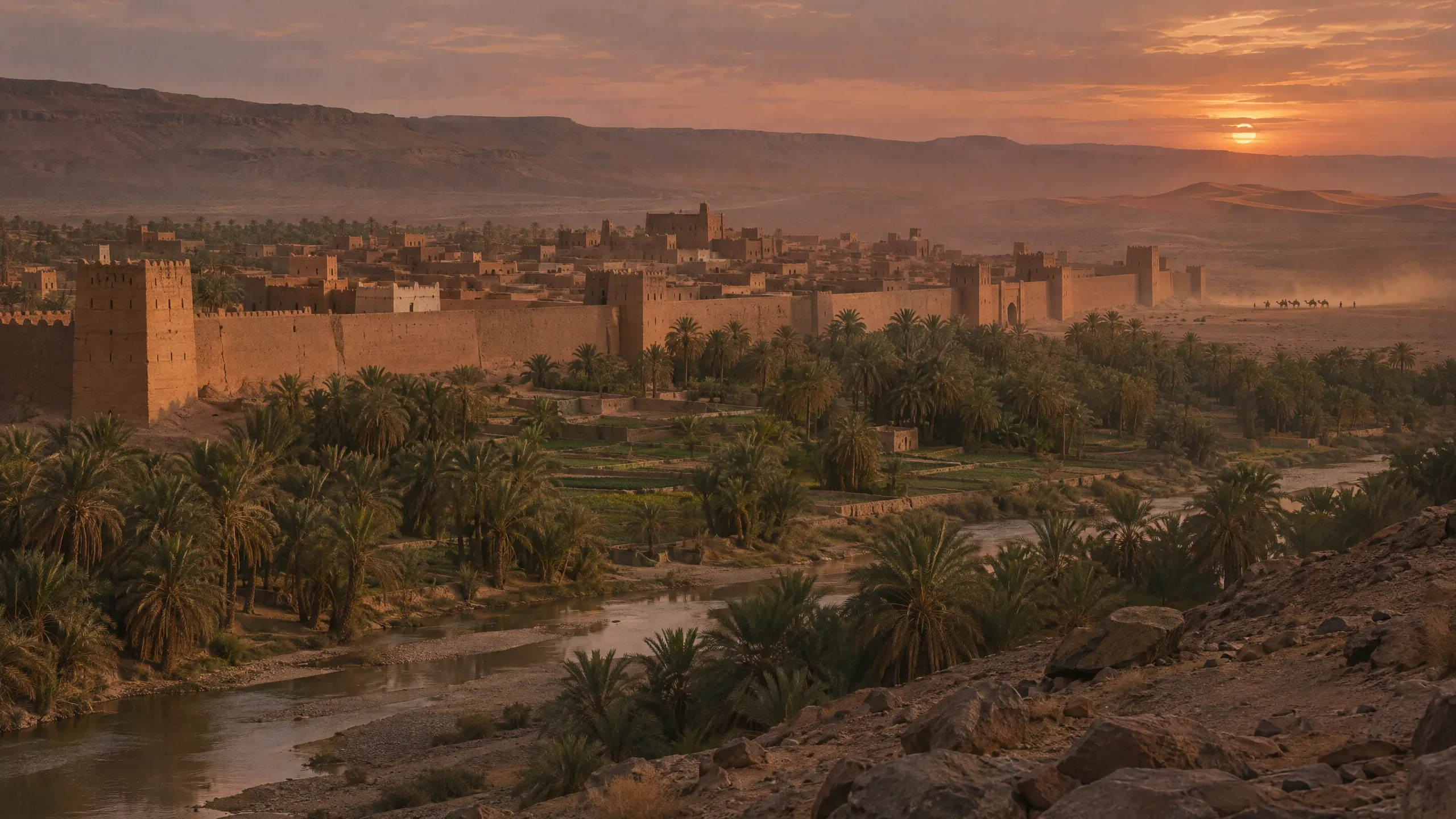
Sijilmasa was a caravan city in the Tafilalt oasis of south-eastern Morocco, on the northern edge of the Sahara. For four years, from 905 to 909, it sheltered Abd Allah al-Mahdi, the Ismaili Imam who had fled Syria, and in August 909 it was the place where he was first acclaimed caliph. The city later became a prize contested by the Fatimids and the Umayyads of Cordoba for its control of the trans-Saharan gold trade.123
Foundation and the Midrarids
The sources place the foundation of Sijilmasa in 140/757 or 141/758. According to al-Bakri, the first settlers were refugees persecuted by the caliphs of the east who became the leaders of the local Miknasa Berbers of the Banu Wasul. The city’s foundation is associated with the spread of Sufri Kharijism among the Berbers.4 The Sufris held that leadership belonged to the most pious member of the community, even a black slave.4
The ruling family, later called the Banu Midrar or Midrarids, governed an independent principality whose territory included Todgha with its silver mine and the town of Ziz. Al-Yasa’ al-Muntasir, a son of Midrar, ruled from 270/883 until the Fatimid capture of the city in 297/909.43
The Imam in hiding
Abd Allah al-Mahdi left Salamiyya in 289/902 with his son Abu’l-Qasim, the future al-Qa’im. After a year in Fustat he turned west rather than to Yemen, and reached Sijilmasa in Shawwal 292/August 905.1 He lived there quietly for four years as a merchant, keeping in contact with the da’i Abu Abd Allah al-Shi’i, who was building a Kutama army in the mountains of eastern Algeria.5 The chamberlain Ja’far ibn Ali, who accompanied him, left an autobiography that al-Qadi al-Nu’man preserved; it describes the household living in a fine house, the Dar Abi Habasha, and probably in contact with the city’s colony of Baghdadi merchants.3
The sources disagree on how al-Mahdi’s identity was discovered. Ibn Khaldun reports an Abbasid letter to the Aghlabids and Midrarids ordering his arrest; Dachraoui attributes the warning to the Aghlabid Ziyadat Allah III; the Kitab al-istibsar says he was denounced by a Jew. Al-Yasa’ at first treated him well but then detained him. Some sources say he was imprisoned and separated from his son; Ja’far’s account says he was placed under house arrest in the home of the amir’s sister, Maryam bint Midrar.3 From his confinement al-Mahdi informed Abu Abd Allah of his danger through Sandal, a young eunuch he had bought in Sijilmasa.3
The proclamation of 909
Having taken Raqqada and ended Aghlabid rule on 25 March 909, Abu Abd Allah marched west, ending the Rustamid state of Tahart on the way; Fenwick notes that Tahart was destroyed and that the Rustamids withdrew to Sedrata in the northern Sahara.367 At Sijilmasa he demanded the release of al-Mahdi and his son; al-Yasa’ had the messengers killed. Abu Abd Allah took the city by assault on 26 August 909.3 The amir fled, was caught a few days later and was flogged; Abu’l-Qasim interceded to spare his life, but he died of his injuries.3
In Dhu’l-Hijja 296/August 909 al-Mahdi was acclaimed caliph at Sijilmasa in ceremonies that lasted several days.2 Ja’far’s account states that he stayed forty days to receive his followers before leaving for Ifriqiya, and that Abu Abd Allah appointed a Mazata officer, Ibrahim ibn Ghalib, as governor.3 Brett describes the expulsion of the Banu Midrar as the first step in a Fatimid policy of controlling the Zanata Berbers of the western Maghrib.8
A contested city
Fatimid rule did not last. The population killed Ibrahim ibn Ghalib and his soldiers and restored a Midrarid, Wasul al-Fath, an Ibadi.3 In 309/921 the Fatimid general Masala ibn Habus of the Miknasa took Sijilmasa and installed a compliant Midrarid, al-Mu’tazz ibn Muhammad, making the city a Fatimid protectorate through the Miknasa; the new amir declared independence as soon as Masala left.39
In 331/942 Muhammad ibn Wasul seized power. He had fought for the Umayyads at Simancas in 327/939, abandoned Sufrism for Maliki Sunnism, took the title amir al-mu’minin and the honorific al-Shakir li’llah, and struck gold coins. Ibn Hawqal describes Sijilmasa in this period as a great city comparable to Qayrawan; a tradition holds that Abd al-Rahman III paid for the marble of Madinat al-Zahra’ in “dinars of Sijilmasa”.10 Brett notes the Umayyad influence behind the prince’s conversion to Malikism.11
Jawhar’s conquest of 958
In 347/958 al-Mu’izz sent his general Jawhar to restore Fatimid authority in the far Maghrib and, according to Di Tolla, to secure control of the gold trade.10 Jawhar took Sijilmasa, struck new coins to replace the Shakiri dirhams, and captured Ibn Wasul, who was handed over by the Matghara Berbers and sent to al-Mu’izz at Mansuriyya.1012 After Jawhar left, the population killed his governor; a later Midrarid, al-Mu’tazz bi’llah, again recognised Fatimid suzerainty.13
Footnotes
-
Farhad Daftary, The Isma’ilis: Their History and Doctrines, 2nd ed. (Cambridge University Press, 2007), p. 125. ↩ ↩2
-
Farhad Daftary, The Isma’ilis: Their History and Doctrines, 2nd ed. (Cambridge University Press, 2007), p. 128. ↩ ↩2
-
A. M. Di Tolla, “Midrār (Banū) ou Midrārides”, Encyclopédie berbère, vol. 32 (Peeters, 2010), pp. 5005–5019, https://journals.openedition.org/encyclopedieberbere/599, section “Les Midrārides et le Mahdī ʿUbayd Allāh”. ↩ ↩2 ↩3 ↩4 ↩5 ↩6 ↩7 ↩8 ↩9 ↩10 ↩11
-
A. M. Di Tolla, “Midrār (Banū) ou Midrārides”, Encyclopédie berbère, vol. 32 (Peeters, 2010), pp. 5005–5019, https://journals.openedition.org/encyclopedieberbere/599, section “Les Banū Wasūl et le Khāriǧisme berbère”. ↩ ↩2 ↩3
-
Farhad Daftary, The Isma’ilis: Their History and Doctrines, 2nd ed. (Cambridge University Press, 2007), p. 126. ↩
-
Farhad Daftary, The Isma’ilis: Their History and Doctrines, 2nd ed. (Cambridge University Press, 2007), p. 127. ↩
-
Corisande Fenwick, “Ifriqiya and the Central Maghreb”, in The Oxford Handbook of Islamic Archaeology (Oxford University Press, 2020), author manuscript p. 10, https://discovery.ucl.ac.uk/10067414/. ↩
-
Michael Brett, “The Fatimid revolution (861–973) and its aftermath in North Africa”, in J. D. Fage (ed.), The Cambridge History of Africa, vol. 2 (Cambridge University Press, 1978), p. 604. ↩
-
Michael Brett, “The Fatimid revolution (861–973) and its aftermath in North Africa”, in J. D. Fage (ed.), The Cambridge History of Africa, vol. 2 (Cambridge University Press, 1978), p. 605. ↩
-
A. M. Di Tolla, “Midrār (Banū) ou Midrārides”, Encyclopédie berbère, vol. 32 (Peeters, 2010), pp. 5005–5019, https://journals.openedition.org/encyclopedieberbere/599, section “Al-Šākir-li-llāh et l’apogée de Sijilmāsa”. ↩ ↩2 ↩3
-
Michael Brett, “The Fatimid revolution (861–973) and its aftermath in North Africa”, in J. D. Fage (ed.), The Cambridge History of Africa, vol. 2 (Cambridge University Press, 1978), p. 613. ↩
-
Farhad Daftary, The Isma’ilis: Their History and Doctrines, 2nd ed. (Cambridge University Press, 2007), p. 156. ↩
-
A. M. Di Tolla, “Midrār (Banū) ou Midrārides”, Encyclopédie berbère, vol. 32 (Peeters, 2010), pp. 5005–5019, https://journals.openedition.org/encyclopedieberbere/599, section “Déclin et disparition de la dynastie des Midrārides”. ↩