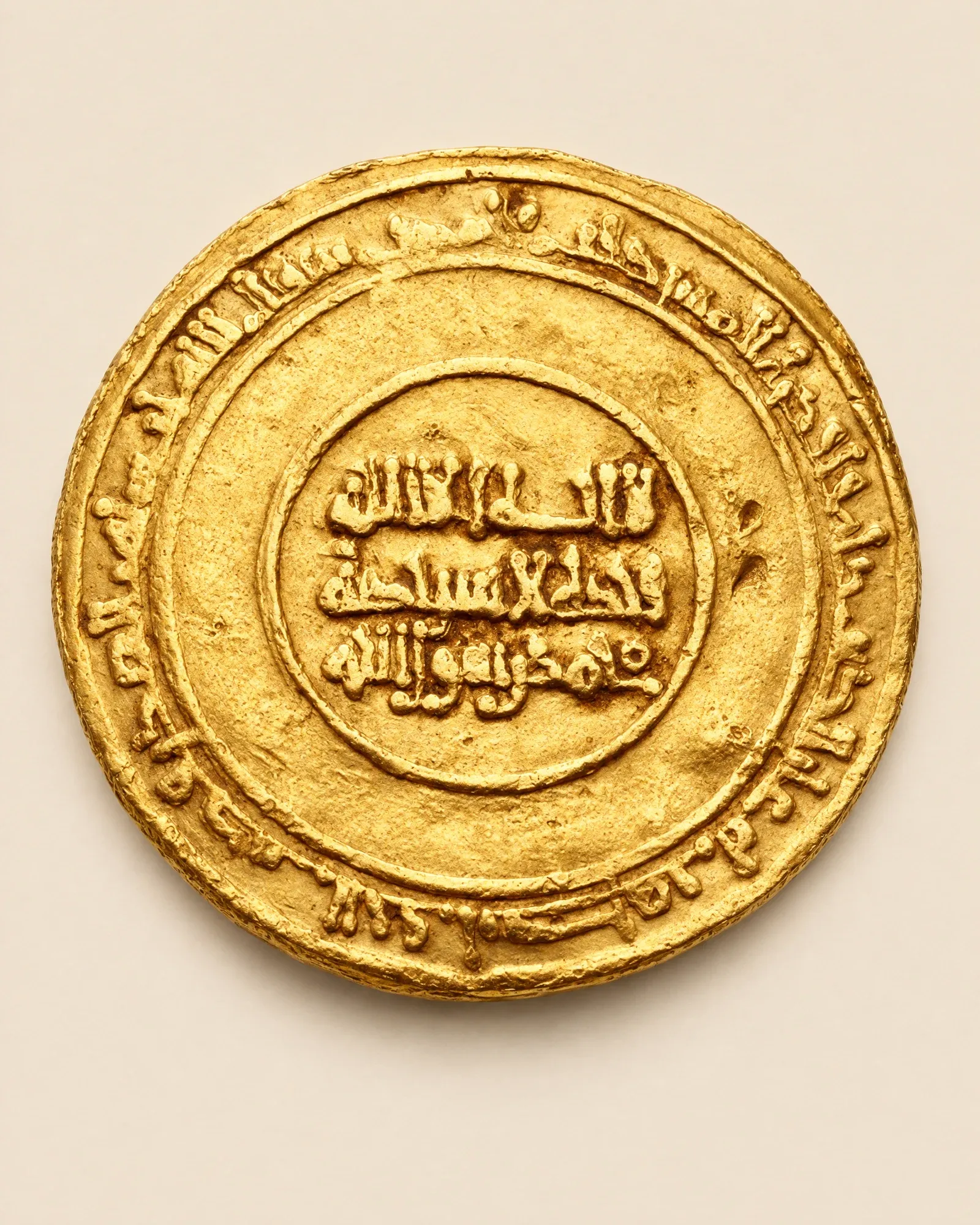
Abu Tahir Isma’il al-Mansur bi’llah was the thirteenth Ismaili Imam and the third Fatimid caliph. He came to power in the middle of a revolt that nearly destroyed the dynasty, defeated it in the field within fifteen months, and in a short reign of about seven years rebuilt the state around a new capital, Mansuriyya.12
Birth and background
Isma’il was born in 301/914 at Raqqada, the former Aghlabid palace city outside Qayrawan that served as the first Fatimid residence in Ifriqiya.1 He was the son of Abu’l-Qasim, the future al-Qa’im, and grew up in Mahdiya, the fortified capital his grandfather al-Mahdi occupied from 308/921.3
The revolt he inherited
When al-Qa’im died in Shawwal 334/May 946, the Khariji rebel Abu Yazid had held Qayrawan since October 944 and had besieged Mahdiya for eight months in 945.45 Abu Yazid, head of the Nukkari branch of the Ibadis, who held that an unjust ruler should be deposed, had raised the Berbers of the Aures and won the backing of Qayrawan’s Maliki scholars; Ismaili, Sunni and Ibadi sources alike later remembered him as a scourge.65
Isma’il kept his father’s death secret and took the offensive in person.12 He relieved Susa, and when Qayrawan closed its gates against Abu Yazid on his return from Susa, Isma’il occupied the city and beat off the rebels’ assault. An Andalusian fleet sent by the Umayyad Abd al-Rahman III to support Abu Yazid turned back.27 Abu Yazid withdrew in Muharram 335/August 946.2
Kiyana
Through the winter of 946–947 Isma’il pursued Abu Yazid westward past Tubna and Msila with his lieutenants Ja’far, son of Ali ibn Hamdun, who had died in the fighting, and Ziri ibn Manad, chief of the Sanhaja.27 In Muharram 336/August 947 Abu Yazid was defeated in the mountains of Kiyana, the site of the later Hammadid capital Qal’at Bani Hammad; he was captured and died of his wounds a few days later.2 Brett records that his skin, stuffed with straw, was displayed as a trophy, and that Tahart, which had defected, was recovered.7 Abu Yazid’s son Fadl continued the fight and was later killed; other sons took refuge with Abd al-Rahman III in Cordoba. The last resistance in the Aures was overcome.27 Only after the victory did Isma’il take the regnal title al-Mansur bi’llah, “the one made victorious by God”.7
Brett notes that Fatimid propaganda presented Abu Yazid as the great Enemy who was to rise against the Imam before the final triumph, so that his defeat could be presented as clearing the way for the dynasty’s eventual victory in the east.7
Mansuriyya
Al-Mansur built a new capital, named after himself, near the village of Sabra south of Qayrawan, and settled there in 337/948.2 Brett describes it as a palace fortress also called Sabra, “fortitude”, which replaced Raqqada a kilometre or two away; Raqqada became a park and parade ground.7 Excavations show that the city was circular. Its palaces, gates and mosque, called al-Azhar, provided a model for Cairo, founded twenty-one years later.2 It remained the capital until the court left for Egypt in 362/973.2 Mahdiya, which al-Mahdi had built with a shipyard and an arsenal for the fleet, ceased to be the seat of government when the court moved in 337/948.8
Reorganising the state
The defence of the west was entrusted to the dynasty’s allies: Ziri ibn Manad’s citadel at Ashir was enlarged and strengthened, his son Buluggin occupied Miliana, and Ja’far ibn Ali governed the Zab from Msila.7 Jawhar, later the conqueror of Egypt, served as al-Mansur’s secretary.9
The Banu Hamdun were among the dynasty’s oldest supporters. Ali ibn Hamdun al-Andalusi had accompanied al-Mahdi from Sijilmasa to Raqqada and built Msila; he died in 334/945–946, and his son Ja’far inherited his position.10 At court, the household was run by the eunuch Jawdhar, who held the office of ustadh, tutor of the royal children; his biography, the Sira of Jawdhar, is an important source for the dynasty’s internal affairs.1112
Among the scholars who fought for al-Mansur against Abu Yazid in 335/947 was the da’i Ja’far ibn Mansur al-Yaman, son of the Yemeni da’i Ibn Hawshab. He had migrated from Yemen to al-Qa’im’s court at Mahdiya and became the leading Fatimid exponent of ta’wil, esoteric interpretation; the later Yemeni historian Idris ranked him above al-Nu’man.13
In Sicily, where unrest had returned during the revolt, al-Mansur appointed al-Hasan ibn Ali al-Kalbi, of the influential Maghribi family of the Banu Abi’l-Husayn, governor in 336/948.14 Al-Hasan recovered the island, and his descendants, the Kalbids, governed it under Fatimid suzerainty for about a century, resuming raids on the Italian mainland.1415
In 337/948 al-Mansur appointed al-Qadi al-Nu’man, who had entered Fatimid service in 313/925 and served as judge of Tripoli and Mansuriyya, to the highest judicial office of the state. It was under al-Mansur’s successor that al-Nu’man completed the Da’a’im al-Islam.16
The Black Stone
In 339/950–951 the Qarmatis of Bahrayn returned the Black Stone, which they had taken from the Ka’ba in 317/930. Brett treats its return as a symbolic Fatimid success, asserting the dynasty’s claim to protect the Holy Places.715 Daftary, following recent scholarship, holds that the Qarmatis returned it in exchange for a payment from the Abbasids and not at al-Mansur’s request, and that they never recognised the Fatimid imamate.17
Death
Al-Mansur died in Shawwal 341/March 953, after a caliphate and imamate of about seven years, and was succeeded by his eldest son, Abu Tamim Ma’add, al-Mu’izz li-Din Allah.2
Footnotes
-
Farhad Daftary, Historical Dictionary of the Ismailis (Scarecrow Press, 2012), s.v. “al-Mansur”. ↩ ↩2 ↩3
-
Farhad Daftary, The Isma’ilis: Their History and Doctrines, 2nd ed. (Cambridge University Press, 2007), p. 147. ↩ ↩2 ↩3 ↩4 ↩5 ↩6 ↩7 ↩8 ↩9 ↩10 ↩11
-
Farhad Daftary, The Isma’ilis: Their History and Doctrines, 2nd ed. (Cambridge University Press, 2007), p. 142. ↩
-
Farhad Daftary, The Isma’ilis: Their History and Doctrines, 2nd ed. (Cambridge University Press, 2007), p. 146. ↩
-
Michael Brett, “The Fatimid revolution (861–973) and its aftermath in North Africa”, in J. D. Fage (ed.), The Cambridge History of Africa, vol. 2 (Cambridge University Press, 1978), p. 609. ↩ ↩2
-
Michael Brett, “The Fatimid revolution (861–973) and its aftermath in North Africa”, in J. D. Fage (ed.), The Cambridge History of Africa, vol. 2 (Cambridge University Press, 1978), p. 608. ↩
-
Michael Brett, “The Fatimid revolution (861–973) and its aftermath in North Africa”, in J. D. Fage (ed.), The Cambridge History of Africa, vol. 2 (Cambridge University Press, 1978), p. 610. ↩ ↩2 ↩3 ↩4 ↩5 ↩6 ↩7 ↩8 ↩9
-
Farhad Daftary, Historical Dictionary of the Ismailis (Scarecrow Press, 2012), s.v. “Mahdiyya”. ↩
-
Farhad Daftary, The Isma’ilis: Their History and Doctrines, 2nd ed. (Cambridge University Press, 2007), p. 156. ↩
-
Farhad Daftary, The Isma’ilis: Their History and Doctrines, 2nd ed. (Cambridge University Press, 2007), p. 157. ↩
-
Michael Brett, “The Fatimid revolution (861–973) and its aftermath in North Africa”, in J. D. Fage (ed.), The Cambridge History of Africa, vol. 2 (Cambridge University Press, 1978), p. 611. ↩
-
Farhad Daftary, The Isma’ilis: Their History and Doctrines, 2nd ed. (Cambridge University Press, 2007), p. 172. ↩
-
Farhad Daftary, The Isma’ilis: Their History and Doctrines, 2nd ed. (Cambridge University Press, 2007), p. 166. ↩
-
Farhad Daftary, The Isma’ilis: Their History and Doctrines, 2nd ed. (Cambridge University Press, 2007), p. 144. ↩ ↩2
-
Michael Brett, “The Fatimid revolution (861–973) and its aftermath in North Africa”, in J. D. Fage (ed.), The Cambridge History of Africa, vol. 2 (Cambridge University Press, 1978), p. 613. ↩ ↩2
-
Farhad Daftary, The Isma’ilis: Their History and Doctrines, 2nd ed. (Cambridge University Press, 2007), p. 169. ↩
-
Farhad Daftary, The Isma’ilis: Their History and Doctrines, 2nd ed. (Cambridge University Press, 2007), p. 151. ↩