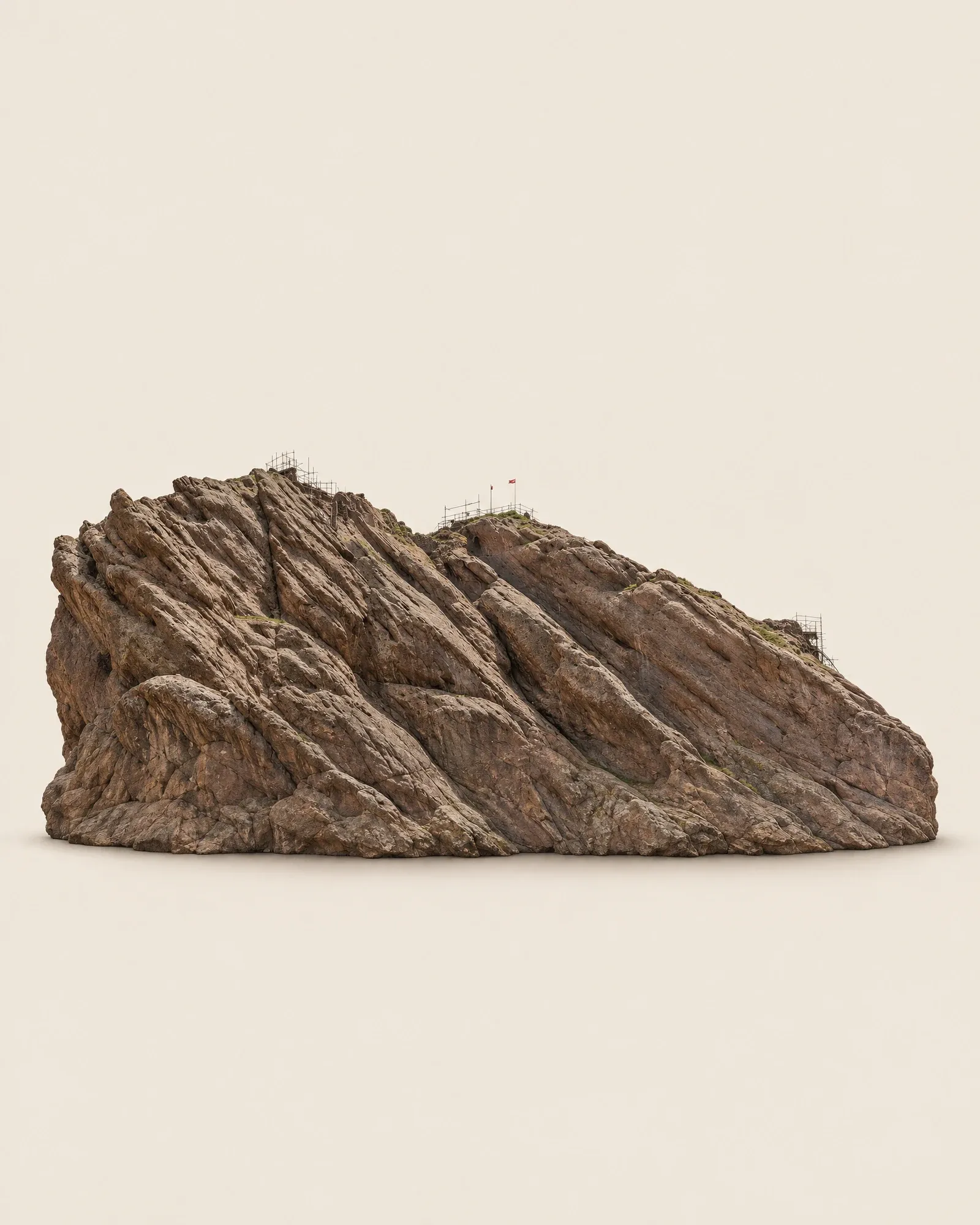
Hasan al-Qahir is counted by the Nizari Ismailis as their twenty-second Imam. He was the son of Muhammad al-Muhtadi and, in the Nizari genealogy, the father of Hasan II, the lord of Alamut who proclaimed the Qiyama in 1164. He is the last of the three hidden Imams of the period of concealment (satr) after Nizar. His importance in Nizari tradition comes almost entirely from his son. Daftary’s list of Nizari Imams gives no dates for him.1
The genealogy
The genealogy circulated among the Nizaris after Hasan II and his son Nur al-Din Muhammad were recognised as Imams. It puts three generations between Hasan II and Nizar, with Hasan “the son of al-Qahir b. al-Muhtadi b. al-Hadi b. Nizar”.2 Once the genealogy was accepted, Daftary writes, “the breach with the preceding period of satr” was complete. Until then the Imam had been hidden from his followers, and Alamut had held only his hujjas and da’is.2
The problem of Hasan II’s parentage
The genealogy had to explain a difficulty. Hasan II succeeded to the leadership of Alamut in 557/1162 as the son and designated heir of Muhammad b. Buzurg-Ummid, the third lord of Alamut. Daftary notes that Hasan “was then considered to be Muhammad b. Buzurg-Ummid’s son”.3 Muhammad b. Buzurg-Ummid was not a descendant of Nizar. So if Hasan II was an Imam by descent, his real father must have been someone else: in the genealogy, al-Qahir.
Nur al-Din Muhammad, Hasan II’s son and successor, made the claim explicit. He taught that his father was an Imam by physical descent from Nizar, the son of a Nizarid who had taken refuge in a village near Alamut.4
Traditions of an exchange at birth
Daftary reports the different ways Nizari tradition reconciled the two accounts. In the most widely popular version, a son born to Nizar’s grandson or great-grandson, the boy who later ruled as Hasan II, was exchanged for a son born at the same time to Muhammad b. Buzurg-Ummid, without Muhammad’s knowledge. In another, a pregnant wife of Nizar’s descendant living at Alamut was placed in Muhammad’s care and in due course gave birth to Hasan II.5 In either case the Nizarid father hidden in the background is the figure the genealogy names al-Qahir.
These stories are reported by Juvayni and other Persian historians writing after the fall of Alamut, and by Nizari tradition. No contemporary source confirms them. They serve as explanations of how a son of the house of Buzurg-Ummid could also be the Imam.5
The years before the manifestation
Al-Qahir’s lifetime, as far as it can be placed, falls in the reign of Muhammad b. Buzurg-Ummid (532–557/1138–1162). By then many Nizaris were disappointed with the military stalemate against the Saljuqs and looked back to the campaigns of Hasan-i Sabbah. Since Nizar’s death they had been waiting for their Imam to appear openly.6
Daftary describes how young Nizaris began to focus on the coming of their Imam and of the qiyama, the resurrection, when justice would be established. They found a leader in Muhammad’s heir Hasan, born in 520/1126, who had studied the teachings of Hasan-i Sabbah, philosophy, Sufi writings and the techniques of ta’wil, esoteric interpretation. Many came to regard him as the Imam promised by Hasan-i Sabbah.6
The reign of Muhammad b. Buzurg-Ummid
In this reign the Nizaris acquired further castles in Daylaman and Gilan, including Sa’adatkuh, Mubarakkuh and Firuzkuh. The fida’is struck at the highest targets. The Abbasid caliph al-Rashid was killed at Isfahan by four fida’is in Ramadan 532 / June 1138, and the Saljuq sultan Da’ud at Tabriz in 538/1143. Around 550/1155 Nizari da’is were sent to Ghur at the invitation of its ruler ‘Ala’ al-Din Husayn, but his son Sayf al-Din Muhammad later had them massacred.7 The Bawandid ruler Shah Ghazi Rustam, whose son Girdbazu was killed by fida’is in 537/1142, repeatedly attacked the Nizaris of Rudbar, killing many and building towers of their heads. In 538/1143 the Nizaris drove off an attack by Sultan Mas’ud’s army on Lamasar and other places in Rudbar.8
Daftary notes that the Nizaris kept libraries at Alamut, in Quhistan and in Syria, with religious and scientific works and equipment. The castles acquired in this reign are named by the Nizari chronicler Hasan b. Salah Munshi Birjandi, as quoted by the Persian historians.9
Repression and accession
Muhammad b. Buzurg-Ummid kept strictly to the shari’a and to the conduct of the da’wa on behalf of the hidden Imam, and he acted against Hasan’s followers. On one occasion he had 250 of them killed at Alamut and expelled the same number from the castle. Hasan then disowned these ideas, in speech and in writing, until Muhammad’s death.10
Muhammad died in Rabi’ I 557 / March 1162 and was buried beside Hasan-i Sabbah, Buzurg-Ummid and Abu ’Ali Ardistani. Hasan, about thirty-five years old and already designated heir, succeeded him. About two and a half years later, on 17 Ramadan 559 / 8 August 1164, Hasan proclaimed the Qiyama at the foot of Alamut. He presented himself as the representative of the hidden Imam, and later Nizari belief held that he was himself the Imam.11
Legacy
Al-Qahir is the point at which the hidden line of Nizar’s descendants and the ruling house of Alamut are joined in Nizari tradition. For historians, his name stands for a genealogical claim that cannot be checked independently. For the Nizari community, he is the Imam whose son brought the Imamate out of concealment. From Hasan II onwards the lords of Alamut were recognised openly as Imams.12
Footnotes
-
Farhad Daftary, Historical Dictionary of the Ismailis (Scarecrow Press, 2012), appendix “Nizari Imams”; Farhad Daftary, The Isma’ilis: Their History and Doctrines, 2nd ed. (Cambridge University Press, 2007), p. 364. ↩
-
Daftary, The Isma’ilis, p. 358. ↩
-
Daftary, The Isma’ilis, p. 363. ↩
-
Daftary, The Isma’ilis, p. 356. ↩
-
Daftary, The Isma’ilis, p. 357. ↩
-
Daftary, The Isma’ilis, p. 355. ↩
-
Daftary, The Isma’ilis, p. 358. ↩
-
Daftary, The Isma’ilis, pp. 358–359. ↩
-
Daftary, The Isma’ilis, pp. 363–364. ↩