The Qiyama (Arabic qiyama, Persian qiyamat, “resurrection”) was proclaimed by Hasan II, the fourth lord of Alamut, on 17 Ramadan 559 / 8 August 1164. Speaking in the name of the hidden Imam, he announced that the Last Day had come. Interpreted spiritually, this meant that the Nizaris were released from the outward obligations of the religious law and could live in the inner truth, a “Paradise” on earth. The Qiyama period lasted forty-six years, until 1210, when Jalal al-Din Hasan III reversed it.1 It is the most debated episode in Nizari history. Almost everything known about it comes from Persian historians hostile to the Nizaris and from a few later Nizari works.2
Background: waiting for the Imam
Since Nizar’s death in 1095 the Nizaris had had no visible Imam. Hasan-i Sabbah and his successors led them as the hujjas of a hidden Imam. They enforced the shari’a strictly. By the middle of the twelfth century the Nizari revolt against the Saljuqs had reached a stalemate.3
Daftary describes how many Nizaris looked back to Hasan-i Sabbah’s campaigns and turned to older Ismaili ideas about the appearance of their Imam and the coming of the qiyama, when justice would be established. They found a leader in Hasan, the heir of Muhammad b. Buzurg-Ummid. He had studied Hasan-i Sabbah’s teachings, philosophy and Sufism and was known for his skill in ta’wil, esoteric interpretation. Muhammad b. Buzurg-Ummid had 250 of his followers killed and expelled another 250 from Alamut. When Muhammad died in Rabi’ I 557 / March 1162, Hasan succeeded him.4
The ceremony at Alamut
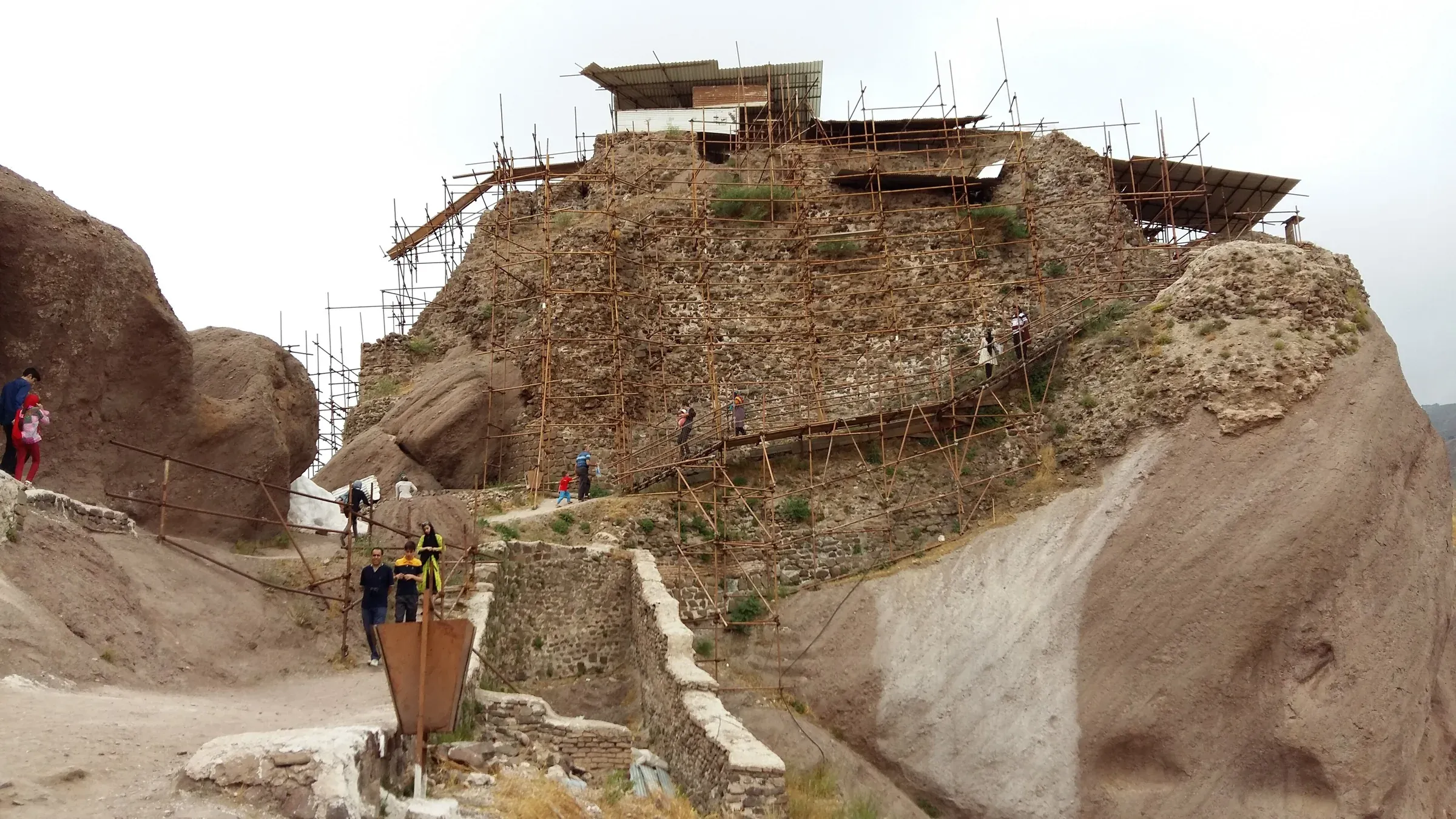
About two and a half years after his accession, Hasan had a pulpit erected in the prayer ground at the foot of Alamut. It faced west, away from Mecca, and carried four banners: white, red, yellow and green. On 17 Ramadan 559, in the middle of the month of fasting, representatives of the Persian Nizari territories assembled. Those from Rudbar and Daylam stood in front, those from Khurasan and Quhistan on the right, and those from central and western Persia on the left.5
At noon Hasan came down from the castle in white and mounted the pulpit with a sword in his hand. He delivered a message that, he said, came from the hidden Imam. The Imam sent his blessings, called the Nizaris his chosen servants, “relieved [them] of the duties and burdens of the shari’a, and … brought [them] to the qiyama”. An Arabic sermon presented as the Imam’s own words was translated into Persian by the jurist Muhammad Busti.5
The sermon named Hasan not only da’i and hujja but khalifa, the Imam’s deputy with full authority. Hasan then led the two prostrations of a festival prayer and invited the assembly to break the fast at a table prepared for them. He called the day the “festival of the resurrection” (’id-i qiyamat). The Nizaris celebrated 17 Ramadan every year afterwards.6
Mu’minabad and Syria
About two months later the proclamation was repeated at Mu’minabad, east of Birjand in Quhistan. Hasan’s sermon and epistle were carried there by Muhammad Khaqan and read out by the ra’is Muzaffar, head of the Quhistani Nizaris since 555/1160. Juvayni dates the ceremony to 28 Dhu’l-Qa’da 559 / 18 October 1164.7
The message at Mu’minabad made Hasan’s claim plainer. As al-Mustansir had been God’s khalifa on earth and Hasan-i Sabbah al-Mustansir’s, so Hasan was now God’s khalifa and Muzaffar was his. Juvayni, who was hostile to the Nizaris, adds that the assembly played the harp and rebeck and drank wine on the steps of the pulpit.8 In Syria the Qiyama was announced somewhat later. Daftary credits Rashid al-Din Sinan with the announcement and notes that it had limited effect there.9
The doctrine
The Qiyama was the Last Day, when humanity would be judged and sent to Paradise or Hell. Drawing on Ismaili ta’wil, the Nizaris interpreted it spiritually for the living. The resurrection was the revealing of the unveiled truth (haqiqa) in the person of the Imam. Those who recognised him could understand the inner meaning (batin) of the law and were already in Paradise. Those who did not were rendered “spiritually non-existent”.10
The Imam who began the Qiyama was the qa’im al-qiyama, “lord of the resurrection”, a rank that Ismaili thought had always placed above that of an ordinary Imam. Later Nizari sources said that Hasan-i Sabbah had sounded the first blast of the trumpet and Hasan II the second.10
According to the Persian historians the doctrine relieved believers of the law: “in this world all is action and there is no reckoning, while in the world of the qiyama all is reckoning and there is no action”. Instead of praying five times a day, believers would be with God in their hearts at all times, which was “true prayer” (namaz-i haqiqi). The other rules of the shari’a were interpreted in the same way. Rashid al-Din and Kashani state that it was for this abolition of the law that the Nizaris were called malahida, “heretics”.11
Nur al-Din Muhammad’s elaboration
Hasan II was murdered at Lamasar in January 1166. His son Nur al-Din Muhammad II spent a forty-four-year reign turning the Qiyama into a systematic doctrine. He stated openly that his father had been the Imam by physical descent from Nizar. He also put the present (hadir) Imam at the centre of the doctrine.12
The Imam was the epiphany (mazhar) of God’s word or command. Believers reached Paradise through a true vision of him, not by living in any particular place. In this doctrine, seeing the Imam rightly meant seeing through his person to the haqiqa, a “batin behind the batin”. The Imam of the Qiyama was identified with the imam-qa’im figure that appeared in each prophetic era. Seen rightly, every Imam was ’Ali, and every believer was Salman.13
Three kinds of people
Under the Qiyama the old da’wa hierarchy faded. Humanity was instead divided into three groups:
- The people of opposition (ahl-i tadadd): those outside the community.
- The people of gradation (ahl-i tarattub): ordinary Nizaris, who held part of the truth.
- The people of union (ahl-i vahdat): those who held the full truth.
Daftary notes that few, if any, reached union. The doctrine’s Sufi parallels, with the Imam as pir or Perfect Man, prepared the ground for the later closeness of Nizaris and Sufis.14
Independence and failure
Daftary reads the Qiyama as “a declaration of independence from the larger Muslim society” and also “an admission of the failure” of the Nizari struggle to win that society over. The outside world was simply declared irrelevant.15 Outsiders hardly noticed it at the time. The proclamation evidently went unnoticed by the outside world until later; contemporary Sunni chroniclers such as Ibn al-Athir do not mention it. Daftary also notes that no libertinism in Rudbar is reported even by Juvayni.16
Reversal and reinterpretation
Hasan III, who had been unhappy with the Qiyama even as heir, reversed it on his accession in 607/1210. He ordered the Nizaris to observe the shari’a in its Sunni form, and the Abbasid caliph accepted him as a Muslim ruler in 1211.17 Under his son Ala al-Din Muhammad III the Nizaris worked out a doctrine that explained the reversal. It is set out in the Rawdat al-taslim associated with Nasir al-Din Tusi.18
In that doctrine the Qiyama had been a temporary state that could be granted or withdrawn by the Imam. Observing the shari’a was a form of taqiyya belonging to an era of concealment (satr). Every Imam was potentially an imam-qa’im, and history alternated between eras of concealment and of manifestation until the final Great Resurrection.18
The sources
The main narrative accounts were written after the fall of Alamut by historians in Mongol service: Juvayni, who completed his history in the 1250s, and the later Rashid al-Din and Kashani. Juvayni had access to books and documents from the Alamut library before it was burned, and the later historians drew on Nizari chronicles that have not survived independently.19
The main Nizari text from the Qiyama era is the Haft bab-i Baba Sayyidna, an anonymous treatise of about 596/1199 and the earliest surviving Nizari work of the Alamut period. It presents Hasan-i Sabbah as the hujja who foretold the coming of the imam-qa’im, and it gives the series of imam-qa’ims of earlier eras.20 Later Nizari authors, writing after the Mongol conquest, preserved further versions of these teachings. None of them is a neutral witness, and the gap between the hostile historians and the community’s own tradition explains much of the modern debate.21
A disputed episode
Daftary emphasises that the account given here rests on the Persian historians, a few later Nizari works and the standard interpretation of Hodgson, Corbin and Madelung. He calls the Qiyama “a highly controversial episode”. Many modern Nizaris question parts of the narrative, especially the claim that the shari’a was simply abolished. In their view a basic function of every Imam is to interpret the law and practice of the faith for his own time, and the Qiyama was the Imam’s reinterpretation for the circumstances of 1164.21
Footnotes
-
Farhad Daftary, The Isma’ilis: Their History and Doctrines, 2nd ed. (Cambridge University Press, 2007), pp. 358–361. ↩
-
Daftary, The Isma’ilis, pp. 358, 361–362. ↩
-
Daftary, The Isma’ilis, pp. 326, 357. ↩
-
Daftary, The Isma’ilis, pp. 357–358. ↩
-
Daftary, The Isma’ilis, p. 359. ↩
-
Daftary, The Isma’ilis, p. 359; ’Ata-Malik Juvayni, The History of the World-Conqueror, tr. J. A. Boyle (Manchester University Press, 1958), vol. 2, p. 691. ↩
-
Daftary, The Isma’ilis, p. 359; Juvayni, World-Conqueror, vol. 2, p. 691. ↩
-
Daftary, The Isma’ilis, pp. 359, 370. ↩
-
Daftary, The Isma’ilis, p. 360. ↩
-
Daftary, The Isma’ilis, p. 363. ↩
-
Daftary, The Isma’ilis, pp. 364–365. ↩
-
Daftary, The Isma’ilis, pp. 365–366. ↩
-
Daftary, The Isma’ilis, p. 360. ↩
-
Daftary, The Isma’ilis, pp. 362, 366. ↩
-
Daftary, The Isma’ilis, p. 375. ↩
-
Daftary, The Isma’ilis, pp. 358, 361; ’Ata-Malik Juvayni, World-Conqueror, vol. 2, pp. 719–721. ↩
-
Daftary, The Isma’ilis, pp. 326, 364–365. ↩