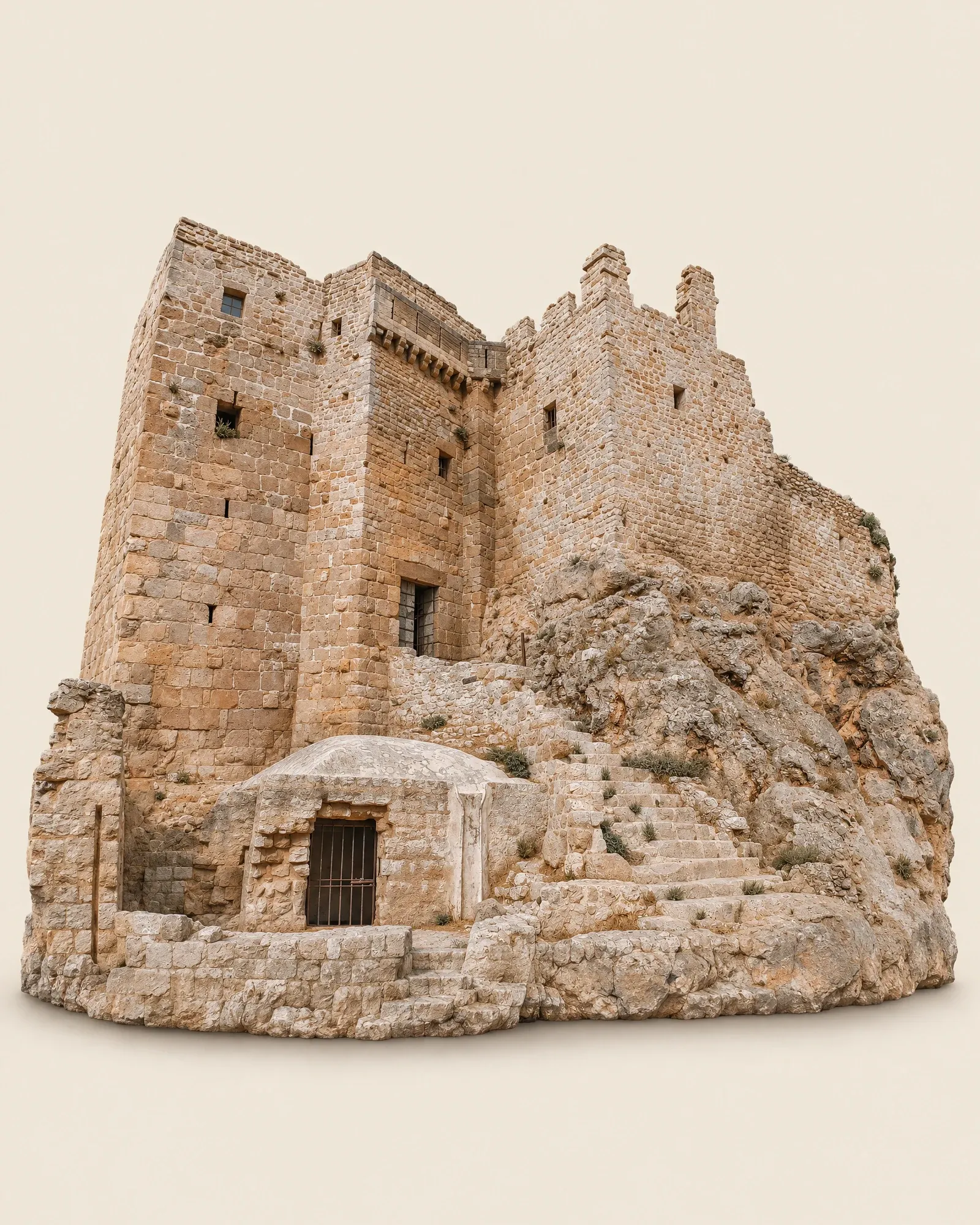
Nur al-Din Muhammad II (1148–1210) was the fifth lord of Alamut and is counted by the Nizari Ismailis as their twenty-fourth Imam. He came to power at nineteen after the murder of his father, Hasan II, and ruled for forty-four years, longer than any other lord of Alamut. He worked out the doctrine of the Qiyama in detail and stated openly that his father, and therefore he himself, descended from Nizar. After about seventy years of concealment, the line of Nizari Imams was thus publicly identified with the rulers of Alamut.1
Accession
Muhammad was born in Shawwal 542 / March 1148. On 6 Rabi’ I 561 / 9 January 1166 his father was stabbed at Lamasar by his brother-in-law Hasan b. Namawar, a member of a local Daylami branch of the Buyid family who opposed Hasan II’s policies. Muhammad succeeded him and at once had Namawar and all his relatives put to death.2
Claiming the Imamate
Muhammad is said to have been a prolific writer. He reaffirmed his father’s policies and spent his life developing the teachings of the Qiyama into a systematic doctrine. Daftary identifies two contributions of his own. He claimed the Imamate for his father, and so for himself, “in the fullest sense”. He also put the Imam, specifically the present (hadir) Nizari Imam, at the centre of the doctrine of the Qiyama.3
Earlier Ismaili expectation required the Imam to be present in person at the time of the Qiyama, because it was the role of the culminating Imam, the qa’im, to begin it. Hasan II had only hinted that he was the Imam himself. Muhammad stated that his father had been the Imam by physical descent too. Hasan II, he taught, was not the son of Muhammad b. Buzurg-Ummid, but of a descendant of Nizar who had secretly taken refuge in a village near Alamut. Daftary writes that “after a period of some seventy years following Nizar’s death, the line of the Nizari imams emerged openly”, and the Nizaris from then on recognised the lords of Alamut as their Imams.4 The genealogy that circulated afterwards ran from Hasan II through al-Qahir, al-Muhtadi and al-Hadi to Nizar. Later traditions explained the apparent parentage with stories of an exchange or adoption at birth.5
The Imam at the centre
Daftary calls the elevation of the present Imam’s teaching authority above that of earlier Imams, and above that of the prophets, “the outstanding feature of Nizari thought”. Hasan-i Sabbah had already taught it. In Muhammad II’s doctrine the Imam, in his eternal essence, was the epiphany (mazhar) of the word (kalima) or command (amr) of God. Believers found Paradise through a true vision of the Imam, not by living in Rudbar, Quhistan or any other place.6
That vision did not mean simply knowing who the Imam was or seeing him in person. It meant seeing through his person to the unveiled truth. The believer would then see the world from the Imam’s point of view and reach a third level of being: the haqiqa, “a world of batin behind the batin”, beyond both the law and its ordinary esoteric interpretation.6
The imam-qa’im
The doctrine added a new figure to Ismaili cyclical history: the imam-qa’im of each prophetic era, contemporary with that era’s prophet and superior to his legatee (wasi). The Haft bab-i Baba Sayyidna, an anonymous Nizari treatise of about 596/1199, lists them. For the eras of Adam, Noah and Abraham they were Malik Shulim, Malik Yazdaq and Malik al-Salam, who together correspond to the biblical Melchizedek. For Moses, Jesus and Muhammad they were Dhu’l-Qarnayn (identified with Khidr), Ma’add and ’Ali.7
Muhammad II identified the present Imam with this figure. Seen rightly, every Imam was ’Ali, and every believer was Salman, the faithful disciple of the Prophet and early follower of ’Ali.7
A community of three ranks
The small, scattered community had no use for the elaborate da’wa hierarchy of the Fatimids, and that hierarchy faded in the Qiyama period. In its place the doctrine divided humanity into three categories. The “people of opposition” (ahl-i tadadd) were those outside the community. The “people of gradation” (ahl-i tarattub) were ordinary Nizaris, who held only part of the truth. The “people of union” (ahl-i vahdat), the elite of the elite, held the full truth.8
Daftary notes that few if any reached the rank of union. Hostile sources took the Qiyama to mean the literal abrogation of the shari’a. The doctrine also had Sufi parallels: the Imam as the Sufi master (pir) or the Perfect Man (insan-i kamil). He suggests these prepared the way for the close association of Nizari and Sufi traditions after the fall of Alamut.9
Persia: a quiet reign
Outside Syria the first three decades of Muhammad II’s reign were uneventful. The Qiyama went unnoticed by the outside world until later: contemporary Sunni chroniclers such as Ibn al-Athir do not mention it.10 Alamut gave refuge to the Badusapanid ruler Hazarasf b. Shahrnush (d. 586/1190), who handed over castles to the Nizaris.11
The political map changed around them. The Khwarazmshah Tekish (r. 1172–1200) and the Abbasid caliph al-Nasir (r. 1180–1225) became the dominant powers in the east. Tekish defeated Tughril III, the last Saljuq ruler of Persia, at Rayy in 590/1194.12
Last years: petty warfare
In the last sixteen years of his reign the Persian Nizaris were again fighting their neighbours. Alamut sheltered Bisutun, a ruler of Ruyan who had rebelled against the Bawandids. From 590/1194 the Nizaris of Quhistan fought the Ghurids and the Nasrid Maliks of Sistan, and the Ghurid ruler Ghiyath al-Din later devastated Quhistan and forced their submission. Around 602/1205 the Khwarazmian general Miyajiq killed many Nizaris. The Nizaris claimed responsibility for the murder of the Ghurid Shihab al-Din in 602/1206, probably to win favour with the Khwarazmshah.13
Other events of these years included the killing of Tekish’s vizier Nizam al-Mulk Mas’ud b. ’Ali in 596/1200, reportedly at the Khwarazmshah’s own request. In 600/1204 many people accused of Ismailism were massacred in lower Iraq.13
Syria and Sinan
In Syria the reign coincided with the leadership of Rashid al-Din Sinan. Sinan had been a close companion of Hasan II at Alamut. He ran the Syrian Nizaris from Masyaf, Kahf and Qadmus with a degree of independence no other Syrian chief da’i had. Daftary reports that Muhammad II tried several times to remove him.14 Sinan died in 589/1193, or less probably a year earlier. His successor, Abu Mansur b. Muhammad, restored Alamut’s authority over the Syrian community.15
The breach with Hasan
The Persian historians describe a growing rift in Muhammad II’s later years with his eldest son Hasan, born in 562/1166–67. Hasan had received the nass in childhood but was unhappy with the doctrine and practice of the Qiyama. He wanted closer relations with the Sunni world and wrote secretly to several Sunni rulers. Muhammad II died, possibly of poison, in Rabi’ I 607 / September 1210. Hasan succeeded him as Jalal al-Din Hasan III and reversed his father’s policy.16
Footnotes
-
Farhad Daftary, The Isma’ilis: Their History and Doctrines, 2nd ed. (Cambridge University Press, 2007), pp. 363–364; Farhad Daftary, Historical Dictionary of the Ismailis (Scarecrow Press, 2012), appendix “Nizari Imams”. ↩
-
Daftary, The Isma’ilis, p. 363. ↩
-
Daftary, The Isma’ilis, p. 363. ↩
-
Daftary, The Isma’ilis, pp. 363–364. ↩
-
Daftary, The Isma’ilis, pp. 363–364. ↩
-
Daftary, The Isma’ilis, p. 365. ↩
-
Daftary, The Isma’ilis, p. 366. ↩
-
Daftary, The Isma’ilis, pp. 362, 366–367. ↩
-
Daftary, The Isma’ilis, pp. 344, 367. ↩
-
Daftary, The Isma’ilis, p. 373. ↩
-
Daftary, The Isma’ilis, pp. 368, 370–371, 373. ↩
-
Daftary, The Isma’ilis, pp. 373, 389. ↩
-
Daftary, The Isma’ilis, p. 375. ↩