What is known
Shah Khalil Allah II, the thirty-ninth Imam of the Qasim-Shahi line, succeeded his father Nur al-Dahr Ali, who died in Rajab 1082/November 1671. His own epitaph records his death in Dhu’l-Hijja 1090/January 1680, which gives him an Imamate of a little over eight years. Daftary calls him the last Qasim-Shahi Imam to reside at Anjudan. His successor, Shah Nizar II, moved the seat of the da’wa to the nearby village of Kahak, opening a new phase of Nizari history.1
Beyond these facts, nothing specific is recorded of his Imamate, and Nizari tradition adds no anecdotes about him. No farman, poem addressed to him or outside reference has been identified. This page sets out the evidence of his tomb and the state of the community he inherited.2
The tombstone
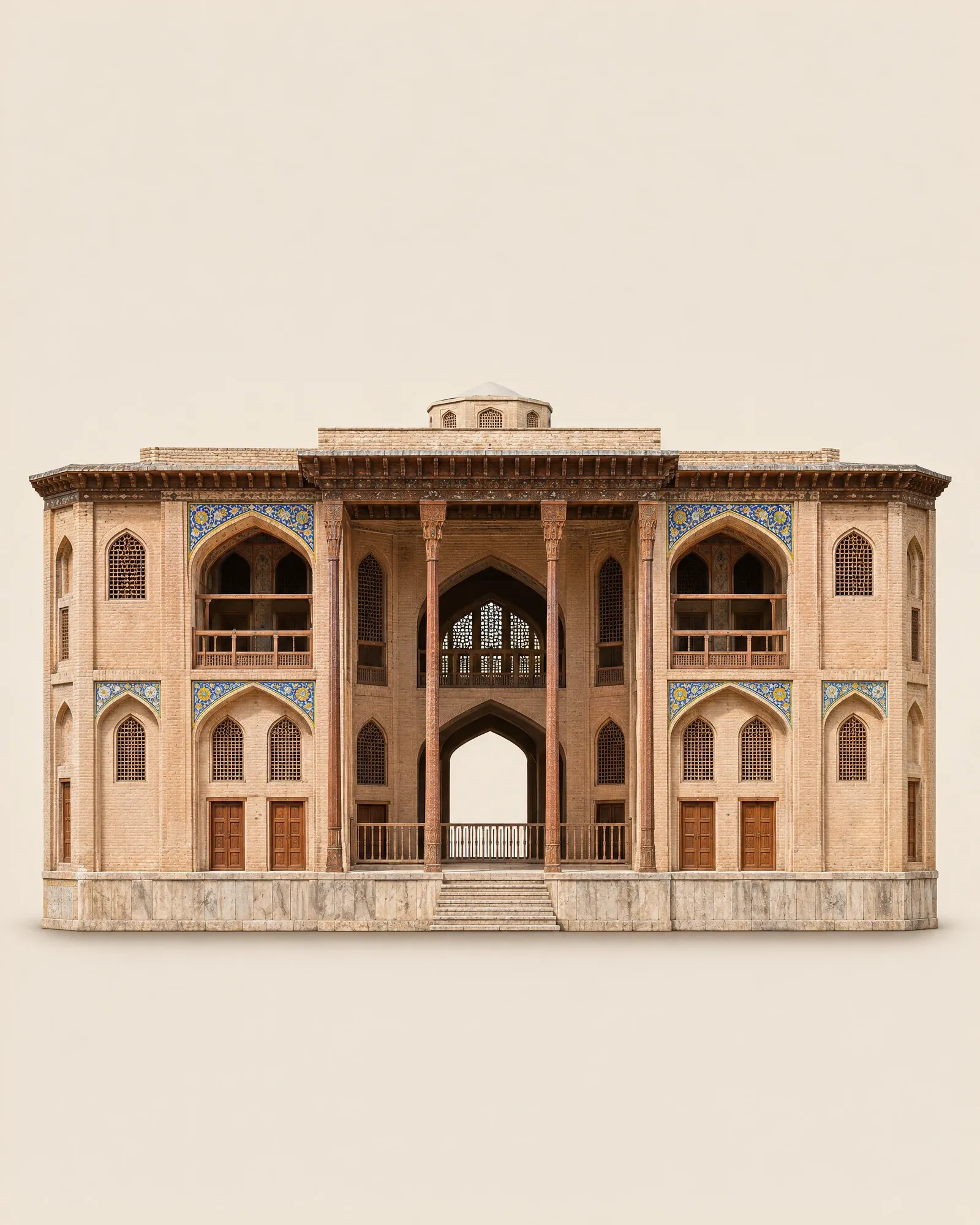
Khalil Allah II’s tombstone is preserved, set into one of the walls of the octagonal mausoleum of Gharib Mirza, known to the villagers as Shah Gharib. It is one of five tombstones inset in that wall. A chamber adjoining the mausoleum once held two more graves, including that of Nur al-Dahr Khalil Allah, probably his father; that structure has disappeared.3
The Anjudan monuments were identified only in 1937, when Ivanow found there an old mosque and three mausoleums containing the tombs of several Imams and their relatives. By the time Daftary visited in 1976, some of what Ivanow had described had gone, abandoned in a dilapidated state, and intruders had dismantled the dated wooden box over Gharib Mirza’s grave. The inscriptions, including Khalil Allah II’s epitaph, are the main documentary evidence for the dates of the later Anjudan Imams.4
The community he inherited
Khalil Allah II inherited the Imamate at the height of the Anjudan revival. Daftary concludes that by the second half of the seventeenth century the revival had achieved definite successes. The poet Mahmud Ali of Mu’minabad, writing in his father’s time, named the Imam’s da’is, teachers and lesser functionaries in Khurasan, Quhistan, Iraq-i Ajam, Kerman, Afghanistan, Badakhshan, Turkistan and the Indian subcontinent, including Multan, Lahore and Gujarat.5
Over two centuries the Imams of Anjudan had reasserted their direct authority over communities that, in the first post-Alamut centuries, had come under hereditary local pirs. The Pandiyat-i javanmardi had been sent to the Khojas of India, Muhammad-Shahi communities in Badakhshan had been invited to transfer their allegiance, and regional da’is were summoned to Persia for consultation and instruction. The religious dues of distant communities, notably the Khojas, flowed to the Imam, who checked them closely.6
The eclipse of the rival line
By Khalil Allah II’s time the long contest with the Muhammad-Shahi Imams had been largely decided. Daftary writes that by the end of the seventeenth century the Qasim-Shahi Imams had gained the allegiance of the Nizari majority in Afghanistan, Central Asia and the Indian subcontinent. The Muhammad-Shahis kept supporters in Badakhshan and around Kabul at least through the seventeenth century, but by the beginning of the nineteenth the Nizaris of the upper Oxus and Afghanistan seem to have generally adhered to the Qasim-Shahi line, although Badakhshan’s communities continued to be led by their own dynasties of pirs. In India the Muhammad-Shahi following disappeared after the seventeenth century, in the wake of Awrangzib’s persecution of the Shi’is of the Deccan.7
The only surviving Muhammad-Shahis today are in Syria, centred on Masyaf and Qadmus. Known locally as the Ja’fariyya and numbering about 15,000, they await the reappearance of their hidden Imam, presumably Amir Muhammad al-Baqir, and follow the Shafi’i school in legal matters. See The Muhammad-Shahi/Qasim-Shahi split.8
By the same date, Daftary notes, the Qasim-Shahi Imams had developed deep roots in central Persia, in Mahallat and other localities around Anjudan, the region where the family’s estates would remain until the nineteenth century. Kahak, the village to which his son would soon move, lies northwest of Mahallat and about thirty-five kilometres from Anjudan.9
Living under the Twelver cover
Khalil Allah II lived in the late Safavid period. The Imams of the later Anjudan period conducted their community’s affairs quietly and kept friendly relations with the Safavid court. Since the early Safavid period the Persian Nizaris had dissimulated as Twelver Shi’is, sharing with them the early Alid heritage and Imami traditions; Shah Abbas I’s edict of 1627 had treated the Shi’is of Anjudan as Twelvers. This form of taqiyya remained in use among Persian Nizaris until the early twentieth century and largely protected them from persecution, but its long use also led to the acculturation of many Nizari groups into the Twelver majority.10
That acculturation is visible at Anjudan itself. The village’s present inhabitants, about a thousand people, are Twelver Shi’is and do not know who is buried in the mausoleums of Shah Qalandar and Shah Gharib. When the Qajar king Nasir al-Din Shah visited Anjudan in Dhu’l-Qa’da 1309/June 1892, he did not suspect the place’s Ismaili past.11
The end of the Anjudan period
With Khalil Allah II’s death in 1680 the Anjudan period ended. His successor Shah Nizar transferred the seat of the Imamate to Kahak, about thirty-five kilometres to the north-east. The Anjudan era had lasted roughly two centuries, from the emergence of Mustansir bi’llah II around 868/1463 to 1090/1680, a span that coincides with the greater part of the Safavid period. In that time the Qasim-Shahi line had moved from obscurity to the leadership of almost all Nizaris outside Syria. The story continues in From Persia to Bombay.12
Footnotes
-
Farhad Daftary, The Isma’ilis: Their History and Doctrines, 2nd ed. (Cambridge University Press, 2007), pp. 425, 437, 439. ↩
-
Daftary, The Isma’ilis, 2nd ed. (Cambridge University Press, 2007), pp. 425, 439. ↩
-
Daftary, The Isma’ilis, 2nd ed. (Cambridge University Press, 2007), pp. 423–425. ↩
-
Daftary, The Isma’ilis, 2nd ed. (Cambridge University Press, 2007), p. 423. ↩
-
Daftary, The Isma’ilis, 2nd ed. (Cambridge University Press, 2007), p. 438. ↩
-
Daftary, The Isma’ilis, 2nd ed. (Cambridge University Press, 2007), pp. 432–434. ↩
-
Daftary, The Isma’ilis, 2nd ed. (Cambridge University Press, 2007), p. 456. ↩
-
Daftary, The Isma’ilis, 2nd ed. (Cambridge University Press, 2007), p. 456. ↩
-
Daftary, The Isma’ilis, 2nd ed. (Cambridge University Press, 2007), p. 456. ↩
-
Daftary, The Isma’ilis, 2nd ed. (Cambridge University Press, 2007), p. 437; Farhad Daftary, Ismailis in Medieval Muslim Societies (I.B. Tauris / Institute of Ismaili Studies, 2005), pp. 195–196, https://archive.org/details/bk862. ↩
-
Daftary, The Isma’ilis, 2nd ed. (Cambridge University Press, 2007), p. 423. ↩
-
Daftary, The Isma’ilis, 2nd ed. (Cambridge University Press, 2007), pp. 423, 439, 456. ↩