Location
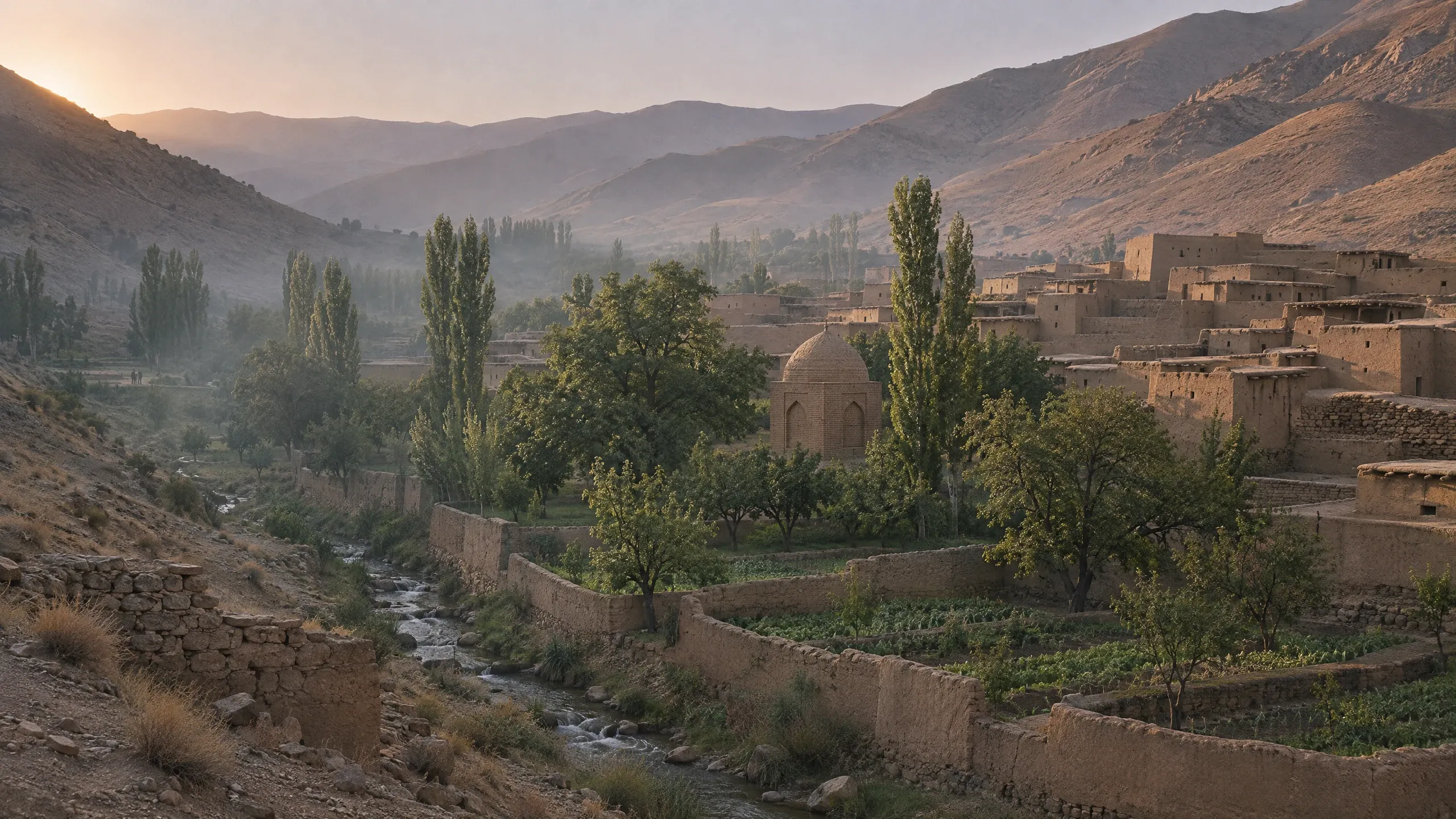
Kahak is a village in central Iran about thirty-five kilometres north-east of Anjudan and north-west of Mahallat, separated from Anjudan by a series of shallow ranges. When Daftary visited in 1976 it was an isolated village with a Twelver Shi’i population of about five hundred. It seems to have mattered more in earlier centuries, when it was a resting place for caravans, with a Safavid caravanserai on the road between Qumm and Arak.1
The move from Anjudan
By the late seventeenth century the Qasim-Shahi Imams had deep roots in central Persia, in Mahallat and the localities around Anjudan. At some point in the first decades of his Imamate (1090–1134/1680–1722), and for reasons that are not known, Shah Nizar II moved his residence and the headquarters of the da’wa from Anjudan to Kahak. Anjudan was abandoned permanently by the Imams, and Daftary dates the end of the Anjudan period, which had lasted about two centuries, to this move.2
Shah Nizar and his son Sayyid Ali lived at Kahak. Their successors later left it as a residence, but the family kept a foothold there at least until the beginning of the nineteenth century.3
Shah Nizar and the Ni’mat Allahis
The Qasim-Shahi Imams had intermittent ties with the Ni’mat Allahi Sufi order from Anjudan times, but the earliest definite evidence of the association goes back to Shah Nizar at Kahak. He had close connections with the order, which had not yet been re-established in Persia, and adopted the Sufi name Ata Allah. Some of his followers, Khurasani nomads who had settled in Sirjan and Kerman, became known as the Ata Allahis. The ties between the Imams and the Ni’mat Allahis became closer still in the eighteenth and nineteenth centuries.4
The mausoleum
Shah Nizar died in Dhu’l-Hijja 1134/September 1722, according to his tombstone, as the Afghan invasion was bringing the Safavid dynasty to an end. He was buried at Kahak in a mausoleum set in a garden, which has since been restored. Several of his followers and relatives were buried in its chambers and around it.5
His son and successor Sayyid Ali lies in the largest chamber of the same building; his tombstone gives his death as 1167/1754. A stone platform found by Wladimir Ivanow in 1937 in the former gardens of Shah Nizar’s residence, on which Shah Nizar is said to have sat when receiving his followers, was no longer in place when Daftary visited in 1976.6
From Kahak to Kerman and back
The safety of the Khoja pilgrims who came from India to see the Imam, and of the dues they carried, became pressing in the troubled years after the fall of the Safavids. Towards the end of Nadir Shah’s reign (1148–1160/1736–1747), Hasan Ali moved the Imam’s residence from Kahak to Shahr-i Babak in the province of Kerman, nearer the routes to Baluchistan and India.7
Kahak did not lose its place in the family. After the Qajar conquest of Kerman in 1209/1794, the Nizari sayyids of Shahr-i Babak were allowed to move to Kahak, where they were given new lands. Shah Khalil Allah, the forty-fifth Imam, lived at Kahak for about twenty years after succeeding in 1206/1792, before moving to Yazd in 1230/1815.8
Kahak in the 1790s and early European notices
Beben and Mohammad Poor give a different account of the family’s return. In their reading, Abu’l-Hasan Ali, the forty-fourth Imam, retired after the Qajar capture of Kerman to his ancestral home at Kahak, probably to escape the violence that followed the imposition of Qajar rule in Kerman, and died there a year later, in 1206/1792; his son Shah Khalil Allah then transferred the seat of the Imamate from Kerman to Kahak, where the Imams held extensive properties. Daftary places Abu’l-Hasan’s death in Kerman. The discrepancy is noted on the Imam’s page.9
Kahak is also the first seat of the Imams to appear in European sources. Early in the nineteenth century Rousseau, the French consul-general in Aleppo, reported on the Ismailis of Syria and Persia and noted that their Imam, Khalil Allah Ali, resided in Kahak. A decade later the British traveller James Fraser recorded further notices of the Imam and his followers in Persia and India.10
Birthplace of Aga Khan I
Shah Khalil Allah’s wife Bibi Sarkara, daughter of the Nizari sayyid and Ni’mat Allahi Sufi Muhammad Sadiq Mahallati, gave birth at Kahak in 1219/1804 to Muhammad Hasan, later Hasan Ali Shah, Aga Khan I. When Shah Khalil Allah moved to Yazd, he left his family at Kahak to live on the revenues of the family estates. After his murder in 1232/1817, a dispute between local Nizaris and Imani Khan Farahani, husband of the Imam’s daughter Shah Bibi, who managed the lands, left the family without support, and the young Imam and his mother moved to Qumm. That move, and the Qajar settlement that followed, shifted the family’s centre to Mahallat.11
Footnotes
-
Farhad Daftary, The Isma’ilis: Their History and Doctrines, 2nd ed. (Cambridge University Press, 2007), p. 456. ↩
-
Daftary, The Isma’ilis, 2nd ed. (Cambridge University Press, 2007), p. 456. ↩
-
Daftary, The Isma’ilis, 2nd ed. (Cambridge University Press, 2007), p. 456. ↩
-
Daftary, The Isma’ilis, 2nd ed. (Cambridge University Press, 2007), pp. 456–457; Daniel Beben and Daryoush Mohammad Poor, The First Aga Khan: Memoirs of the 46th Ismaili Imam (I.B. Tauris / Institute of Ismaili Studies, 2018), Introduction, pp. 26–27. ↩
-
Daftary, The Isma’ilis, 2nd ed. (Cambridge University Press, 2007), pp. 457–458. ↩
-
Daftary, The Isma’ilis, 2nd ed. (Cambridge University Press, 2007), pp. 458–459. ↩
-
Daftary, The Isma’ilis, 2nd ed. (Cambridge University Press, 2007), pp. 459–460. ↩
-
Daftary, The Isma’ilis, 2nd ed. (Cambridge University Press, 2007), pp. 462–463. ↩
-
Daniel Beben and Daryoush Mohammad Poor, The First Aga Khan: Memoirs of the 46th Ismaili Imam (I.B. Tauris / Institute of Ismaili Studies, 2018), Introduction, Part III; Beben and Mohammad Poor, The First Aga Khan, Foreword; Daftary, The Isma’ilis, 2nd ed. (Cambridge University Press, 2007), p. 462. ↩
-
Beben and Mohammad Poor, The First Aga Khan (2018), Introduction. ↩
-
Daftary, The Isma’ilis, 2nd ed. (Cambridge University Press, 2007), pp. 463–464. ↩