Names and title
The thirty-fourth Imam of the Qasim-Shahi line was named Abbas Shah, son of Abd al-Salam Shah. He was also known as Gharib Mirza, and the villagers of Anjudan still call his mausoleum that of Shah Gharib, without knowing who is buried there. Like his grandfather Mustansir bi’llah II, he carried the title Mustansir bi’llah. Counting the Fatimid caliph-Imam al-Mustansir and his grandfather, Daftary notes, he was in fact the third Ismaili Imam to bear it, and he is therefore known in the scholarship as Mustansir bi’llah III.1
Daftary reads the repetition of the Fatimid title by grandfather and grandson as a sign that the Imams of Anjudan were consciously reviving the old glories of the Ismailis. “Gharib”, meaning stranger or exile, and “Shah” belong instead to the Sufi naming conventions that the Imams adopted as cover in the Anjudan period, alongside names like Shah Qalandar.2
A short Imamate
His Imamate was brief. Traditional accounts date the death of his father to 899/1493–1494. According to Nizari tradition Gharib Mirza died in 902/1496–1497; the date Muharram 904/August 1498 was inscribed on the wooden box (sanduq) made for the grave of “Shah Mustansir ibn Shah Abd al-Salam” in his mausoleum. Daftary treats the inscription as corroborating a short Imamate and uses 904/1498 as the date of his death. Ivanow, writing in 1963, gives 904/1499.3
Nothing is recorded of his acts as Imam. He held office in the last years of Aq Qoyunlu rule in western Persia and died three years before the Safavid Isma’il entered Tabriz in the summer of 907/1501 and proclaimed Twelver Shi’ism as the religion of his realm. His Imamate therefore closes the pre-Safavid phase of the Anjudan revival.4
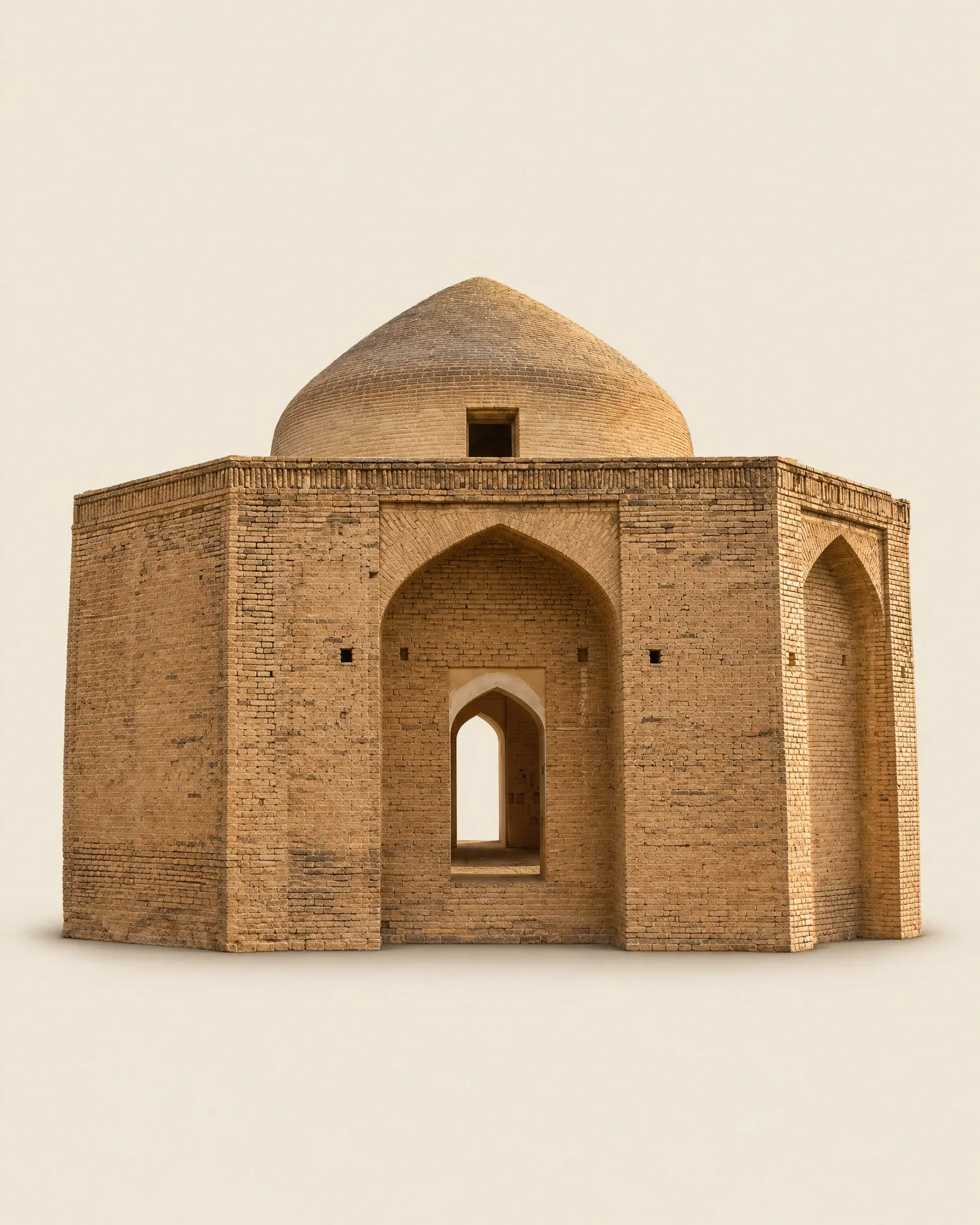
The mausoleum of Shah Gharib
Gharib Mirza’s octagonal mausoleum at Anjudan is the second of the Imams’ tombs there, after that of Mustansir bi’llah II. Ivanow identified it during his visit in 1937. The wooden box over the grave, with its dated inscription naming the Imam and his father, survived until recent decades, when intruders dismantled it; only pieces remain in the mausoleum. Five tombstones are set into one of its walls, among them that of Khalil Allah II, the thirty-ninth Imam, who died in Dhu’l-Hijja 1090/January 1680 and was the last Imam to live at Anjudan.5
The building is thus a record of the whole Anjudan period. Its inscription names Abd al-Salam Shah as the buried Imam’s father, and the stones in its walls carry the dynasty’s history to the end of the seventeenth century. For the Imams between Gharib Mirza and Khalil Allah I, Abu Dharr Ali and Murad Mirza, no graves have been located at Anjudan.6
Abu Ishaq Quhistani and the revival of Nizari writing
The most important development associated with Gharib Mirza’s time is literary. Daftary identifies Abu Ishaq Quhistani, probably a native of the district of Mu’minabad in Quhistan, as a contemporary of Mustansir bi’llah III, and his work as among the earliest fruits of the Anjudan revival: the first Persian doctrinal treatises produced by Nizaris after the fall of Alamut.7
Abu Ishaq’s book, known as the Haft bab (“Seven Chapters”), names as the Imam of the time an al-Mustansir bi’llah. Ivanow observed that this could be either Mustansir bi’llah II, who died in 885/1480, or Gharib Mirza, the second Imam of Anjudan to bear the name; he could find nothing more about the author’s life. Ivanow edited and translated the Haft bab in 1959. Like the other Qasim-Shahi works of the Anjudan period, it retained the teaching of the late Alamut period as elaborated after the declaration of the qiyama, with little of the Fatimid interest in cosmology. The title “Seven Chapters” is, in Ivanow’s view, a camouflaging designation that displaced the book’s original name.8
The book’s later history shows how fragile this literature was. Ivanow found that it had been re-edited several times, its first chapter replaced by that of another work, and that Khayrkhwah-i Harati turned it, in the mid-sixteenth century, into the Kalam-i pir, attributed to Nasir Khusraw. That version, filled out with quotations from Twelver works of the Safavid period, became one of the most revered books of the Ismailis of Badakhshan.9
The Muhammad-Shahi rival
In Gharib Mirza’s lifetime the rival Muhammad-Shahi line was still active and, in some regions, stronger. Its Imams had a large following in Badakhshan, and in 913/1507, nine years after Gharib Mirza’s death, Shah Radi al-Din ibn Tahir, who had earlier led the Nizaris of Quhistan and who may be identified with the thirtieth Muhammad-Shahi Imam, came from Sistan to Badakhshan and with local Nizari help established his rule over much of it. He was killed in the spring of 915/1509 amid quarrels among his supporters, and his head was taken to the fortress of Zafar on the left bank of the Kokcha, and the local Timurid ruler, Mirza Khan, then persecuted the Muhammad-Shahi Nizaris of Badakhshan. Radi al-Din’s son, Shah Tahir al-Husayni Dakkani, became the most famous Imam of the Muhammad-Shahi line; see Shah Tahir Dakkani. The Anjudan Imams’ efforts to win over Muhammad-Shahi communities, begun by Mustansir bi’llah II and pursued by Abd al-Salam Shah in his farman of 895/1490, thus continued under Gharib Mirza’s successors. See The Muhammad-Shahi/Qasim-Shahi split.10
Succession
Gharib Mirza was succeeded around 904/1498 by his son Nur al-Din Muhammad, known as Abu Dharr Ali, the thirty-fifth Imam, whose long Imamate spanned the reigns of the first two Safavid shahs and the first Safavid persecutions of the Nizaris.11
Footnotes
-
Farhad Daftary, The Isma’ilis: Their History and Doctrines, 2nd ed. (Cambridge University Press, 2007), p. 423. ↩
-
Daftary, The Isma’ilis, 2nd ed. (Cambridge University Press, 2007), p. 431. ↩
-
Daftary, The Isma’ilis, 2nd ed. (Cambridge University Press, 2007), pp. 423, 425; Wladimir Ivanow, Ismaili Literature: A Bibliographical Survey (Ismaili Society, 1963), p. 141, https://archive.org/details/ismaili-literature-a-bibliographical-survey. ↩
-
Daftary, The Isma’ilis, 2nd ed. (Cambridge University Press, 2007), pp. 430–431, 435. ↩
-
Daftary, The Isma’ilis, 2nd ed. (Cambridge University Press, 2007), pp. 423–425, 439. ↩
-
Daftary, The Isma’ilis, 2nd ed. (Cambridge University Press, 2007), pp. 423, 436. ↩
-
Daftary, The Isma’ilis, 2nd ed. (Cambridge University Press, 2007), pp. 433, 441. ↩
-
Ivanow, Ismaili Literature (1963), pp. 141–142; Daftary, The Isma’ilis, 2nd ed. (Cambridge University Press, 2007), pp. 433, 440. ↩
-
Ivanow, Ismaili Literature (1963), p. 142; Daftary, The Isma’ilis, 2nd ed. (Cambridge University Press, 2007), p. 433. ↩
-
Daftary, The Isma’ilis, 2nd ed. (Cambridge University Press, 2007), pp. 432–433, 452. ↩
-
Daftary, The Isma’ilis, 2nd ed. (Cambridge University Press, 2007), pp. 425, 435–436. ↩