From Anjudan to Kahak
Shah Nizar II succeeded his father Khalil Allah II as the fortieth Imam of the Qasim-Shahi line in 1090/1680 and held the Imamate for forty-two years, until 1134/1722. By the time of his accession, Daftary notes, the Qasim-Shahi Imams had developed deep roots in central Persia, in Mahallat and other localities around Anjudan, and had won the allegiance of the Nizari majority in Afghanistan, Central Asia and the Indian subcontinent.1
Sometime during the earliest decades of his Imamate, and for reasons that are not known, Shah Nizar transferred his residence and the headquarters of the da’wa to Kahak, a village about thirty-five kilometres north-east of Anjudan and north-west of Mahallat, separated from Anjudan by a number of shallow ranges. The Imams never returned to Anjudan. The move marked the end of the Anjudan period of Nizari history, which had lasted about two centuries.2
Kahak
Kahak is now a small and isolated village with a Twelver Shi’i population of about five hundred. It seems to have mattered more in the past, as a resting place for caravans, with a Safavid caravanserai on the road between Qumm and Arak. Shah Nizar and his immediate successor lived there. The Imams later ceased to reside at Kahak, but they kept a foothold in the village at least until the beginning of the nineteenth century; Aga Khan I was born there.3
The village is cited in some ginans, the devotional hymns of the Khojas, as the abode of the Imams. Its monuments show why. In the compound of Shah Nizar’s mausoleum and in the adjacent garden there are several tombstones with inscriptions in Khojki, the script used by the Nizari Khojas for Sindhi and related languages. They attest to the pilgrimages of Khojas who regularly made the long and dangerous journey from India to see their Imam. Daftary concludes that by this time close relations had developed between the Imams and their Khoja followers in Sind, Panjab, Gujarat and elsewhere in South Asia.4
Ata Allah: the Ni’mat Allahi connection
The Qasim-Shahi Imams seem to have had some association with the Ni’mat Allahi Sufi order, intermittently, from the Anjudan period onward, but the earliest definite evidence of it dates from Shah Nizar. He had close connections with the order, which at that time had not yet been revived in Persia, and adopted the tariqa name Ata Allah.5
The order, founded by Shah Ni’mat Allah Wali, had spread widely in his lifetime and during the fifteenth century acquired initiates in Kerman, Yazd, Fars and Khurasan. Its influence reached the Indian subcontinent, where the Bahmanid rulers of the Deccan patronised it, and its masters came to reside there. In Persia it lost much of its significance under the hostile policies of the Safavids, a fate shared by other Sufi orders. It is today, with its several branches, the most widespread Sufi order in Persia.6
The link with the Ni’mat Allahis would recur. In the late eighteenth century the order was revived in Persia, Shah Nizar’s great-great-grandson Abu’l-Hasan Ali supported its masters in Kerman, and Shah Khalil Allah married the daughter of a Ni’mat Allahi dervish. Ni’mat Allahi sources even claim that Aga Khan I was initiated into the order in his youth under the name Ata Allah Shah, echoing Shah Nizar’s, though Nizari sources do not substantiate this. For the Imams, the order’s Shi’i colouring and its standing among Persian elites made it a natural form of outward affiliation, as other Sufi forms had been since the fifteenth century.7
The Ata Allahis of Kerman
Shah Nizar’s Sufi name explains why some of his followers in Kerman came to be known as Ata Allahis. These Nizaris, originally nomadic tribesmen in Khurasan, were settled in the district of Sirjan and elsewhere in Kerman on Shah Nizar’s own initiative. The settlement gave the Imams a constituency in south-eastern Persia, on the routes from the Persian Gulf and Baluchistan along which Khoja pilgrims and their dues travelled. Within a generation the Imams would move there themselves: Hasan Ali, Shah Nizar’s grandson, settled at Shahr-i Babak, between Rafsanjan and Sirjan.8
Persia at his death
Shah Nizar’s long Imamate covered the last decades of the Safavid dynasty. He died in 1722, the year an Afghan invasion swept across Persia and reached Kahak itself. The Safavid order did not recover. During the Imamate of his grandson Hasan Ali, Nadir Shah Afshar expelled the Afghans, overthrew the Safavid dynasty and proclaimed himself king. In the disorder that followed the fall of the Safavids, Khoja pilgrims travelling to the Imams around Anjudan and Mahallat were often robbed and killed between Nain and Yazd by Bakhtiyari tribesmen, and extorted by officials along the route. That insecurity, rather than any change of doctrine, drew the Imams south-east, towards the Kerman communities Shah Nizar had settled and the Gulf ports used by their Indian followers.9
Death and mausoleum
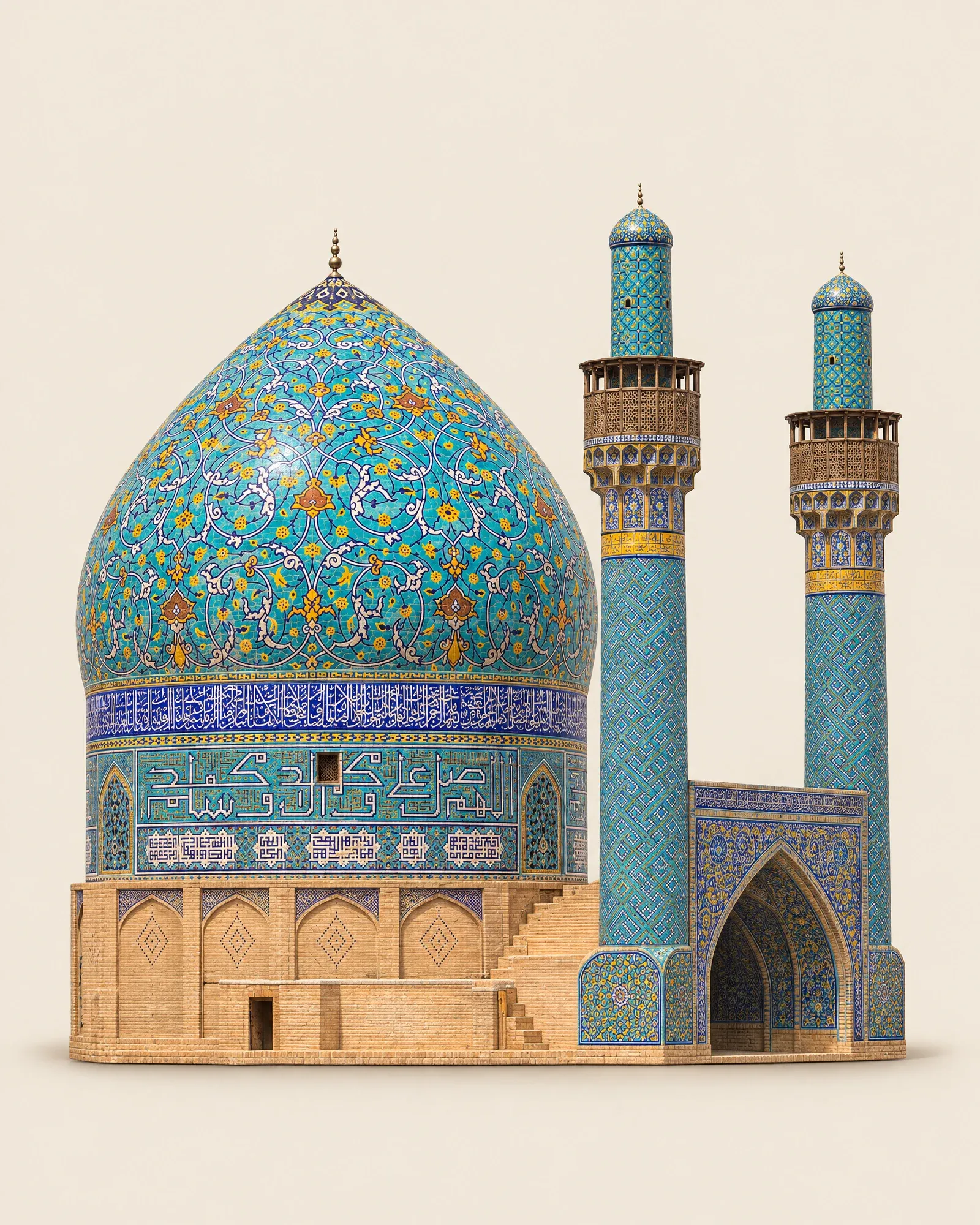
According to the inscription on his tombstone, Shah Nizar II died in Dhu’l-Hijja 1134/September 1722, shortly before the Afghan invasion of Persia reached Kahak. Nizari sources place his death almost a century earlier, in 1038/1628; the tombstone is the more reliable witness. His mausoleum still stands at the western end of Kahak. It formed part of his former residence and has several chambers, each holding a few graves.10
In 1937 Ivanow found in the former gardens of the residence a stone platform on which, it is related, Shah Nizar used to sit when he received his followers; by 1976 it was no longer in place. The mausoleum was restored, poorly, in 1966, at the cost of its carved wooden doors and other original fixtures. Shah Nizar was succeeded by his son Sayyid Ali, who is buried in the largest chamber of the same mausoleum.11
Footnotes
-
Farhad Daftary, The Isma’ilis: Their History and Doctrines, 2nd ed. (Cambridge University Press, 2007), p. 456. ↩
-
Daftary, The Isma’ilis, 2nd ed. (Cambridge University Press, 2007), p. 456. ↩
-
Daftary, The Isma’ilis, 2nd ed. (Cambridge University Press, 2007), pp. 456, 463. ↩
-
Daftary, The Isma’ilis, 2nd ed. (Cambridge University Press, 2007), p. 457. ↩
-
Daftary, The Isma’ilis, 2nd ed. (Cambridge University Press, 2007), pp. 427, 456–457. ↩
-
Daftary, The Isma’ilis, 2nd ed. (Cambridge University Press, 2007), pp. 429, 461. ↩
-
Daftary, The Isma’ilis, 2nd ed. (Cambridge University Press, 2007), pp. 457, 461–463, 466. ↩
-
Daftary, The Isma’ilis, 2nd ed. (Cambridge University Press, 2007), pp. 457, 459. ↩
-
Daftary, The Isma’ilis, 2nd ed. (Cambridge University Press, 2007), pp. 457, 459. ↩
-
Daftary, The Isma’ilis, 2nd ed. (Cambridge University Press, 2007), p. 457 and fig. 17. ↩
-
Daftary, The Isma’ilis, 2nd ed. (Cambridge University Press, 2007), pp. 457–458. ↩