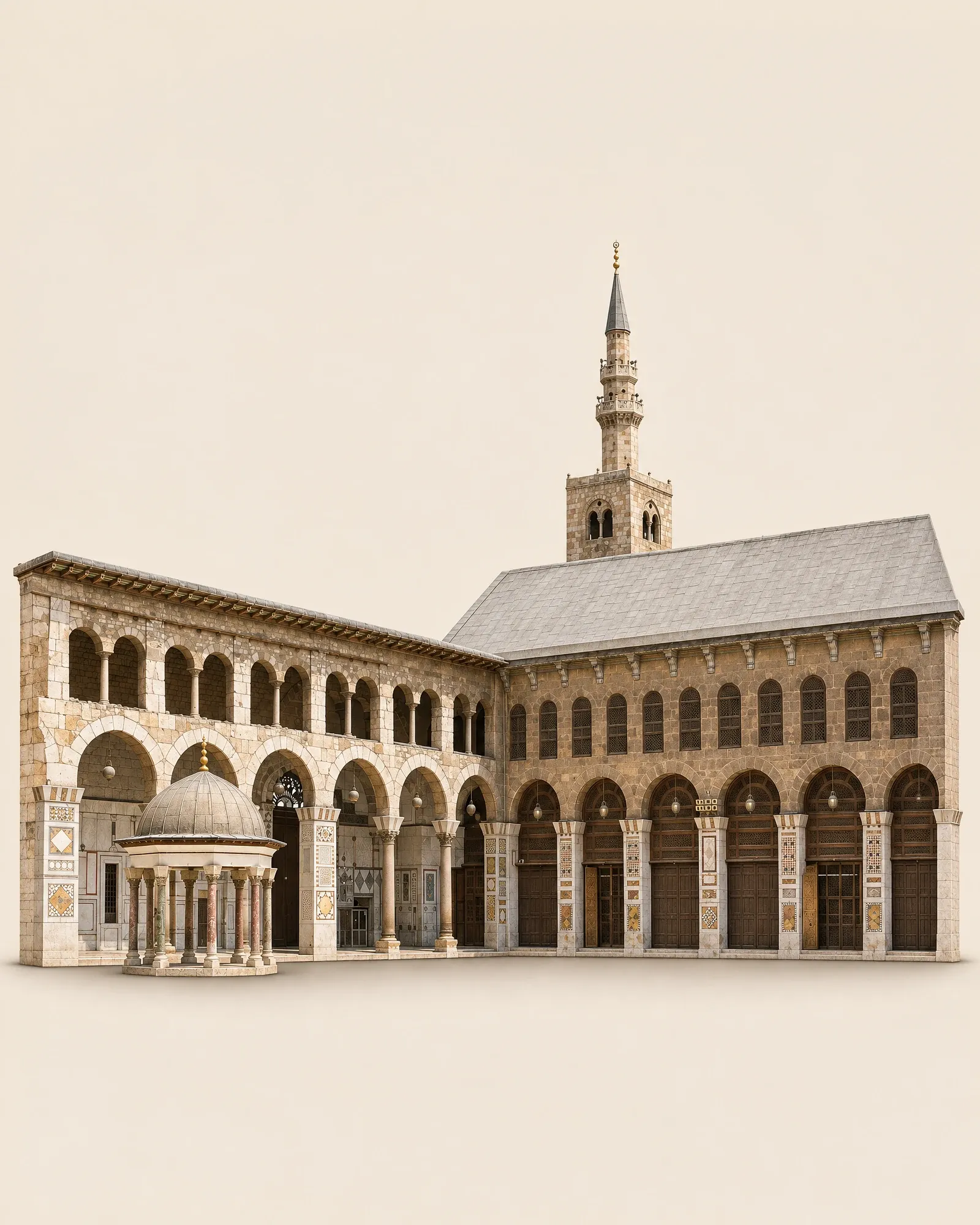
Name and family
Abu Ja’far Muhammad b. Ali was the son of the Imam Ali Zayn al-’Abidin. His mother, Umm ’Abd Allah Fatima, was a daughter of al-Hasan b. Ali and is described in the sources as a saintly woman. He therefore descended from both of the Prophet’s grandsons. His honorific al-Baqir is usually explained as baqir al-’ilm, “he who splits open knowledge”, meaning that he was learned in the religious sciences. A tradition holds that the Prophet gave him the name when predicting his birth, and charged the long-lived Companion Jabir b. ’Abd Allah al-Ansari (d. 73/692) with greeting him.1
Dates
Most Shi’i sources say al-Baqir was born in Medina in 57/677 and died there in 114/732 at the age of fifty-seven. Madelung notes that the preference for these dates rests partly on the parallel of the number 57. Al-Waqidi gives his death as 117/735 and Khalifa b. Khayyat as 118/736. Madelung considers these later dates more likely, because reports about the rising of al-Baqir’s half-brother Zayd in 120–122/738–740 suggest that al-Baqir had died recently and that his Kufan followers had not yet settled the succession. Al-Mas’udi’s date of 125–126/743–744 is too late. A birth date of 44/664 implied by al-Waqidi is impossible, since his father was twenty-three at Karbala in 61/680. Births in 54/676 and 59/678–679 are also recorded.2
Daftary dates al-Baqir’s death “around 114/732–733, a century after the Prophet”, and gives the length of his imamate as almost twenty years, beginning on the death of his father in 95/714.3
Childhood: Karbala and the Harra
As an infant al-Baqir was present at the battle of Karbala, where his grandfather al-Husayn was killed in 61/680. According to al-Mada’ini, his father sent him and his brother ’Abd Allah to Ta’if with the family of the Umayyad Marwan b. al-Hakam just before Yazid’s army besieged Medina in 63/683. A parallel report by Abu Mikhnaf mentions only ’Abd Allah. Most of al-Baqir’s life was spent in Medina.4
The Imam of a small community
When al-Baqir succeeded his father, the Husaynid line had only a modest following. Daftary describes him as seeing himself as the sole legitimate ’Alid authority while remaining politically quiescent. His claims were challenged from within the family, both by his half-brother Zayd b. Ali and by the Hasanid ’Abd Allah b. al-Hasan al-Muthanna, who promoted his own son Muhammad, later called al-Nafs al-Zakiyya.5
Al-Baqir’s followers included Zurara b. A’yan, who had first been a follower of Zayd, Muhammad b. Muslim al-Ta’ifi and the Kufan poet al-Kumayt b. Zayd al-Asadi (d. 126/743). According to the reports Madelung summarises, al-Baqir rewarded al-Kumayt for reciting a poem before him and allowed him to praise the Umayyads. He also attended the funeral of the Shi’i poet Kuthayyir ’Azza in Medina in 105/723. The Shi’i biographical (rijal) works that preserve much of this material include those of al-Kashshi, al-Najashi (d. 450/1058), al-Tusi (d. 460/1067) and Ibn Shahrashub (d. 588/1192).6
Shi’i reports also say that the caliph Hisham (r. 105–125/724–743) briefly summoned al-Baqir to Damascus, where he confounded Christians in debate. Late Sunni reports that he died at Humayma, the Abbasid family seat in Palestine, probably confuse him with the Abbasid Muhammad b. Ali and are unreliable.7
Two portraits
Sunni and Shi’i sources agree that al-Baqir was an eminent scholar but describe his views in opposite ways. In Sunni sources he appears as a member of the conservative aristocracy of Medina who calls Abu Bakr and ’Umar Imams of right guidance, curses al-Mukhtar as a liar, disowns the Kufan extremists al-Mughira b. Sa’id and Bayan, denies the doctrine of raj’a (return before the Resurrection), and denies being the Mahdi. Sunni hadith critics treat him as a trustworthy transmitter. Al-Tabari cites him often on the lives of Muhammad and Ali, including a long report on the events that led to al-Husayn’s death; al-Nasa’i counts him among the early jurists of Medina.8
In Shi’i tradition he is the founder of the religious and legal teaching that his son Ja’far al-Sadiq developed and that became the basis of Imami Shi’ism. Here he stands in the radical Shi’i tradition: he rejects the caliphates of Abu Bakr, ’Umar and ’Uthman and attributes supernatural qualities and knowledge to the ‘Alid Imams. Madelung suggests that he adopted from the Kaysaniyya, the main radical Shi’i group of his time, doctrines such as bada’ and raj’a.9
Taqiyya
Madelung explains the contrast between the Sunni and Shi’i portraits by al-Baqir’s systematic practice of taqiyya, precautionary dissimulation of belief. He is quoted as saying: “Taqiyya is part of my religion and the religion of my fathers. Whoever has no taqiyya has no faith.” Madelung concludes that neither portrait should be considered basically fictitious. Daftary notes that al-Baqir is credited with introducing the principle of taqiyya, which both the Twelvers and the Ismailis later adopted.10
The Imamate and ’ilm
Daftary credits al-Baqir with explaining the functions of the Imams and their divinely bestowed attributes, the basis of the doctrine of the Imamate later systematised in Ja’far’s circle. He also made al-Baqir and al-Sadiq responsible for a decisive change in Shi’i law. They did not only transmit hadith from the Prophet through Ali; they also interpreted the law on their own authority. As a result, Shi’i hadith came to include the sayings of the Imams themselves.11
Law
Al-Baqir’s imamate coincided with the beginnings of Islamic jurisprudence (fiqh). Both Imami and Zaydi works quote his legal and ritual opinions frequently. Some basic rules of Twelver law go back to him, including the permission of temporary marriage (mut’a) and the prohibition of wiping over footwear (mash ’ala’l-khuffayn) in ritual ablution. Daftary notes that the Ismailis and Zaydis did not uphold the permission of mut’a.12
A Qur’an commentary attributed to al-Baqir was transmitted by his disciple Abu’l-Jarud Ziyad b. al-Mundhir and is quoted often in the Tafsir of ’Ali b. Ibrahim al-Qummi; it reflects a strictly predestinarian theology. Al-Baqir also appears as the source of apocalyptic prophecies, transmitted mainly by Jabir al-Ju’fi. Madelung concludes that most of this material is later elaboration.13
The ghulat
Al-Baqir’s following included members of the ghulat, the Kufan Shi’i “exaggerators”. The most important were al-Mughira b. Sa’id, whom Daftary calls the first Shi’i gnostic, and Abu Mansur al-’Ijli. Al-Mughira taught a mystical interpretation of the letters of the alphabet that anticipated later Ismaili speculation. Abu Mansur claimed to have ascended to heaven and taught that prophecy would continue in his descendants for six generations, the seventh being the Mahdi.14
Al-Baqir reportedly disowned both men. Daftary dates the drawing of the ghulat into the Husaynid following to al-Baqir’s time. Al-Mughira was burned in Kufa in 119/737 by the governor Khalid b. ’Abd Allah al-Qasri, and Abu Mansur was executed by Yusuf b. ’Umar al-Thaqafi in 124/742.15
Death and succession
Al-Baqir was buried in the Baqi’ al-Gharqad cemetery in Medina. Some anachronistic Shi’i stories claim he was poisoned, either by the caliph ’Abd al-Malik (d. 86/705) or by Ibrahim b. al-Walid (r. 127/745). Madelung does not treat these stories as historical.16
His followers then divided. One group, the Baqiriyya, awaited his return. Others joined al-Nafs al-Zakiyya or the Kufan extremists. A loyal group recognised his eldest son, Abu ’Abd Allah Ja’far, as Imam by designation (nass). In the Nizari numbering used on this site al-Baqir is the fourth Imam; in the Twelver numbering he is the fifth.17
Footnotes
-
Wilferd Madelung, “Baqer, Abu Ja’far Mohammad,” Encyclopaedia Iranica, vol. III, fasc. 7 (1988), pp. 725–726, https://www.iranicaonline.org/articles/baqer-abu-jafar-mohammad/. ↩
-
Madelung, “Baqer, Abu Ja’far Mohammad,” Encyclopaedia Iranica, vol. III, fasc. 7 (1988), p. 725, https://www.iranicaonline.org/articles/baqer-abu-jafar-mohammad/. ↩
-
Farhad Daftary, The Isma’ilis: Their History and Doctrines, 2nd ed. (Cambridge University Press, 2007), pp. 67–68, 71. ↩
-
Madelung, “Baqer, Abu Ja’far Mohammad,” Encyclopaedia Iranica (1988), p. 725, https://www.iranicaonline.org/articles/baqer-abu-jafar-mohammad/. ↩
-
Daftary, The Isma’ilis, 2nd ed. (Cambridge University Press, 2007), p. 68. ↩
-
Daftary, The Isma’ilis, 2nd ed. (Cambridge University Press, 2007), p. 68; Madelung, “Baqer,” Encyclopaedia Iranica (1988), https://www.iranicaonline.org/articles/baqer-abu-jafar-mohammad/. ↩
-
Madelung, “Baqer, Abu Ja’far Mohammad,” Encyclopaedia Iranica (1988), p. 725, https://www.iranicaonline.org/articles/baqer-abu-jafar-mohammad/. ↩
-
Madelung, “Baqer, Abu Ja’far Mohammad,” Encyclopaedia Iranica (1988), pp. 725–726, https://www.iranicaonline.org/articles/baqer-abu-jafar-mohammad/. ↩
-
Madelung, “Baqer, Abu Ja’far Mohammad,” Encyclopaedia Iranica (1988), p. 726, https://www.iranicaonline.org/articles/baqer-abu-jafar-mohammad/. ↩
-
Madelung, “Baqer, Abu Ja’far Mohammad,” Encyclopaedia Iranica (1988), p. 726, https://www.iranicaonline.org/articles/baqer-abu-jafar-mohammad/; Daftary, The Isma’ilis, 2nd ed. (Cambridge University Press, 2007), p. 68. ↩
-
Daftary, The Isma’ilis, 2nd ed. (Cambridge University Press, 2007), pp. 68–69. ↩
-
Madelung, “Baqer, Abu Ja’far Mohammad,” Encyclopaedia Iranica (1988), p. 726, https://www.iranicaonline.org/articles/baqer-abu-jafar-mohammad/; Daftary, The Isma’ilis, 2nd ed. (Cambridge University Press, 2007), pp. 68–69. ↩
-
Madelung, “Baqer, Abu Ja’far Mohammad,” Encyclopaedia Iranica (1988), p. 726, https://www.iranicaonline.org/articles/baqer-abu-jafar-mohammad/. ↩
-
Daftary, The Isma’ilis, 2nd ed. (Cambridge University Press, 2007), pp. 69–70. ↩
-
Daftary, The Isma’ilis, 2nd ed. (Cambridge University Press, 2007), pp. 71–72; Madelung, “Baqer,” Encyclopaedia Iranica (1988), https://www.iranicaonline.org/articles/baqer-abu-jafar-mohammad/. ↩
-
Madelung, “Baqer, Abu Ja’far Mohammad,” Encyclopaedia Iranica (1988), pp. 725–726, https://www.iranicaonline.org/articles/baqer-abu-jafar-mohammad/. ↩
-
Daftary, The Isma’ilis, 2nd ed. (Cambridge University Press, 2007), pp. 71, 86. ↩