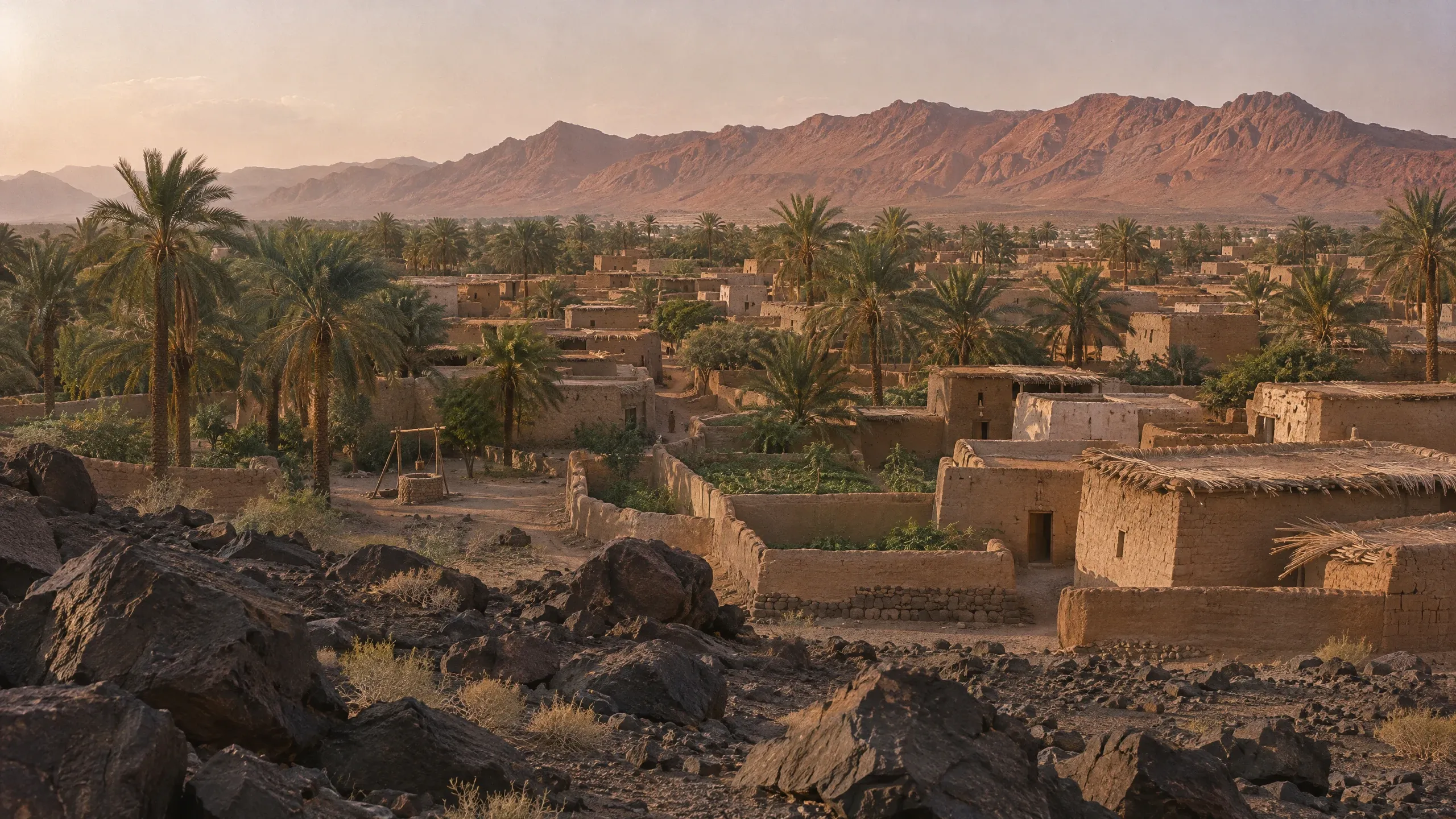
The city of the Prophet
Medina, formerly Yathrib, lies in the Hijaz north of Mecca. The Prophet Muhammad’s emigration (hijra) from Mecca to Medina in September 622 marks the start of the Islamic era. From Medina he founded a state of considerable power, and he died there on 13 Rabi’ I 11/8 June 632. For the next century and more, Medina was home to the family from which the Shi’i Imams came. Daftary calls it “the permanent domicile of the ’Alids”.1
The succession of 632
Immediately after the Prophet’s death, Daftary writes, a minority in Medina held that Ali ibn Abi Talib was better qualified than any other candidate to lead the community. Ali was the Prophet’s first cousin and son-in-law, married to his daughter Fatima. The majority chose Abu Bakr. Ali’s candidacy continued to be supported by his partisans in Medina, both among the Meccan emigrants (muhajirun) and among the Medinan helpers (ansar). Shi’i tradition bases Ali’s claim above all on the Prophet’s words at Ghadir Khumm, between Mecca and Medina, on 18 Dhu’l-Hijja 10/16 March 632: “He of whom I am the master, of him Ali is also the master.”2
During the caliphates of Abu Bakr, ’Umar and ’Uthman, Ali withdrew from the active role he had played in the Prophet’s time and stayed at his house in Medina. Daftary notes that this should not be read as reluctance: the first two caliphs tried to keep him out of any position of influence.3
Revolt and the move to Iraq
Discontent with ‘Uthman’s rule brought rebel contingents from Kufa, Basra and Egypt to Medina under the leadership of the Kufan qurra’. In 35/656 mutineers from the Arab army of Egypt killed ’Uthman. In the confused atmosphere that followed, Ali was acclaimed caliph in Medina. When Talha, al-Zubayr and ’A’isha rebelled, Ali left Medina to gather support at Kufa. Daftary observes that with the civil wars that followed, the centre of caliphal authority moved from Medina to the provinces of Iraq and Syria.4
Al-Hasan and al-Husayn
After abdicating to Mu’awiya in 41/661, al-Hasan returned to Medina with his family and spent the last decade of his life there. Kufan Shi’is visited him there and tried in vain to persuade him to rise against Mu’awiya. He asked to be buried beside his grandfather, the Prophet, or, if that would cause bloodshed, beside his mother Fatima in the Baqi’ al-Gharqad cemetery. The former governor Marwan b. al-Hakam swore he would not allow al-Hasan to lie next to the Prophet, and he was buried in al-Baqi’. Madelung records that Mu’awiya rewarded Marwan by reappointing him governor of Medina.5
Al-Husayn also lived in Medina, where his Iraqi supporters kept visiting him in large numbers. Unlike al-Hasan, he answered sharply when Marwan, as governor, had Ali cursed from the pulpit. After Mu’awiya’s death on 15 Rajab 60/22 April 680, Yazid ordered the governor of Medina to secure al-Husayn’s oath of allegiance. Al-Husayn left for Mecca, and from there set out for Kufa and Karbala. His surviving son and the women of his family were later sent back to Medina.6
The Imams of Medina
Ali Zayn al-’Abidin was born in Medina in 38/658–659, according to most sources, and returned there from Damascus after Karbala. During the rebellion of Medina against Yazid in 63/683, he wrote to the caliph assuring him of his loyalty and sheltered Marwan’s wife and property, then left for an estate near the city. Madelung notes that he supported 100 families in Medina on a permanent basis. He was buried next to his uncle al-Hasan in al-Baqi’.7
Muhammad al-Baqir was born in Medina in 57/677, according to most Shi’i sources, and spent most of his life there. In Sunni sources he appears as a member of the conservative aristocracy of Medina, and al-Nasa’i lists him among the city’s early jurists. He died around 114/732–733 and was buried in al-Baqi’.8
Ja’far al-Sadiq
Ja’far al-Sadiq was, in Gleave’s phrase, apparently “happy to pursue a scholarly imamate, studying and teaching in Medina”. Daftary notes that pious Muslims of Medina and Kufa accepted him as a teacher beyond his own followers, and that Abu Hanifa and Malik b. Anas reportedly studied with him or transmitted from him. He visited his partisans in Kufa only occasionally. In 126/744, at a gathering of the Hashimids at al-Abwa’ near Medina, ’Abd Allah al-Mahd persuaded those present to swear allegiance to his son, the Hasanid Muhammad al-Nafs al-Zakiyya.9
Ja’far died in 148/765 (some Shi’is say he was poisoned on the orders of al-Mansur). He was buried in al-Baqi’ beside his father, his grandfather and al-Hasan b. Ali. Daftary notes that the Wahhabis destroyed these tombs in modern times.10
Isma’il and Muhammad b. Isma’il
Isma’il, Ja’far’s designated heir in Ismaili tradition, lived in Medina. He reportedly protested there against the execution of al-Mu’alla b. Khunays by the governor Dawud b. Ali, whose term lasted only a few months in 133/750. Most sources say Isma’il died before his father in Medina and was buried in al-Baqi’. The Indian Ismaili author Hasan b. Nuh al-Bharuchi relates that he visited Isma’il’s grave in 904/1498. On the disputed succession, see the succession of Isma’il.11
Isma’il’s son Muhammad had at least two sons while he lived openly in Medina. When most of al-Sadiq’s followers recognised other sons, his position in the Hijaz, where his uncle and chief rival Musa also lived, became untenable. Daftary suggests that, probably not long after al-Sadiq’s death, Muhammad left Medina for the east and went into hiding, which earned him the epithet al-Maktum, “the Hidden”. His departure marks the beginning of the period of concealment (dawr al-satr). In 179/795–796 Harun al-Rashid arrested Musa al-Kazim in Medina and took him to Iraq as a prisoner.12
Footnotes
-
Farhad Daftary, The Isma’ilis: Their History and Doctrines, 2nd ed. (Cambridge University Press, 2007), pp. 36, 49. ↩
-
Daftary, The Isma’ilis, 2nd ed. (Cambridge University Press, 2007), pp. 37–39. ↩
-
Daftary, The Isma’ilis, 2nd ed. (Cambridge University Press, 2007), p. 41. ↩
-
Daftary, The Isma’ilis, 2nd ed. (Cambridge University Press, 2007), pp. 44–45. ↩
-
Wilferd Madelung, “Hasan b. ’Ali,” Encyclopaedia Iranica, vol. XII, fasc. 1 (2003), pp. 26–28, https://www.iranicaonline.org/articles/hasan-b-ali/; Daftary, The Isma’ilis, 2nd ed. (Cambridge University Press, 2007), pp. 48–49. ↩
-
Wilferd Madelung, “Hosayn b. ’Ali i. Life and significance in Shi’ism,” Encyclopaedia Iranica, vol. XII, fasc. 5 (2004), pp. 493–498, https://www.iranicaonline.org/articles/hosayn-b-ali-i/. ↩
-
Wilferd Madelung, “’Ali b. al-Hosayn b. ’Ali b. Abi Taleb,” Encyclopaedia Iranica, vol. I, fasc. 8 (1985), pp. 849–850, https://www.iranicaonline.org/articles/ali-b-hosayn-b-ali/. ↩
-
Wilferd Madelung, “Baqer, Abu Ja’far Mohammad,” Encyclopaedia Iranica, vol. III, fasc. 7 (1988), pp. 725–726, https://www.iranicaonline.org/articles/baqer-abu-jafar-mohammad/; Daftary, The Isma’ilis, 2nd ed. (Cambridge University Press, 2007), p. 71. ↩
-
Robert Gleave, “Ja’far al-Sadeq i. Life,” Encyclopaedia Iranica, vol. XIV, fasc. 4 (2008), pp. 349–351, https://www.iranicaonline.org/articles/jafar-al-sadeq-i-life/; Daftary, The Isma’ilis, 2nd ed. (Cambridge University Press, 2007), pp. 74, 80, 85. ↩
-
Daftary, The Isma’ilis, 2nd ed. (Cambridge University Press, 2007), p. 86. ↩
-
Daftary, The Isma’ilis, 2nd ed. (Cambridge University Press, 2007), p. 91; Farhad Daftary, “Esma’il b. Ja’far al-Sadeq,” Encyclopaedia Iranica, vol. VIII, fasc. 6 (1998), pp. 625–626, https://www.iranicaonline.org/articles/esmail-b-jafar/. ↩
-
Daftary, The Isma’ilis, 2nd ed. (Cambridge University Press, 2007), pp. 95–96. ↩