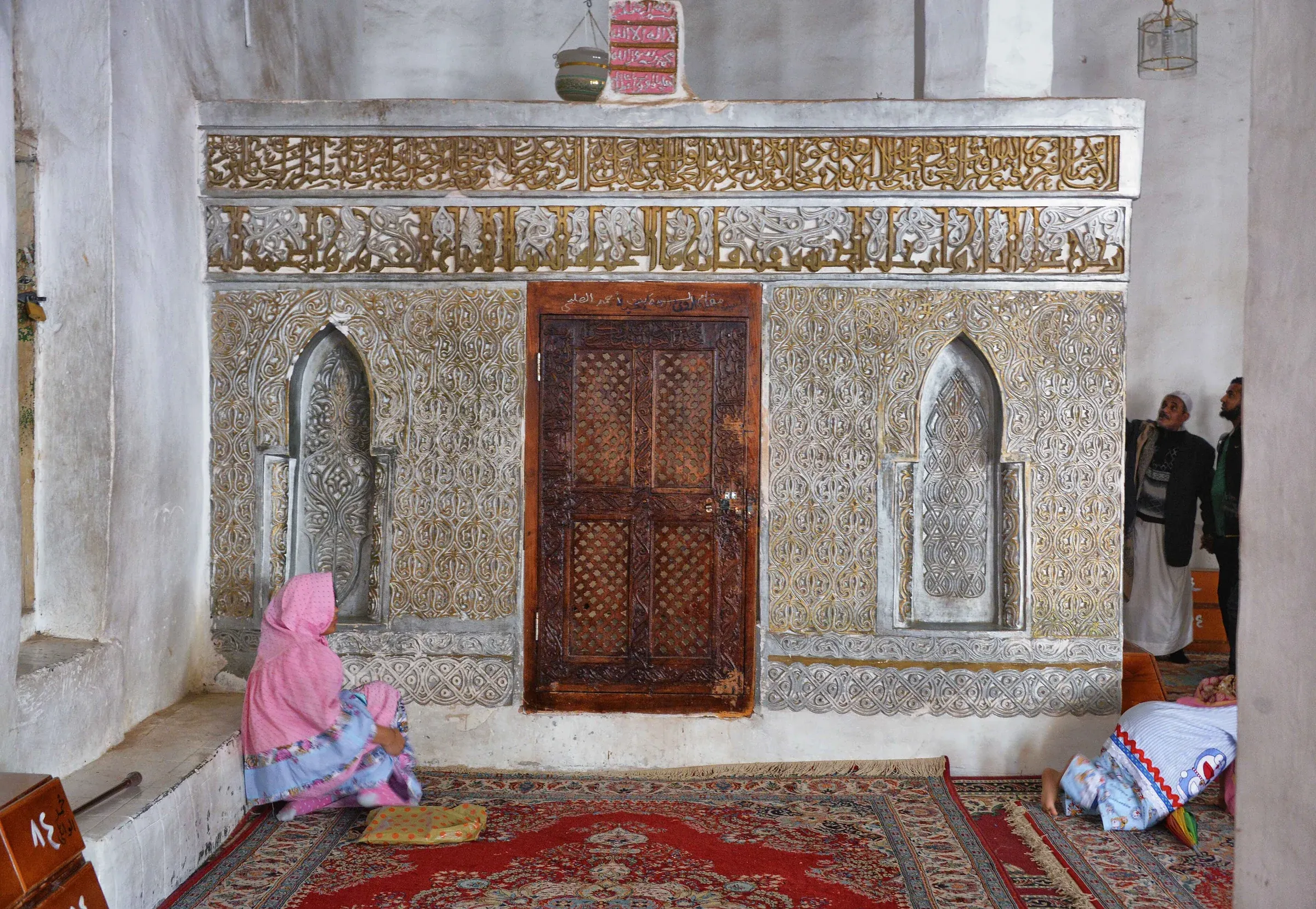
Arwa bint Ahmad al-Sulayhi (1048–1138), known in the sources as al-Malika al-Sayyida al-Hurra, “the Queen, the Noble Lady”, ruled Sulayhid Yemen for over half a century as a vassal of the Fatimids. Farhad Daftary describes her as perhaps the only woman in medieval Islam to hold religious as well as political leadership. The Fatimid Imam-caliph al-Mustansir appointed her hujja of Yemen, the highest rank in the Yemeni da’wa. After the succession crises of 1094 and 1130 she sided with al-Musta’li and then with al-Tayyib. She founded the independent Tayyibi da’wa, the line from which the Daudi, Sulaymani and Alawi Bohras descend (see Musta’li-Tayyibi Ismailis and the Bohras).1
Sources
The earliest narrative of the Sulayhids and of Arwa’s career is the history of Yemen by Najm al-Din ’Umara al-Hakami. He was a Yemeni poet who moved to Egypt and was executed in Cairo in 569/1174 for plotting to restore the Fatimids. The main Ismaili account is the seventh volume of the ’Uyun al-akhbar by Idris ’Imad al-Din (d. 872/1468), the nineteenth Tayyibi da’i mutlaq. Letters (sijillat) from the Fatimid chancery to the Sulayhids also survive. Husain F. al-Hamdani (1901–1962) used his family’s manuscripts to write the first modern scholarly studies.2
The Sulayhid dynasty
The Ismaili da’wa had once controlled most of Yemen, but by the early eleventh century it survived only in secret, with support from tribes of the Banu Hamdan. Its leader, the da’i Sulayman b. ’Abd Allah al-Zawahi of Haraz, chose as his successor ’Ali b. Muhammad al-Sulayhi, son of the qadi of Haraz and a Hamdani chief. In 439/1047 ‘Ali rose in revolt at Masar in Haraz. By 455/1063 he had conquered all of Yemen. He made San’a’ his capital and had the Fatimid khutba read throughout his lands.3
‘Ali’s wife and cousin, Asma’ bint Shihab, took an active part in governing, and Arwa was raised in her household at the Sulayhid court. The Najahids of Zabid murdered ‘Ali in 459/1067. His son Ahmad al-Mukarram, who had married Arwa in 458/1066, succeeded him and was invested by al-Mustansir. Asma’ went on advising her son until her death in 467/1074.4
Ruler of Yemen
Daftary’s sources say Arwa was born in Haraz in 440/1048 (less probably 444/1052). They describe her as intelligent, pious, independent, courageous and highly literate. Soon after Asma’ died, she took control of the state, and her name was read in the khutba after al-Mustansir’s. Al-Mukarram had facial paralysis from war wounds and withdrew from public life, keeping only the title of ruler. He died in 477/1084, and from then on Arwa ruled alone.5
One of her first acts was to move the capital from San’a’ to Dhu Jibla in the southern highlands, a town founded in 459/1066 beneath the mountain of al-Ta’kar. There she built a new palace and turned the old one into a congregational mosque, where she was later buried. Daftary’s dictionary dates the move to about 480/1087. By then most of northern Yemen had been lost to the Zaydi Qasimi amirs.6
Hujja of Yemen
Under ’Ali al-Sulayhi, the ruler of the state was also the chief da’i. These two roles later separated. ’Ali sent the chief qadi Lamak b. Malik al-Hammadi to Cairo in 454/1062. Lamak stayed nearly five years with the chief da’i al-Mu’ayyad fi’l-Din al-Shirazi at the Dar al-’Ilm and returned with Ismaili books, as chief da’i of Yemen (da’i al-balagh). Al-Mukarram became head of state only.7
Shortly after al-Mukarram’s death in 477/1084, al-Mustansir appointed Arwa hujja of Yemen. This rank stood above Lamak’s, which made her the senior figure in the Yemeni da’wa. Daftary calls this the first time the rank of hujja, or any high rank of the Ismaili hierarchy, was given to a woman. Yemen does not appear in the known lists of the twelve jaziras (“islands”) of the Fatimid da’wa. Daftary therefore reads the title in its narrower sense, the highest dignitary of a region, in the way Nasir Khusraw was called hujja of Khurasan. The contemporary Yemeni author al-Khattab b. al-Hasan defended the appointment and argued that a woman could hold the rank.8
Al-Mustansir also placed Arwa in charge of the da’wa in western India. Da’is sent from Yemen founded an Ismaili community in Gujarat from about 460/1067–68. That community kept close ties with Yemen, which is why it later followed Arwa’s Tayyibi line and became the Bohras.9
The split of 1094
After al-Mustansir died in 1094, the vizier al-Afdal placed al-Musta’li on the throne instead of Nizar. Arwa and the da’i Lamak recognised al-Musta’li, and with them all of Yemen joined the Musta’li side of the split. On Lamak’s death in 491/1098, his son Yahya b. Lamak succeeded him as chief da’i. Yahya died in 520/1126 and was succeeded by al-Dhu’ayb b. Musa al-Wadi’i al-Hamdani.10
Cairo’s relations with Arwa became strained in her later years. Al-Afdal sent an agent, Ibn Najib al-Dawla, to Yemen in 513/1119. He was recalled in 519/1125 and drowned on the voyage back, and rumours circulated that he had spread pro-Nizari propaganda. Daftary writes that by the 1130s Arwa had already lost faith in Cairo.11
Founding the Tayyibi da’wa
Al-Musta’li’s son al-Amir sent Arwa an epistle announcing the birth of his son al-Tayyib in Rabi’ II 524 / March 1130. Al-Khattab, then assistant to al-Dhu’ayb, left an eyewitness account of the rejoicing at the Sulayhid court. Nizari fida’is killed al-Amir in Dhu’l-Qa’da 524 / October 1130. His cousin ’Abd al-Majid first ruled as regent and then, in 526/1132, declared himself Imam-caliph as al-Hafiz. Arwa rejected al-Hafiz and recognised al-Tayyib as Imam. Her followers were first known as the Amiriyya and later as the Tayyibiyya.12
Nothing is known for certain about al-Tayyib himself. Daftary considers it likely that he was killed in infancy on al-Hafiz’s order. Tayyibis believe he went into concealment and that the imamate continues, hidden, among his descendants. Soon after 526/1132 Arwa named al-Dhu’ayb al-da’i al-mutlaq, the “da’i with absolute authority”, who led the da’wa on behalf of the hidden Imam. This made the da’wa independent of the Sulayhid state as well as of Cairo. The office of da’i mutlaq continues in the Tayyibi communities today.13
Rival Yemeni Ismailis
Not all of Yemen followed her. The Zuray’ids of Aden and some of the Hamdanids of San’a’, who had broken free of Sulayhid rule, recognised al-Hafiz and the later Fatimid caliphs. This Hafizi Ismailism was tied to the Fatimid state. It faded after the fall of the Fatimids in 567/1171 and the Ayyubid invasion of Yemen in 569/1173. The Tayyibi da’wa, based in Haraz, survived.14
Death and legacy
Arwa died in Sha’ban 532 / April 1138, and the Sulayhid dynasty effectively ended with her, though members kept a few fortresses for some decades. She left her famous jewellery collection to the Imam al-Tayyib. Al-Khattab was killed six months after her death. Al-Dhu’ayb then took Ibrahim b. al-Husayn al-Hamidi as his assistant, and Ibrahim became the second da’i mutlaq when al-Dhu’ayb died in 546/1151.15
Daftary compares Arwa’s role with that of Hasan-i Sabbah. Each set up an independent da’wa while the Imam they recognised could not be reached, and in his view the Musta’li-Tayyibi community owes its survival largely to her. The Tayyibis also preserved much of the Ismaili literature of the Fatimid period.16
Her tomb in the mosque at Dhu Jibla was visited for centuries by pilgrims of many communities, not all of whom knew of her Ismaili connection. Zaydis and other opponents tried several times to destroy the mosque. Her tomb chamber, with its Qur’anic inscriptions, survived until September 1993, when members of a local Sunni group who opposed shrine visitation damaged it.16
Footnotes
-
Farhad Daftary, “Sayyida Hurra: The Ismaili Queen of Yaman”, in Ismailis in Medieval Muslim Societies (I.B. Tauris / Institute of Ismaili Studies, 2005), pp. 89–91; Farhad Daftary, Historical Dictionary of the Ismailis (Scarecrow Press, 2012), s.v. “Arwa bint Ahmad al-Sulayhi”. ↩
-
Daftary, “Sayyida Hurra”, p. 91. ↩
-
Daftary, “Sayyida Hurra”, pp. 91–92; Daftary, Historical Dictionary, s.v. “Sulayhids”. ↩
-
Daftary, “Sayyida Hurra”, p. 92. ↩
-
Daftary, “Sayyida Hurra”, pp. 92–93; Daftary, Historical Dictionary, s.v. “Arwa bint Ahmad al-Sulayhi”. ↩
-
Daftary, “Sayyida Hurra”, p. 93; Daftary, Historical Dictionary, s.v. “Sulayhids”. ↩
-
Daftary, “Sayyida Hurra”, pp. 93–94; Farhad Daftary, The Isma’ilis: Their History and Doctrines, 2nd ed. (Cambridge University Press, 2007), p. 263. ↩
-
Daftary, “Sayyida Hurra”, p. 94. ↩
-
Daftary, “Sayyida Hurra”, pp. 94–95. ↩
-
Daftary, The Isma’ilis, pp. 243, 263–264. ↩
-
Daftary, The Isma’ilis, p. 263; Daftary, “Sayyida Hurra”, p. 97. ↩
-
Daftary, The Isma’ilis, pp. 244, 246, 262; Daftary, “Sayyida Hurra”, pp. 97–98. ↩
-
Daftary, “Sayyida Hurra”, pp. 98–99; Daftary, The Isma’ilis, p. 264. ↩
-
Daftary, “Sayyida Hurra”, p. 98; Daftary, The Isma’ilis, pp. 255–260. ↩
-
Daftary, “Sayyida Hurra”, p. 99; Daftary, The Isma’ilis, pp. 264–265. ↩